Michael Bretschneider-Hagemes (2018). The Occlusion Method for Measuring Visual Demand at the IT-Based Driver’s Workplace. In: Advances in Physical Ergonomics and Human Factors: Part II. AHFE Open Access, vol. 2. https://doi.org/10.54941/ahfe100053
The standard ISO 16673 addresses the use of in-vehicle information systems (IVIS) and the measurement of the associated visual demand. The proposed measuring method investigates secondary tasks at the driver’s workplace in terms of their visual demand. The contributory factors and hence levers for prevention work are the complexity of the task, the usability of the man-machine interface (MMI) with its retroactive effects on task complexity, and device visibility (clear identification of symbols) and position. These factors are rendered measurable in their cumulative visual effect by the occlusion method so that valid and practical recommendations can be made.
Due to the digitisation of the working environment and the ever more widespread use of information and communication technologies (ICT), drivers’ workplaces are often equipped with integrated vehicle information and communications systems (see DGUV 2009). The driver’s work often entails the use of several digital systems. Because of these systems’ potential for distraction, they need to be optimally integrated in terms of user ergonomics (see Krems et al., 2003). This applies as much to factory-fitted systems from the original equipment manufacturer as to retrofits. The frequently interlinked systems are useful, for instance, for awarding tasks, scheduling and navigation as well as for mobile information gathering. These devices are typically satellite navigation systems, notebooks integrated in the driver’s workplace for the provision of mobile technical services, telematics applications in logistics etc. To ascertain whether workplace design incorporating mobile IT is risk-free, the employer has to conduct a risk assessment.
PROBLEM Vehicle drivers are inevitably confronted with the challenges of man-machine interaction by virtue of the task of driving. To cope with these challenges and thus prevent accidents, a variety of advanced driver assistance systems have been developed. There is now a genuine concern that, as a result of the digitised networks in vehicles in the form of IVIS, the liberated resources are not only put to other use but also overworked. The interaction with mobile IT in the vehicle increases the workload considerably, with dramatic effects in terms of distracting and even hampering the driver while driving.
From field observations in connection with earlier projects, the highly intense use of mobile IT at drivers’ workplaces is a familiar phenomenon. Often three to four systems (navigation system, telematics, tablet computers or smartphones) may be in use simultaneously or in quick succession. The burden of distraction often seems to surpass that of ICT in private vehicles. By studying visual demand, a first attempt has been made to obtain an objective picture of the problem at the driver’s workplace.
METHOD
IFA has a laboratory set-up for the application of the occlusion method on the principles of ISO 16673 (see ISO 2007). The key item of equipment is the visual occlusion spectacles whose lenses are constructed with liquid crystals that occlude, i.e. block, the view at defined intervals. Depending on requirements, the secondary tasks being investigated are simulated with a tablet computer (Apple iPad 2) and/or facilitated by the original equipment installed in the vehicle.
Test subjects In keeping with ISO 16673, 10 test subjects are considered sufficient. All persons should be holders of a driver’s licence and have sufficient driving experience. A degree of routine in the operation of the interfaces concerned and hence in the performance of a secondary task is then assumed.
Training and dummy run Before the test runs proper, each test subject is familiarised with the system. The test set-up, the purpose of the test and the secondary task are explained. The test subject is informed of the start and end commands for the secondary task. This way, the test operator knows when the task has been completed and records the time accordingly. After the explanations, dummy runs are carried out (see Fig. 1). The secondary task being investigated is performed both unoccluded (without spectacles) and occluded (with spectacles). Once the test subject confirms his/her familiarity with the system, the dummy runs are stopped. The results of the dummy runs are noted in the record.
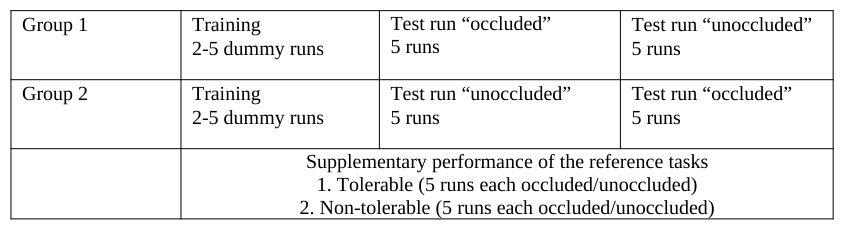
Test runs proper After the dummy runs, the test runs proper are initiated. For this, the secondary task is performed by each test subject unoccluded (baseline) 5 times and occluded 5 times. ISO 16673 proposes the formation of two groups that perform the test occluded and unoccluded in the opposite order. This way, possible habituation can be identified and if necessary filtered out. In addition to the measurement defined by the standard, two reference tasks, one tolerable and one non-tolerable, are performed and timed so that the results of the secondary task under investigation can be judged better. The proposed tolerable reference task is the changing of the radio station. The non-tolerable reference task is the posting of a predefined text in a web forum (social network) via a tablet computer.
Table 1: Test Procedure
Survey of test subjects To lend further detail to the test, the subjects are surveyed on the secondary tasks investigated with the aid of a standardised questionnaire. The appraisals (for subjective yardsticks, see Praxenthaler, 2003, p. 37) are documented with the test results of each test subject. From the responses, it is possible to modify the design of workplaces with greater precision.
Interpretation of the values To assess visual demand, the resumability ratio (R) is the key variable in data interpretation. R is calculated from the total shutter open time (TSOT) divided by the total task time unoccluded (TTTunoccl) without any outside influence. The TTTunoccl value is known from the baseline measurement. TSOT is obtained from task performance with an occlusion measurement. The mean values of the test subjects are referred to in each case. If R = 1, the need for total visual control is assumed for the task (otherwise the test subject would have been able to continue working in the occluded state and R < 1), but there is no time delay due to the interruption of the visual task. These secondary tasks tend to be unproblematical and can be tolerated at the driver’s workplace.
If R > 1, there is an interruption-related delay in the performance of the task. The visual demand of these tasks is high. Whether such a task is still to be tolerated at the driver’s workplace should be more precisely investigated with the aid of the tolerated/not tolerated reference task suggested above. If the measured value is within the tolerated range, this task can also be deemed tolerable.
If R < 1, at least partial controllability without visual attention is assumed. These secondary tasks are unproblematical and can be tolerated at the driver’s workplace at least on the basis of their visual demand.
OUTLOOK A variety of secondary tasks are tested for their visual distraction demand. The provisional selection is based on installed equipment found in the field and information from the accident insurance institutions and their member firms (see DGUV, 2012). The following systems are initially examined: navigation system, tablet computer/smartphone (reading and acknowledging a dispatcher’s message, acknowledgement of an appointment inquiry). The purpose is to objectivise demand with the goal of modifying the task and educating the users concerned. Further test scenarios and adaptations of the methods are being planned.
The conference presentation shows the current state of the test set-up and of the planned test scenarios and the field- based recruitment of test subjects.
REFERENCES
DGUV (2009): BGI/GUV-I 8696: Einsatz von bordeigenen Kommunikations- und Informationssystemen mit Bildschirmen an Fahrerarbeitsplätzen, Berlin. DGUV (2012): BGI/GUV-I 8704: Modern field service technicians’ exposure to stresses and risks from working with mobile
ICT, Berlin. ISO (2007): ISO 16673 - Road vehicles — Ergonomic aspects of transport information and control systems — Occlusion method to assess visual demand due to the use of in-vehicle systems, Reference number ISO 16673:2007(E). Krems, J.F., Keinath, A., Baumann, M., Jahn, G. (2003): Die Okklusionsmethode: Ein einfaches und valides Verfahren zur
Bewertung der visuellen Beanspruchung von Zweitaufgaben?, In: Schlag, B. (Hrsg., 2011): Verkehrspsychologie, Lengerich: Pabst Science Publishers, p. 335 ff. Praxenthaler, M. (2003): Experimentelle Untersuchung zur Ablenkungswirkung von Sekundäraufgaben während zeitkritischer Fahrsituationen, Inaugural-Dissertation zur Erlangung der Doktorwürde der Philosophischen Fakultät II (Psychologie und Pädagogik) der Universität Regensburg.
LISTED IN THE AHFE DIGITAL BOOKSTORE CATALOGUE
Explore the complete digital volume
Advances in Physical Ergonomics and Human Factors: Part II
Read this individual research paper free through the original publisher, or explore the full digital proceedings book.
ISBN 978-1-4951-2105-0
Explore this ISBN in the AHFE Bookstore ↗Listed in the July 2026 bookstore catalogue; search by ISBN to confirm current availability · Digital book purchase optional