Cheng-Li Liu, Shiaw-Tsyr Uang (2019). Effects of Depth Perception Cues and Display Types on Presence in the Elderly within a 3D Virtual Store. In: Advances in Cognitive Engineering and Neuroergonomics. AHFE Open Access, vol. 7. https://doi.org/10.54941/ahfe100221
Many of the increasing elderly population have problems performing daily tasks due to restricted mobility, inconvenience, and/or fear of crime. Computers at home with an Internet connection can provide this relatively immobile population with a new channel to access information and services, including the ability to shop. Virtual environments (VEs) technology applied in web shops is its ability to provide a 3D perspective to customers for more real sense on goods and shopping environment. A sense of presence is one of the critical components required by any effective VE. In contrast, when the quality of depth perception cues is poor, whether the cybersickness for the elderly will be easily caused to influence the feeling of presence and performance of goods-searching or not? An experiment addressed associations between presence and cybersickness, and performance of 3D virtual store in the elderly participation with autostereoscopic, stereoscopic and monocular display in good/poor depth perception cues. Results showed that the virtual store via autostereoscopic display with high quality depth perception cues will produce good sense and realism in stereopsis. However, if the depth perception cues are poor, don’t use 3D displays especially stereoscopic display; otherwise the elderly may lose the interest in 3D virtual store because of cybersickness being serious even more than monocular display.
As the worldwide elderly population is rapidly increasing (Jones & Fox, 2009), the combination of virtual environments (VEs) and the Internet would introduce a new mode of online shopping for this population. Therefore, we are deeply convinced that 3D virtual web stores will become increasingly popular in the future, and the elderly will become an increasingly important demographic for online shopping. The 3D virtual store is different from the common website store, and it is expected that viewing goods with lifelike 3D appearances may hold a special attraction for the elderly. Therefore, it is important that VE designers develop the illusion of being “present” in a VE (Sylaiou et al., 2008). Several researchers have found that presence is generally regarded as a vital component of VEs, as users must experience and interact with the VE in real time (Nichols et al., 2000; Sheridan, 1992). Presence has been identified as the defining characteristic, a design goal or a desirable outcome of VE participation (Wilson, 1997; Steuer, 1992). Freeman et al. (1999) described presence as the observer’s subjective sensation of being in a remote environment, while Lombard and Ditton (1997) proposed that presence is a perceptual illusion of non- mediation involving continuous responses of the human sensory, cognitive and affective processing systems. Therefore, though it will be a challenge for online shopkeepers and programmers (Mikropoulos & Strouboulis, 2004), it is important to create the sensation of presence for online shoppers by designing 3D virtual stores that will immerse the user in the shopping experience.
Certain factors influence the degree of presence within a VE. For example, depth perception is a primary factor in self-inclusion (Sadowski & Stanney, 2003). Wickens et al. proposed that people could use a variety of depth perceptions to sense the shapes and distances of objects within the 3D environment (Wickens et al., 1989). Depth perception is the result of a variety of depth cues that are typically classified into visual depth cues, which can be further categorized into monocular and binocular cues and oculomotor depth cues. Monocular cues are subdivided into pictorial depth cues and motion cues. Images can provide static depth cues including interposition, linear perspective, relative and known sizes, texture gradients, heights in the picture plane, light and shadow distributions, and aerial perspectives. Motion cues involve shifts in the retinal image and are induced by relative movements between the observer and the object. Among these cues are motion parallax, kinetic depth effect, and dynamic occlusion. Binocular cues, on the other hand, take advantage of both eyes by allowing each eye to receive slightly offset views of the same visual scene and include stereopsis, which is the perception of depth from binocular vision through the exploitation of parallax. Other depth cues include the oculomotor depth cues, which occur via accommodation and convergence and involve combining visual and proprioceptive information from the eye to derive information related to distance. In a generally accepted view, the mutual interplay between accommodation and convergence is modeled as two dual and parallel feedback control systems that are connected via cross-links. Both feedback control systems receive the same physical input, that is, fixation to a point or region that differs in distance from a previously fixated object (Lambooij et al., 2009). In an artificial display, 3D displays could provide an enhanced perception of depth and are, therefore, thought to represent an important contribution to increasing the sensation of presence (Ijsselsteijn et al., 1998).
A 3D display is any display device capable of conveying a stereoscopic perception of 3D depth to the viewer. A variety of technologies for visualizing 3D scenes on displays have been demonstrated and refined. For optimum visual comfort, all depth cues delivered by a 3D display must be both mutually linked and consistent with natural viewing, and they must present offset images displayed separately to the left and the right eye. The most common families of 3D displays are stereoscopic and autostereoscopic. Stereoscopic 3D displays utilize the conventional stereo principle, that is, delivering two views of the same scene to the viewer's left and right eyes. Per frame, only one set of images is presented. Binocular separation of the views is created by multiplexing methods utilizing space/direction-division, time-division, polarization-division or various combinations thereof. Eyewear is needed to present binocular scenes; LCD-shutter glasses create active 3D visualizations, and anaglyph- or polarization-based glasses produce passive 3D scenes (Benzie et al., 2007; Lambooij et al., 2009). To clarify, shutter glasses are designed to show one image to one eye at time 1 and a different image to the other eye at time 2. In contrast to the stereoscopic view, autostereoscopic displays yield more natural 3D images without glasses. This type of display is realized by creating a fixed viewing zone for each eye (parallax-barrier or lenticular). In a more advanced approach, the parallax-barrier or lenticular viewing zones are combined with tracking for eye detection and viewing zone movement (shifting barriers or lenticulars, steerable backlight). Only binocular parallax, however, is provided as a depth cue. In contrast to the traditional autostereoscope, multi-view autostereoscopic 3D displays create a discrete set of perspectives per frame and distributes the views across the viewing field. These views are generally classified into spatial or time-multiplexing types. Spatial-multiplexed displays, however, tend to have lower resolution and poor alignment. Thus, time-multiplexed displays without alignment issues or reduced resolution have been proposed (Toyooka, K., 2001; Cornelissen et al., 1999). The light emitted by these displays is redirected to the viewer’s eyes by sequentially switching the light source. A novel time-multiplexed display with a dual directional light-guide and a micro-grooved structure is patterned to restrict the viewing cones and display a uniform image (Chu et al., 2005). Holography is a diffraction-based coherent imaging technique in which a 3D scene can be reproduced from a flat, 2D screen with a complex amplitude transparency (amplitude and phase values). Holographic displays reconstruct the wave field of a 3D scene in space by modulating coherent light, for example, with a spatial light modulator. Because of its superior capabilities, real-time holography is commonly considered to be the ideal 3D technique. However, real-time holographic displays are expensive, new, and rare. Although they alone among 3D display technologies provide extremely realistic imagery, their cost must be justified. Each specific computer graphics application dictates whether holovideo is a necessity or an extravagant expense. Furthermore, holovideo is much more complicated than other methods, requires a high control voltage, and provides a limited viewing angle. Therefore, this study is focused on the effects of presence within stereoscopic and autostereoscopic displays as compared to monocular displays within a 3D virtual store.
Some users exhibit symptoms that parallel the symptoms of classical motion sickness both during and after a VE experience. Referred to as cybersickness, it is most probably caused by a sensory conflict between the three major spatial senses: the visual system, the vestibular system, and the non-vestibular or proprioception system (Spek, 2007; LaViola, 2000). The main symptoms of cybersickness are eye strain, disorientation and nausea (Stanney, 2002; Lathan, 2001). However, few studies have been performed on the effect of the quality of depth perception cues on cybersickness in the elderly or the relationship between the sense of presence and display types with respect to the elderly. Therefore, the purpose of this study is 1) to clearly understand the effects of the quality of depth perception cues in 3D displays as compared to 2D displays (i.e., monocular display) on presence and cybersickness in the elderly within a 3D virtual store and 2) to discuss the differences in the ease of finding goods given two levels of depth perception cues (i.e., high and low) presented using different display types.
METHOD
Participants We selected 60 people with an average age of 65.3 years to participate in the experiment. Each participant was paid a nominal NTD1000 as compensation for their time. All participants were fully informed and signed a consent form. Some researchers found that repeated exposure to the same VE with a separation of less than seven days significantly affected the levels of cybersickness, inducing disorientation and nausea (Stanney, 2002; Lathan, 2001). Therefore, the participants in the study were not exposed to the experimental VEs for at least 2 weeks prior to the experiment.
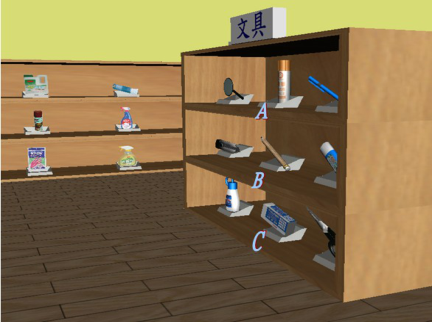
Apparatus and the VE The experimental environment was constructed by developing software and presenting the images on three types of displays: a 46〞3D stereoscopic display with active LCD-shutter glasses and two fields of 1080-line interleaved vertical resolution lines of 1920 horizontal pixels each to simultaneously show two 3D images with polarization at a 2000:1 contrast ratio; a 46〞3D autostereoscopic LCD display with a free lenticular lens, designed with 1920x1080 resolution and a 1200:1 contrast ratio; and a 42〞2D monocular TFT-LCD display. This study is focused on the effect of autostereoscopic and stereoscopic displays on the sense of presence and symptoms of cybersickness in the elderly when 3D scenes are visualized through common, commercial 3D display types. The 2D monocular displays were commonly used to show VEs in the past, but, in this study, a 2D display with monocular cues was designed as a control used to compare the differences between 2D and 3D displays on the sense of presence and cybersickness. The VE scene for our study was a retail store containing four categories: stationeries, hand tools, cleaning articles and toiletries, as shown in Figure 1. Stationeries and hand tools included eighteen objects exhibited in the center of the retail store. Cleaning articles and toiletries included twenty-seven objects exhibited around the retail store.
Figure 1. A scene of the experimental 3D retail store.
Figure available in the original PDF paper.
In addition, the scene was designed in two different display conditions, which contained high-level or low-level depth perception cues. Figure 2(a) shows a scene with low-quality depth perception cues in which the objects are designed with 2D images. Figure 2(b) shows a scene with high-quality depth perception cues in which the objects are designed with 3D stereo pictures and exhibit good shape and depth.
(a) (b)
Figure 2. A scene of: (a) low level depth perception cues with 2D images; (b) high level depth perception cues with 3D stereo pictures
Experimental design and procedures The study involved a 2 (levels of depth perception cues: low and high) × 3 (types of display: autostereoscopic display, stereoscopic display and monocular display) between-subjects experiment resulting in a full-factorial design with six treatment conditions. During the exposure period, there were eight target objects for which participants were required to search. However, only six of these objects were exhibited in the showroom. When the target object was found, participants were to move the cursor over the object and push the left button on the control device to identify the object. If the object was the target, the system would beep once to notify the participant. At the same time, the participant was to write down the correct position on the check sheet (i.e., each showcase was numbered). If the participant determined that a particular target object was not exhibited in the showroom, the participant was to mark “X” in the corresponding column.
Before exposure, participants were asked to complete a simulator sickness questionnaire (SSQ) documenting the severity levels of 16 sickness symptoms (Kennedy et al., 1993). According to the study by Kennedy et al. (1993), nausea seldom occurs when the SSQ score is less than 7.5. Therefore, if a participant reported any moderate symptom of discomfort or sickness in the pre-exposure SSQ, that is, the SSQ score was greater than 7.5, then the participant was asked to rest for 10 minutes and then complete a second pre-exposure SSQ. If the second pre- exposure SSQ score was still greater than 7.5, the participant was withdrawn from the study. During the exposure, participants could freely involve themselves in the VE by manipulating the mouse button and rotating the scene around the vertical or lateral axes. They could also zoom in using the SHIFT key and zoom out using the CTRL key. When all six target objects were found, and the other two objects were confirmed to not be present in the showroom, the experiment was concluded. Finally, participants were asked to complete a presence questionnaire (PQ) and an SSQ. The PQ was devised to measure user presence within a VE on a 7-point scale and consisted of 4 categories (control factors, sensory factors, distraction factors and realism factors) with 32 questions regarding user interaction (Witmer & Signer, 1998).
RESULTS
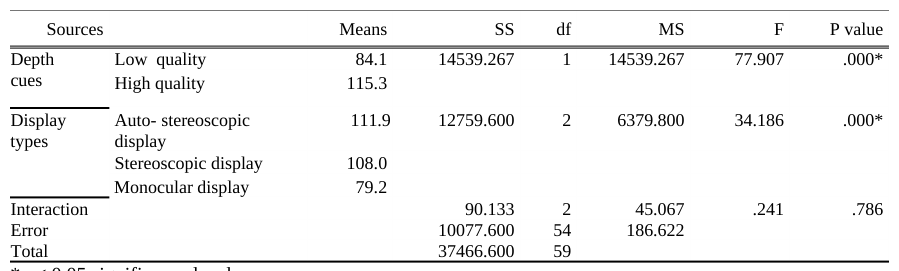
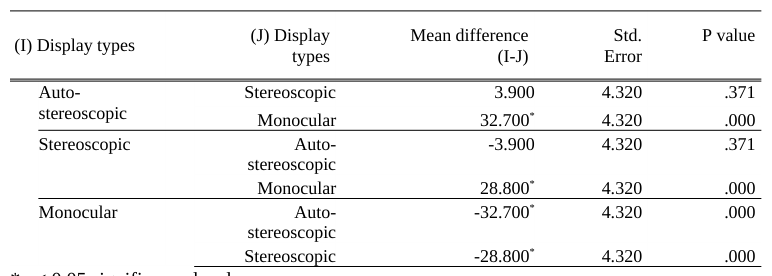
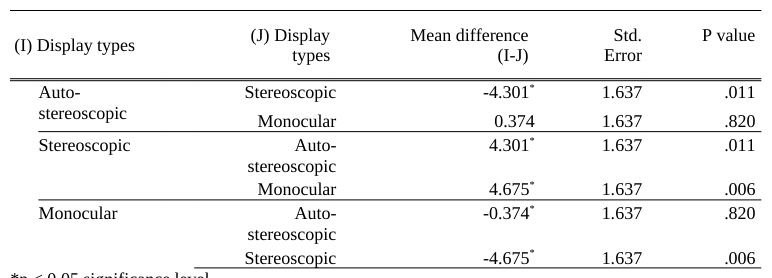
Table 1 shows that high-quality depth perception cues, i.e., 3D stereo pictures for multiple viewpoints, provided participants a sense of presence that was significantly higher than that they experienced with low-quality cues, i.e., 2D images. This result suggests that 3D stereo images may provide enough stereopsis and stereo acuity for users to identify objects, examine those objects from multiple viewpoints and interact with those objects, thereby allowing participants to experience a stronger sense of presence than did the 2D images of objects within the virtual store. In addition, there were significant differences among display types. Therefore, there was a need for further investigation into the effects of different display types on the sense of presence. A post-hoc test performed in Turkey was used for pair-wise comparison of display types, and the results are shown in Table 2. The results show that the sense of presence was stronger in 3D displays than in monocular displays.
Furthermore, we assessed the degree of the participant’s feelings of presence, realism and involvement with the virtual store to understand the influences of depth perception cues and display types. Testing the differences between the two depth perception cue levels with these three rating factors demonstrated that participants perceived stronger feelings of presence, realism and involvement/control when experiencing high-quality depth perception cues (sensory: high-quality depth perception cues are better than low-quality cues (t(29) = 14.222, p < 0.000); realism: high-quality depth perception cues are better than low-quality cues (t(29) = 6.634, p < 0.000); involvement/control: high-quality depth perception cues are better than low-quality cues (t(29) = 16.093, p < 0.000)). Additionally, a test of differences among display types with these three rating factors shows that participants felt the sensory, realism and involvement/control aspects to be strongest in autostereoscopic displays and weakest in 2D displays.
Table 1: ANOVA analysis of the effects of depth perception cues and display types on presence scores Sources Means SS df MS F P valueTable 2: Turkey’s post-hoc tests for the effects of display types on presence Mean difference
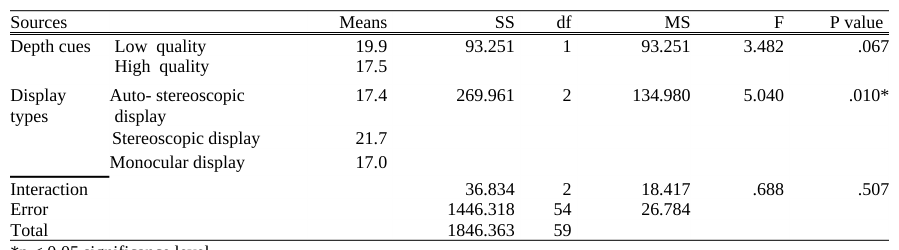
Symptoms of cybersickness were evaluated by the SSQ after exposure. Table 3 shows that the effect of the depth perception cues was insignificant but that the display type was significant. Turkey’s post-hoc test was used for pair- wise comparison of display types as shown in Table 4. The stereoscopic display seems to induce cybersickness more easily than other display types. As a result, our concern became which category of sickness was the most easily induced. Table 5 shows SSQ sub-scores for the different display types. Oculomotor disturbances, i.e., nausea and disorientation, appear to be more common than the other categories, especially in 3D displays. The cause of these disturbances may be the conflict between the fixed focal depth of the image plane and the depth cues provided within a 3D display. These conflicting stimuli would promote an inappropriate ocular response in viewing a virtual environment. In addition, the score of the disorientation sub-scale was higher than the scores of the other sub-scales for all displays. We found that the major symptoms of disorientation were difficulty focusing and blurred vision, which are symptoms related to disturbed visual processing and also belong to the category of oculomotor disturbances during the simulation. The results show that there was a significant increase in oculomotor disturbances for the elderly after 3D virtual store exposure on 3D displays.
Table 3: ANOVA analysis of the effects of depth perception cues and display types on cybersickness scores Sources Means SS df MS F P value Depth cues Low quality 19.9 93.251 1 93.251 3.482 .067 High quality 17.5Table 4: Turkey’s post-hoc tests for the effects of display types on cybersickness Mean difference P value (I) Display types (J) Display typesTable 5: SSQ sub-scores for display types Display types SSQn* SSQo SSQd Autostereoscopic Mean(scores) 8.586 17.434 20.880 display Mean(times) 0.9 2.3 1.5 SD(scores) 6.113 4.330 7.141 Stereoscopic Mean(scores) 11.925 20.087 26.448 display Mean(times) 1.25 2.65 1.9 SD(scores) 4.238 4.451 6.225 Cognitive Engineering and Neuroergonomics (2019)
Table available in the original PDF paper.
Monocular Mean(scores) 7.632 16.297 22.272 display Mean(times) 0.8 2.15 1.6 SD(scores) 4.991 4.451 6.997 *SSQn: nausea; SSQo: oculomotor disturbance; SSQd: disorientation Overall performance within the 3D virtual store was determined by the total time (seconds) spent searching for and confirming the target objects. The total time spent on finding six target objects in the showroom was recorded, and the correct positions on the check sheet were written down. The ANOVA result indicates that there was no significant difference between low-quality depth perception cues and high-quality depth perception cues (F(1, 54) = 0.058, p = 0.811). However, there was significant difference among display types (F(2, 54) = 260.665, p < 0.000).
DISCUSSION
In this study, participants’ experiences of the degree of presence and level of cybersickness when using different depth perception cues and different display types were compared. As expected, virtual scenes designed with high- quality depth perception cues provide a better sense of presence than scenes with low-quality depth perception cues, especially when shown on a 3D auto-stereoscopic display. The results indicate that when objects were designed with low-quality perception cues, i.e., 2D images, the user’s sense of presence and realism were significantly impaired. If the 3D virtual store was shown on a 3D display with high-quality depth perception cues, the 3D stereo pictures may provide enough stereopsis within the 3D displays to produce an enhanced binocular disparity for users examining objects from multiple viewpoints. Furthermore, participants would feel a stronger sense of presence within the virtual store. 2D monocular display images provide a two-dimensional representation of a three-dimensional scene. Information pertaining to the third dimension, that is, the range or distance to each pixel, is lost as the scene is flattened onto the image plane. The other interesting outcome from the rating items was that those participants who perceived the virtual store with the 3D autostereoscopic display demonstrated a stronger overall sense of presence, including the sensory, realism and involvement/control sub-factors, than they did with the 3D stereoscopic display. It is possible to hypothesize that there are some disadvantages to the elderly when influencing the sense of presence within a stereoscopic display.
The experimental results in 3D displays appear to support Singer and Witmer (1996), who reported that the experience of sickness may detract from the sense of presence. However, the cybersickness rating evaluated on the monocular display was not significantly different when using high- or low-quality depth perception cues, but the feeling of presence was significantly different. This result indicates that cybersickness and a lower sense of presence may be produced independently, though they are related to oculomotor disturbances. If the objects are presented as 2D images shown on a 3D display, the depth cues might disappear, thus inducing mismatched oculomotor cues, i.e., accommodation and convergence. These conflicting stimuli would promote an inappropriate ocular response when viewing a virtual environment. It is expected that participants experiencing low-quality depth perception cues may have a poor sense of objects and lose depth cues within the virtual store, leading to increased oculomotor disturbances when compared to high-quality depth perception cues. Therefore, participants exposed to a virtual store with low-quality depth perception cues on a 3D display may report some level of cybersickness and experience a reduced sense of presence. However, in a 2D monocular display, both 2D and stereo 3D images become monocular cues with the same pictorial depth cues and motion cues, and the oculomotor disturbances may, therefore, be expected to be slighter. However, sensory conflicts will be serious whenever the sensory information is not the stimulus that the participant expects based on experience. Thus, regardless of the quality of the depth perception cues within a monocular display, sensory conflicts will arise easily. Consequently, the severity of cybersickness symptoms is not significantly different when using high- or low-quality depth perception cues on a monocular display. Additionally, participants required glasses to view the virtual store on a 3D stereoscopic display. When oculomotor disturbances occurred during VE exposure, participants could adjust the glasses and forehead angle to reduce the influence of oculomotor disturbances, but the symptoms of blurred vision would increase. Therefore, the total scaled cybersickness scores is lowest for the autostereoscopic display.
CONCLUSIONS
Virtual stores with 3D images and thus high-quality depth perception cues allow older users to experience good stereo acuity. The current study found that the elderly who browsed in a 3D virtual store with high-quality depth perception cues did benefit from binocular disparity within a 3D display and were able to experience a sense of presence. Although the 3D displays provided a stereopsis environment, the side effect of cybersickness from exposure in a VE can be serious when the depth perception cues are poor, especially within a stereoscopic display. Overall, the reported sense of presence when browsing a virtual store on a 3D display was positive when the symptoms of cybersickness were slight. However, cybersickness and a lower sense of presence were independent of each other when using a monocular display. Thus, the theorized assumption that an experience of sickness may detract from the sense of presence was not supported. Our conclusion is that a presenting a virtual store via an autostereoscopic display with high-quality depth perception cues will produce a good sense of presence and realism in stereopsis, thereby allowing the elderly to engage with and become involved in the virtual store. However, if the depth perception cues are poor, 3D displays, especially stereoscopic ones, should be avoided to prevent the elderly from experiencing cybersickness and, consequently, losing interest in the 3D virtual store, as the cybersickness is more serious than that experienced with a monocular display.
Due to advancements in technology, psychological tests of presence and self-reported symptoms of cybersickness on holographic displays should be considered as the technological problems associated with holographic displays (e.g., high control voltage and limited viewing angle, high costs) are solved. Additionally, this research would be a step toward designing a warning system to detect operational problems and prolonged exposure, and such a system could help to combat cybersickness within a 3D environment.
ACKNOLOWLEDGEMENT The authors would like to thank the National Science Council of the Republic of China for financially supporting this work under Contract No. 102-2221-E-238-004.
REFERENCES
Benzie, P., Watson, J., Surman, P., Rakkolainen, I., Hopf, K., Urey, H., Sainov, V., Kopylow, C. von. (2007), “A survey of 3DTV displays: techniques and technologies”, IEEE Transactions on Circuits and Systems for Video Technology, 17, pp. 1647- 1658. Chu, Y.M., Chien, K.W., Shieh, H.P.D., Chang, J.M., Hu, A., Shiu, Y.C., Yang, V. (2005), “3D mobile display based on dual-
directional light guides with a fast-switching liquid-crystal panel”, Journal of the Society for Information Display, 13, p. 875. Cornelissen, H.J., Greiner, H., Dona, M.J. (1999), “Frontlights for Reflective Liquid Crystal Displays Based on Lightguides with Micro-Groove”, SID Symposium Digest, 30, pp. 912-914. Freeman, J., Avons, S.E., Pearson, D.E., Ijsselsteijn, W.A. (1999), “Effects of sensory information and prior experience on direct
subjective ratings of presence”, Presence: Teleoperators and Virtual Environments, 8, pp. 1-13. Ijsselsteijn, W., Ridder, H., Hamberg, R., Bouwhius, D., Freeman, J. (1998), “Perceived depth and the feeling of presence in 3DTV”, Displays, 18, pp. 208-214. Jones, S., Fox, S. (2009), “Generations online in 2009”, Pew Internet & American Life Project Report. Kennedy, R.S., Lane, N.E., Berbaum, K.S., Lilienthal, M.G. (1993), “Simulator sickness questionnaire: an enhanced method for
quantifying simulator sickness”, International Journal Aviation Psychology, 3, pp. 203-220. Lambooij, M., Ijsselsteijn, W., Fortuin M., Heynderickx, I. (2009), “Visual discomfort and visual fatigue of stereoscopic displays: a review”, Journal of Imaging Science and Technology, 53, pp. 1-14. Lathan, R. (2001), “Tutorial: a brief introduction to simulation sickness and motion programming”, Real Time Graphics, 9, pp.
3-5. LaViola, J.J. (2000), “A discussion of cybersickness in virtual environment”, SIGCHI Bulletin, 32, pp. 47-56. Lombard, M., Ditton, T. (1997), “At the heart of it all: the concept of presence”, Journal of Computer Mediated Communication,
3. available online at http://jcmc.indiana.edu/vol3/issue2/lombard.html.
Mikropoulos T.A., Strouboulis, V. (2004), “Factors that influence presence in educational virtual environments”, Cyberpsychology & Behavior, 7, pp. 582–591. Nichols, s., Haldane, C., Wilson, J.R. (2000), “Measurement of presence and its consequences in virtual environments”,
International Journal of Human-Computer Studies, 52, pp. 471-491. Sadowski, W., Stanney, K. M. (2003), “Presence in virtual environments”, in: Handbook of Virtual Environments: Design, Implementation, and Applications, Stanney, K.M. (Ed.). Lawrence Erlbaum Associates, Mahwah, NJ. Pp. 791-806. Sheridan, T.B. (1992), “Musings on telepresence and virtual presence”, Presence: Teleoperators and Virtual Environments, 1, pp.
120-125. Singer, M.J., Witmer, B.G. (1996), “Presence measures for virtual environments: background and development”, Interim Report, US Army Research Institute Press. Spek, V.D. (2007), “The effect of cybersickness on the affective appraisal of virtual environments”, Master’s thesis, University of
Utrecht. Stanney, K.M. (2002), Handbook of Virtual Environments. Earlbaum Press. Steuer, J. (1992), “Defining virtual reality: dimensions determining telepresence”, Journal of Communications, 42, pp. 73-93. Sylaiou, S., Karoulis, A., Stavropoulos, Y., Patias, P. (2008), “Presence-centered assessment of virtual museums’ technologies”, Journal of Library and Information Technology, 28, pp. 55-62. Toyooka, K. (2001), “The 3D Display Using Field-Sequential LCD with Light Direction Controlling Backlight”, SID’01 Digest.
pp. 177-180. Wickens, C.D., Todd, S., Seidler, K. (1989), “Three-Dimensional Displays: Perception, Implementation, Applications”, Published by Crew System Ergonomics Information Analysis Center. Wilson, J.R. (1997), “Autonomy, interaction and presence”, Presence: Teleoperators and Virtual Environments, 1, pp. 127-132. Witmer, B.G., Singer, M.J. (1998), “Measuring presence in virtual environments: a presence questionnaire”, Presence, 7, pp.
225-240.
LISTED IN THE AHFE DIGITAL BOOKSTORE CATALOGUE
Explore the complete digital volume
Advances in Cognitive Engineering and Neuroergonomics
Read this individual research paper free through the original publisher, or explore the full digital proceedings book.
ISBN 978-1-4951-2101-2
Explore this ISBN in the AHFE Bookstore ↗Listed in the July 2026 bookstore catalogue; search by ISBN to confirm current availability · Digital book purchase optional