A plastic model is provided as a kit to be assembled by hobbyists, and intended for static display. Although numerous products are designed and provided by many firms, the blue prints tend to be drawn empirically by engineers. Then, modelers sometimes get tired when they make the same parts repetitively. Electroencephalogram (EEG) is an attractive measure for neurocognitive functions. Especially, frontal midline theta brain wave activity (Fm theta) has been reported to be a good sign for such brain functions. Fm theta is a paradoxical phenomenon that slow brain wave is activated under high arousal condition. Many studies have reported that Fm theta can be recorded during some mental workload task performances: mental calculation, working memory tasks, and TV games. We have already discovered that plastic model building can can evoke a more sustained and higher amplitude Fm theta, compared with mental calculation, the original and standard task for Fm theta activation (Takao et al., 2010). There is no other study on brain function for plastic model buildings. In this paper, we discuss the possibility of Fm theta as a neurocognitive method to evaluate blue print.
A plastic model is provided as a kit to be assembled by hobbyists, and intended for static display. The earliest plastic model kit was manufactured about 80 years in United Kingdom. More than 200 toy makers currently design, produce and sell numerous types of plastic model kit in many advanced and developing countries. In spite of popularity of plastic model building as a hobby, the factors attracting hobbyists have not been studied neurocognitively. Senses of accomplishment and devotion are empirically thought to be linked to this kind of hobby. Electroencephalogram (EEG) is an attractive measure for neurocognitive functions. Especially, frontal midline theta brain wave activity (Fm theta) has been reported to be a good sign for a sense of devotion (Mizuki et al., 1980).
Fm theta is a paradoxical phenomenon that slow brain wave is activated under high arousal condition. Many studies have reported that Fm theta can be recorded during some mental workload task performances: mental calculation, working memory tasks, and TV games. In our preliminary study, the plastic model building can also evoke a more sustained and higher amplitude Fm theta, compared with mental calculation, the original and standard task for Fm theta activation (Takao et al., 2010).
It is conceivable that the products which promote a sense of devotion should be attractive to hobbyists. However, the blue prints tend to be drawn empirically by designers and engineers, but have not been validated neurocognitively. In this study, we record Fm theta as a quantitative measure for a sense of devotion while the modeler is building plastic model, and discuss the correlation between the specific procedures and sense of devotion.
MATERIALS AND METHODS
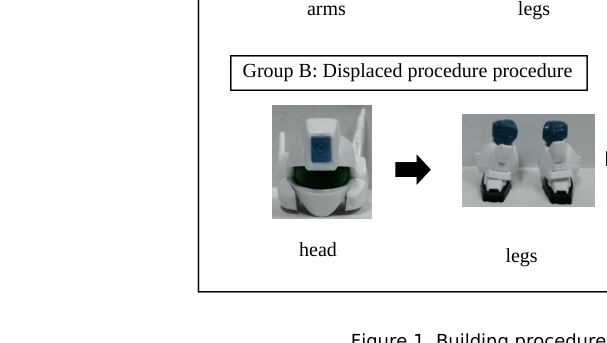
Sixteen college students were recruited to perform the plastic model building. Eight were novice modelers, and the others were experienced modelers. The participants were randomly divided into two groups (Figure 1). One group referred to the original procedure assigned in the blue print, and built the kit (Group A; 8 modelers). The other one referred to the unintentionally displaced procedure, and built it (Group B; 8 modelers). Each group comprised of four novices and four experienced. The plastic models were the armored robots which are simple and easy to build (D-style series; Kotobukiya inc., Tokyo, Japan; http://main.kotobukiya.co.jp/dstyle/). Building processes were video-taped to analyze the modeler’s behavior. All the modelers could complete these model kits within 30 minutes.
EEGs were recorded monopolarly from disc electrodes placed on Fp1, Fpz, Fp2, F3, Fz, F4, C4. Cz and C5 during the whole procedure. Fm theta was automatically identified in power spectrum in 1 second intervals (dominant theta rhythm in frontal mildline region; 4-7Hz). Noises were detected in raw EEG waveforms, and exscinded in the recordings. Informed consent was obtained from all the modelers after the purpose and procedures were explained. All of the procedures were performed following Declaration of Helsinki and institutional ethical guidelines. The purpose and procedures were approved by the institutional ethical committee.
Group A: Original procedure
arms legs head trunk
Group B: Displaced procedure procedure
head legs trunk arms
Figure 1. Building procedures of plastic model kit
RESULTS
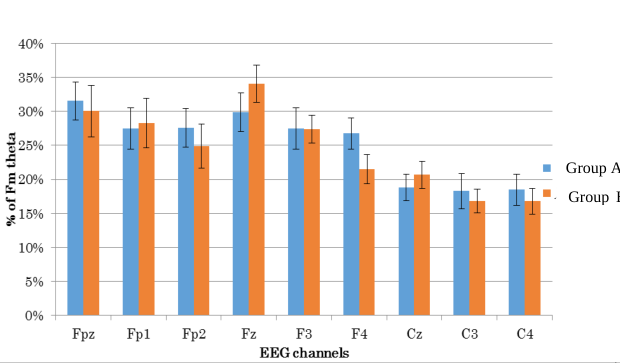
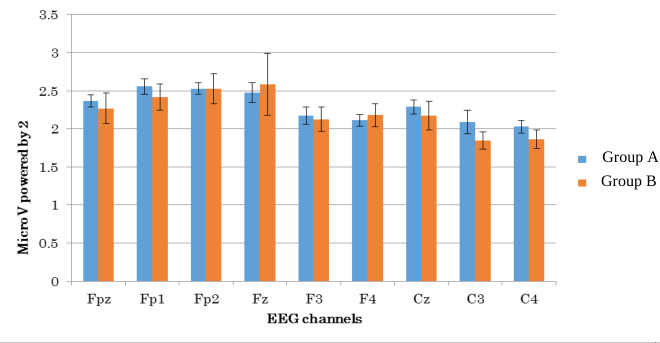
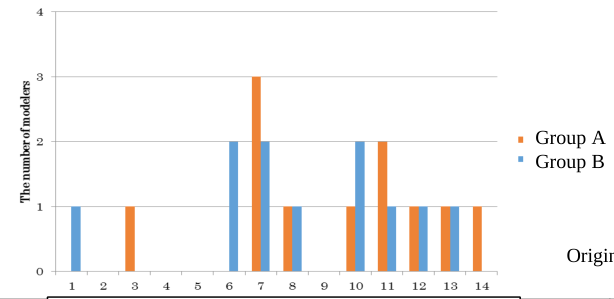
Figure 2 shows that appearance of Fm theta during plastic model building. Student’s t-test yielded no statistical significance between groups A and B. Spectral power also showed no statistical difference between both groups (Figure 3). These results indicate that displacement of procedure did not influence sense of devotion.
Group A Group B
Figure 2. Appearance of Fm theta during plastic model kit building (%)
Group A Group B
Figure 3. Spectral power of Fm theta during plastic model kit building (%)
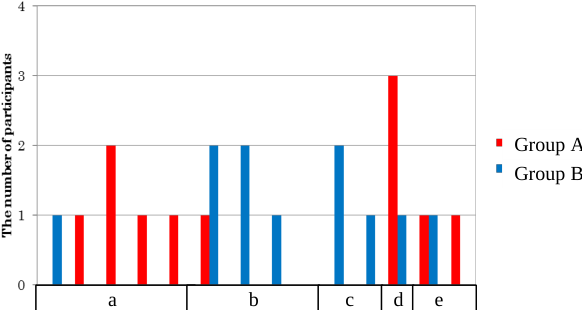
We analyzed the correlations between the specific procedures and sense of devotion in experienced modelers. We defined the increase of Fm theta power in each procedure as follows: the averaged power of Fm theta exceeds above 1.5 times the value of standard deviation calculated from all epochs (1s each). Figure 5 shows that no specific procedure potentiates Fm theta. Figure 6 indicates that Fm theta does not tend to increase depending on time of building, although the data is not currently big enough to deduce the conclusion. Hence, it seems there is no correlation between the specific procedure and sense of devotion in experienced modelers.
DISCUSSION
In this study, we could record Fm theta while modelers were building the plastic model kits. As shown in Figure 2 and 3, the appearance time and power were almost same between novice and experienced modelers. This fact shows that plastic model building is a good task to induce sense of devotion regardless his or her experience. However, Fm theta could not be used as a measure of devotion, although Fm theta is widely recognized as a good sign for a sense of devotion (Mizuki et al., 1980).
We have already reported that a remarkable rise of Fm theta appearance and power occurs when the modeler builds the last procedure and completes the kit (Takao et al., 2010). This fact suggests that Fm theta could correlate with sense of accomplishment as well as sense of devotion. In the current study, such rise could not be seen, because the current analyzing method is different from the previous one (qualitative and quantitative).
Each procedure includes many processes: looking at blue print, cutting and assembling parts. Our analyzing system could not analyze such processes, because we manually described the time and modeler’s behavior refereeing to video-tape. The automated video-analyzing system should overcome such limitation.
Group A Group B
a b c d e
Figure 5. Increase of Fm theta power in each procedure of plastic model kit building in the experienced modelers. a) arms, b) legs, c) head, d) trunk, e) completion
Figure 6. Increase of Fm theta power during plastic model kit building in the experienced modelers. The abscissa shows the number of procedure drawn in the original blue print. The number in parentheses also describes the same procedure. The numbers were aligned sequentialy.
REFERENCES
Mizuki, Y., Tanaka, M., Isozaki, H., Nishijima, H., Inanaga, K. (1980), “Periodic appearance of theta rhythm in the frontal midline area during performance of a mental task” Electroencephalogram and Clinical Neurophysiology, Volume 49, No. 3-4, p.p. 345-351. Takao, M., Kadota, Y., Yamagami, M., Taniuchi, J., Masuda, N., Shimizu, S., Kamei, T. (2010), “Fm theta brain
wave activity during plastic model building” The 8th world congress of International Brain Research Organization, Florence, Italy.
LISTED IN THE AHFE DIGITAL BOOKSTORE CATALOGUE
Explore the complete digital volume
Advances in Cognitive Engineering and Neuroergonomics
Read this individual research paper free through the original publisher, or explore the full digital proceedings book.
ISBN 978-1-4951-2101-2
Explore this ISBN in the AHFE Bookstore ↗Listed in the July 2026 bookstore catalogue; search by ISBN to confirm current availability · Digital book purchase optional