Micael Gonçalves, Vladimiro Lourenço, Lídia Lemos Ribeiro, Ricardo Silva, Nélson Costa (2026). Driver Interaction, Needs, and Preferences for Steering-Wheel HMIs: An International Survey. In: Human Interaction and Emerging Technologies (IHIET 2026). AHFE Open Access, vol. 236, pp. 622–632. https://doi.org/10.54941/ahfe1008137
The increasing integration of Advanced Driver Assistance Systems (ADAS), infotainment platforms, and connected technologies has transformed the steering wheel into a central Human–Machine Interface (HMI) for drivers. Despite this evolution and the growing complexity of automotive HMIs, quantitative studies providing a holistic understanding of drivers’ interaction patterns, preferences, and unmet needs regarding steering-wheel interfaces remain limited. This study aims to characterize current driver interaction with steering-wheel HMI technologies and identify design implications for future automotive interfaces through an international online survey conducted among drivers holding a valid motor vehicle driving license. A total of 280 participants from multiple nationalities completed the questionnaire, covering driver profiles, vehicle technologies, steering-wheel interaction and usability. Data were analysed using descriptive statistical methods to identify interaction patterns, usability challenges, and user expectations.The results indicate that steering-wheel controls are particularly relevant for infotainment and communication functionalities, with nearly 80% participants reporting regular use. In contrast, ADAS-related steering-wheel controls presented lower usage levels. Although participants generally perceived steering-wheel layouts and icons as intuitive and recognizable, difficulties in locating functions, non-intuitive layouts, and excessive numbers of physical buttons were identified as relevant usability challenges. Participants showed a preference for customizable controls, simplified layouts, and adaptive functionalities to improve convenience while reducing interaction complexity and driver distraction.The findings provide empirical insights into current driver interaction with steering-wheel HMI technologies and support the user-centred design of future automotive interfaces. The design implications can assist researchers and manufacturers in developing safer, more intuitive, and adaptable steering-wheel HMIs.
The automotive industry is undergoing a transformation driven by the increasing digitalization, connectivity, and automation of vehicles. The integration of Advanced Driver Assistance Systems (ADAS), infotainment platforms, and connected functionalities has shifted driver–vehicle interaction from traditional mechanical controls towards increasingly complex Human–Machine Interface (HMI) ecosystems (KPMG, 2012; Fagnant and Kockelman, 2015; Wachenfeld and Winner, 2016). Within this evolution, the steering wheel has emerged as a critical interaction hub, extending its traditional role of vehicle control to support access to digital vehicle functionalities. However, the growing number of integrated functions introduces new design challenges, requiring a balance between functionality, simplicity, personalization, and safety. Therefore, understanding driver behaviours, expectations, and interaction patterns is essential for the development of effective steering-wheel HMIs (Banjo, Stewart and Fasli, 2016; Gkikas, 2016; Wang et al., 2025). Human-centred design approaches are increasingly relevant in automotive HMI development, with previous research highlighting the importance of intuitive interaction mechanisms and effective information presentation to reduce cognitive workload and improve driving performance. However, many studies rely on controlled experimental environments, providing limited understanding of drivers’ everyday interaction behaviours, preferences, and challenges with steering-wheel HMIs within the broader ecosystem of ADAS, infotainment systems, smartphone integration, and voice interaction (Burnett and Porter, 2001; Borghini et al., 2012; Gáspár, Szalay and Aradi, 2014; ISO, 2019; McDonnell et al., 2021). To address this gap, this paper presents an international online survey aimed at characterizing driver interaction, needs, and preferences regarding automotive HMI technologies, with particular emphasis on steering-wheel interfaces. Building upon previous qualitative investigations based on focus groups, the survey analysed 280 responses from drivers of multiple nationalities to identify current interaction patterns, usability challenges, and design opportunities for future steering-wheel HMIs.
The main contributions of this work are: (i) the characterization of driver interaction patterns with steering-wheel HMI technologies through an international survey; (ii) the identification of usability challenges and user expectations regarding current and future automotive interfaces; and (iii) the derivation of user-centred design implications to support safer, more intuitive, and more adaptable steering-wheel HMIs.
The remainder of this paper is organized as follows. Section 2 describes the methodology, including survey design, questionnaire structure, participant recruitment, and data analysis. Section 3 presents the survey results, while Section 4 discusses the main findings and design implications. Finally, Section 5 summarizes the conclusions, limitations, and future research directions.
METHODOLOGY
This study adopted a quantitative research approach based on an international online survey, developed to complement qualitative findings obtained through focus groups. The questionnaire was developed based on a previous qualitative research phase involving four focus group sessions with 27 participants, each lasting approximately 90 minutes. These sessions explored drivers’ experiences and perceptions regarding steering-wheel HMIs and in-vehicle technologies, providing insights used to define the main survey topics and questions. The questionnaire aimed to collect data regarding driver profiles, driving contexts, vehicle technologies, interaction behaviors, perceived usability, and expectations regarding future steering- wheel HMI functionalities. It was developed and distributed using the LimeSurvey platform provided by the Department of Production and Systems of the School of Engineering of the University of Minho, with data collection conducted between June and August 2024.
The questionnaire comprised five sections covering: (1) sociodemographic and driving profile; (2) driving behaviour and vehicle usage context; (3) vehicle characteristics and in-vehicle technologies; (4) steering-wheel interaction and usability assessment; and (5) voice control and smartphone interaction. The questionnaire included closed-ended questions using categorical and Likert- type scales, complemented by open-ended questions addressing interaction difficulties and desired functionalities.
Participation in the survey was voluntary and restricted to drivers holding a motor vehicle driving licence. A total of 280 participants from multiple nationalities completed the questionnaire. Participants were recruited through institutional mailing lists from the University of Minho and ZF Lifetec, the industrial partner of the research project, reaching drivers with different demographic characteristics, driving experiences, and familiarity with automotive technologies.
The collected data were analysed using descriptive statistical methods, including frequency distributions, percentages, and measures of central tendency and dispersion. The analysis focused on four dimensions: (i) driver and vehicle characterization; (ii) adoption and usage of in-vehicle technologies; (iii) steering-wheel interaction patterns and usability perceptions; and (iv) user needs and expectations regarding future HMI functionalities.
RESULTS
This section presents the main findings of the online survey. The results are organized into four parts: participant and driving profiles, vehicle characteristics and adoption of in-vehicle technologies, steering-wheel interaction patterns, and usability challenges and user expectations regarding future steering-wheel HMIs.
Driver Interaction, Needs, and Preferences for Steering-Wheel HMIs 625 Participant and Driving Profile
A total of 280 participants completed the online questionnaire. The sample included drivers from multiple nationalities, predominantly Portuguese (60.0%), followed by Spanish (21.1%), Chinese (8.2%), and German (7.8%). Most respondents were male (63.2%), while 35.7% were female.
Participants were aged between 20 and 100 years (average age of 41.6 years; SD = 12.3) and had between 1 and 82 years of driving experience (average of 21.7 years; SD = 12.3). Most participants held higher education qualifications (84.6%).
Regarding driving behavior, the most common annual mileage was 10,000–15,000 km (26.4%), while 75.7% of participants reported typical trips lasting 15–60 minutes. Half of the respondents used their vehicles for both professional and private purposes, and 33.9% regularly drove on a combination of urban roads, highways, and rural roads.
Vehicle Characteristics and Adoption of In-Vehicle Technologies The majority of participants reported driving vehicles equipped with combustion engines (82.5%), followed by hybrid vehicles (8.6%). More than 60% of the reported vehicles were manufactured after 2012, indicating that most respondents drove relatively recent vehicles.
The reported vehicles covered eight market segments: urban commuter, technology enthusiast, performance enthusiast, luxury seeker, family- oriented, eco-friendly, budget-conscious, and adventurer/off-roader. Family- oriented (29.6%), urban commuter (27.9%), and budget-conscious (18.9%) vehicles represented the largest groups.
Regarding ADAS, anti-lock braking systems (ABS) and parking sensors were the most frequently reported technologies, present in 70% and 60% of vehicles, respectively. All remaining ADAS functionalities were reported by fewer than half of the participants. Among infotainment systems, media reproduction (65%), climate control (63%), navigation (53%), and mobile communication (52%) were the most frequently used functionalities.
Considering only participants who expressed an opinion, 80% did not perceive in-vehicle systems as distracting, while 20% considered them distracting. Regarding system configuration preferences, 79% reported using factory settings rather than customized configurations. When customization or troubleshooting was required, trial and error (44%) was the most common strategy, followed by online tutorials (23%) and the vehicle manual (21%).
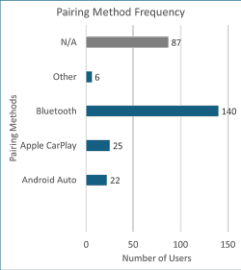
Voice control adoption was limited, with only 30% of participants reporting its use, mainly for communication and navigation. Smartphone integration was predominantly achieved through Bluetooth, while self- reported smartphone use during driving remained low (Figure 1).
(a) (b)
Figure 1: Voice control usage (a) and smartphone pairing method (b).
Overall, these results indicate that participants are regularly exposed to a broad range of automotive technologies, particularly infotainment functionalities. However, interaction remains strongly concentrated on established and familiar features, suggesting that future HMI developments should consider not only technological availability but also user familiarity, discoverability, and ease of interaction.
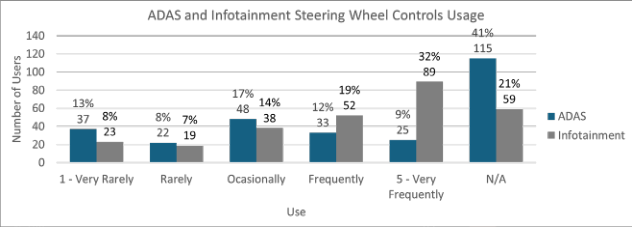
Steering-Wheel Interaction Patterns The analysis of steering-wheel interaction revealed higher usage of infotainment-related controls than ADAS-related controls (Figure 2). Overall, 78.9% of participants reported using steering-wheel infotainment controls, with 31.8% indicating frequent use. In contrast, 41.1% reported not using ADAS-related steering-wheel controls, while the remaining participants reported varying levels of use.
Figure 2: Usage frequency of steering-wheel controls (ADAS vs infotainment).
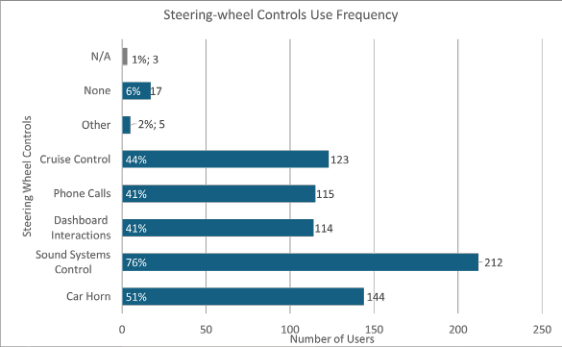
Participants were allowed to select multiple steering-wheel functionalities. Sound-related controls were the most frequently used (76%), followed by cruise control, phone call controls, and dashboard interaction, each reported by more than 40% of participants (Figure 3). These results indicate that steering-wheel interaction is primarily associated with frequently used driving functions.
Figure 3: Most frequently used steering-wheel functionalities.
Participants generally perceived steering-wheel controls as intuitive and easy to understand. Among those expressing an opinion, 75.7% classified the steering-wheel layout as somewhat intuitive (23.9%), intuitive (30.4%), or extremely intuitive (21.4%). Similarly, 83% considered steering-wheel icons recognizable. Despite these positive perceptions, usability challenges were reported. Participants identified difficulties related to locating specific functions, control organization, and excessive interaction complexity, indicating that current challenges are more related to interface organization than to the recognition of individual controls.
The perceived distraction associated with steering-wheel controls varied according to functionality. Sound controls and the car horn were considered the least distracting functions, while dashboard interaction, phone calls, and GPS-related controls presented higher variability in perceived distraction levels.
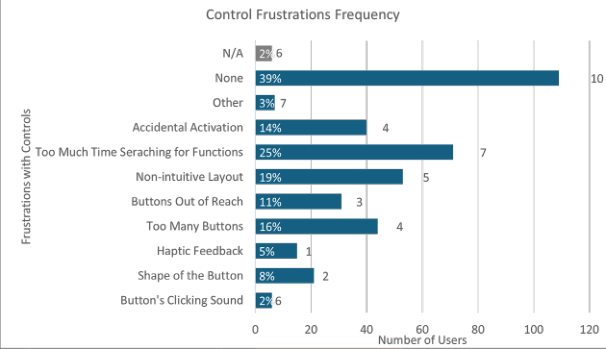
Usability Challenges and User Expectations Although steering-wheel controls were generally perceived positively, several usability challenges were identified. Regarding the main frustrations with current steering-wheel HMIs (Figure 4), 39% of participants reported no relevant issues. Among those reporting difficulties, the most frequent challenge was locating specific functions (25%), followed by non-intuitive control layouts (19%) and excessive numbers of physical buttons (16%).
These results are consistent with previous findings regarding steering- wheel interaction patterns, suggesting that current interfaces are generally understandable but may become challenging as the number of functions increases. In particular, difficulties in locating controls and concerns regarding layout organization indicate that the main usability limitations appear to be related to the layout of steering-wheel controls and the accessibility of functionalities rather than the absence of recognizable interaction elements.
Figure 4: Steering-wheel frustrations and desired functionalities.
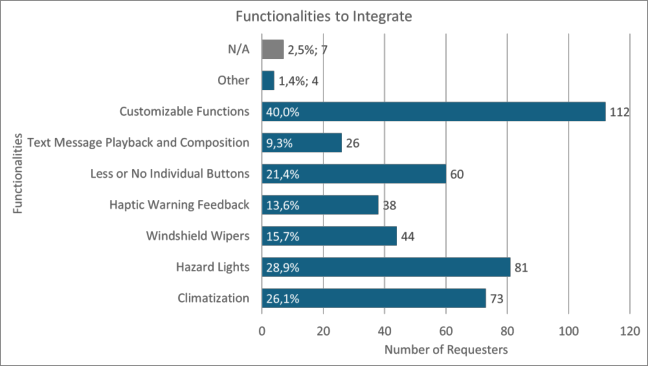
Participants were also asked which additional functionalities or improvements they would like to see integrated into future steering-wheel interfaces (Figure 5). The most frequently requested feature was customizable controls, selected by 40% of respondents. Other relevant preferences included the integration of hazard light controls (28.9%), climate control functionalities (26.1%), and a reduction in the number of individual physical buttons (21.4%). The preference for customizable controls and fewer physical buttons suggests that users value flexibility and simplicity, rather than the continuous addition of new functionalities.
Figure 5: Controls/Functionalities to integrate.
The preference for customizable controls represents a relevant finding, as it suggests that users value the ability to adapt the interface according to their individual needs and usage patterns rather than simply increasing
Driver Interaction, Needs, and Preferences for Steering-Wheel HMIs 629 the number of available functions. Similarly, the demand for fewer buttons indicates a preference for simpler and more efficient interaction mechanisms, where accessibility and personalization may be prioritized over functional expansion.
Overall, the results indicate that future steering-wheel HMIs should focus on improving interaction flexibility and reducing complexity. Rather than adding additional controls, future designs should consider adaptive and customizable interfaces capable of providing access to relevant functions according to driver preferences, context of use, and interaction frequency.
DISCUSSION
The results of this study provide insights into how drivers currently interact with automotive HMI technologies and highlight important considerations for future steering-wheel interface design. Overall, the findings indicate that the steering wheel remains a relevant interaction point within modern vehicles, particularly for frequently accessed infotainment and communication functionalities. However, they also reveal a tension between the increasing number of available functions and the need to maintain simple, intuitive, and safe interactions.
One of the main findings of this study is the different adoption level between infotainment-related and ADAS-related steering-wheel controls. While infotainment functionalities such as audio control, communication, and dashboard interaction are regularly accessed through steering-wheel interfaces, ADAS-related controls present lower levels of usage. This difference may be explained by the fact that many ADAS functionalities operate in the background and require driver intervention only under specific conditions. These results suggest that future steering-wheel HMI designs should account for the different interaction patterns associated with infotainment and ADAS functionalities, rather than adopting a uniform design approach for all steering-wheel controls.
The results also reveal an important distinction between interface recognizability and interaction efficiency. Although most participants considered steering-wheel icons recognizable and layouts generally intuitive, a relevant proportion reported difficulties in locating specific functions and identified non-intuitive layouts as a source of frustration. This suggests that current usability challenges are not necessarily caused by a lack of understanding of individual controls, but rather by increasing interface complexity and the difficulty of efficiently navigating multiple available functions. From a Human Factors perspective, this highlights the importance of considering not only whether users can recognize and interpret an interface element, but also whether they can access the required function quickly and with minimal cognitive demand during driving.
Another relevant finding concerns user expectations regarding future steering-wheel interfaces. The preference for customizable controls was the most frequently identified desired functionality, indicating that drivers value personalization and adaptation according to their individual needs.
Rather than continuously increasing the number of physical controls, future steering-wheel HMIs should explore personalization mechanisms that allow users to prioritize frequently accessed functions, configure layout, and reduce unnecessary complexity. Such approaches may contribute to improving usability while maintaining the advantages of direct physical interaction.
The preference for fewer physical buttons further reinforces the need to rethink the organization of steering-wheel controls. While physical controls provide important benefits, including tactile feedback and reduced visual attention requirements, excessive button density may negatively affect discoverability and increase cognitive workload. Future steering-wheel interfaces may benefit from combining physical controls with alternative interaction approaches, allowing drivers to select the most appropriate interaction according to the driving context.
Table 1 summarizes the main survey findings and their corresponding design implications for future steering-wheel HMIs. These implications highlight the need to balance functionality, usability, personalization, and safety when designing future driver interfaces.
Table 1: Summary of survey findings and resulting design implications for future steering-wheel HMIs.
Table available in the original PDF paper.
Survey Finding Design Implication
Prioritize high-frequency functions to ensure quick and intuitive interaction during driving
Steering-wheel controls are frequently used for infotainment and communication functionalities ADAS-related steering-wheel controls present lower usage frequency compared with infotainment controls
Consider different interaction strategies for assistance functionalities, considering their occasional and context-dependent use
Drivers generally recognize control icons, but some experience difficulties locating specific functions
Improve functional organization and control grouping to enhance discoverability and reduce cognitive effort
Users report frustrations related to excessive numbers of buttons and non- intuitive layouts
Reduce interface complexity by avoiding unnecessary physical controls and improving interaction hierarchy
Customizable steering-wheel controls are the most desired future functionality
Enable personalization mechanisms that allow drivers to adapt controls according to preferences and usage patterns Consider integrating relevant vehicle functions based on frequency of use and driver needs
Drivers request additional functionalities, such as climate control and hazard light access Voice interaction presents limited adoption among participants
Further improve voice interaction systems to increase reliability, usability, and acceptance as complementary alternatives to physical controls.
Overall, the results suggest that future development of steering-wheel HMIs should focus not only on expanding available functionalities, but also on creating user-centred interaction systems that balance functionality, simplicity, personalization, and safety.
CONCLUSION
This paper presented the results of an international online survey aimed at understanding driver interaction, needs, and preferences regarding automotive HMI technologies, with particular emphasis on steering-wheel interfaces. Based on responses from 280 drivers with different backgrounds and driving experiences, the study characterized current interaction patterns, frequently accessed functionalities, and usability challenges associated with steering-wheel HMIs.
The results confirm the relevance of steering-wheel interfaces within modern vehicles, particularly for infotainment and communication functionalities. Although current interfaces are generally perceived as intuitive and recognizable, challenges remain regarding function accessibility, control organization, and interaction complexity. Drivers also expressed a preference for customizable and simplified interfaces, highlighting the importance of personalization and adaptability in future steering-wheel HMI development.
This study contributes empirical insights to support the user-centred design of future automotive interfaces by identifying current driver behaviours, usability limitations, and design opportunities. The findings highlight the need to balance technological capabilities with human factors considerations, particularly regarding usability, cognitive workload, and driver safety.
This study presents some limitations. The survey relied on self-reported data, which may be influenced by participants’ subjective perceptions, previous experiences with vehicle interfaces, and difficulties in accurately recalling interaction behaviours. Furthermore, although the sample included participants from different nationalities and driving backgrounds, it does not represent the complete diversity of global drivers and vehicle usage contexts. Future research should complement these findings with experimental evaluations in simulated or real driving environments, enabling the assessment of objective interaction performance, cognitive workload, and driver behaviour when using novel steering-wheel HMI concepts.
Future work will focus on translating the identified user needs and design implications into the development and validation of innovative steering-wheel HMI prototypes. Experimental studies combining behavioural, subjective, and physiological measures will provide further insights into the usability, safety, and effectiveness of innovative steering-wheel HMI concepts under simulated driving conditions.
ACKNOWLEDGEMENT
This work has been supported by the European Union under the Next Generation EU, through a grant of the Portuguese Republic’s Recovery and Resilience Plan (PRR) Partnership Agreement, within the scope of the project GreenAuto: Green Innovation for the Automotive Industry (Project ref. nr. 54- C6448637037-00000013). This work has also been supported by FCT – Fundação para a Ciência e Tecnologia within the R&D Unit Project Scope UID/00319/2025 - Centro ALGORITMI (ALGORITMI/UM) https://doi. org/10.54499/UID/00319/2025.
REFERENCES
Banjo, O., Stewart, D. and Fasli, M. (2016) ‘Optimising mixed model assembly lines for mass customisation: A multi agent systems approach’, Advances in Transdisciplinary Engineering, 3, pp. 337–342. Available at: https://doi. org/10.3233/978-1-61499-668-2-337. Borghini, G. et al. (2012) ‘Assessment of mental fatigue during car driving by using
high resolution EEG activity and neurophysiologic indices’, Annual International Conference of the IEEE Engineering in Medicine and Biology Society. IEEE Engineering in Medicine and Biology Society. Conference, 2012, pp. 6442–6445. Available at: https://doi.org/10.1109/EMBC.2012.6347469. Burnett, G. and Porter, J. (2001) ‘Ubiquitous computing within cars: Designing controls for non-visual use’, International Journal of Human-Computer Studies, 55, pp. 521–531. Available at: https://doi.org/10.1006/ijhc.2001.0482. Fagnant, D.J. and Kockelman, K. (2015) ‘Preparing a nation for autonomous
vehicles: Opportunities, barriers and policy recommendations’, Transportation Research Part A: Policy and Practice, 77, pp. 167–181. Available at: https://doi. org/10.1016/j.tra.2015.04.003. Gáspár, P., Szalay, Z. and Aradi, S. (2014) Highly Automated Vehicle Systems. Gkikas, N. (2016) Automotive ergonomics: Driver-vehicle interaction, Automotive Ergonomics: Driver-Vehicle Interaction. ISO (2019) ‘ISO 9241-210:2019 Ergonomics of human-system interaction —
Human-centred design for interactive systems.’ KPMG (2012) ‘Self-driving cars: The next revolution’. McDonnell, A. et al. (2021) ‘This Is Your Brain on Autopilot: Neural Indices of Driver Workload and Engagement During Partial Vehicle Automation’, Human Factors: The Journal of the Human Factors and Ergonomics Society, 65, pp. 1435–1450. Available at: https://doi.org/10.1177/00187208211039091. Wachenfeld, W. and Winner, H. (2016) ‘The Release of Autonomous Vehicles -
Autonomous Driving: Technical, Legal and Social Aspects’, in M. Maurer et al. (eds). Berlin, Heidelberg: Springer Berlin Heidelberg, pp. 425–449. Available at: https://doi.org/10.1007/978-3-662-48847-8_21. Wang, Y. et al. (2025) Human-Machine Interaction (HMI) Design for Intelligent Vehicles: From Human Factors Theory to Design Practice. Available at: https:// doi.org/10.1007/978-981-97-7823-2.
SEARCH THE AHFE DIGITAL BOOKSTORE BY ISBN
Explore the complete digital volume
Human Interaction and Emerging Technologies (IHIET 2026)
Read this individual research paper free through the original publisher, or explore the full digital proceedings book.