Yi Xiaohan (2026). "MESANS": A Responsive Variable Font System Based on Cuneiform Aesthetics and Its Adaptability in Smart Media Environments. In: Usability and User Experience. AHFE Open Access, vol. 232, pp. 359–367. https://doi.org/10.54941/ahfe1008064
With the development of smart media, static typefaces can no longer meet the demands of adaptive interfaces. Digital interfaces face the dual challenges of visual homogenization and flattened cultural expression, which undermines user immersion and contextual awareness. Existing research on variable fonts primarily focuses on the adjustment of geometric parameters such as weight and width, lacking exploration into transforming cultural symbols into dynamic design logic. Designing a variable font system that can both carry cultural identity and flexibly respond to context and user behavior has thus become a significant research gap.This study designs and develops "Mesans"—a responsive variable font system based on the aesthetics of cuneiform script—and investigates how its dynamic visual characteristics can enhance user cognition, emotion, and interface adaptability. The research deconstructs the "reed stylus impression" into two variable axes—"serif sharpness" and "stroke terminal form"—and constructs a responsive logic framework that enables the font to transition smoothly between "legibility" and "cultural expression" based on contextual modes, content keywords, or scrolling speed.Upon completion of the prototype, five UX designers and two content creators will be invited for interviews to gather feedback on cultural translation, dynamic naturalness, the balance between function and expression, and potential application scenarios. These insights will lay the foundation for subsequent iteration and empirical research. This study aims to advance cultural innovation in variable font technology and provide new perspectives for building more humanistically oriented intelligent interfaces.
With the rapid development of smart media environments, static typefaces can no longer meet the complex demands of adaptive interfaces. At the same time, digital interfaces are increasingly confronted with the dual challenges of visual homogenization and flattened cultural expression—issues that not only diminish users’ immersion and emotional engagement but also hinder interfaces from conveying contextually rich and differentiated information. This brings to mind a remark by design historian Robin Kinross (1992),
360 Xiaohan who noted that typefaces are never neutral carriers, but rather material manifestations of ideology and cultural values. When the typefaces used in digital interfaces lose their distinctiveness, what we lose is not merely visual diversity, but the capacity to convey nuanced emotions and cultural depth through text.
From an academic perspective, existing research on variable fonts has largely focused on the adjustment of geometric parameters—such as variations in weight and width—while lacking explorations that systematically transform culturally significant symbols with deep historical roots into dynamic, variable design logic. Therefore, how to design and implement a variable font system that both carries distinct cultural identity and responsively adapts to real-time context, user behavior, and content semantics within intelligent environments has become a critical, interdisciplinary research gap spanning human-computer interaction, typography, and digital heritage innovation.
This study aims to design, develop, and conduct a preliminary evaluation of an innovative typeface system named “Mesans”—a responsive variable font system rooted in the aesthetics of ancient cuneiform writing. The core objective is to investigate how the system’s dynamically adjustable visual characteristics can effectively enhance users’ cognitive processing efficiency, deepen emotional engagement, and improve overall contextual adaptability of interfaces within specific application scenarios.
LITERATURE REVIEW
The Development of Variable Font Technology The standardization of variable font technology began in 2016 with the release of the OpenType 1.8 specification, jointly published by Adobe, Apple, Google, and Microsoft. This technology allows a single font file to present continuous morphological variations along multiple design axes (such as weight, width, optical size, etc.), providing new tools for responsive design. However, current design practices for variable fonts remain largely focused on the adjustment of geometric parameters, while their potential for cultural expression has yet to be fully explored.
Responsive Interfaces and Data-Driven Design Data-driven design employs real-time data as design parameters, enabling interfaces to dynamically adapt to users and their environments. Existing research has explored areas such as dynamic color systems (Jansen et al., 2019) and adaptive layouts. However, studies that map data to the micro- level morphology of typeforms—such as serifs or terminals—remain extremely scarce, primarily due to the lack of appropriate font tools and design grammars.
“MESANS”: A Responsive Variable Font System Based on Cuneiform Aesthetics 361 Writing Tool Traces and Embodied Cognition
McLuhan (1964) argued that media are extensions of the human body, and that writing tools shape both the form of script and the ways in which humans think. This observation holds true for typography as well: the shape and usage of a writing tool profoundly influence the form of script, and in turn, affect how we feel when reading. The writing tool for cuneiform was a reed stylus, used by pressing it into clay and then pulling it out—a process fundamentally different from later practices of “gliding” a quill or pen across paper. When reading cuneiform, one can almost sense how much force the scribe applied, where they paused, and whether the stroke ended with a clean lift.
Embodied cognition theory emphasizes that the interaction between the body and the environment shapes cognitive processes (Varela et al., 1991). Consequently, visual languages derived from the traces of tools may unconsciously evoke embodied memories of writing actions, thereby enhancing the embodied experience of reading. Existing research has shown that typefaces with historical textures can enhance users’ emotional engagement and cultural identity (Dixon 2020). Thus, those wedge-shaped traces may serve not only as visual features but also as subtle cues that evoke the embodied memory of “pressing and pulling.”
RESEARCH METHODOLOGY This study adopts a mixed approach combining design research with qualitative user research. The design research component focuses on the conceptual construction, visual language refinement, and technical implementation of the Mesans typeface system. The qualitative user research component employs semi-structured in-depth interviews to gather early feedback from professional designers and content creators, providing a foundation for subsequent iteration and quantitative experimentation.
Typeface Design: Cultural Translation and Variable Axis Definition The core task of the Mesans typeface design is to transform the physical trace of the “reed stylus impression” from cuneiform writing into a dynamic design language for digital typefaces. This transformation process consists of two steps: extraction of visual motifs and definition of design parameters.
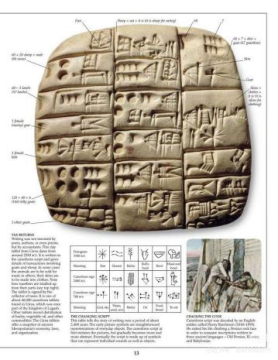
First, through visual analysis of cuneiform tablet images held in the British Museum collection, the author identified the core visual characteristics of cuneiform script: the wedge-shaped triangular forms at the start and end of strokes, and the gradations from deep to shallow that occur as the angle of the reed stylus changes during the course of a stroke. These features reflect the physical movements of Sumerian scribes as they pressed the reed stylus into moist clay tablets.
Based on the above analysis, this study extracts two core design variables and defines them as two exclusive axes of the Mesans variable font: (1) Cuneiform Intensity Axis: Controls the sharpness and depth of the serif
forms. At 0%, the serifs are completely smooth, presenting a sans-serif form suitable for high-legibility reading scenarios. At 100%, the serifs take on their most pronounced wedge-shaped form, reproducing the characteristic impressions made by the reed stylus at the start and end of strokes—ideal for culturally expressive contexts. Intermediate values enable smooth transitions between these two states. (2) Terminal Form Axis: Controls the treatment of stroke endings. At 0%, terminals are cut flat, offering the clean simplicity of modern sans-serif typefaces. At 100%, terminals end with a sharp, torn-like texture, simulating the natural tearing effect that occurs when the reed stylus is lifted from the clay tablet.
In addition, Mesans retains conventional weight and width axes to ensure practicality and versatility in basic typographic settings. All variable axes comply with the OpenType variable font specification and support continuous numerical interpolation.
Responsive Logic Framework The responsive logic framework of Mesans consists of three layers, responsible respectively for signal reception, signal mapping, and visual output:
(1) Input Layer: Receives real-time signals from multiple sources, including: User-defined modes: such as “Reading Mode” (prioritizing high legibility) and “Exhibition Mode” (emphasizing cultural expression);
Environmentally sensed parameters: such as ambient light intensity (which can be captured via sensors to dynamically adjust weight for improved readability);
“MESANS”: A Responsive Variable Font System Based on Cuneiform Aesthetics 363 Content semantics: keyword extraction from text using natural language processing (e.g., detecting historically relevant terms like “Sumerian,” “code,” “clay tablet”) to trigger adjustments along the relevant design axes;
Interaction data: such as the user’s scrolling speed or gaze duration.
(2) Mapping Layer: Maps the signals collected by the input layer to target values along the variable axes. The mapping function can be designed as linear or nonlinear to accommodate different user experience requirements. Future research may introduce machine learning models to achieve adaptive mapping based on individual user preferences.
(3) Output Layer: Updates font rendering in real time via CSS properties or JavaScript APIs. To ensure visual smoothness, the system employs a high-frequency update mechanism and incorporates easing functions, preventing abrupt morphological jumps that could interfere with the user’s reading experience.
Technical Implementation The Western character set of Mesans was designed using Glyphs 3 font design software, covering uppercase and lowercase letters, numerals, and basic punctuation marks. After completing the glyph design, the OpenType Variable Font format was generated using Glyphs’ variable font export function. This format is compatible with mainstream operating systems and browsers, supporting dynamic control of each design axis’s value through the CSS font-variation-settings property.
User Interview Design To obtain early design feedback and explore the application potential of the Mesans system, this study plans to conduct an exploratory user interview study.
Participants: Seven senior professionals with practical experience in related fields were invited to participate, including: Five user experience designers with over three years of work experience; Two digital content creators (such as museum digital curators and interactive narrative designers).
Interview Process: A semi-structured interview format was adopted, lasting approximately 50 minutes, divided into four stages:
1. Introduction and Warm-up (5 minutes): Introducing the research background, the basic concept of Mesans, and the interview purpose to participants. 2. Demonstration Viewing (10 minutes): Playing a dynamic demonstration video of Mesans in a digital museum context, showcasing how the font smoothly transitions between “efficient reading” and “cultural expression” modes based on user scrolling speed. 3. Core Interview (30 minutes): Discussing four core topics — First impressions of cultural translation design: Is the introduction of cuneiform elements appropriate and meaningful?
364 Xiaohan Perception of the naturalness of dynamic changes: Is the transition smooth? Does it interfere with reading?
Evaluation of the balance between functionality and expressiveness: Are both modes fit for their purpose?
Ideas for potential application scenarios: Which fields are most suitable for adopting this type of font?
4. Summary and Suggestions (5 minutes): Gathering participant suggestions for system improvement. Data Analysis: The interviews were audio-recorded and transcribed verbatim. Thematic analysis was used to code and analyze the transcriptions.
RESULTS
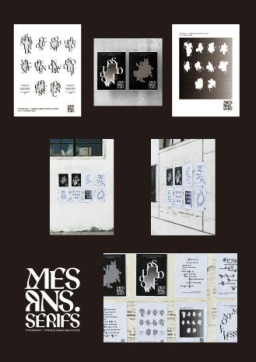
Font Design Outcomes The Mesans font has been completed, comprising 26 uppercase letters and 26 lowercase letters, as shown in Figure 2.
Figure 2: Design of the mesans font.
Expected Findings From User Interviews As the interviews have not yet been conducted, this section provides predictions of potential feedback based on insights from similar studies:
Evaluation of Cultural Translation: It is anticipated that designers will generally recognize that the introduction of cuneiform elements can endow the interface with a distinct cultural identity, setting it apart from conventional sans-serif typefaces.
Perception of Dynamic Changes: Participants are expected to emphasize that dynamic changes need to be sufficiently subtle to avoid distracting users. A high degree of simplicity should be maintained in reading mode, while cultural characteristics can be moderately strengthened in display mode.
“MESANS”: A Responsive Variable Font System Based on Cuneiform Aesthetics 365 Identification of Application Scenarios: Potential application scenarios are expected to include cultural heritage applications, dynamic brand identities, immersive exhibition guidance systems, educational digital content, and the like.
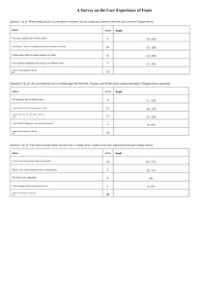
In addition, a user experience questionnaire survey was conducted for this study to provide data reference for subsequent interviews (see Figure 3).
Figure 3: User experience questionnaire survey data.
The above expected findings will be compared with actual data after the interviews are conducted, serving to guide system optimization and provide hypotheses for subsequent quantitative experiments.
DISCUSSION
Effectiveness of Cultural Translation Design The design practice of Mesans demonstrates that traces of ancient writing can be successfully transformed into a dynamic design language within modern digital interfaces. This translation process is not a simple replication of shapes, but requires a deep understanding of the movement trajectories and physical characteristics of the original writing tools—how Sumerian scribes held the reed pen, how they applied pressure to the clay tablet, and how they completed each stroke—translating this “embodied” knowledge into contemporary design parameters. Through this process, cuneiform elements not only gain visual recognition but also are expected to evoke associations in users regarding the history of writing and cultural heritage. This “revitalization” of cultural symbols infuses digital interfaces with emotional depth, potentially enhancing users’ memory retention of content and their sense of cultural identity.
Dynamic Response and User Experience Binding font morphology to real-time data and user behavior adds a dynamic sense of liveliness to the interface. When text subtly changes in response to users’ reading behavior, an implicit dialogue is established between the interface and the user. However, the intensity of dynamic changes must
366 Xiaohan adhere to the principle of moderation: excessive amplitude or frequency can disrupt reading fluency, while changes that are too subtle may be overlooked by users and fail to achieve the intended effect. Future research needs to systematically explore optimal mapping functions and change thresholds to balance aesthetic expression with functional requirements.
Limitations and Future Work This study currently has the following limitations: Insufficient Technical Implementation: While Mesans has completed font design and the construction of its responsive logic framework, full technical implementation and systematic user testing have not yet been conducted.
Character Set Limitations: Currently, only Latin characters are supported, which cannot be directly applied to non-Latin writing systems such as Chinese.
Simplified Response Logic: The current mapping logic employs preset rules and has not yet introduced advanced methods such as machine learning to achieve personalized adaptation.
Future work will focus on the following directions: Completing technical implementation based on the proposed logical framework and conducting formal user interviews and quantitative experiments (such as reading performance tests and emotional scale measurements) to verify the user experience effects of responsive typefaces.
Exploring the possibilities of combining Chinese character forms with cuneiform aesthetics to expand the cultural applicability of the font system.
Developing more intelligent mapping algorithms, such as machine learning models based on user behavioral data, enabling the font to learn from individual usage patterns and achieve more personalized dynamic adjustments.
CONCLUSION
Here’s the translation: Mesans transforms ancient cuneiform writing traces into variable design axes and establishes dynamic mapping relationships with environmental data and user behavior, demonstrating the potential for typefaces to evolve from static symbols into dynamic interfaces within intelligent media environments. The innovation of this study lies in introducing cultural heritage symbols into the field of variable font design, offering new design approaches for culturally adaptive intelligent interfaces.
Mesans is not a simple replication of cuneiform script, but rather a dialogue with a four-thousand-year-old writing tradition through a contemporary design language. It attempts to demonstrate that the cultural heritage left by ancient peoples can be “revitalized” through design, moving from museum display cases into everyday digital interfaces. Through in-depth user research and systematic iteration in the future, Mesans is expected to realize practical value in areas such as digital cultural heritage communication, brand experience design, and intelligent educational tools.
“MESANS”: A Responsive Variable Font System Based on Cuneiform Aesthetics 367
ACKNOWLEDGMENT
Thank you to my senior for the advice and to my classmates who completed the questionnaire, which helped make my research more comprehensive.
REFERENCES
Brown, T. (2016). Variable fonts, a new kind of font for flexible digital design. A List Apart. Dixon, C. (2020). Typography and national identity: A historical perspective. Design
and Culture, 12(2), 167–184. Jansen, Y., et al. (2019). Data-driven design: A systematic review. Proceedings of CHI
2019. McLuhan, M. (1964). Understanding Media: The Extensions of Man. McGraw-Hill. OpenType Specification 1.8. (2016). Microsoft & Adobe https://docs.microsoft.com/ typography/opentype/. Varela, F. J., Thompson, E., & Rosch, E. (1991). The Embodied Mind. MIT Press.
LISTED IN THE AHFE DIGITAL BOOKSTORE CATALOGUE
Explore the complete digital volume
Usability and User Experience
Read this individual research paper free through the original publisher, or explore the full digital proceedings book.
ISBN 979-8-950676-08-6
Explore this ISBN in the AHFE Bookstore ↗Listed in the July 2026 bookstore catalogue; search by ISBN to confirm current availability · Digital book purchase optional