Xue Ding, Ziyun Huang (2026). Design and Implementation of the Meituan Design System Tool Based on Design Token. In: Usability and User Experience. AHFE Open Access, vol. 232, pp. 328–337. https://doi.org/10.54941/ahfe1008061
In medium and large internet enterprises, designers and developers rely on independent design systems and front-end component libraries for digital product production. However, manual synchronization between these two assets leads to low production efficiency and inconsistent user experiences. Design tokens have been proven to be an effective solution to this challenge. However, few studies have explored how to implement design tokens in real production environments, particularly within medium and large enterprises. Taking Meituan as a case, this research examines how design tokens can be applied to enhance production efficiency and experience consistency. Through user interviews, we identified three key pain points. Based on these findings, we developed a design system tool integrating design tokens. The tokens are organized within a three-tier framework (Base–Semantic–Component). Additionally, the traditional collaborative workflow between designers and developers is restructured into a new process: Design Definition → Standardized Sync → Development Reuse → Global Update). The tool’s interaction design is also optimized for non-technical designers, enabling them to configure and manage design systems smoothly. The usability testing results indicate that the tool has good usability, with a System Usability Scale (SUS) score of 78.3. It significantly enhances collaboration efficiency between designers and developers, reduces synchronization time between design systems and front-end component libraries, and eliminates all inconsistencies between these two assets. This study provides a practical reference for the effective implementation of design tokens in medium and large enterprises.
The development of the Internet has significantly reduced the marginal cost of information dissemination, enabling digital products to be rapidly promoted and used (Fabregas, Kremer and Schilbach, 2019)2019. As of June 2025, the number of Internet users in China reached 1.123 billion, with an Internet penetration rate of 79.7% (The 56th Statistical Report on China’s Internet Development, 2025). In light of the continuously shifting user demands and developing technologies, it is imperative for digital products to expedite their iterations in order to effectively respond to market changes and sustain their competitive edge (Bullinger, Warschat and Fischer, 2000). Therefore, digital Received January 19, 2026; Revised April 3, 2026; Accepted April 19, 2026; Available online July 20, 2026
Design and Implementation of the Meituan Design System Tool Based on Design Token 329 products require high experience consistency and production efficiency. Design consistency can effectively reduce users’ cognitive load, making it easier for them to learn and operate products, while also helping shape product brands and deepen users’ brand recognition (Li, Li and Yang, 2019). Additionally, consistency implies standardization, which is beneficial for improving production efficiency in large-scale product manufacturing. As to production efficiency, the large user base results in a variety of scenarios and requirements, which makes producing digital products more complex. Consequently, individuals can no longer complete the production process independently and must rely on teamwork. Design systems have emerged to meet the need for efficient collaborative production within Internet companies’ product lines. These systems are collections of reusable components that are integrated through clear, standardised processes and guidelines/tools. They are aimed at helping UX/UI design teams to collaborate more efficiently and to enhance the consistency of user experience (Lamine and Cheng, 2022). Front-end component libraries are the physical realization of design systems. Through these, developers can reproduce design mockups authentically, improve collaborative development efficiency, avoid errors in development, and achieve the expected user experience of design mockups (Feng, Li and Zhang, 2023; Palomino et al., 2025).
Meituan is a leading tech-driven retail company in China. In a conventional designer-developer collaboration workflow, the design system and the front- end component libraries are two completely independent asset libraries. The front-end component libraries must be updated precisely in a 1:1 manner whenever the design system changes. This ensures the front-end R&D team can develop products fully aligned with design mockups, thereby guaranteeing consistency in the user experience. However, as synchronous updates between the design system and the front-end component libraries cannot be achieved, whenever the design system changes, the front-end component library requires many manual operations to ensure synchronisation with the design system, resulting in low production efficiency of digital products. Due to the untimely updating of the front-end component libraries, there are many differences between products developed using these libraries and the design mockups. This leads to poor consistency in the experience of digital products.
Against this backdrop, design tokens have proven to be an effective solution to these challenges. By storing visual design characteristics (e.g. typography, spacing and border radii) rather than hard-coded values (e.g. hex colour codes and pixel values), design tokens provide a common language for designers and developers (Jeong and Pan, 2024). This fosters seamless synchronisation between design systems and front-end component libraries, reducing manual synchronisation effort, eliminating communication ambiguity across teams and ensuring cross-platform consistency. Furthermore, design tokens support the scalability of design systems and facilitate the creation of multiple theme variants, such as brand-specific skins, light/dark modes and compliance- driven themes. These features enable design tokens to adapt to the trend of complex product production and multi-team collaboration, thereby aligning with the development direction of digital products.
330 Ding and Huang This study applies design tokens to a design system tool. Semi-structured interviews are conducted to understand how users configure and manage design systems in practice. Based on these insights, a collaborative workflow is defined for designers and developers using the new tool: Design Definition → Standardised Sync → Development Reuse → Global Update. The tool’s interaction design has also been refined to make it more user-friendly for designers and non-technical users. Six participants took part in the usability test and the results confirmed that the tool meets user needs in terms of both functionality and usability. The research aims to improve collaboration between designers and developers in medium and large enterprises such as Meituan, thereby increasing the efficiency of production and consistency of user experience of digital products.
RELATED WORK
Designer-Developer Collaboration: Pain Points and Research Gaps To ensure consistency between the front-end component library and the design system, designers must manually annotate changes to visual details in the design system and notify developers to make corresponding adjustments to the library. This process requires significant coordination between the two roles: developers must manually locate and modify code in a vast codebase, while designers must repeatedly verify that the component library changes meet design expectations. This is time-consuming and labour-intensive, significantly slowing the iteration of the front-end component library. Moreover, manual operation is prone to errors, ultimately leading to a divergence in visual details between the two assets.
Current solutions to this problem fall into three categories: Designers can provide manually annotated system documents to developers. Design platforms like Figma can automatically parse design systems into code parameters for direct developer use. Alternatively, automatic synchronisation can be implemented between the design system and component library using the design token. Manual documentation places the annotation burden on designers and requires developers to manually edit code, resulting in low overall efficiency. Automated parsing from design systems reduces designers’ workload but does not alleviate the burden on developers. In contrast, the design token serves as a universal bridge between design and development. By defining the design system through tokens, designers enable developers to directly reference the relevant code. This eliminates the need for communication and translation steps, thereby freeing up productivity for both parties.
The concept of the design token was first introduced in 2014 by the Lightning Design System team at Salesforce. The principle is to store and transmit the smallest unit of visual design decisions, such as colour, typography and dimensions, within a design system. Using the name-value pair format means that specific visual parameters, such as #508BFF, are abstracted away from hard-coded values and transformed into entities that can be recognised by design tools and code. This enables design decisions to be transferred
Design and Implementation of the Meituan Design System Tool Based on Design Token 331 seamlessly between different media (web, iOS, Android, etc.) and creative tools (Figma, Sketch, etc.), ensuring design consistency and traceability.
However, current research on design tokens has a critical gap: it has paid little attention to their implementation in medium and large enterprises. Such organisations have numerous product lines and complex design-development workflows. Using design tokens in these contexts requires restructuring collaborative processes. Furthermore, frequent personnel turnover in enterprises requires establishing a robust permission control function to ensure stable production workflows, which remains a critical challenge.
Optimizing Design System Tools for Non-Technical Designers Another research gap lies in the usability of design token-based tools for non- technical designers. Non-technical UX/UI designers are core users of low- code tools. To improve usability, such tools often offer intuitive interaction features such as selection controls and drag-and-drop operations (Li and Wu, 2022). This aligns with designers’ preference for direct visual feedback. However, when designers lack an understanding of how design tokens work, improper configuration often occurs. Furthermore, these tools typically offer inadequate assistance. Non-technical users find it difficult to independently solve configuration problems. This lack of flexibility and troubleshooting support hinders the wider adoption of design token-based tools in the real environment—yet few existing studies have investigated these token usability challenges for non-technical designers.”
METHODOLOGY
User Interview We conducted a semi-structured interview with users to explore their needs and pain points regarding a new design system tool. Eight participants from Meituan’s design team were recruited to ensure a balanced gender ratio, with ages ranging from 21 to 30. All participants had experience of using design systems. Before the interview began, each participant signed an informed consent form agreeing that their behavioural data would be anonymised and used for academic research purposes. The interview focuses on three topics: ‘Pain points in collaboration between Meituan designers and developers’, ‘Understanding of design tokens’, and ‘Interaction needs for non-technical designers’. The one-to-one interviews took place in meeting rooms at Meituan and lasted around 20 minutes each. With consent from the participants, all interviews were documented to ensure data integrity and reliability. The interview questions are shown in the appendix. Through qualitative analysis of the interview content, three core problems were identified: Firstly, multiple component variants in the design system are easily missed during updates, resulting in minor adjustments often doubling the development workload and incurring high cross-team communication costs. Secondly, the design system lacks version change tracking, change validation and permission control functions. Thirdly, non-technical users struggle to understand technical concepts and find the product interaction logic insufficiently intuitive. Users
332 Ding and Huang also have only a basic grasp of design tokens, which reduces the operational efficiency and design delivery accuracy of the tool. Based on these insights, the following core user requirements have been identified: improving the configuration efficiency of the design system, enhancing its management and collaboration capabilities, and simplifying product operation for non- technical users.
Product Design Based on the three core requirements identified through user research, we designed the product as follows.
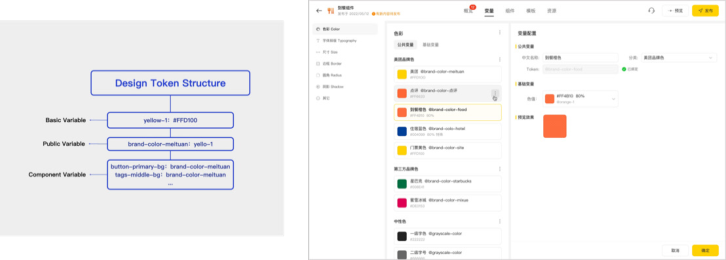
Firstly, to improve the configuration efficiency of the design system and reduce cross-team communication costs, we have integrated design tokens into the tool. Design tokens can be directly manipulated and reused (Shi et al., 2025). They abstract visual information into concrete parameters and establish a common language between design and development. This enables automated synchronisation from design systems to the front-end component library. To ensure that design tokens serve as the ‘single source of truth’ for implementing design systems and break down collaboration barriers between design and development teams, we have categorised and structured fragmented tokens systematically, based on the industry-recognised semantic layering methodology. This approach adheres to atomic design principles and the W3C DTCG system, organising tokens into three hierarchical levels according to the logic of ‘raw properties without context → semantic properties with explicit application intent’: Foundational Layer (e.g. yellow-1: #FFD100), Semantic Layer (e.g. brand-color-meituan: yellow-1) and Component Layer (e.g. button-primary-bg: brand-color-meituan). In the tool, each layer is clearly distinguished by the following names: “Base Variable” for the foundation layer, “Public Variable” for the semantic layer, and “Component Variable” for the component layer (see Fig. 1). The design tool enables designers to configure tokens independently across three tiers: base tokens, semantic tokens and component tokens.
Figure 1: Design token structure and design token tool.
Design and Implementation of the Meituan Design System Tool Based on Design Token 333 With the implementation of the new design system tool, a new workflow between designers and developers should be established. This new process consists of four phases: Design Definition, Standardised Sync, Development Reuse and Global Update. Specifically, designers use the new tool to configure and publish a design system based on design tokens. The corresponding design token configuration file is then automatically generated and synchronised with the developers’ system. Developers then use supporting tools to convert these tokens into style variables that can be applied directly within the component library, enabling the reuse of design logic in code. As the entire front-end component library is built on these standardised variables, updating the design system only requires the latest token file to be synchronised, triggering global, automatic adaptation across all related components and eliminating the need for manual code adjustments.
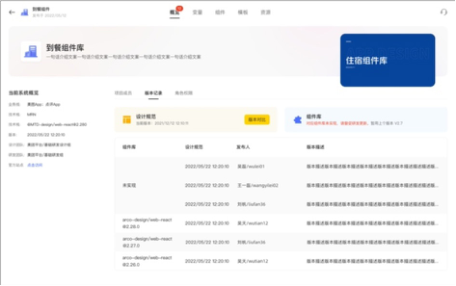
Secondly, to enhance the management and collaboration capabilities of the design system, we have developed features for recording version history, validating tokens and controlling permissions. The ‘Version Comparison’ feature (see Fig. 2) presents version differences visually, helping designers to efficiently identify and accurately understand the details of system changes.
Figure 2: Version history recording.
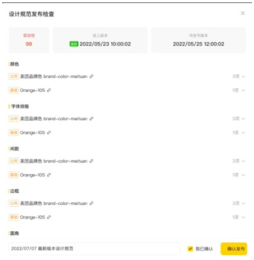
When designers submit updated token configurations, the design system tool automatically validates these changes and displays them in a modal dialog for review before publishing (See Fig.3).
Figure 3: Design token validation dialog.
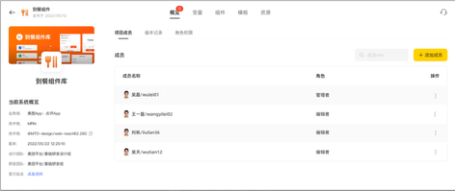
334 Ding and Huang The permission control function includes three user roles. Viewers (e.g. developers) are granted read-only access to design system assets to prevent unintended modifications to the source data. Editors (e.g. designers) can edit and publish token configurations to support the iterative updating of the design system. Administrators have full permissions to edit, publish and manage user roles, including adding or removing editors. This mechanism enables the seamless online transfer of design system permissions, ensuring both asset security and the continuous, stable operation of collaborative workflows (See Fig. 4).
Figure 4: Permission control.
Finally, to simplify product operation for non-technical users, the product interaction design is optimised, explanatory annotations are provided for technical terms and step-by-step guidance is offered for key functions. This helps users quickly grasp the workflow of the tool. Additionally, we offer a what-you-see-is-what-you-get interface with real-time configuration previews so users can see the result of each operation immediately, without the need for complex adjustments.
Usability Testing The primary objectives of this usability testing were twofold: to evaluate the practical application and effectiveness of the design solutions and to identify potential usability issues for future improvements.
Due to the limited testing resources available from the enterprise, designers with relevant professional experience were selected for usability testing to simulate a realistic corporate work environment. Six participants aged 21–26 were recruited; they were all graduates of the design programme at Hunan University. Most of them are employed as UX/UI designers at large companies such as Baidu, Meituan and Kuaishou, and have over two years’ experience using mainstream design tools such as Figma. However, none of them have received front-end development training, and their understanding of design tokens was either preliminary or non-existent. Before the study began, all participants provided informed consent for the anonymous use of their data.
The testing procedure consisted of practical tasks, the System Usability Scale (SUS) questionnaire and subsequent semi-structured interviews. The tasks were designed around critical application scenarios of the tool.
1. Verifying the design token collaboration workflow by simulating a primary button style update, which required participants to configure and publish the corresponding tokens. 2. Validating the management and collaboration functions of the tool.
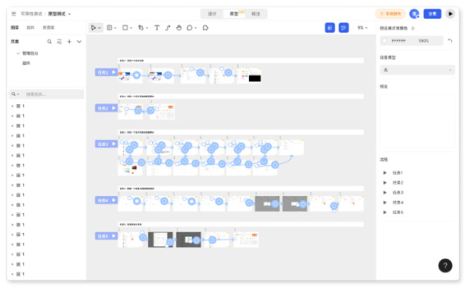
Participants completed the System Usability Scale (SUS) after the first two tasks. The SUS (introduced by Brooke in 1986 and widely validated for usability evaluation) employed a standard 5-point Likert scale (Brooke, 1996). Tests were conducted one-on-one. Participants accessed a high-fidelity, interactive prototype with fully preset logic via an online link (see Fig. 5).
The semi-structured interview focused on:
1. The perceived difficulty of understanding the three-tier Token framework. 2. Confidence in completing configuration and debugging tasks without coding skills. 3. The perception of the availability of effective help when problems arise. 4. Perceived efficiency gains compared to the traditional workflow involving manual annotation and cross-team communication. 5. Suggestions for tool improvement.
For data analysis, this study adopted a mixed-methods approach. Two key quantitative metrics were calculated: task completion rate and System Usability Scale (SUS) scores. Qualitatively, thematic analysis was conducted on the interview transcripts to derive deeper insights.
Figure 5: Design system tool UI prototype.
All participants successfully completed all of the tool’s operational tasks, resulting in a task completion rate of 100%. The average task time is within a reasonable range, indicating that the new workflow is efficient. After calculation, the SUS score was found to be 78.3. According to the established benchmark proposed by Bangor (Bangor, Kortum and Miller, 2009), this exceeds the ‘acceptable’ threshold and is close to the ‘good’ rating. In conclusion, the tool is usable at a good level.
Qualitative feedback provided deeper insights. Most participants said that the three-tier token framework was understandable, though a guided
336 Ding and Huang tutorial was suggested to reinforce the conceptual model. Participants consistently perceived the tool as more efficient than traditional manual workflows. One designer noted that it eliminated ‘tedious documentation markup and repetitive back-and-forth with developers’. Features such as the real-time preview were highlighted as significantly enhancing their sense of control during configuration. Finally, some participants anticipated potential flexibility constraints when styling highly complex components and identified this as a key area for future development.
CONCLUSION AND FUTURE WORK This study addresses two research gaps: the lack of research on design token implementation in medium and large enterprises, and the inadequate usability of design token tools for non-technical designers.
Key contributions of this study are as follows. Theoretically, it enriches the application of design tokens in complex organizations and builds a new workflow. It also supplements research on accessible low-code tool by lowering technical barriers for non-technical designers. Practically, the new tool achieves a System Usability Scale (SUS) score of 78.3, reduces synchronization time between design systems and front-end component libraries, and eliminates manual errors.
Despite these contributions, this study has some limitations: the tool used in the experiment is a prototype, whose technical stability has not been verified over an extended period; additionally, the usability test sample is limited to only 6 designers, lacking a perspective from developers; Finally, the experiment’s insufficient samples and scenarios also result in inadequate universality of the conclusions. Future work will expand test samples across roles and enterprises, extend the token framework to encompass more design aspects, and conduct long-term industrial application tracking to refine the tool.
REFERENCES
Bangor, A., Kortum, P. and Miller, J. (2009) “Determining What Individual SUS Scores Mean: Adding an Adjective Rating Scale,” Journal of Usability Studies, 4(3), pp. 114–123. Brooke, J. (1996) “SUS - A quick and dirty usability scale,” Usability evaluation in
industry, 189(194), pp. 4–7. Bullinger, H.-J., Warschat, J. and Fischer, D. (2000) “Rapid product development — an overview,” Computers in Industry, 42(2–3), pp. 99–108. Fabregas, R., Kremer, M. and Schilbach, F. (2019) “Realizing the potential of
digital development: The case of agricultural advice,” Science, 366(6471), p. eaay3038. Feng, K.J.K., Li, T.W. and Zhang, A.X. (2023) “Understanding Collaborative Practices and Tools of Professional UX Practitioners in Software Organizations,” in Proceedings of the 2023 CHI Conference on Human Factors in Computing Systems, pp. 1–20. Jeong, J. and Pan, Y. (2024) “Design System Construction Framework Using Figma,”
Journal of Digital Contents Society, 25(3), pp. 615–624.
Design and Implementation of the Meituan Design System Tool Based on Design Token 337 Lamine, Y. and Cheng, J. (2022) “Understanding and Supporting the Design Systems
Practice,” Empirical Software Engineering, 27(6), p. 146. Li, L. and Wu, Z. (2022) “How Can No/Low Code Platforms Help End-Users Develop ML Applications? - A Systematic Review,” in HCI International 2022 – Late Breaking Papers: Interacting with Extended Reality and Artificial Intelligence, pp. 338–356. Li, W., Li, C. and Yang, Y. (2019) “How Consistent Is Your GUI Design?,” in
Companion Publication of the 2019 Conference on Computer Supported Cooperative Work and Social Computing, pp. 278–282. Palomino, P., Fonseca, M., Souza, J., Toda, A., Pereira, R.L., Cordeiro, T., Pedro Da Silva, A. and Demerval, D. (2025) “Enhancing Developers Experience (DevEx) for Successful Design System Implementation,” International Journal of Human– Computer Interaction, 41(1), pp. 807–819. Shi, X., Wang, Y., Rossi, R. and Zhao, J. (2025) “Brickify: Enabling Expressive
Design Intent Specification through Direct Manipulation on Design Tokens,” in Proceedings of the 2025 CHI Conference on Human Factors in Computing Systems, pp. 1–20. The 56th Statistical Report on China’s Internet Development (2025). China Internet Network Information Center (CNNIC), pp. 1–3.
APPENDIX
User interview questions I. Pain points in collaboration between Meituan designers and developers
1. How much time do you spend reviewing the visual style of developed products to ensure that they match the design drafts? 2. What are some common problems that arise during the design– development collaboration process, and how do you typically prevent or address them? 3. If a design system tool were available, what core functions would it need to effectively improve the efficiency of collaboration between design and development teams?
II. Understanding of design tokens
1. How familiar are you with the concept of design tokens? What potential challenges or limitations do you foresee in applying them at Meituan? 2. Are you familiar with the three-tier structure of design tokens: global, semantic, and component-level?
III. Interaction needs for non-technical designers
1. Which low-code or no-code tools do you regularly use for UX/UI design? 2. What problems have you encountered while using these tools, and how might they affect your efficiency or the accuracy of your designs? 3. As a designer without a technical background, what intuitive interactions or features would make these tools easier to learn and use?
LISTED IN THE AHFE DIGITAL BOOKSTORE CATALOGUE
Explore the complete digital volume
Usability and User Experience
Read this individual research paper free through the original publisher, or explore the full digital proceedings book.
ISBN 979-8-950676-08-6
Explore this ISBN in the AHFE Bookstore ↗Listed in the July 2026 bookstore catalogue; search by ISBN to confirm current availability · Digital book purchase optional