Simon Saurbier, Markus Pisarzowski, Andre Becker, Lukas Kleinhans, Lukas Bunk, Dieter Krause, Sven Matthiesen (2026). Measurement and Evaluation of the Interaction Forces of Specific Hammer Drilling Strategies to Determine Requirements for Dynamic Hand-Arm Models. In: Human Factors and Systems Interaction. AHFE Open Access, vol. 230, pp. 71–81. https://doi.org/10.54941/ahfe1007978
In the development of hand-held technical systems, it is crucial to consider the relevant subsystems (user, technical system, environment). As there are confounders for each of the three subsystems, acquiring the necessary knowledge about their interaction for product development is difficult. Test benches can replace individual subsystems with functionally equivalent structures and are subject to the actual loads from the applications like power tools. To reduce human influence, mechanical hand-arm models are used. These models exhibit vibration characteristics that can be proven to be equivalent to those of the human hand-arm system via mechanical impedance (MI) measurement, provided they are exposed to identical vibration excitations. Current research considers the influence of grip force to be more significant than factors such as anthropometry or push force. However, the influence of push and grip forces, which vary over time, on mechanical impedance is not considered. The objective of this work was to investigate this influence. To investigate this influence, a study is conducted with ten test subjects who used a hammer drill. The grip and push forces were measured. The test subjects performed three drilling strategies from the skilled crafts sector: one hole, a vent hole and five holes in row. The data show a grip force for single drilling that increases constantly during drilling. The same effect was also found for vent drilling. An opposite trend for the grip force was measured for five holes drilled in a row. Here, the grip force decreases on average over the five holes. These results form the starting point for developing the 'IPEK Hand-Arm Model of the Saurbier Generation' (IPEK-HAMS), as they reveal the fundamental requirements for a dynamic hand-arm model. In particular, these include the recording of time-varying force curves, which is a prerequisite for deriving the vibration behavior of the human hand-arm system. Building on the state-of-the-art HAM, this model enables the reproducible evaluation of power tools during application-oriented operation by taking grip and push forces that change over time into account.
The field of human-machine interaction research is constantly expanding. This also includes the interaction between humans and power-tools. What makes this special is the direct flow of force and information between humans and power-tools. In the research environment, the focus is on the load on the hand-arm system (HAS). Such loads, for example due to vibrations, can lead to health issues. Possible consequences include hand-arm vibration syndrome (HAVS) or white finger disease. In order to evaluate the vibration transmission to the HAS, the biodynamic response of the HAS is required (Griffin, 1990). A common parameter for determining this response is mechanical impedance (MI). According to ISO 10068:2012, MI is the complex ratio of the exciting harmonic force to the system velocity at the hand (ISO 10068:2012-12). MI is also a relevant parameter in product development (Lindenmann et al., 2021). It is used in the development of physical hand-arm models (HAM). In these models, MI controls the dynamic interaction behavior of the system. The HAM is intended to represent the direct effect equivalent of the HAS. According to Matthiesen et al., (Matthiesen et al., 2016; Matthiesen et al., 2018b; Matthiesen et al., 2018a) HAM should enable the reproducible testing of power-tools and other devices . There are already several HAMs in current research (Cronjäger et al., 1984; Matthiesen et al., 2016). It is known that there are various factors that influence human MI, which must be considered in the development of HAM. Known variables include the coupling forces (push and grip) on handles, arm posture, and the level of knowledge of the test subjects (Adewusi et al., 2010; Dolan et al., 1993; Lin et al., 2007). There are studies that prove the influence of these variables. Some of these studies were conducted on hammer drilling with a hammer drill. In a study with five test subjects, Jahn showed that housing vibration decreases when the push force is increased (Jahn, 1985). In contrast, in a study with three test subjects, Uhl et al., found that a higher push force leads to higher vibrations in the main handle (Uhl et al., 2019). However, due to the small number of participants and the non-comparable push forces, the results are not transferable. In comparison to studies with test subjects, Botti et al. conducted a study with a HAM and an automated test bench for push force (Botti et al., 2020). The HAM was verified by Rempel et al. to replicate the measurement data of four construction workers with 90.2 N (Rempel et al., 2017). In order to understand the influence of the grip force, which is defined as more significant in the current state of research (Lindenmann et al., 2021), the grip force is defined by (Welcome et al., 2004) as a counterforce pair that acts on the tool handle and cancels itself out in the plane of separation. The grip force influences the MI and the power consumption of the HAM (Aldien et al., 2006; Aatola, 1989; Forte, 2017; Oddo et al., 2004). Studies dealt with the measurement of grip forces during use. However, these studies were conducted with a sensor grip, which consists of two half-shells and alter the haptics during use and therefore do not reflect reality (Dempsey et al., 2000; McGorry, 2001). For this reason, capacitive grip force foils were used in other studies (Welcome et al., 2004; Lindenmann et al., 2021; Kaulbars und Lemerle, 2007; Kaulbars, 2006). These measurements and ISO 10068:2012 specify static grip forces of 25
Measurement and Evaluation of the Interaction Forces 73 N to 210 N. ISO 10068:2012 specifies the MI for static grip forces ranging from 25 N to 50 N. In his study involving two test subjects, (Kaulbars, 2006) arrived at grip forces of 210 N. The current state of research generally indicates that the grip force has a significant influence on MI and that it can be measured using capacitive sensors foils. Grip force is therefore one of the requirements for the development of HAM. The problem is that, in the current state of research, only static grip force curves that do not change over time have been considered and determined. This knowledge is therefore not transferable to the development of dynamic HAMs intended to simulate real-world applications such as hammer drilling, which require consideration of application strategies including singlehole drilling, venthole extraction to prevent boreflour compression, and continuous drilling represented here by five consecutive holes. Thus, this work deals with the determination of requirements for the development of dynamic HAM. This leads to the following research question: How do the grip and push forces applied by the user change over time when using different hammer drill strategies?
METHOD AND MATERIALS This research question was addressed through the conduct of a user study.
Test Subjects Ten test subjects aged between 23 and 29 participated in the study. All test subjects were right-handed and had no previous medical conditions affecting the hand-arm system. All test subjects participated in the study voluntarily and were able to interrupt or discontinue it at any time. All ten test subjects completed the study and performed all measurements.
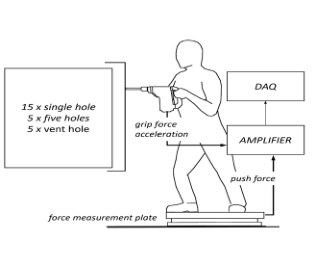
Experimental Setup The data for this study was collected in the Power-Tool Test Field (DFG 275571425). This test field has an underground positioning system for concrete that can be adjusted for height and angle. This made it possible for all test subjects to drill with a 90-degree angle in their elbows. The study was conducted in accordance to the methods described by (Lindenmann et al., 2021) using a hammer drill. (GBH 3-28 DRE, Robert Bosch GmbH, Gerlingen, Germany). Hammer drilling was performed with an 8 mm SDS- Plus drill bit (Hilti AG, Kaufering, Germany) with a target depth of 90 mm, which was visually marked with tape on the drill bit. During drilling, the forces and moments were measured using the force measurement plate shown in Figure 1 (BP600900-1000, Advanced Mechanical Technology Inc., Watertown, MA 02478, USA). Two PCB 356A02 acceleration sensors (PCB Piezotronics, Depew, NY, USA) were attached to the hammer drill as close as possible to the hand in accordance with DIN EN ISO 5349-2:2015-12. The forces were measured on both handles using a capacitive sensor foil. Due to the different geometries of the handles, Tekscan’s 9833 (Tekscan, Inc., Nordwood, United States) sensor foil was used on the main handle. Tekscan’s 3000 foil was used on the side handle. All systems were synchronized,
triggered, and recorded by an ADWIN Pro II real-time measurement system. The measurement data from the Tekscan foil was stored in the Tekscan software as ASCII and fsx files.
Figure 1: Schematic test setup including measured values (grip force, push force, and acceleration). DAQ = data acquisiton system.
Experimental Procedure At the start of the study, the test subjects were informed about how their data would be processed, after which they had to sign a consent form. Demographic and anthropometric data of the subject were recorded (see Table 1). The test procedure was standardized and predefined to eliminate any influence by the study design. Afterwards, the subjects were allowed to familiarize themselves with the setup. Maximum grip force measurements were performed before each drilling block. The study itself involved drilling 15 single holes, five vent holes, and five sets of five holes.
Table 1: Anthropometric data of the test subjects (N = 10).
Table available in the original PDF paper.
Age Hand Length in mm
Height in mm Arm Length in mm
24.5 ±1.7 189.4mm ±7.7mm
Mean of the 10 test subjects
1816.5mm ±73.8mm
691.6mm ± 58.9mm
Data Analysis The grip and push forces recorded using the Tekscan foil were evaluated using Lindenmann et al. (2021) established method. Data normalisation and aggregation were applied uniformly to all measurements in MATLAB (The MathWorks, Inc., Massachusetts, USA). The signals were segmented according to the drilling cycle, based on the push force. These signals were
Measurement and Evaluation of the Interaction Forces 75 smoothed using moving average filtering of the force signal and its gradient to reduce high-frequency fluctuations. The extremes of the first derivative were then used to identify the phases of maximum force increase and decrease, thereby defining the boundaries of the force intervals that characterise the temporal structure of the drilling process. This procedure was applied to each drilled hole. As the drilling types differed in the number and duration of intervals, temporal normalisation was performed to enable superposition of all trials. To this end, the mean interval length for each drilling type was determined, after which the individual signals were time-scaled accordingly. Finally, the mean and interquartile range were computed for each drilling type to enable statistical comparison.
RESULTS
Research question: “How do the grip and push forces applied by the user change over time when using different hammer drill strategies?”
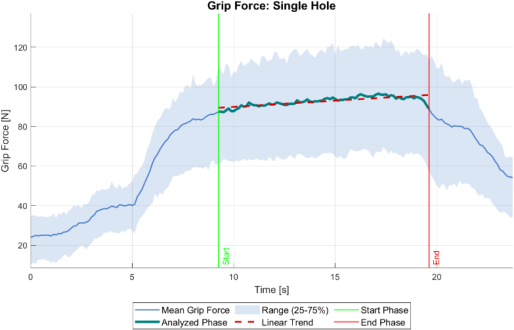
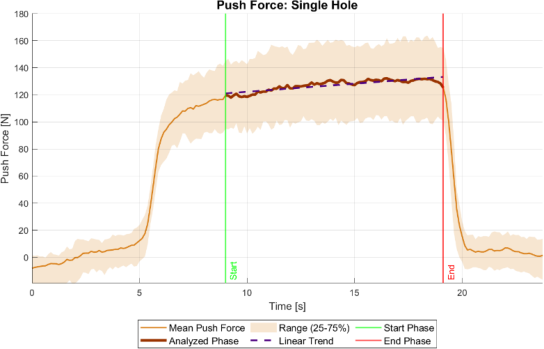
Single Hole For a single hole, the average grip force (Figure 2) in the drilling range is 92.71 N (with a maximum of 96.63 N), increasing by 6.5 N over the drilling duration at a 90% start–end threshold. There is a variability of 1.48 N. The corresponding push force (Figure 3) averages 127.24 N (with a maximum of 132.17 N), increasing by 12.14 N under the same threshold conditions. There is a variability of 2.12 N, representing the standard deviation from the trend line.
Figure 2: The grip force curve at the main grip for all single holes of the test subjects (n = 10) is shown in black as the mean over time in seconds in Newton (N).Figure 3: The push force curve at the main handle for all single holes of the test subjects (n = 10) is shown as a mean in black over time in seconds in Newton (N).
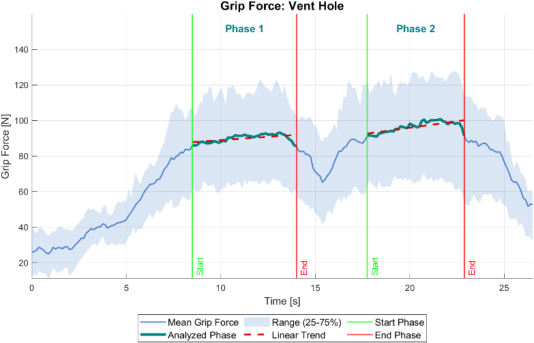
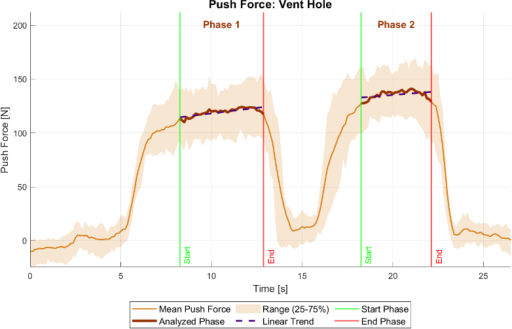
Vent Hole For the vent hole, the grip force averages 89.89 N (maximum 93.28 N) in Phase 1 and increases by 4.12 N over the drilling duration at a 90% start–end threshold, with a variability of 1.92 N. In Phase 2, the grip force increases to an average of 96.41 N (maximum 100.76 N), with an increase of 7.44 N and a variability of 2.21 N. Correspondingly, the push force averages 119.38 N (maximum 124.07 N) in Phase 1, increasing by 9.52 N with a variability of 2.25 N. Phase 2 shows higher values, with an average of 135.61 N (maximum 141.17 N) and an increase of 5.28 N and a variability of 3.66 N.
Figure 4: The grip force curve at the main grip for all vent holes of the test subjects (n = 10) is shown in black as the mean over time in seconds in Newton (N).Figure 5: The push force curve at the main handle for all vent holes of the test subjects (n = 10) is shown as a mean in black over time in seconds in Newton (N).
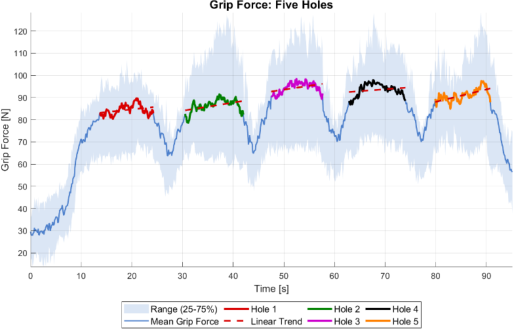
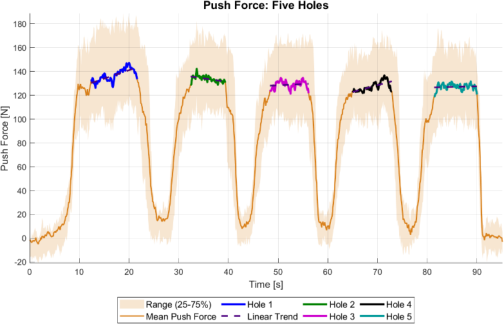
Five Holes The grip force shows an overall linear trend across the five drill holes, increasing by an average of 2.04 N per hole. There is an upward progression up to hole 3, where the mean value is 94.5 N. This is followed by a decrease to 91.1 N for holes 4 and 5. By contrast, the push force shows a negative linear trend, decreasing by an average of 9.8 N across all holes, with variability of 2.59 N. A detailed evaluation of each hole is provided in Table 2.
Table 2: The mean grip and push force, maximum grip and push force, and trend grip and push force over a hole, as well as the variability of the grip and push force over a hole, are displayed in Newtons—for each of the five holes individually.
Table available in the original PDF paper.
Grip Force Hole 1 Hole 2 Hole 3 Hole 4 Hole 5 Mean in N 84.5 N 86.4 N 94.5 N 93.5 N 91.1 N Maximum in N 89.7 N 91.5 N 98.5 N 98.0 N 97.5 N
Trend in N 2.6 N 4.2 N 3.5N 1.9 N 6.1 N Variability in N 2.2 N 2.5 N 2.3 N 2.8 N 2.1 N Push Force Hole 1 Hole 2 Hole 3 Hole 4 Hole 5
Mean in N 136.8 N 133.6 N 128.8 N 127.3 N 127.1 N Maximum in N 147.2 N 142.3 N 134.6 N 136.7 N 131.7 N Trend in N 13.1 N -4.3 N 1.6 N 9.0 N 0.9 N
Variability in N 3.5 N 2.2 N 3.4 N 3.0 N 2.9 N
Figure 6: The grip force curve at the main grip for all five holes of the test subjects s(n = 10) is shown in black as the mean over time in seconds in Newton (N).Figure 7: The push force curve at the main handle for all five holes of the test subjects (n = 10) is shown as a mean in black over time in seconds in Newton (N).
DISCUSSION
In contrast to research results that have focused primarily on static or grip forces under laboratory conditions, the results of this study show that time- resolved, dynamic grip forces vary significantly over time in actual use. The measured force curves are user- and task-specific and therefore cannot be easily generalized. Nevertheless, the results reveal clear trends. These show that the temporal structure of the grip force has a relevant influence on human- machine interaction. To realistically reproduce these dynamic force curves in test benches, the MI of humans under dynamic force must be measured. This data can be used to optimize existing HAMs. Current research (Saurbier et al., 2025) has shown that users can reliably follow specified dynamic force curves, enabling the experimental acquisition of corresponding MI data. The
Measurement and Evaluation of the Interaction Forces 79 result from this study also makes it evident that, in the future, it will not be sufficient to develop dynamic HAMs alone. Rather, the control and adaptation behaviour of humans must also be explicitly considered. Consequently, the underground, HAM, and human control must be considered as a coupled overall system. This work shows how application-oriented measurements can contribute to an integrative view of humans, machines, and control.
LIMITATIONS Due to the known methodological sensitivities associated with hand-arm measurements, the results of this study should be interpreted with caution. Current research shows that the grip diameter can influence the absolute forces measured (Lindenmann et al., 2021). Furthermore, the grip positions are crucial. The position and rotation of the wrist can also influence the measured data. It should also be noted that a test subject may grip with their finger exactly at the transition of the foil. This can lead to inaccuracies in the measurement. This error may be exacerbated by the necessary cutting of the film to fit the handles. Compared to the current state of research, the foil used in this study is a validated and recognized measurement technique. In addition, the foil is thinner than the foils used previously (Lindenmann et al., 2021). This means that the haptic properties and diameter of the handles are less affected in this study. Further uncertainties arise from the different anthropometry of the test subjects and the possibility of individually adjusting the side grip. There are also uncertainties to be observed in the measurements and their evaluation. In the applications, the drilling depth was specified as a control variable. This means that the test subjects may have drilled for different lengths of time. This has led to difficulties in standardization. Due to these uncertainties, the transferability of the data must be verified. Nevertheless, the observed trends provide meaningful insight for the development of physical HAM and extend the current state of research.
CONCLUSION
This study measures the interaction forces of grip and push over time during realistic applications. The aim is to use these interaction force curves to derive requirements for the development of physical hand-arm models that change over time. The objective is to determine the subjects MI using dynamic, time-varying, realistic grip-force curves, which will be employed as reference values for developing HAM. To this end, this work was to conduct a user study with ten subjects to simulate realistic interaction forces with users: three realistic use cases: single drilling, vent drilling, and five holes in a row. The grip and push forces measured in this study are slightly below the forces known in the current state of research. In comparison, the average grip force for a drill hole in this study is 95 N. For comparison: In Lindenmann et al. (2021), the grip forces range between 84 N and 156 N. Since this study is exploratory in nature, the measurement data cannot be used as a new standard. However, they do provide an impression of the trends in the
interactions between humans and power-tools over time. The different trends in individual applications are particularly noteworthy. On average, the grip force increases continuously during the course of a single drilling operation. The same effect also occurs with vent drilling. This trend is not observed in the fifth drilling operation. Here, the grip force decreases over the course of the five drilling operations.
Declaration of Generative AI Use in the Writing Process The authors used Deepl SE, Copilot and ChatGPT5.2 to improve writing and language skills and subsequently reviewed and edited all content, assuming full responsibility for the publication.
ACKNOWLEDGMENT
This research is funded by the German Research Foundation (DFG) under proposals 530564503 (‘Dynamically adaptive impedance elements for influencing vibrations in validation environments’). The test equipment has been supported accordingly DFG (275571425). The authors bear sole responsibility for the research results, which do not represent the official opinion of the DFG.
REFERENCES
Aatola, S. (1989): Transmission of vibration to the wrist and comparison of frequency response function estimators. In: Journal of Sound and Vibration 131 (3), S. 497–507. DOI: 10.1016/0022-460X(89)91009-2. Adewusi, S. A.; Rakheja, S.; Marcotte, P.; Boutin, J. (2010): Vibration transmissibility
characteristics of the human hand–arm system under different postures, hand forces and excitation levels. In: Journal of Sound and Vibration 329 (14), S. 2953–2971. DOI: 10.1016/j.jsv.2010.02.001. Aldien, Y.; Marcotte, P.; Rakheja, S.; Boileau, P.-É. (2006): Influence of hand forces and handle size on power absorption of the human hand–arm exposed to zh-axis vibration. In: Journal of Sound and Vibration 290 (3-5), S. 1015–1039. DOI: 10.1016/j.jsv.2005.05.005. Botti, L.; Martin, B.; Barr, A.; Kapellusch, J.; Mora, C.; Rempel, D. (2020): R2:
Drilling into concrete: Effect of feed force on handle vibration and productivity. In: International Journal of Industrial Ergonomics 80, S. 103049. DOI: 10.1016/j. ergon.2020.103049. Cronjäger, L.; Jahn, R.; Riederer, H. (1984): Entwicklung eines Versuchsstandes zur reproduzierbaren Messung der Vibration schlagender handgeführter Maschinen. Wiesbaden: VS Verlag für Sozialwissenschaften. Dempsey, P. G.; McGorry, R. R.; Cotnam, J.; Braun, T. W. (2000): Ergonomics
investigation of retail ice cream operations. In: Applied ergonomics 31 (2), S. 121–130. DOI: 10.1016/s0003-6870(99)00043-5. Dolan, J. M.; Friedman, M. B.; Nagurka, M. L. (1993): Dynamic and loaded impedance components in the maintenance of human arm posture. In: IEEE Trans. Syst., Man, Cybern. 23 (3), S. 698–709. DOI: 10.1109/21.256543. Forte, Paola (2017): Identification of the hand-arm system mechanical impedance
by simultaneous measurement of grip, transmitted force and acceleration with an adaptable instrumented handle. In: Cogent Engineering 4 (1), S. 1291778. DOI: 10.1080/23311916.2017.1291778.
Measurement and Evaluation of the Interaction Forces 81 Griffin, M. J. (1990): Handbook of human vibration. London: Academic Press. ISO 10068:2012-12, Dezember 2012: ISO 10068:2012-12: Mechanical vibration
and shock - Mechanical impedance of the human hand-arm system at the driving point. Jahn, Reiner (1985): Einflußgrößen auf die Beschleunigungen elektropneumatischer Bohrhämmer. Dissertation. Universität Dortmund, Dortmund. Kaulbars, U.; Lemerle, P. (2007): Measurement of the coupling forces for evaluating
the hand-arm vibrations - Refinement of a measuring system; [Messung der Ankopplungskräfte zur Beurteilung der Hand-Arm- Schwingungen - Weiterentwicklung Eines Messsystems]. In: VDI Berichte (2002), S. 99–111. Kaulbars, Uwe (2006): Schwingungen fest im Griff. Neues System zur Messung von Ankopplungskräften. In: Technische Überwachung (47), S. 35–40. Lin, J.; McGorry, R. W.; Chang, C. (2007): Hand-handle interface force and
torque measurement system for pneumatic assembly tool operations: suggested enhancement to ISO 6544. In: Journal of occupational and environmental hygiene 4 (5), S. 332–340. DOI: 10.1080/15459620701285644. Lindenmann, A.; Uhl, M.; Gwosch, T.; Matthiesen, S. (2021): The influence of human interaction on the vibration of hand-held human-machine systems - The effect of body posture, feed force, and gripping forces on the vibration of hammer drills. In: Applied ergonomics 95, S. 103430. DOI: 10.1016/j.apergo.2021.103430. Matthiesen, S.; Mangold, S.; Bruchmueller, T. (2018a): The influence of variating
passive user interactions on power tools in the context of product development. In: Forschung im Ingenieurwesen 82 (2), S. 157–168. DOI: 10.1007/s10010-018- 0269-x. Matthiesen, S.; Mangold, S.; Germann, R.; Schäfer, T.; Schmidt, S. (2018b): Hand-arm models for supporting the early validation process within the product development of single impulse operating power tools. In: Forschung im Ingenieurwesen 82 (2), S. 119–129. DOI: 10.1007/s10010-018-0265-1. Matthiesen, S.; Mangold, S.; Zumstein, T. (2016): Ein anpassbares Hand-Arm-
Modell mit rotatorischem Freiheitsgrad zur Validierung handgehaltener Geräte. Würzburg, 26.-27. April 2016. Nichtredigierter Manuskriptdruck. Düsseldorf: VDI Verlag GmbH (VDI-Berichte, 2277). McGorry, R. W. (2001): A system for the measurement of grip forces and applied moments during hand tool use. In: Applied ergonomics 32 (3), S. 271–279. DOI: 10.1016/S0003-6870(00)00062-4. Oddo, R.; Loyau, T.; Boileau, P. E.; Champoux, Y. (2004): Design of a suspended
handle to attenuate rock drill hand-arm vibration: model development and validation. In: Journal of Sound and Vibration 275 (3-5), S. 623–640. DOI: 10.1016/j.jsv.2003.06.006. Rempel, David; Barr, Alan; Antonucci, Andrea (2017): A New Test Bench System for Hammer Drills: Validation for Handle Vibration. In: International Journal of Industrial Ergonomics 62, S. 17–20. DOI: 10.1016/j.ergon.2016.08.001. Saurbier, S.; Spengler, C.; Kienzle, J.; Bunk, L.; Krause, D.; Matthiesen, S. (2025):
Modeling realistic grip force curves from hammer drill applications to determine mechanical impedance using a translational shaker system. In: VDI Wissensforum GmbH (Hg.) 2025 – 5. VDI-Fachtagung Schwingungen , VDI Berichte 2463, S. 229–242. Uhl, M.; Bruchmüller, T.; Matthiesen, S. (2019): Experimental analysis of user forces by test bench and manual hammer drill experiments with regard to vibrations and productivity. In: International Journal of Industrial Ergonomics 72, S. 398–407. DOI: 10.1016/j.ergon.2019.06.016. Welcome, D.; Rakheja, S.; Dong, R.; Wu, J. Z.; Schopper, A. W. (2004): An
investigation on the relationship between grip, push and contact forces applied to a tool handle. In: International Journal of Industrial Ergonomics 34 (6), S. 507–518. DOI: 10.1016/j.ergon.2004.06.005.
LISTED IN THE AHFE DIGITAL BOOKSTORE CATALOGUE
Explore the complete digital volume
Human Factors and Systems Interaction
Read this individual research paper free through the original publisher, or explore the full digital proceedings book.
ISBN 979-8-950676-06-2
Explore this ISBN in the AHFE Bookstore ↗Listed in the July 2026 bookstore catalogue; search by ISBN to confirm current availability · Digital book purchase optional