Tzu-yang Wang, Hiroyasu Ujike (2025). Exploring factors influencing recovery process of visual fatigue and virtual reality sickness. In: Human Factors in Design, Engineering, and Computing. AHFE Open Access, vol. 199, pp. 883–890. https://doi.org/10.54941/ahfe1006901
This study examined factors influencing the recovery process of visual fatigue and virtual reality (VR) sickness. Two experiments investigated how factors affect symptom reduction after VR exposure. In Experiment 1, body movement (standing vs. walking) and visual motion (roll vs. pitch inclination) were manipulated. While no significant effects appeared in SSQ scores, visual motion influenced focus-related symptoms in the VISQ, suggesting different recovery dynamics for visual fatigue. Experiment 2 tested control methods (arm swing, controller, auto) and found that symptoms decreased over time regardless of condition. Overall, recovery from VR sickness was time-dependent, whereas visual fatigue was more sensitive to visual motion. These results highlight distinct recovery mechanisms and emphasize the importance of adequate rest after VR exposure.
Virtual reality (VR) technologies have become increasingly prevalent in entertainment, training, and clinical applications. Despite their growing accessibility, users frequently experience visual fatigue and virtual reality sickness (VR sickness), such as eye strain, dizziness, and nausea. These symptoms can compromise user comfort, reduce task performance, and limit the duration and frequency of VR use. Understanding not only the factors that induce such discomfort but also those that influence the recovery process after VR exposure is therefore essential for enhancing user experience and promoting safer VR interaction.
Previous research has identified several key causes of VR sickness, including sensory conflict between visual, vestibular, and proprioceptive inputs (Reason & Brand, 1975) and postural instability (Riccio & Stoffregen, 1991). Many studies have examined the influence of display properties, motion types, and visual flow on symptom development (e.g., Diels & Howarth, 2011; Chang et al., 2020). However, while these works have improved our understanding of VR sickness induction, relatively little is known about how individuals recover once symptoms have
appeared. Recovery process is particularly important because VR systems are increasingly used in repeated or prolonged sessions, where incomplete recovery could lead to cumulative discomfort.
Several factors may influence recovery after VR exposure. For instance, physical movement may affect both the induction and alleviation of motion sickness (Wang & Ujike, 2025). Similarly, the type and direction of visual motion may modulate how quickly sensory equilibrium is reestablished. Furthermore, the method of control, for example, whether users move via controller input compared to automatic translation may influence self- motion perception and, consequently, the continuing time of sickness symptoms.
The present study aimed to explore the factors influencing the recovery process of visual fatigue and virtual reality sickness. Two experiments were conducted to examine how factors affect recovery process. Experiment 1 investigated the effects of body movement (standing vs. walking) and visual motion (roll vs. pitch inclination) on symptom change during recovery. Experiment 2 examined how different control methods (arm swing, controller, and automatic movement) affect post-exposure sickness levels. Together, these experiments explore recovery mechanisms in VR environments.
EXPERIMENT 1
Method
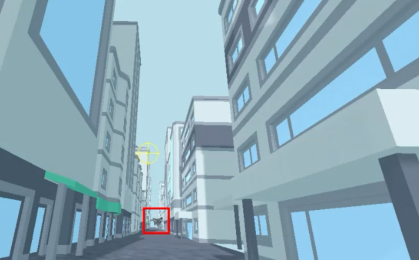
This experiment employed a within-participant design with two independent variables: body movement and visual motion. For the body movement variable, participants viewed the visual stimuli either while standing on a stationary treadmill or while walking on the treadmill at a constant speed of 4 km/h. For the visual motion variable, the virtual environment was presented with either a roll-direction inclination or a pitch-direction inclination, as illustrated in Figure 1.
Figure 1: Scene used in Experiment 1.
Exploring Factors Influencing Recovery Process of Visual Fatigue 885
Participant Nineteen participants (mean age = [28.84 ± 4.40]) participated in the experiment. All participants received compensation in accordance with the regulations of the Japan Advanced Institute of Science and Technology (JAIST). The study complied with the ethical standards and legal requirements of JAIST, and the experimental protocol was approved by the institutional review board. Written informed consent was obtained from all participants before the experiment.
Procedure After providing informed consent, participants closed their eyes and wore an eye mask for five minutes to facilitate dark adaptation and ensure rapid adjustment to the luminance level of the head-mounted display (HMD). They then put on socks, shoes, a safety harness, and the HMD. At the beginning of each session, participants completed a short practice trial to become familiar with treadmill walking and with the sensation of forward motion in the virtual environment.
Following the practice, participants completed the Simulator Sickness Questionnaire (SSQ) and the Visually Induced Symptoms Questionnaire (VISQ) as pre-test measures. Depending on the assigned condition, the treadmill was either activated or kept stationary. Once the treadmill reached a steady speed, the virtual environment was presented through the HMD. Participants then performed a pigeon-tracking task, in which a series of pigeons appeared and moved within the virtual scene. They were instructed to turn their head toward each pigeon and maintain their orientation until the target disappeared.
Upon completion of the task, the treadmill was stopped, and participants again completed the SSQ and VISQ to record immediate symptom changes. A uniform blue screen was then displayed in the HMD for 21 minutes to serve as a recovery phase. During this period, the SSQ and VISQ were presented every seven minutes, and participants were asked to report their symptoms each time. The experiment consisted of four conditions, each conducted in a separate session. Sessions were separated by at least 40 minutes to minimize carry-over effects. The order of conditions was randomized for each participant. All participants completed the full set of conditions across two non-consecutive days, with each day lasting approximately four hours.
Measurement Two self-report measures were used to assess visual fatigue and sickness symptoms. The Simulator Sickness Questionnaire (SSQ; Kennedy et al., 1993) consists of 16 items rated on a four-point scale. It provides a total score and three subscales: Oculomotor (reflecting visual fatigue and eye strain), Disorientation (reflecting dizziness and vertigo), and Nausea (reflecting stomach discomfort and sickness). The total score is calculated as a weighted sum of all items. The SSQ is widely used to evaluate simulator and virtual-reality sickness (e.g., Wang & Ujike, 2025).
886 Wang and Ujike
The Visually Induced Symptoms Questionnaire (VISQ; Watanabe et al., 2024) was used to evaluate symptoms related to both motion sickness and visual fatigue. It consists of 15 items rated on a four-point scale and includes four subscales: Headache, Autonomic Nervous System, Eye, and Focus.
Results
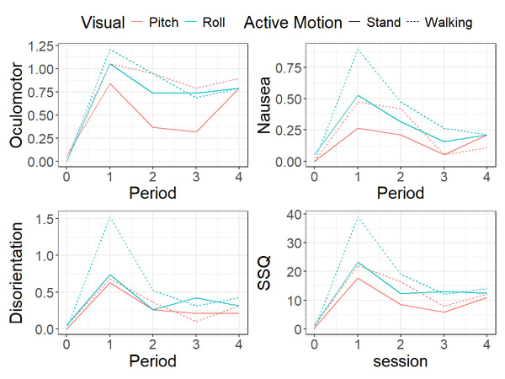
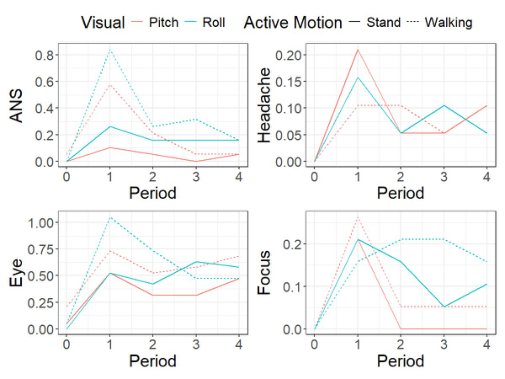
The results of the SSQ and VISQ are shown in Figure 2 and Figure 3, respectively. Period 0 represents the score before the pigeon-tracking task; Period 1 represents the score right after the pigeon-tracking task; the other three periods present the three scores during the recovery phase.
Figure 2: Results of SSQ.Figure 3: Results of VISQ.
Linear mixed models were constructed to analyze the effects of body movement, visual motion and period, with all included as fixed effects, on
Exploring Factors Influencing Recovery Process of Visual Fatigue 887
the score. Random intercepts for participants were included to account for repeated measures. The score in Period 1 was considered as a covariate.
For the three subscale scores and the overall score of SSQ, the results of the linear mixed model indicated no significant main effect of visual motion (Oculomotor: F(1, 194.86) = 0.016, p = .899; Nausea: F(1, 201.15) = 0.741, p = .390; Disorientation: F(1, 204.99) = 1.430, p = .233; SSQ: F(1, 206.96) = 1.97, p = .161) nor significant main effect of body movement (Oculomotor: F(1, 194.86) = 1.306, p = .255; Nausea: F(1, 199.93) = 1.138, p = .287; Disorientation: F(1, 203.63) = 3.071, p = .081; SSQ: F(1, 205.29) = 1.592, p = .209). For the effect of period, there is a significant effect on the score of Nausea (F(2, 196.40) = 5.153, p = .007).
For the four subscale scores of VISQ, the results of the linear mixed model indicated a significant main effect of body movement on the score of autonomic nervous system (F(1, 210.74) = 4.320, p = .039) but no significant effect on other subscales (Headache: F(1, 196.36) = 0.506, p = .478; Eye: F(1, 202.17) = 0.679, p = .411; Focus: F(1, 194.84) = 3.771, p = .054). The results also indicated a significant main effect of visual motion on the score of focus (F(1, 194.93) = 9.93, p = .002) but no significant effect on other subscales (ANS: F(1, 195.85) = 1.092, p = .297; Headache: F(1, 194.92) = 0.089, p = .766; Eye: F(1, 198.15) = 0.036, p = .849). A further analysis of the item in “Focusing” subscale showed that the “Hazy” symptom experienced in roll-walking condition recovered slower than in pitch-walking condition (t(197) = 2.817, p = .005), and the “Difficulty focusing” symptom experienced in the walking condition recovered slower than in the standing condition (F(1, 196.342) = 5.674, p = .018).
EXPERIMENT 2
Method
This experiment employed a within-participant design with one independent variable: control method. The control method had three types: Arm Swing, Controller, and Auto. In the Arm Swing condition, participants controlled the speed of movement in the virtual environment by swinging their arms. In the Controller condition, participants used the joystick on a handheld controller to regulate their movement speed. Both Arm Swing and Controller served as experimental conditions, while Auto served as the control condition, in which the movement speed was pre-defined and not controlled by the participant. Each participant took part in one of the two experimental conditions (Arm Swing or Controller) and the Auto condition.
Participant Thirty participants took part in this experiment (mean age = [31.2 ± 8.6]). All participants received monetary compensation in accordance with the regulations of the National Institute of Advanced Industrial Science and Technology (AIST). The study adhered to the ethical guidelines and legal requirements of AIST, and the experimental protocol was approved in advance by the AIST ethics review board. Written informed consent was obtained from all participants prior to participation.
888 Wang and Ujike
Procedure After providing informed consent, participants first completed a questionnaire assessing their physical condition and then performed a vision test. A short practice session was conducted to familiarize them with the experimental task. Following the practice, participants closed their eyes and wore an eye mask to facilitate dark adaptation and enable rapid adjustment to the luminance of the head-mounted display (HMD).
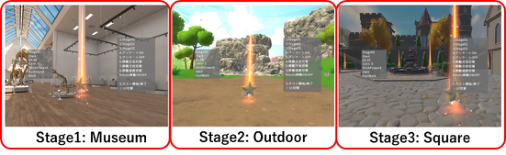
The main experiment consisted of two sessions. After doing the HMD, participants were exposed to a virtual environment composed of three stages (see Figure 4). In each stage, they were instructed to rotate their body to face a target star and then move forward toward it using the assigned control method.
Figure 4: Results of VISQ.
Immediately after completing the star-tracking task, participants rated their perceived sickness using a 7-point sickness scale. This scale was administered four times at 3-minute intervals during the subsequent recovery phase, allowing for the assessment of symptom progression over time.
Results
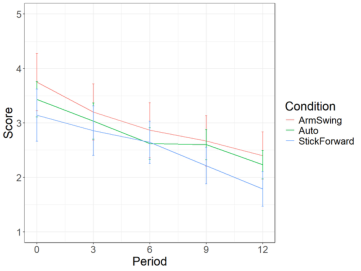
The result is shown in Figure 5. Period 0 represents the score after the star- tracking task; Period 3–12 represents the score the four scores during the recovery phase.
Figure 5: Results of 7-point sickness scale.
Exploring Factors Influencing Recovery Process of Visual Fatigue 889
Linear mixed models were constructed to analyze the effects of control method and period, with all included as fixed effects, on the score. Random intercepts for participants were included to account for repeated measures. The score in Period 0 was considered as a covariate. There was a significant effect on period (F(1, 197.84) = 50.855, p <.001), but no significant effect on control method (F(2, 201.01) = 0.909, p = .405).
DISCUSSION
The present study examined factors influencing the recovery process of visual fatigue and VR sickness across two experiments. The overall goal was to clarify how factors affect symptom changes following VR exposure.
In Experiment 1, the effects of body movement (standing vs. walking) and visual motion (roll vs. pitch inclination) were investigated. Although these manipulations did not produce significant main effects on any symptom dimension measured by the SSQ, VISQ revealed a significant effect of body movement on autonomic responses and a significant effect of visual motion on focus-related symptoms. The former finding suggests that autonomic symptoms gain from VR with physical activities have a different recovery process from VR with stationary. However, this is probably because the physical activity caused a high heart rate which is one of the items in the questionnaire autonomic symptoms. We have removed the item, and the linear mixed model did not show significant effect. Therefore, a future experiment to examine this effect is necessary. The latter finding suggests that visual motion type influenced the recovery of focus-related symptoms. Because the immediate post-exposure score was controlled as a covariate, this difference cannot be explained by higher initial symptoms. Instead, it indicates that the rate of recovery differed between the roll and pitch conditions. One possible reason is that roll motion involves more complex rotational optic flow and requires additional oculomotor adjustments to maintain visual stability, which may delay the re-adaptation of visual focus after VR exposure. Further investigation is needed to confirm this effect.
In Experiment 2, the study explored how different control methods affect sickness recovery. Although a robust main effect of period was again observed, confirming that symptom severity decreased over time regardless of the control condition, no significant main effect of control method was found. The absence of differences between active and passive control conditions suggests that recovery mechanisms may depend more on exposure duration and rest than on the type of control interface itself.
Taken together, these findings indicate that recovery from VR-induced symptoms is primarily time-dependent, but that visual fatigue—particularly focus-related symptoms—may be more susceptible to the characteristics of visual motion than to body movement or control method. This distinction highlights that VR sickness and visual fatigue, while related, may arise from partially different underlying mechanisms and recover along different temporal trajectories.
CONCLUSION
The present study investigated factors influencing the recovery process of visual fatigue and VR sickness. Across two experiments, symptom levels
890 Wang and Ujike
consistently decreased over time, indicating that recovery primarily follows a time-dependent pattern. While overall VR sickness symptoms measured by the SSQ were not strongly affected by body movement, visual motion, or control method, the VISQ results revealed that visual fatigue, particularly focus-related symptoms, was sensitive to the type of visual motion. This suggests that visual fatigue and VR sickness may involve partially distinct mechanisms and recovery dynamics.
Overall, the findings highlight that sufficient rest and visually neutral environments are essential for effective recovery after VR exposure. Future studies should extend the observation period and incorporate objective physiological and oculomotor measures to better understand the processes underlying symptom reduction. A clearer understanding of these mechanisms will support the design of VR systems and user protocols that promote faster recovery and more comfortable long-term use.
ACKNOWLEDGMENT
This work was supported by JSPS KAKENHI Grant Number JP23K28137 and Council for Science, Technology and Innovation, “Cross-ministerial Strategic Innovation Promotion Program (SIP), Development of foundational technologies and rules for expansion of the virtual economy” (JPJ012495) (funding agency: NEDO).
REFERENCES
Chang, E., Kim, H. T., & Yoo, B. (2020). Virtual reality sickness: A review of causes and measurements. International Journal of Human–Computer Interaction, 36(17), 1658–1682. Diels, C., & Howarth, P. A. (2011). Visually induced motion sickness: Single-versus
dual-axis motion. Displays, 32(4), 175–180. Kennedy, R. S., Lane, N. E., Berbaum, K. S., & Lilienthal, M. G. (1993). Simulator sickness questionnaire: An enhanced method for quantifying simulator sickness. The international journal of aviation psychology, 3(3), 203–220. Reason, J. T., & Brand, J. J. (1975). Motion sickness. Academic press. Riccio, G. E., & Stoffregen, T. A. (1991). An ecological theory of motion sickness
and postural instability. Ecological psychology, 3(3), 195–240. Wang, T. Y., & Ujike, H. (2025). Effects of Physical Walking Movement on Virtual Reality Sickness Caused by Visual Motion Not Due to Walking. International Journal of Human–Computer Interaction, 1–21. Watanabe, H., Wang, T. Y., Ando, H., Mizushina, H., Morita, T., Emoto, M.,... &
Ujike, H. (2024). Visually induced symptoms questionnaire (VISQ): A subjective evaluation method for biomedical effects induced by stereoscopic 3D video. Applied Ergonomics, 117, 104238.
LISTED IN THE AHFE DIGITAL BOOKSTORE CATALOGUE
Explore the complete digital volume
Human Factors in Design, Engineering, and Computing
Read this individual research paper free through the original publisher, or explore the full digital proceedings book.
ISBN 978-1-964867-75-5
Explore this ISBN in the AHFE Bookstore ↗Listed in the July 2026 bookstore catalogue; search by ISBN to confirm current availability · Digital book purchase optional