Manabu Chikai, Kentaro Watanabe, Bach Quang Ho, Jooho Park, Yui Murakami, Kayo Koike, Min Ma, Masahiro Tsutsu (2025). Remote Customer Service Interaction Using Avatar Robots: The Influence of Interpersonal Distance and Operator's Visibility. In: Human Factors in Design, Engineering, and Computing. AHFE Open Access, vol. 199, pp. 680–686. https://doi.org/10.54941/ahfe1006880
This study aims to determine what constitutes a “good avatar-mediated interaction” during customer service. We experimentally investigated how changes in the surrounding environment during remote customer service via avatar robots affected the interaction. The nature of interactions involving avatar robots is significantly influenced by spatial factors. Specifically, the physical distance between the customer and robot as well as the robot’s camera angle can affect how the customer is perceived by the service provider, which may affect the quality of the interaction. However, these effects are not yet fully understood. The experiment was conducted in a controlled environment involving a participant playing the role of a customer and an avatar robot representing the service provider (who interacted with the customer through the robot). The customer was instructed to face and interact with the avatar robot, while the operator was connected remotely and responded through the robot. We collected speech data (audio and speech-to-text) from the simulated interactions along with eye-tracking data from the operator. After each trial, the participants provided subjective evaluations, including a score for the interaction (0–100; higher is better), stress level rating (0–100; higher is more stressful), and perceived sense of interpersonal distance (five-point scale from “very distant” to “very close”). The findings indicate that greater interpersonal distance between the customer and avatar robot tends to reduce stress. Customers also exhibit higher stress when seated, suggesting that posture influences their emotional responses. When the customer was outside the robot’s camera frame, the operator’s gaze was directed less frequently toward the control interface, implying a disruption in visual engagement. These results suggest that customer visibility and spatial positioning during remote service significantly influence interaction quality.
Remote Customer Service Interaction Using Avatar Robots 681
INTRODUCTION
This study aims to determine what constitutes a “good avatar-mediated interaction” during customer service by focusing on the operator’s working environment.
We considered remote customer service using avatar robots as a potential approach for new ways of working. Since the COVID-19 outbreak in 2020, the need for social distancing and advancements in artificial intelligence technologies have led to the emergence of various innovations. Consequently, opportunities for staff members to engage in face-to-face customer service have become increasingly limited. The use of avatar robots and web-based services is expected to increase to enable more remote customer interactions. Watanabe (2023) mentioned that avatar technologies used in remote customer service may complement traditional face-to-face customer service by redefining the concept of the workplace, promoting skill development among employees, and enhancing their wellbeing. Watanabe and Ho (2023) noted that customer service mediated by avatar robots can improve the flexibility of service delivery.
However, operators (i.e., staff members who interact with customers via avatar robots) are required to face a personal computer or similar device throughout the day. Unlike “traditional”face-to-face customer service, operators must rely on avatar robots to interpret the customer’s situation. One consideration in an effective interaction is the physical distance [i.e., personal space (Hall, 1966)] between the avatar robot and customer. Previous research (Walters et al., 2005) using a robot known as PeopleBot reported that the social distance between humans and robots tends to approximate the concept of personal space observed in human-to-human interactions.
Previous studies revealed that a personal space similar to that between humans also exists between humans and robots. However, our study focused on situations in which customers interacted with avatar robots in real time. We examined how the ability of operators to view customer video footage affects customer service interactions. We investigated the relationship between the customer’s visual appearance and the perceived distance from the avatar robot, and collected subjective evaluations of service quality and stress levels during customer service interactions to explore the factors contributing to operator fatigue. These evaluations are used to assess the impact of visual and spatial factors on the operator’s experience.
MATERIALS AND METHODS
We conducted the experiment with ten participants (five men and five women, average age: 40.3) acting as customers and one female staff member acting as an operator. This study was approved by AIST ergonomic experiment committee (HF2024-949). All the participants provided informed consent.
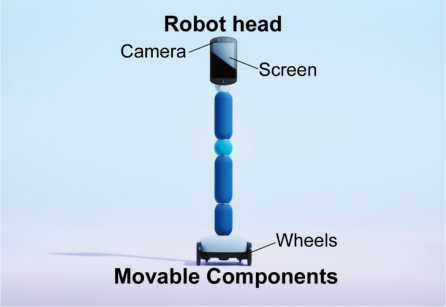
The experiment involved a simulated interaction between a customer and an operator. The participant assigned as the customer was instructed to face and interact with the avatar robot (Fig. 1) within the laboratory. The participant assigned as the operator was instructed to connect to the avatar robot remotely via a network and respond to the customer. The experimental
scenario included inquiries such as “Which is the gate for the flight I want to board?” “How do I get to that gate from my current location (including distance and estimated time)?” “Where do I buy souvenirs?” or “Where is the restroom?” No specific script was provided in advance for these interactions. Instead, the content of inquiries was handed to participants playing the role of the customer in the form of a mock boarding pass, which they could refer to during the experiment.
Figure 1: Avatar-robot “newme” [feature of newme].
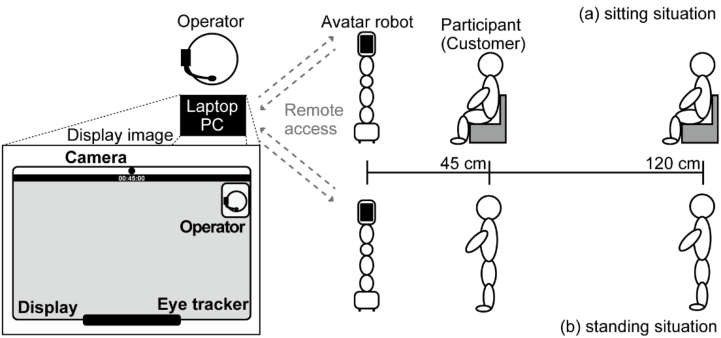
The experimental conditions were designed based on three factors: the distance between the customer and robot (45 cm and 120 cm), the posture of the customer (standing or seated), and the tilt angle of the tablet used to ensure the avatar robot’s field of view (with or without tilt). All combinations of these conditions were tested, resulting in a total of eight trials per participant. The order of the trials was randomized for each participant. Figure 2 shows the experimental conditions used in this study.
During the experiment, speech data (audio recordings and transcribed text) from the simulated customer service interactions were recorded. The operator’s gaze point was recorded using an eye-tracking device (Tobii Pro Nano by Tobii) to determine the regions of the control screen being looked at. After each trial, participants were asked to provide subjective evaluations by answering the following questions: “Please rate the quality of this customer service interaction (0–100 points),” “Please rate your stress level during this interaction (0–100),” “How did you feel about the distance between you and the customer? (1 = very far, 2 = somewhat far, 3 = neutral, 4 = somewhat close, and 5 = very close).” Participants were instructed that a higher score for interaction quality indicated a better evaluation, while a higher score for stress level indicated greater stress (i.e., a more stressful experience).
The analysis of the subjective evaluation comprised the following steps. For each trial, the average scores of all participants were calculated for both the customer service and stress level ratings. A nonparametric multiple comparison test (Friedman test) was conducted to compare these scores across trials. The Bonferroni correction was then applied as a post-hoc test
Remote Customer Service Interaction Using Avatar Robots 683
to examine differences between trials. Statistical analyses were performed using statistical software (SPSS Statistics ver. 27 by IBM). In contrast, the analysis of the gaze data was conducted as follows. The operator’s gaze points during customer service interactions were analyzed to determine which regions of the application interface were viewed, as shown in Fig. 2. Based on the customer’s posture, the visibility of the customer’s face was classified into three categories: fully visible, partially visible (eyes and/or mouth visible), and not visible at all.
Figure 2: Experimental condition and experimental setup of eye tracker.
RESULTS AND DISCUSSIONS
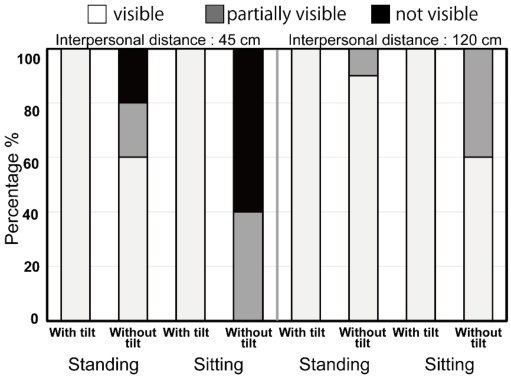
Figure 3 compares the visibility of the customer’s face during the customer service interaction. The results indicated that under an interpersonal distance of 45 cm without a tablet tilt, it was difficult for operators to observe the customer’s facial expressions. In particular, at a 45 cm interpersonal distance, sitting posture, and no tilt, more than half of the customers’ facial expressions were not observable. Conversely, when the interpersonal distance was 120 cm, facial expressions were generally observable in almost all conditions.
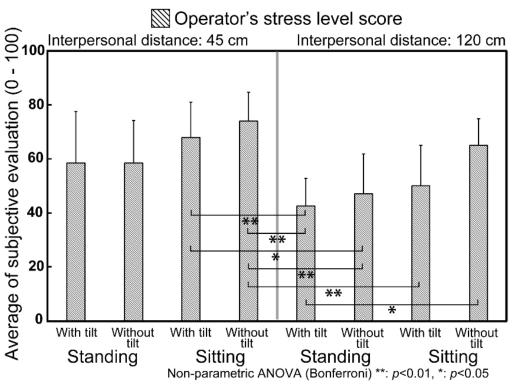
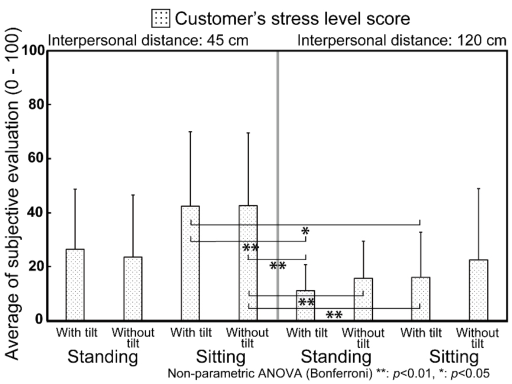
Figure 4 shows the results of the operators’ subjective evaluations. The results revealed significant differences in stress levels. Under the 120 cm interpersonal distance condition, operators tended to report relatively lower stress levels. In contrast, at a 45 cm interpersonal distance with a sitting posture, stress levels were higher than those in the other conditions. Figure 5 presents customers’ subjective evaluations. As with the operators, customers reported higher stress levels at the 45 cm interpersonal distance in the sitting posture condition compared with the other trials. At a 120 cm interpersonal distance, stress levels were lower, suggesting that when the personal space corresponds to social distance (120 cm), stress tends to be reduced.
These findings suggest that operator stress during customer service interactions may be influenced by the difficulty in observing the customer’s condition. According to Sundaram and Webster (Sundaram and Webster,
2000), customers evaluate service interactions based on factors such as staff body movements (kinematics), vocal characteristics during conversations (paralanguage), personal space (proxemics), and physical appearance. The findings of this study indicate that when the personal space corresponds to a social distance of 120 cm, both operators and customers tend to experience lower stress levels. In contrast, when the interpersonal distance was 45 cm, stress levels tended to increase. Furthermore, when operators do not adjust the tablet angle to secure a proper field of view, it becomes difficult to observe the customer’s facial expressions, potentially leading to increased mental stress.
Figure 3: Results of the visibility of the customer’s face during remote service.Figure 4: Results of the analysis of variance (ANOVA) on operators’ stress score.
Remote Customer Service Interaction Using Avatar Robots 685
Figure 5: Results of the analysis of variance (ANOVA) on customer’s average stress score.
CONCLUSION
In this study, we investigated the effects of interpersonal distance and visibility of the customer on interaction satisfaction and stress levels during remote customer service interactions mediated by an avatar robot.
The findings revealed that when the interpersonal distance between the customer and avatar robot was relatively large (120 cm in this experiment), both operators and customers tended to report lower stress levels. When the customer was in a seated posture, stress levels tended to be higher. These results suggest that the customer’s visual appearance and posture during remote interactions may influence the interaction quality.
While this study focused on the operator’s visibility as one factor contributing to fatigue during avatar robot operation, it is necessary to consider various environmental factors on the customer’s side in future work. By conducting further experiments that take these factors into account, we aim to develop a more comfortable and effective working environment.
ACKNOWLEDGMENT
This study was supported by the Small/Startup Business Innovation Research Program, Ministry of Land, Infrastructure, Transport and Tourism (MLIT), Japan. We would like to thank all study participants and staffs of the avatarin Inc.
REFERENCES
D. S., Sundaram; C., Webster. (2000) The role of nonverbal communication in service encounters. Journal of Services Marketing, 14(5). E. T., Hall. (1966) The Hidden Dimension, Doubleday Publishing Group. Feature of newme, The avatarin website: https://about.avatarin.com/service/feature/.
K., Watanabe. (2023). “Augmented telework with avatar technology: Impact on workplace and required actions,” in A Research Agenda for Workplace Innovation: The Challenge of Disruptive Transitions, Edward Elgar, Oeij, P. R. A., Dhondt, S., McMurray, A. J. (eds.). pp. 51–66. K., Watanabe, B. Q., Ho, (2023), “Avatar-mediated service encounters: Impacts and
research agenda, ” The Service Industries Journal, Vol. 43, Issue 3–4. M. L., Walters., K., Dautenhahn. et al. (2005) The Influence of Subjects’ Personality Traits on Personal Spatial Zones in a Human-Robot Interaction Experiment, Proceedings of 2005 IEEE International Workshop on Robots and Human Interactive Communication, pp. 347–352.
LISTED IN THE AHFE DIGITAL BOOKSTORE CATALOGUE
Explore the complete digital volume
Human Factors in Design, Engineering, and Computing
Read this individual research paper free through the original publisher, or explore the full digital proceedings book.
ISBN 978-1-964867-75-5
Explore this ISBN in the AHFE Bookstore ↗Listed in the July 2026 bookstore catalogue; search by ISBN to confirm current availability · Digital book purchase optional