Tetsuro Ogi, Xiangyu Sheng, Yuki Kida (2025). Personal Space for Avatar Communication in Real and Virtual Environments. In: Affective and Pleasurable Design. AHFE Open Access, vol. 164, pp. 172–178. https://doi.org/10.54941/ahfe1006073
In recent years, the development of the metaverse and avatar robots have led to construct an avatar society, where people communicate with each other using their avatars. Just as psychology has been developed as academic studies for building a better society in the real world, the construction of avatar psychology is necessary to build a better avatar society. This paper addresses the issue of personal space as one of the topics of avatar psychology.Personal space is the space in which people feel uncomfortable when other people exist, and it is important for us to have a suitable personal space for comfortable communication. Personal space is known to change depending on the relationships between people such as family, friends, business associates, and others, personal attributes such as gender and age, and the social and cultural background in which the person grew up. Considering such knowledge about personal space is important to improve work efficiency and realize comfortable communication of users when designing spaces where people gather, such as offices, conference rooms, restaurants, event halls, etc. In contrast, there are few research cases on personal space for avatars in the metaverse, and the most of the current spaces in the metaverse are designed using the knowledge about personal space for humans in the real world. In this study, we aim to build a more comfortable and productive metaverse space or a coexistence workspace with communication robots by considering the knowledge of personal space for various avatars. Specifically, the personal space for a CG avatar in a virtual space and the personal space for an avatar robot in a real space were measured through the experiments and it was compared with the personal space for a human in the real space. In particular, when measuring the personal space in a virtual space, accurate measurement can be performed by observing a real-size avatar model from a first-person perspective using an HMD. In addition, the impressions felt by users when facing a human, an avatar robot, and a CG avatar were evaluated using the SD (Semantic Differential) method.The experimental results showed that the personal space for a CG avatar was slightly larger than the personal space for a physical opponent such as a real human and an avatar robot. This difference is thought to be due to the fact that the impressions of familiarity, security, and emotional richness were smaller for a CG avatar than a real human or an avatar robot. It was also shown that the personal space for a CG avatar changed depending on the character expression and the body size of the avatar. Therefore, it is expected that these results can be used as a guideline for improving comfortable communication and work efficiency when designing communication spaces in the metaverse or designing workspaces where avatar robots exist in the real space.
In recent years, with the spread of the metaverse and avatar robots, avatar societies have been built in which people communicate with each other using avatars (Takeuchi, 2020) (Nakayama, 2024). Just as psychology has developed as a fundamental academic field for building a better society in the real world, the construction of avatar psychology is necessary to build a better avatar society in the virtual world (Ogi, 2025). In particular, understanding the influence of one’s avatar on others and how one is influenced by others’ avatars is an important issue in building a better society. In this paper, the issue of personal space is addressed as one of the topics in avatar psychology.
PERSONAL SPACE In the real world, it is important for humans to maintain an appropriate personal space for each other to communicate comfortably. In the previous research, it is shown that personal space differs depending on the relationship between people, such as family, friends, work colleagues, and strangers, and they are called intimate distance, personal distance, social distance, and public distance, respectively (Hall, 1966). It is also known that personal space differs depending on personal attributes such as gender, age, and body size,
Personal Space for Avatar Communication in Real and Virtual Environments 173
or the social and cultural background in which a person grew up (Harper, 1978) (Lomranz, 1975). Considering such knowledge about personal space is important in designing spaces where many people gather, such as offices, conference rooms, restaurants, event halls, etc., in order to improve the comfort and work efficiency of users.
In contrast, there is still little knowledge about personal space for avatars, and the current situation is that the metaverse space is designed and avatar robots are placed using knowledge about personal space for humans in the real world. However, it has been shown that personal space exists in virtual spaces, and that personal space differs depending on the height of the avatar (Nishihara, 2015) (Hata, 2024). In addition, by measuring personal space for approaching robots, it has been shown that personal space also exists for robots (Leichtmann, 2022). In this study, personal space for humans and avatar robots, and personal space in real and virtual worlds are compared, by conducting experiments to measure personal space for avatars in various environments. Such knowledge can be used to design comfortable and productive metaverse spaces and collaborative working spaces with avatar robots.
EXPERIMENT ON MEASURING PERSONAL SPACE IN REAL AND VIRTUAL SPACES In this study, experiments on measuring personal space to actual human and avatar robot in real world, and personal space to CG avatars of human and robot in virtual world were conducted and experimental results were compared.
To measure personal space for humans in the real world, a corridor in a building was used. The subject stood at a fixed position, and the experimenter approached the subject from a position 4 m away, walking slowly step by step. When the subject felt that the other person was too close and it made him or her uncomfortable, the subject stopped the other person and the distance between the subject and the experimenter was measured.
In the experiment using the avatar robot, SoftBank’s humanoid robot Pepper was used. Pepper is 121 cm tall and can be controlled remotely using software. The subject stood at a fixed position, and the robot moved forward little by little from the same starting point as for a human. When the subject felt uncomfortable with the robot’s presence, the subject asked the experimenter to stop the robot, and the distance between the subject and the robot was measured.
In the experiment using the CG avatars in the virtual world, a virtual space with the same corridor width and the same wall positions as the real space was constructed. And a human CG avatar with the same height (180 cm) resembling the experimenter was created by using the avatar creation software Character Creator 3, and a CG robot avatar with the same height (121 cm) resembling the humanoid robot Pepper was also created. In order to compare the sense of distance with the experiment in the real space, it is important to create the virtual space and CG avatar in the same size as the real space so that the subject can feel them in real size. The
models of the virtual space and the avatar were constructed using Unity, and they were shared over the Internet using VRChat, so that the experimenter and the subject can share the same virtual world. The subject and the experimenter experienced the virtual world from a first-person view using the Meta Quest3 HMD. The experimenter moved the avatar forward little by little from a remote location using a controller, and the subject watched the avatar approaching. And when the subject felt uncomfortable with the avatar’s presence, the subject asked the experimenter to stop the avatar and the distance between the experimenter’s avatar and the subject’s avatar in the virtual world was measured.
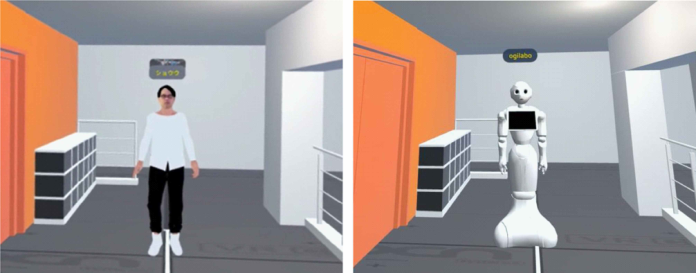
Figure 1 shows the CG avatars used in the experiment. The subjects were nine graduate students, and the experiment was conducted twice for each subject, in random order, for four different conditions: human in real space, robot in real space, human avatar in virtual space, and robot avatar in virtual space. In addition, since personal space is influenced by impressions of the other person, the subjects were asked to evaluate seven impression terms related to the other person, robot and avatars on a seven-point scale using the semantic differential (SD) method. The adjective pairs used in the SD method were friendly-unfriendly, interesting-uninteresting, safe- dangerous, attractive-unattractive, emotional-unemotional, polite-impolite, and realistic-unrealistic. These words were selected from the most frequently mentioned adjectives that were listed by the subjects in a preliminary survey to describe their impressions of the avatars.
Figure 1: Human avatar and robot avatar used in the experiment.
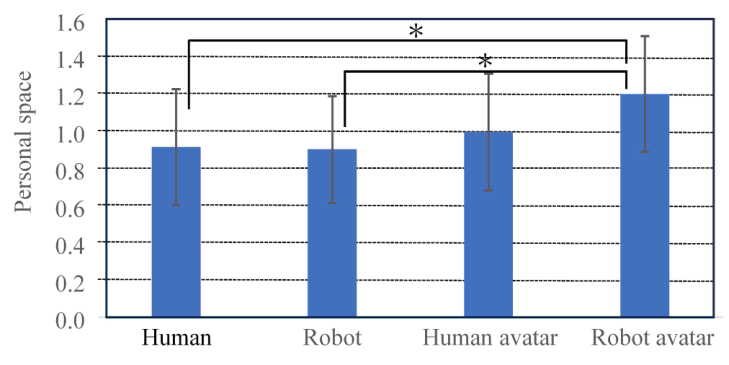
Figure 2 shows the personal space measured in the experiment. The graph shows the average and standard deviation of the measured distance to humans and robots in real space, and to human avatars and robot avatars in virtual space. These results show that for robots, the personal space of the CG robot avatar in the virtual space was significantly larger than the personal space of a physical robot in the real space. For humans, there was no significant difference, but the personal space of the CG human avatar was somewhat larger than that of the human in the real space. Furthermore, when comparing the personal space of humans and robots, no significant difference was found between either physical human and robot in the real space and CG avatars in the virtual space.
Personal Space for Avatar Communication in Real and Virtual Environments 175
Figure 2: Personal space measured in the experiment.
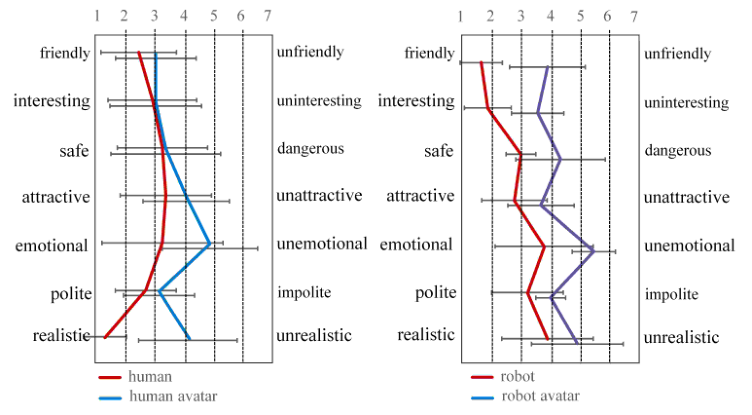
Figure 3 shows the results of impressions of the human, robot, human avatar and robot avatar, based on the SD method. The results show that impressions of human avatar and robot avatar in the virtual space were more negative than impressions of human and robot in the real space. It is thought that this is because CG avatars are expressionless compared to real human and robot, and it is difficult to feel a positive impression of them. This is thought to be the reason why the personal space for CG avatars in the virtual space was larger.
Figure 3: Impressions of the human, robot and CG avatars.
EXPERIMENT ON MEASURING PERSONAL SPACE OF VARIOUS AVATARS In the above-mentioned experiment, though the personal space in the virtual space was larger than the personal space in the real space, there was no significant difference between humans and robots. Further investigation is necessary to determine whether this result is essential or whether it was due to the characteristics of the humans and robots used in the experiment. There was a height difference between the humans and robots used in the experiment, and previous research has shown that human height affects personal space felt by the other person. Also, different people have different impressions of humans. Therefore, additional experiments were conducted in the virtual space using robot avatar of different height and human avatar with different characteristics, because it is not possible to change the characteristics of actual humans and robots in the real world.
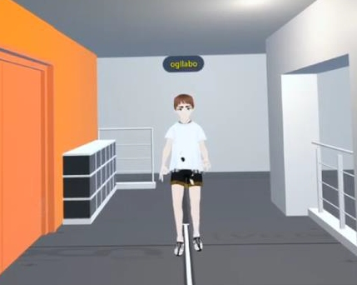
Specifically, we conducted experiments using a character human avatar with different face and the same height (180 cm), and a robot avatar with the same height as the human (180 cm). The experimental procedure was the same as the previous experiment, in which the avatars were gradually moved forward to the subject from a distance of 4 m, and when the subjects felt too close and uncomfortable, the avatar were stopped and the distances between the avatars were measured. Figure 4 shows the character human avatar used in the experiment.
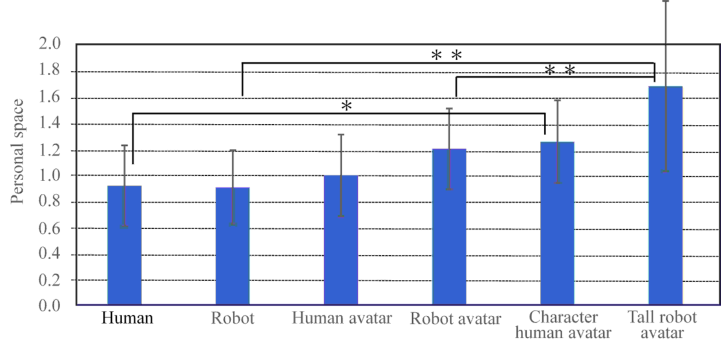
Figure 5 shows the results of the experiment in which data for two avatars were added. The results show that for human avatars, there was significant difference between the personal space of real human and the personal space of character human avatar. And for robot avatars, the personal space was significantly increased when the height of the avatar was large. These results suggest that the impression of avatars and the size of CG avatars in the virtual space also affected the personal space. However, further experimental investigation is required to understand the relationship between avatar representation and personal space.
Figure 4: Experiment using character CG avatar.
Personal Space for Avatar Communication in Real and Virtual Environments 177
Figure 5: Personal space of avatars with different characteristics.
DISCUSSION
The above experiments provided some knowledge about the personal space for avatars, which can be applied to the design of the metaverse or collaborative spaces with robots.
Current metaverse space are often designed based on the size of the real space or are often designed without considering the number of avatars gathering there. In addition, collision detection between avatars is often not calculated due to the computational load, resulting in situations where avatars are extremely close to each other or even overlapped in some cases. In such situations, it is necessary to design a virtual space that takes into account the personal space felt by the user. In particular, when users who participate in the metaverse using a PC screen are included, a mechanism to control the distances among avatars automatically is necessary, since these users do not have a first-person view and are not aware of personal space.
Recently, avatar robots have been used to provide services to customers in places such as airports, shopping malls, restaurants, etc., but the distances that should be kept between the robots and human customers are often not considered. Since the personal space for the robot is affected by the impression of the appearance and its body size, the distance between the robot and the customer must be considered for each robot.
Thus, when designing a space where avatars are used, it is important to construct a more comfortable metaverse space or a more comfortable collaborative space between humans and robots, by taking into account the distance between avatars or between humans and robots based on the personal space.
CONCLUSION
In this study, experiments to measure the personal space for humanoid robot used in real space and CG avatars used in virtual space were conducted, and they were compared with the personal space of humans in the real world.
The results showed that the personal space for CG avatars were larger than real humans and robots, and it suggests that the personal space is influenced by negative impressions of CG avatars.
Future work will include further experiments on measuring personal space for various avatar expressions, and applying such knowledge to designing a metaverse space where a lot of avatars gather and a collaborative work space between humans and robots.
REFERENCES
Hall, E. T. (1966) The hidden dimension, Doubleday & Company. Harper, R. G., Wiens, A. N. and Matarazzo, J. D. (1978) Non-verbal communication; The state of the art, Wiley Interscience. Hata, M. Miyashita, K and Mishima, H. (2024) Effects of VR avatars on personal
space, The 22nd conference of the Japanese society for cognitive psychology. Leichtmann, B., Lottermoser, A., Berger, J., and Nitsch, V. (2022) Personal space in human-robot interaction at work: Effect of room size and working memory load. ACM Transactions of Human-Robot Interaction, Vol. 11, Issue 4, pp. 1–19. Lomranz, J. (1975) Cultural Variations in Personal Space, The Journal of Social
Psychology, Vol. 99, Issue 1, pp. 21–27. Nishihara, R. and Okubo, M. (2015) A study on personal space in virtual space based on personality, Procedia Manufacturing. Nakayama, Y. and Sumi, K. (2024) The Impact of Anonymity on Communication in
the Metaverse, 2024 IEEE 48th Annual Computers, Software, and Applications Conference (COMPSAC). Ogi, T. (2025) Psychology for Avatar Communication, Emotional Engineering, Vol. 10, pp. 107–120, Springer. Takeuchi, K., Yamazaki, Y. and Yoshifuji K. (2020) Avatar Work: Telework for
Disabled People Unable to Go Outside by Using Avatar Robots, HRI2020 ACM/ IEEE International Conference on Human-Robot Interaction, pp. 53–60.
LISTED IN THE AHFE DIGITAL BOOKSTORE CATALOGUE
Explore the complete digital volume
Affective and Pleasurable Design
Read this individual research paper free through the original publisher, or explore the full digital proceedings book.
ISBN 978-1-964867-40-3
Explore this ISBN in the AHFE Bookstore ↗Listed in the July 2026 bookstore catalogue; search by ISBN to confirm current availability · Digital book purchase optional