Tia Bajaj, Madhusudan Vijayakumar, Duha Ali (2025). From Capability to Accessibility: A Usability Heuristics Approach to Space Mission Planning Tools. In: Human Factors in Design, Engineering, and Computing. AHFE Open Access, vol. 199, pp. 368–378. https://doi.org/10.54941/ahfe1006849
Designing and operating space missions is a technically demanding and iterative process that requires engineers to balance spacecraft design, mission requirements, and trajectory optimization. Existing aerospace software tools, while technically sophisticated, often lack accessibility and usability, unintentionally excluding users with diverse physical, cognitive, and sensory needs. This gap between capability and inclusivity limits participation in mission design, particularly in educational contexts where accessibility is essential. This paper presents a novel framework for embedding human factors and accessibility principles into the architecture of aerospace mission design tools. Drawing on usability heuristics and Universal Design for Learning (UDL) principles, we develop three core contributions: (1) accessibility heuristics that translate inclusive design standards into actionable requirements for aerospace applications, (2) a comprehensive ruleset for architecture design focusing on progressive disclosure, multimodal representation, and user-centred interaction patterns within mission planning interfaces, 3) improved aesthetics compared to legacy mission planning applications, reducing visual clutter and cognitive load. Together, these artifacts form a methodology for systematically applying usability principles to aerospace system architecture. By embedding accessibility at the architectural level, the platform moves beyond compliance to actively support engagement, comprehension, and collaboration.
Space mission planning is among the most technically complex and demanding interdisciplinary challenges in the aerospace industry (Bloebaum & McGowan, 2012; Defoort et al., n.d.; Isaji et al., 2022; Ross, n.d.). Successfully designing and operating space missions requires engineers to balance spacecraft design, trajectory optimization, and diverse mission requirements while accounting for evolving technological constraints (Englander et al., 2017; Harris et al., 2024). The process is inherently iterative, involving repeated trade studies that often rely on user experience to inform decision making and develop a coherent and feasible mission architecture (Ross, n.d.; Takubo et al., 2025).
From Capability to Accessibility: A Usability Heuristics Approach 369
Over the last several decades, advances in computational modelling have given rise to sophisticated tools that are increasingly able to support such complex tasks. Platforms such as NASA’s General Mission Analysis Tool (GMAT)(Corbin, 2024), Systems Tool Kit (STK) (Advancing Space Mission Analysis and Design With Simulation, n.d.), FreeFlyer (AI Solutions) (Engineering Services and Products for Space Missions, n.d.), and other institutional resources software provide robust capabilities for trajectory analysis, operational simulation, and systems integration making them indispensable to mission designers and educators. However, despite their high performance, these interfaces frequently assume advanced prior knowledge, employ visually dense architectures, and offer limited support for users with diverse physical, cognitive, or sensory needs. Thus, often prioritizing technical depth over accessibility. These limitations are especially evident in academic contexts, where inaccessible tools become barriers to participation (Laskey & Keebler, 1990; Mittendorf, n.d.; Moon et al., n.d.).
This imbalance between capability and inclusivity has created a critical gap in aerospace education and practice (Interagency Roadmap to Support Space-Related STEM Education and Workforce, n.d.; “Recognizing and Overcoming Barriers to Participation in STEM,” 2022). Consequently, creating a dichotomy between capability and inclusivity when training the next generation of engineers. Such exclusion undermines ongoing academic efforts in promoting STEM education, restricting innovation by narrowing the pool of contributors.
Usability in Space Context As space exploration expands beyond government programs into academia and private enterprise, usability in mission design tools has become increasingly critical (Space Mission Design Tools - NASA, n.d.). The advent of low-cost launch platforms and educational CubeSat programs has generated avenues for students and emerging innovators to engage in mission planning (“Integrated CubeSat Engineering,” n.d.; Vijayakumar et al., n.d.). However, many existing tools assume prior expertise not only in the field but also in software operation, leading to steep learning curves that hinder learning and accessibility. To facilitate the participation of individuals across diverse ability levels, it is essential to integrate human factors into the development of mission planning tools (Human Factors & Performance - NASA, n.d.). In human factors research, usability refers to the degree to which specified users can effectively, efficiently, and satisfactorily use a product to achieve their specified goals. In an aerospace context, usability enables users of varying experience levels to interact confidently with complex mission systems and inform decisions (Sándor, n.d.). Tools characterized by intuitiveness and responsiveness not only expedite the design process but also reduce errors and enhance comprehension of critical mission trade-offs. Usability in this context is not simply an aesthetic improvement—it is an enabler of equitable participation in aerospace education.
Challenges in Space Mission Planning Tools Despite their analytical sophistication, most existing aerospace mission planning tools remain optimized for technical performance rather than user accessibility (Laskey & Keebler, 1990). Their interfaces are often characterized by dense information displays, overlapping panels, and limited customization, resulting in steep learning curves for new users (Corbin, 2024). The absence of multimodal interaction options is particularly problematic in educational environments, where inclusivity and accessibility are critical to effective learning and skill development. Closing this gap requires not only the redesign of aerospace computing environments but also a shift in design strategies toward systems that are both technically robust and human centred. Although accessibility guidelines are well established in general software development, they have not been systematically applied to the specialized domain of aerospace mission planning. Further, the absence of explicit heuristics or design frameworks, suggests accessibility continues to be treated as an afterthought rather than a foundational principle.
Research Gap and Research Objectives Heuristics, play a vital role in developing complex systems and inform strategies and guidelines for decision-making. A focus on human factors in system design could enhance architecture development. Addressing the clear lack of accessibility in mission planning, this initiative proposes a set of comprehensive guidelines and strategies to implement mission planning tool, significantly broadening user access while meeting the rigour and technical girth of the industry. With the goal of developing an accessible and user- friendly framework mission planning, this paper presents three primary objectives:
1. Accessibility Heuristics – To create a detailed set of heuristics grounded in usability principles that translate inclusive design standards into actionable requirements for aerospace applications. 2. Human-Centered Architecture Ruleset – To propose an architectural framework that systematically incorporates human factors to improve usability, comprehension, and overall user experience. 3. Enhanced Aesthetic Design – To establish visual and interaction design guidelines that reduce cognitive load, minimize visual clutter, and improve user engagement compared to legacy models.
Together, these objectives form a methodological foundation for future aerospace tools, ensuring that the capabilities evolve hand in hand with the user needs.
FRAMEWORK DEVELOPMENT METHODOLOGY This research presents a framework that embeds human factors and accessibility principles into the architecture of aerospace mission planning tools. The study follows a multi-phase methodology grounded in usability heuristics, Universal Design for Learning (UDL) principles, and comparative evaluations of existing aerospace interfaces. Guided by these frameworks, the
From Capability to Accessibility: A Usability Heuristics Approach 371
research develops three key outcomes: (1) accessibility heuristics tailored to aerospace applications, (2) a human-centred architectural ruleset translating these heuristics into design structures, and (3) aesthetic guidelines that enhance clarity, reduce cognitive load, and improve user engagement. This section outlines the methodology and design processes that underpin the development of the proposed framework.
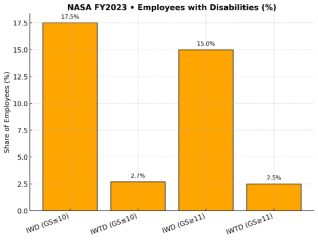
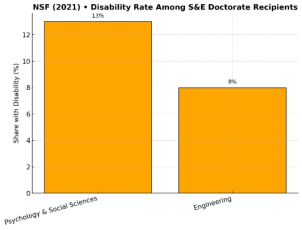
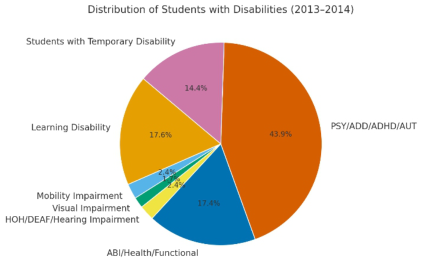
Accessibility Heuristics Accessibility remains a critical yet often neglected dimension of participation in STEM. According to the NSF Diversity and STEM 2023 report, approximately 9% of the U.S. population has at least one disability, yet only 3% of the STEM workforce identifies as having one. Among college-educated workers, about 12% report at least one disability, but representation declines to 8% within engineering fields, including aerospace. Similarly, NASA’s Equal Employment Opportunity Commission (EEOC) data indicates that individuals with disabilities comprise roughly 8–10% of NASA’s workforce, highlighting persistent challenges in fully integrating accessibility into aerospace workforce. Within academic environments, comparable disparities exist. Data from Cal Poly’s Disability Resource Center shows that about 4.3% of the engineering student body reports having at least one disability, reflecting a diverse set of accessibility needs ranging from sensory and mobility accommodations to cognitive and mental health support.
Figure 1: NASA report 2023.
Despite growing awareness of inclusivity, accessibility most mission planning tools fail to include accessibility options such as screen-reader compatibility, customizable color contrast, or comprehensive keyboard navigation. We believe the lack of heuristic grounding results in design patterns that hinder diverse user engagement. To address these disparities, this research developed domain-specific accessibility heuristics by adapting established usability standards to the aerospace context. The process began with a comparative analysis of government and commercial mission planning platforms to identify recurring usability pain points related to accessibility, layout complexity, and feedback responsiveness. These observations were systematically mapped to the Universal Design for
Learning (UDL) framework and Nielsen’s usability heuristics to create an aerospace-specific heuristic model. Each heuristic was cross-referenced against UDL’s three foundational principles ensuring rigor and alignment with various user needs.
Figure 2: NSF report 2021.Figure 3: Cal poly – distribution of students with disabilities (2013–2014).
The resulting accessibility heuristics were consolidated into a practical checklist that ensures consistency, reliability, and transferability across aerospace applications. Each guideline maps to UDL checkpoints and technical implementation requirements, enabling developers and educators to evaluate compliance and design quality effectively. By embedding accessibility at the architectural level, the framework transforms accessibility from a retroactive fix into an intrinsic design, keeping user needs at the heart of the design.
From Capability to Accessibility: A Usability Heuristics Approach 373
Provide content in multiple formats (HTML, text, audio transcripts).
Use alt text, captions, and transcripts for all media.
- Exportable tutorials in text and audio formats. - Toggle for simplified text version of content (e.g., “Download as Plain Text” or “Listen to This Page”). - Downloadable documentation/export options (PDF, DOCX, ODT). Accessible Visuals & Media
- All images must include alt text fields. - Built-in Text-to-Speech buttons. - Embedded videos include captions and downloadable transcripts. - Accessible notifications for background events (e.g., “Saved successfully,” “Upload complete”) - Tooltip system (hover) for media. Digital Document Accessibility
Provide visible, accessible help and feedback options.
- Exported PDFs must include tags, headings, and table structures. - Option to generate “Screen Reader Mode” reports. Inclusive Communication & Feedback Channels
- Persistent “Need Help?” button on every page. - Specific, easy-to-correct form error messages. - Include Accessibility feedback form - Accessibility preferences saved to user profiles
Human-Centred Architecture Ruleset The accessibility heuristics established in the previous phase serve as the foundation for a human-centred architectural framework that integrates inclusivity into the core design and functionality of aerospace mission planning tools. To transform these heuristics into actionable architectural principles, a user background study on the use of aerospace tools was conducted to understand the intended audience comprising students, early- career professionals, and individuals with diverse cognitive and sensory
needs and variability in technical proficiency, computational familiarity, etc. Further, expanding beyond the aerospace industry, the users were surveyed on their preferred choice of tools and the reason for their inclination towards it. This was done to widen the perspective used to summarize the user experience. These findings were essential for shaping an architecture that supports flexibility, reduces cognitive load, and enables users to tailor their interaction with the system based on experience level and accessibility needs.
Drawing from these user insights and the derived accessibility heuristics, recurring usability challenges such as interface rigidity, information overload, and lack of progressive onboarding were systematically analysed. To operationalize these findings and compile these reports, a comprehensive guidelines document was created, bridging real-world accessibility principles with all technical implementation standards for the development of the mission planning tools. The resulting framework functions as a living documentation system, guiding developers and designers through design decisions that enhance engagement, comprehension, and efficiency.
Checklist Category Recommendation Summary Mapped Tool Feature(s) Accessible Visuals & Media Use alt text, captions, and transcripts for all media.
- Embed alt text to all media - Built-in Text-to-Speech buttons. - Embedded videos include captions and downloadable transcripts. - Accessible notifications for background events (e.g., “Saved successfully,” “Upload complete”) - Tooltip system (hover) for diagrams and simulations. Clean Layouts & Simplified Interaction
Use clean UI, simple navigation, and reduce visual clutter.
- Left-hand or upper navigation menu with clear hierarchy. - Option to switch to contrast modes depending on user preference. - Minimalist dashboard with distinct sections. - Keyboard shortcuts for common actions. Inclusive Communication Provide visible, accessible help and feedback options.
- Embed help feature across the tool - Establish easy-to-correct pathways - Establish user Feedback Report loop
From Capability to Accessibility: A Usability Heuristics Approach 375
Interface Aesthetics and Design Enhancement Aesthetics is not merely a decorative characteristic; it is a fundamental root to usability, cognition, and emotional engagement. In systems centred around accessibility, particularly in high-stake environments like aerospace, an intentionally curated aesthetic fosters trust, clarity, and sustained attention. Aesthetics directly influences the user experience with a web-tool, reducing cognitive strain and enhancing information retention by creating visual harmony.
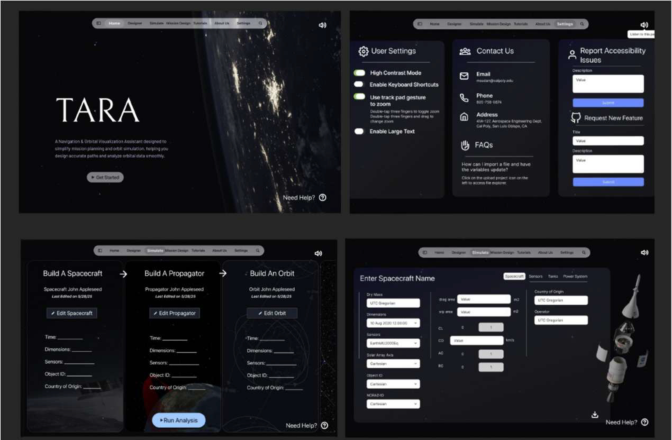
The accessibility heuristics and architecture rulesets are translated into a tangible design environment following aesthetic guidelines by designing a simple prototype. The prototype was developed as a modular, web-based interface to maximize accessibility and scalability across manifold devices and user contexts. To achieve a balance between functional precision and inclusive aesthetics, key features of the prototype included:
Progressive Complexity Architecture. The interface architecture employed a progressive disclosure methodology wherein mission parameters, trajectory data, and advanced control functionalities were systematically presented through hierarchical information layers.
Functional Minimalism in Visual Communication. The visual design framework prioritized functional clarity over decorative elements, ensuring that all interface components served explicit communicative purposes.
Multimodal Information Representation. The interface incorporated multimodal data presentation strategies integrating visual displays, alternative representational formats, and supplementary auditory or textual feedback mechanisms.
Adaptive Interface Customization. The system implemented configurable interaction parameters enabling users to personalize their interface experience through adjustable visual elements including color schemes, typography scaling, and data visualization layer configurations. This customization framework reflects Universal Design for Learning (UDL) principles, specifically addressing diverse learning preferences and accessibility requirements within the aerospace domain.
Cognitive Load Optimization. The architectural design strategically minimized visual and cognitive burden through systematic interface decluttering, standardized labeling conventions, readily accessible help resources, and optimized information flow pathways.
Every design element, such as appropriate color schemes optimized for visually impaired learners, alongside accessible auditory cues, were thoughtfully embedded in the prototype. High contrast colour options ensured that trajectory plots, spacecraft schematics, and interface elements remained legible across different visual conditions. The selection process was informed by WCAG 2.1 contrast guidelines and validated through pilot testing with diverse participants. The structural layout of the tool was subjected to iterative prototyping and testing. Early mock-ups explored
multiple organizational strategies, including hierarchical menus, dashboard- style overviews, and tab-based navigation.
Figure 4: Screenshot illustrating the prototype’s aesthetic principles.
CONCLUSION
The purpose of this research is to act as a pilot for further human- centred designs within aerospace engineering. Future research will expand usability testing to a broader participant base to evaluate the effectiveness of the proposed accessibility heuristics and prototype in diverse operational environments. Advancements to the software platform also include taking the prototype to a fully functional tool, developing the back end of the web application to ensure all features are live and seamlessly integrated. By testing a wider range of mission planning contexts, a more comprehensive and validated foundation for accessibility can be established. Such refinements will enable engineers and designers to integrate human-centred design principles from the earliest stages of system development rather than post- design considerations.
Accessibility and usability are fundamental to the success of modern engineering systems. Systemic barriers have long excluded capable individuals from contributing to the industry, and these findings underscore the urgency of designing tools that create pathways for broader participation. From improving user experience to enhancing operational performance and cross-disciplinary understanding, this project ensures that future aerospace platforms are as inclusive as they are powerful, enabling users of all abilities to explore, simulate, and analyse aerospace operations with confidence.
From Capability to Accessibility: A Usability Heuristics Approach 377
REFERENCES
Advancing Space Mission Analysis and Design With Simulation. (n.d.). Retrieved October 23, 2025, from https://www.ansys.com/blog/advancing-space-mission- analysis-design-with-simulation. Bloebaum, C. L., & McGowan, A.-M. R. (2012, September 17). The Design of
Large-Scale Complex Engineered Systems: Present Challenges and Future Promise. 12th AIAA Aviation Technology, Integration, and Operations (ATIO) Conference and 14th AIAA/ISSMO Multidisciplinary Analysis and Optimization Conference, Indianapolis, Indiana. https://doi.org/10.2514/6.2012–5571. Corbin, E. (2024, July 31). General Mission Analysis Tool (GMAT). Goddard Engineering and Technology Directorate. https://etd.gsfc.nasa.gov/capabilities/ capabilities-listing/general-mission-analysis-tool-gmat/. Defoort, S., Balesdent, M., Klotz, P., Schmollgruber, P., Morio, J., Hermetz, J.,
Blondeau, C., Carrier, G., & Bérend, N. (n.d.). Multidisciplinary Aerospace System Design: Principles, Issues and Onera Experience. Englander, J. A., Vavrina, M. A., Lim, L. F., McFadden, L. A., Rhoden, A. R., & Noll, K. S. (2017). Trajectory Optimization for Missions to Small Bodies with a Focus on Scientific Merit. Computing in Science & Engineering, 19(4), 18–28. https:// doi.org/10.1109/MCSE.2017.3151246. Engineering Services and Products for Space Missions. (n.d.). A.i. Solutions.
Retrieved October 23, 2025, from https://ai-solutions.com/. Harris, G. W., He, P., & Abdelkhalik, O. O. (2024). Control Co-Design Optimization of Spacecraft Trajectory and System for Interplanetary Missions. Journal of Spacecraft and Rockets, 61(4), 939–952. https://doi.org/10.2514/1. A35680. Human Factors & Performance—NASA. (n.d.). Retrieved October 23, 2025, from
https://www.nasa.gov/reference/jsc-human-factors-performance/. Integrated CubeSat Engineering. (n.d.). AIAA - Shaping the Future of Aerospace.
Retrieved October 23, 2025, from https://aiaa.org/courses/integrated-cubesat- engineering/. Interagency Roadmap to Support Space-Related STEM Education and Workforce.
(n.d.). Isaji, M., Takubo, Y., & Ho, K. (2022). Multidisciplinary Design Optimization Approach to Integrated Space Mission Planning and Spacecraft Design. Journal of Spacecraft and Rockets, 59(5), 1660–1670. https://doi.org/10.2514/1. A35284. Laskey, L., & Keebler, J. R. (1990). Evaluating System Usability, Workload Suitability,
and User Experience of Game-Based Virtual Reality in Spaceflight Education and Training. The Journal of Aviation/Aerospace Education & Research. https:// doi.org/10.15394/jaaer.2023.1948. Mittendorf, K. F. (n.d.). Reimagining Access: Critical Examination of Barriers to Full STEM Workforce Participation for. Moon, N. W., Todd, R. L., Morton, D. L., & Ivey, E. (n.d.). Accommodating Students
with Disabilities in Science, Technology, Engineering, and Mathematics (STEM): Findings from Research and Practice for Middle Grades through University Education. Recognizing and Overcoming Barriers to Participation in STEM. (2022, April 1).
Aerospace America. https://aerospaceamerica.aiaa.org/departments/recognizing- and-overcoming-barriers-to-participation-in-stem/. Ross, A. M. (n.d.). Multi-Attribute Tradespace Exploration With Concurrent Design as a Value-Centric Framework for Space System Architecture and Design. Sándor, A. (n.d.). Human Research Program—Space Human Factors & Habitability
Space Human Factors Engineering Project.
Space Mission Design Tools—NASA. (n.d.). Retrieved October 23, 2025, from https://www.nasa.gov/smallsat-institute/space-mission-design-tools/. Takubo, Y., Gammelli, D., Pavone, M., & D’Amico, S. (2025). Agile Tradespace Exploration for Space Rendezvous Mission Design via Transformers (No. arXiv:2510.03544). arXiv. https://doi.org/10.48550/arXiv.2510.03544. Vijayakumar, M., Skamser, W., & Abdelkhalik, O. (n.d.). Design of Initial Guess
Low Thrust Trajectories Using Clohessy-Wiltshire Equations.
LISTED IN THE AHFE DIGITAL BOOKSTORE CATALOGUE
Explore the complete digital volume
Human Factors in Design, Engineering, and Computing
Read this individual research paper free through the original publisher, or explore the full digital proceedings book.
ISBN 978-1-964867-75-5
Explore this ISBN in the AHFE Bookstore ↗Listed in the July 2026 bookstore catalogue; search by ISBN to confirm current availability · Digital book purchase optional