Hongyue Wu (2025). Artificial Intelligence and the future of work in the construction industry: A systematic review. In: Human Factors in Design, Engineering, and Computing. AHFE Open Access, vol. 199, pp. 1155–1165. https://doi.org/10.54941/ahfe1006927
Artificial Intelligence (AI) has been adopted in the construction industry for multiple tasks. While it was identified that AI has critical impacts on the future of work, few studies have explored the construction workforce. Existing studies mainly discussed the applications of AI on construction tasks, while a comprehensive review of how AI will influence the future of work in this sector is still lacking. To address the gaps, this study conducts a systematic review to investigate how AI will influence the future of work in the construction industry. Based on over 500 articles, 20 studies from 2020 to 2025 were reviewed to identify current trends and challenges in this field. Key findings reveal that current research trends include construction operations and AI, construction workforce education and AI, construction industry development and AI, as well as AI and relevant technologies. It was indicated that AI will not replace the labor workforce but will redefine some existing roles and create new roles in the construction industry. Main challenges include AI-related skills and training to develop the AI-skilled workforce, human-centered AI that emphasizes human-AI collaboration, and integration of AI and relevant technologies in the construction industry. Future studies could focus on human-centered AI development, AI-related training and education, and construction industry development with AI. Companies should pay attention to AI-related training, adjustment of roles, and transparent communication. This study provides a comprehensive understanding of how AI could reshape the future of work in the construction industry and reveals future research directions, contributing to both workforce development and AI integration in this sector. The recommendations could also help foster a balanced, human-centric AI adoption process in the construction industry.
With the labor-intensive nature of the construction industry, Artificial Intelligence (AI) has shown the potential to enhance productivity, safety, and efficiency of construction projects, as well as address complex challenges in construction management (Musarat et al., 2024; Rafsanjani and Nabizadeh, 2023; Zhang and Jiang, 2024). Even though the construction sector was recognized as relatively slow in technological adoption, AI has become a part
of workplaces and organizations in this sector (Pink et al., 2024). However, the impacts of AI integration on the future of work for the construction workforce remain unclear. For example, it was estimated that around 35% of construction jobs in the U.S. are at high risk of automation by 2030 (de Soto et al., 2022), causing concerns regarding the future of jobs and wages. On the contrary, some studies indicated that AI could create new and specialized roles in the construction sector (Hajirasouli et al., 2025), which will not reduce total employment. Therefore, to better promote AI integration and prepare the construction workforce for future changes, it is necessary to investigate how AI adoption could reshape the future of work in the construction industry.
Existing studies have discussed the impacts of AI on the future of work. For example, AI could complement and support existing tasks, replace some human tasks, and generate new roles (Selenko et al., 2022). It will also influence workplace and organizational practices (e.g., document and information access, information management, and decision-making) (Gkinko and Elbanna, 2023a, 2023b). However, limited studies paid specific attention to the construction industry. Current studies reviewed the applications of AI and relevant technologies in the construction field, such as construction projects, education, and management (Ilbeigi and Farahani, 2025; Li, Zhang, et al., 2025; Zhang and Jiang, 2024). Even though some studies mentioned the influences of AI on the construction workforce from certain perspectives, such as trust between AI and workers (Chang and Hasanzadeh, 2024; Emaminejad et al., 2024; Emaminejad and Akhavian, 2024), AI-related skills and training (Darko et al., 2020; Nabizadeh Rafsanjani and Nabizadeh, 2023), and the relationships between AI and employment (Hajirasouli et al., 2025; Ren et al., 2024), a comprehensive review of how AI will influence the future of work in this sector is still missing.
To address the above research gap, this study aims to conduct a systematic review to investigate how AI will reshape the future of work in the construction industry. Through literature identification and screening, 20 articles were included in further analysis. Bibliometric analysis and review of full-text were conducted to extract and interpret the key information from the literature. Finally, the key findings and recommendations were summarized. This study provides new insights into the construction workforce development by highlighting the comprehensive impacts of AI on the future of work and supports future research and practices by offering recommendations.
METHODOLOGY
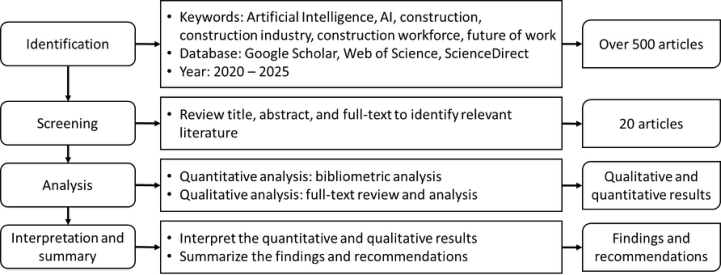
A systematic review was conducted in this study to investigate how AI influences the future of work in the construction industry. The literature search and screening process follows the PRISMA (Preferred Reporting Items for Systematic reviews and Meta-Analyses) framework (Page et al., 2021). Figure 1 shows the methodology of this study, including four steps: literature identification, literature screening, data analysis, and interpretation and summary (Passas, 2024).
Artificial Intelligence and the Future of Work in the Construction Industry 1157
Figure 1: Research methodology of this study.
The first step is to search relevant literature in multiple databases (i.e., Google Scholar, Web of Science, and ScienceDirect). Keywords used for search include: “future of work”, “artificial intelligence”, “AI”, “construction”, and “construction industry”. Over 500 articles were identified in this step. Second, at the screening step, the titles and abstracts of the articles were reviewed to exclude irrelevant literature. 35 articles were downloaded for further review. After that, full-tests were carefully reviewed to identify the literature closely related to the topic. Finally, 20 articles were included for further analysis. Third, the analysis step covers both qualitative and quantitative analyses. Quantitative analysis covers the bibliometric analysis conducted by VOS viewer to show the relationships between keywords in the identified articles. Qualitative analysis indicates reviewing full-texts and summarizing key information manually. The last step is interpreting both the quantitative and qualitative results and summarizing key findings and recommendations for both future research and industrial practices.
RESULTS AND DISCUSSION
Based on quantitative and qualitative analysis, current research trends in the intersection of AI and the construction workforce are summarized. Major challenges in this field are also identified. Finally, future research directions and practical recommendations are proposed.
Research Trends
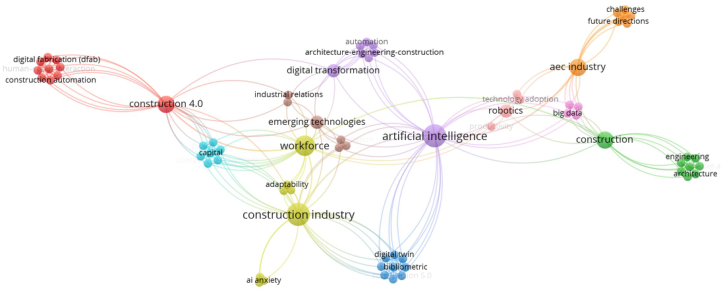
Figure 2 shows the network graph of 20 articles using the VOS viewer. Different colors and lines represent the clusters of items (keywords from articles) and their relationships. In total, 72 items were included in this network, forming ten clusters. The “artificial intelligence” and “construction industry” were the core items in the network, which are the most relevant keywords of this topic. Some other items also played an important role, such as “workforce”, “construction 4.0”, “capital”, “robotics”, “automation”, “digital transformation”, etc., indicating that this is a comprehensive topic that mostly considers the connections between construction operations, workforce development, and digital technologies.
1158 Wu
Figure 2: Network graph of keywords.
Table 1 shows the detailed items for the ten clusters. Four major research trends were summarized: (1) Cluster 1: Construction operations and AI, (2) Clusters 2, 4, and 10: Construction workforce education and AI, (3) Clusters 3, 5 and 6: Construction industry development and AI, and (4) Clusters 7, 8 and 9: AI and relevant technologies.
Table 1: Clusters in the network graph.
Table available in the original PDF paper.
Clusters Items (Keywords) Cluster 1 Construction 4.0, construction automation, digital fabrication (dfab), human-robot interaction, industrialized construction, organizational structure, platform-based integration, project delivery and contract strategies, project-based integration, robotic construction
Cluster 2 Architecture, construction, education, engineering, generative AI, LLM (large language models), practice, trends, upskilling Cluster 3 Bibliometric, construction 5.0, digital twin, HRC (human-robot-collaboration), human centricity, industrial 5.0, IOT (internet of things), resilience, sustainability
Cluster 4 Adaptability, AI anxiety, AI literacy, case study, construction industry, modern methods of construction, skills, workforce Cluster 5 Architecture-engineering-construction, artificial intelligence, automation, digital transformation, industry 4.0, machine intelligence, review, scientometric
Cluster 6 Capital, competitive advantage, competitiveness, future, industrial revolution, resources, technological change Cluster 7 AEC industry, challenges, future directions, large language models, literature review, transformer-based architecture, use cases
Cluster 8 Emerging technologies, home automation, industrial relations, internet of things, smart manufacturing, socio-technical change Continued
Artificial Intelligence and the Future of Work in the Construction Industry 1159
Table 1: Continued Clusters Items (Keywords)
Table available in the original PDF paper.
Cluster 9 Big data, human centered, machine reading comprehension, natural language processing Cluster 10 Productivity, robotics, technology adoption, trust
The first research area supported by Cluster 1 is how to apply AI in construction operations, such as “construction automation”, “human-robot interaction”, “project delivery and contract strategies”, “platform-based integration”, and “project-based integration”. It indicates that AI could transform the future of work by revolutionizing construction operation methods, including both construction and management. For example, Darko et al. (2020) indicated that adopting AI could lead to the re-engineering of construction processes. Musarat et al. (2024) explored the ways and obstacles of robotic adoption in construction. Johare et al. (2022) discussed how AI could change business strategies in the construction sector. One key finding is that AI is not likely to completely replace the human workforce (Emaminejad and Akhavian, 2024; Johare et al., 2022). Human input and cooperation are important for the successful and effective adoption of AI and relevant technologies (Rafsanjani and Nabizadeh, 2023).
Second, current studies discussed how AI influences the construction workforce and education, as shown in clusters 2, 4, and 10. A majority of studies mentioned that AI is closely related to education and training. Adopting AI requires upskilling of workers, such as a fundamental understanding of AI, familiarity with AI tools, integration of AI and construction knowledge, and other digital transformation skills (Li, Griffin, et al., 2025; Onatayo et al., 2024). New human roles and skill sets may evolve as AI and other digital technologies become established (Pink et al., 2024). Robust training programs are necessary for developing the AI-skilled workforce (Bogosian et al., 2020), which is also an essential component for managing workforce productivity (Nwaogbe et al., 2025). Also, construction workers’ adaptability and anxiety about AI are significant topics. It was shown that a clear understanding of AI and relevant skills could reduce AI anxiety and facilitate adaptation to AI use (Li, Griffin, et al., 2025; Maitz et al., 2022). In addition, some studies investigated the trust between AI and the construction workforce (Chang and Hasanzadeh, 2024; Emaminejad et al., 2024; Emaminejad and Akhavian, 2022), showing the multiple dimensions of trust frameworks.
Third, AI was closely related to the construction industry development, as shown in clusters 3, 5, and 6. Human-centric approach of AI adoption and human-AI collaboration emphasize the transformation of the construction workforce with upskilling or reskilling, leading to the transition of the industry (Akhavan et al., 2025). Integrating AI adoption with construction 5.0 & industry 5.0 and construction 4.0 & industry 4.0 connects the new approach with resilience, sustainability, and other dimensions of the industrial revolution (Akhavan et al., 2025; Hajirasouli et al., 2025). It was also highlighted that even though there are some concerns about
1160 Wu
job displacements, AI adoption will not reduce total employment in the construction industry: existing roles will evolve, and new roles will be created (de Soto et al., 2022). AI adoption and the workforce’s adaptability will also influence the competitive advantage of organizations in the construction industry (Aigbe et al., 2024). Besides the AI-relevant training, AI-integrated organizations also require dynamic leadership and excellent teamwork (Ren et al., 2024).
Finally, some studies explored AI and other relevant technologies, as listed in clusters 7, 8, and 9, such as generative AI, large language models (LLM), internet of things (IoT), big data, and natural language processing (NLP) (Johare et al., 2022; Kampelopoulos et al., 2025). One major finding is that the application of these technologies requires human-centered approaches and should consider social and organizational changes.
Main Challenges According to the literature review, three main challenges were summarized as follows: (1) AI-related skills and training, (2) Human-centered AI, and (3) Integration of AI in the construction industry.
A majority of studies mentioned that developing the AI-skilled workforce is the major challenge in this field. The adoption of AI in the construction industry causes concerns, such as job displacement, changes in operations, security, etc. (Bogosian et al., 2020). These concerns will not only influence workers’ productivity and well-being (Emaminejad et al., 2024) but also hinder the implementation efforts of AI (Li, Griffin, et al., 2025). Moreover, it was indicated that construction workers have a rather superficial and vague understanding of AI and lack appropriate resources of information about AI (Maitz et al., 2022). Therefore, it is necessary to provide specialized training and orientation programs to familiarize workers with AI and relevant technologies (e.g., robotics) and address their concerns over the implementation of these new technologies (Musarat et al., 2024). The training and required skills would cover a wide range of topics, such as basic concepts of AI, AI roadmaps and strategies at the company-level, required and specialized skills for utilizing AI in their tasks, strategies to embrace changes, etc.
How to develop human-centered AI is another key concern. Existing studies mainly focus on the technical aspects of AI adoption in multiple construction tasks and highlight the improvement of performance. However, it was shown that AI will not completely replace the labor force (Pink et al., 2024). Instead, human workers and AI may need to collaborate in future construction tasks. When the AI is unable to properly handle complex human-related information and tasks in construction operations, human input is necessary (Rafsanjani and Nabizadeh, 2023). In the transition from construction 4.0 to construction 5.0, it is important to integrate a human-centric approach into advanced technologies such as AI (Re Cecconi et al., 2024). A balanced collaboration between humans and intelligent technologies is emphasized to improve construction efficiency
Artificial Intelligence and the Future of Work in the Construction Industry 1161
and performance as well as enhance human well-being. Therefore, the development of human-centered AI and relevant strategies and training is necessary for AI adoption in the construction industry.
Many studies also emphasized the importance of integrating AI into construction practices, particularly in conjunction with other technologies. As one of the advanced technologies, AI is usually connected with many other tools when applied in the construction field, such as robotics, IoT, big data, etc. (Johare et al., 2022; Kampelopoulos et al., 2025; Musarat et al., 2024). There are also some well-developed technologies in construction practices, such as Building Information Modelling (BIM). Utilizing these technologies could improve the productivity, safety, and efficiency of construction projects. Thus, how to integrate these different technologies and apply them in construction practices becomes an important challenge. It requires a comprehensive understanding of the construction process, knowledge of various technologies, and consideration of workers’ adaptability to changes.
Future Research Directions and Practical Recommendations Based on the current research trends and main challenges, some future research directions are discussed. The first research direction is the development of human-centered AI in construction operations. Existing studies emphasized the importance of a human-centric approach in AI adoption, while specific strategies and methods are still missing. From a technical perspective, future studies could explore how machines can better understand and utilize human input in the construction industry, especially considering different construction tasks. From the human perspective, researchers could investigate diverse factors that may influence the human- AI interaction, such as trust building, workers’ adaptability, and workers’ knowledge, skills, and abilities, which could contribute to workforce transition in the construction industry in the new era of AI and other relevant technologies. Moreover, future work could focus on the AI-related workforce training and education. While many studies highlighted the importance of AI-related training, more efforts should be made to develop specific and robust training programs. The training program not only aims to equip workers with technical knowledge of AI adoption but also offers support to the acceptance of new technologies and a smooth transition of human- AI interaction in the construction industry. Also, AI-related topics should be emphasized in construction education to provide the necessary knowledge to the new generation of the workforce. In addition, future studies could further explore construction industry development with AI. With the progress of AI adoption in the construction industry, more cases and data will be available to analyze the current trends and predict future directions of the development of construction industry. Also, it was indicated that AI adoption could support construction 5.0 and industry 5.0. More efforts are needed to explore specific ways to contribute to construction 5.0 with AI and other relevant technologies.
1162 Wu
From a practical perspective, several recommendations are provided for construction companies to better adapt to AI adoption. First, AI-related training is a necessary part to be provided. The training topics may include the introduction of AI and its application in the construction industry, required skills for different roles that may interact with AI in various ways, the culture of innovation and adaptability to changes, etc. It is an essential element to prepare workers for AI and other potential new technologies. Specific training should be provided to the management team to help establish AI roadmaps for the company. Second, with the AI integration, companies should adjust existing roles and create new roles considering AI-human collaboration. With AI adoption, some existing roles that were done by humans may be changed to be undertaken in collaboration between humans and machines. It is important to develop guidance for workers regarding how to work with AI. Also, new human roles may evolve as AI is utilized in multiple tasks, such as an AI developer. Companies should analyze their unique needs and resources to make decisions about adjusting roles in response to AI adoption. In addition, communication should be emphasized throughout the process. Most concerns stem from a lack of information and communication. To promote AI adoption, companies should develop programs to achieve transparent and prompt communication. The information that workers should be aware of may include the AI roadmaps and strategic plans at the company level, role adjustments related to AI adoption, and resources for training and relevant support regarding working with AI.
CONCLUSION
The construction industry, traditionally characterized by slow technological adoption, is undergoing a transformative shift due to the integration of AI. This study conducted a systematic review to investigate how AI will reshape the future of work in the construction industry. The methodology follows the PRISMA framework for literature search and screening. After screening over 500 sources, 20 studies from 2020 to 2025 were systematically reviewed to identify current trends, challenges, and opportunities at the intersection of AI and the future of work in the construction industry. There are some key findings. First, four current research trends were identified through a bibliometric analysis, which resulted in ten clusters: construction operations and AI, construction workforce education and AI, construction industry development and AI, as well as AI and relevant technologies. Although there are some concerns of job displacement, it was shown that AI is unlikely to replace the labor workforce in the construction industry, but will redefine some existing roles and create new roles. Main challenges include AI-related skills and training to develop the AI-skilled workforce, human-centered AI that emphasizes human-AI collaboration, and integration of AI and relevant technologies in the construction industry. Finally, future directions about human-centered AI development, AI-related training and education, and construction industry development with AI, as well as practical recommendations of AI-related
Artificial Intelligence and the Future of Work in the Construction Industry 1163
training, adjustment of roles, and transparent communication were provided to guide future research and industry practices. This study provides an innovative and comprehensive understanding of AI’s role in reshaping the future of work in the construction industry and reveals future research directions, contributing to both workforce development and AI integration in this sector. Practically, the provided recommendations could help foster a balanced, human-centric AI adoption process in the construction industry. However, this study has two limitations. First, as a preliminary literature review, this study covers a limited number of studies. Future work could expand the keywords and range of publication years to include more relevant articles. Second, this study mainly focuses on the content analysis of literature, while the information of the author, year, and region is not included. Future studies could also explore other elements in the bibliometric analysis to provide a more comprehensive understanding of this field.
REFERENCES
Aigbe, F., Aigbavboa, C., Aliu, J. and Amusan, L. (2024), “Understanding the Future Competitive Advantages of the Construction Industry”, Buildings, Multidisciplinary Digital Publishing Institute (MDPI), Vol. 14, No. 6, p. 1616, doi: 10.3390/buildings14061616. Akhavan, M., Alivirdi, M., Jamalpour, A., Kheradranjbar, M., Mafi, A., Jamalpour,
R. and Ravanshadnia, M. (2025), “Impact of Industry 5.0 on the Construction Industry (Construction 5.0): Systematic Literature Review and Bibliometric Analysis”, Buildings, Multidisciplinary Digital Publishing Institute (MDPI), Vol. 15, No. 9, p. 1491, doi: 10.3390/buildings15091491. Bogosian, B., Bobadilla, L., Alonso, M., Elias, A., Perez, G., Alhaffar, H. and Vassigh, S. (2020), “Work in Progress: Towards an Immersive Robotics Training for the Future of Architecture, Engineering, and Construction Workforce”, 2020 IEEE World Conference on Engineering Education (EDUNINE), IEEE, pp. 1–4, doi: 10.1109/EDUNINE48860.2020.9149493. Chang, W.-C. and Hasanzadeh, S. (2024), “Toward a Framework for Trust Building
between Humans and Robots in the Construction Industry: A Systematic Review of Current Research and Future Directions”, Journal of Computing in Civil Engineering, Vol. 38, No. 3, doi: 10.1061/JCCEE5. CPENG-5656. Darko, A., Chan, A. P. C., Adabre, M. A., Edwards, D. J., Hosseini, M. R. and Ameyaw, E. E. (2020), “Artificial intelligence in the AEC industry: Scientometric analysis and visualization of research activities”, Automation in Construction, Elsevier B. V., Vol. 112, p. 103081, doi: 10.1016/j.autcon.2020.103081. Emaminejad, N. and Akhavian, R. (2022), “Trustworthy AI and robotics: Implications for the AEC industry”, Automation in Construction, Elsevier B. V., Vol. 139, p. 104298, doi: 10.1016/j.autcon.2022.104298. Emaminejad, N. and Akhavian, R. (2024), “Trust in Construction AI-Powered
Collaborative Robots: A Qualitative Empirical Analysis”, Computing in Civil Engineering 2023, American Society of Civil Engineers, Reston, VA, pp. 513–521, doi: 10.1061/9780784485224.062. Emaminejad, N., Kath, L. and Akhavian, R. (2024), “Assessing Trust in Construction AI-Powered Collaborative Robots Using Structural Equation Modeling”, Journal of Computing in Civil Engineering, American Society of Civil Engineers (ASCE), Vol. 38, No. 3, doi: 10.1061/JCCEE5. CPENG-5660.
1164 Wu
García de Soto, B., Agustí-Juan, I., Joss, S. and Hunhevicz, J. (2022), “Implications of Construction 4.0 to the workforce and organizational structures”, International Journal of Construction Management, Taylor and Francis Ltd., Vol. 22, No. 2, pp. 205–217, doi: 10.1080/15623599.2019.1616414. Gkinko, L. and Elbanna, A. (2023a), “The appropriation of conversational AI
in the workplace: A taxonomy of AI chatbot users”, International Journal of Information Management, Elsevier Ltd, Vol. 69, p. 102568, doi: 10.1016/ j.ijinfomgt.2022.102568. Gkinko, L. and Elbanna, A. (2023b), “Designing trust: The formation of employees’ trust in conversational AI in the digital workplace”, Journal of Business Research, Elsevier Inc., Vol. 158, p. 113707, doi: 10.1016/j.jbusres.2023.113707. Grant Nwaogbe, Eyo Ekpenyong and Osahon Urhoghide. (2025), “Managing
workforce productivity in the post-pandemic construction industry”, World Journal of Advanced Research and Reviews, GSC Online Press, Vol. 25, No. 1, pp. 572–588, doi: 10.30574/wjarr.2025.25.1.0051. Hajirasouli, A., Assadimoghadam, A., Bashir, M. A. and Banihashemi, S. (2025), “Exploring the Impact of Construction 4.0 on Industrial Relations: A Comprehensive Thematic Synthesis of Workforce Transformation in the Digital Era of Construction”, Buildings, Multidisciplinary Digital Publishing Institute (MDPI), Vol. 15, No. 9, p. 1428, doi: 10.3390/buildings15091428. Ilbeigi, M. and Darestani Farahani, P. (2025), “Future of Construction Engineering Education in the Automation Era”, Journal of Civil Engineering Education, American Society of Civil Engineers (ASCE), Vol. 151, No. 4, doi: 10.1061/ jceecd.eieng-2098. Johare, K. P., Wagh, V. G. and Shaligram, A. D. (2022), “Scope and Impact of
Internet of Things (IoT) and Artificial Intelligence (AI) in the Global Construction Industry”, IJIRMPS, Vol. 10, No. 4, pp. 134–139. Kampelopoulos, D., Tsanousa, A., Vrochidis, S. and Kompatsiaris, I. (2025), “A review of LLMs and their applications in the architecture, engineering and construction industry”, Artificial Intelligence Review, Springer Nature, Vol. 58, No. 8, p. 250, doi: 10.1007/s10462–025-11241–7. Li, H., Zhang, Y., Cao, Y., Zhao, J. and Zhao, Z. (2025), “Applications of artificial
intelligence in the AEC industry: a review and future outlook”, Journal of Asian Architecture and Building Engineering, Taylor and Francis Ltd., Vol. 24, No. 3, pp. 1672–1688, doi: 10.1080/13467581.2024.2343800. Li, K., Griffin, M. A. and Xia, M. (Rachel). (2025), “How do workforce adaptability and reskilling initiatives drive innovations: the case of Western Australian construction industry”, Construction Management and Economics, Routledge, Vol. 43, No. 9, pp. 1–18, doi: 10.1080/01446193.2025.2511831. Maitz, K., Fessl, A., Pammer-Schindler, V., Kaiser, R. and Lindstaedt, S. (2022), “What do Construction Workers Know about Artificial Intelligence? An Exploratory Case Study in an Austrian SME”, Mensch Und Computer 2022, ACM, New York, NY, USA, pp. 389–393, doi: 10.1145/3543758.3547545. Musarat, M. A., Alaloul, W. S., Rostam, N. A. Q. A. and Khan, A. M.
(2024), “Substitution of workforce with robotics in the construction industry: A wise or witless approach”, Journal of Open Innovation: Technology, Market, and Complexity, Elsevier B. V., Vol. 10, No. 4, p. 100420, doi: 10.1016/ j.joitmc.2024.100420. Nabizadeh Rafsanjani, H. and Nabizadeh, A. H. (2023), “Towards human-centered artificial intelligence (AI) in architecture, engineering, and construction (AEC) industry”, Computers in Human Behavior Reports, Elsevier B. V., Vol. 11, p. 100319, doi: 10.1016/j.chbr.2023.100319.
Artificial Intelligence and the Future of Work in the Construction Industry 1165
Onatayo, D., Onososen, A., Oyediran, A. O., Oyediran, H., Arowoiya, V. and Onatayo, E. (2024), “Generative AI Applications in Architecture, Engineering, and Construction: Trends, Implications for Practice, Education & Imperatives for Upskilling—A Review”, Architecture, Multidisciplinary Digital Publishing Institute (MDPI), Vol. 4, No. 4, pp. 877–902, doi: 10.3390/architecture4040046. Page, M. J., McKenzie, J. E., Bossuyt, P. M., Boutron, I., Hoffmann, T. C.,
Mulrow, C. D., Shamseer, L., et al. (2021), “The PRISMA 2020 statement: an updated guideline for reporting systematic reviews”, BMJ, BMJ Publishing Group, Vol. 372, p. n71, doi: 10.1136/bmj.n71. Passas, I. (2024), “Bibliometric Analysis: The Main Steps”, Encyclopedia, MDPI AG, Vol. 4, No. 2, pp. 1014–1025, doi: 10.3390/encyclopedia4020065. Pink, S., Lyall, B. and Korsmeyer, H. (2024), Construction Work Futures:
Automation, Robotics and Work Futures in the Australian Construction, doi: 10.26180/26368825. Re Cecconi, F., Khodabakhshian, A. and Rampini, L. (2024), “Industry 5.0 in Construction: Towards a More Human-Centric and Ethical AI”, pp. 101–122, doi: 10.1007/978–3-031–77197-2_6. Ren, J., Ishak, S. and Hamzah, H. Z. (2024), “AI and the Future of Work:
Investigating the Transformation of the Labor Market in China’s Secondary Sector with a Focus on Income Distribution, Skill Gaps, and Unemployment Rates”, Cuadernos de Economia, Asociacion Cuadernos de Economia, Vol. 47, No. 134, pp. 38–52, doi: https://doi.org/10.32826/cude.v47i134.1405. Selenko, E., Bankins, S., Shoss, M., Warburton, J. and Restubog, S. L. D.
(2022), “Artificial Intelligence and the Future of Work: A Functional-Identity Perspective”, Current Directions in Psychological Science, SAGE Publications Inc., Vol. 31, No. 3, pp. 272–279, doi: 10.1177/09637214221091823. Zhang, J. and Jiang, S. (2024), “Review of artificial intelligence applications in construction management over the last five years”, Engineering, Construction and Architectural Management, Emerald Publishing, doi: 10.1108/ECAM-03–2024- 0313.
LISTED IN THE AHFE DIGITAL BOOKSTORE CATALOGUE
Explore the complete digital volume
Human Factors in Design, Engineering, and Computing
Read this individual research paper free through the original publisher, or explore the full digital proceedings book.
ISBN 978-1-964867-75-5
Explore this ISBN in the AHFE Bookstore ↗Listed in the July 2026 bookstore catalogue; search by ISBN to confirm current availability · Digital book purchase optional