Maria Moga (2025). Visual Complexity and Aesthetic Value in Design: Between Hedonomics, Emotional Experience, and Ergonomic Aesthetics. In: Human Systems Engineering and Design (IHSED2025): Future Trends and Applications. AHFE Open Access, vol. 198, pp. 207–215. https://doi.org/10.54941/ahfe1006777
This article proposes a methodology for analyzing morphological load in the design of seating objects, with a focus on the relationship between aesthetics and functionality. Drawing on recent theoretical concepts such as embodied aesthetics and affective ergonomics, a semi-quantitative evaluation grid is developed to quantify the degree of formal elaboration of a chair based on six key criteria: complexity, functional justification, expressiveness, adaptability, sensory interaction, and affective function. The grid is applied to eight iconic chairs from modern and postmodern design, resulting in a tripartite typology: chairs with predominantly functional load, predominantly aesthetic load, and balanced load. Through comparative analysis and graphical representation of these models, the decisive role of morphology in communicating the aesthetic and ergonomic values of the product is highlighted. The article contributes to the development of an evaluation method applicable in design research, education, and professional practice.
In the context of the evolution of contemporary product design, a productive tension can be observed between the functional demands of objects and the aesthetic aspirations of forms. This dynamic is particularly evident in the case of seating objects—especially chairs—which lie at the intersection of the human body, space, and visual language.
Starting from the premise that the form of a seating object can carry morphological load driven by either functional or aesthetic considerations, we propose a comparative analysis that distinguishes between typologies in which morphological load is dictated by ergonomics, by aesthetic intent, or by seating instruments that achieve a balance between the two.
In this article, we propose an analytical grid that quantifies both aesthetic and functional load, applicable transversally across examples of iconic design. The objective is to formulate a theoretically grounded and empirically tested typology that offers a clear tool for evaluating the morphology of seating objects.
THEORETICAL FRAMEWORK Embodied Aesthetics and the Perception of Form
One of the most relevant contemporary directions is embodied aesthetics, which argues that aesthetic appreciation is deeply rooted in the body, movement, and sensation (Johnson, 2007; Gallagher, 2005). Embodied aesthetics serves as the philosophical and cognitive foundation of a new design paradigm—one in which form is not merely “applied on top of function,” but directly participates in function through the body, emotion, and sensation.
It is thus both a direct precursor and a theoretical validation source for hedonomics, ergonomic aesthetics, and emotional experience in design. Accordingly, the form of a chair is not merely a visual element but is perceived through a multisensory and kinesthetic register. This approach justifies forms that may appear “formally loaded” as fulfilling a bodily function of anticipating comfort or posture.
Affective Ergonomics and Functional Morphology In parallel, the field of affective ergonomics proposes an expansion of classical ergonomics by integrating emotional and symbolic dimensions (Norman, 2004; Zhou, Zhang & Liu, 2023). According to this paradigm, functional morphology is not aesthetically neutral: certain forms contribute to emotional comfort and support affective relationships with the product. Therefore, formal complexity can have indirect ergonomic justification.
Morphological Load: Between Expressiveness and Functionality Building on these foundations, one can speak of a theory of morphological load as an analytical dimension in design. This involves evaluating form not only in terms of proportions and materials, but also in terms of the level of formal elaboration (details, volumes, curves, decorative elements) relative to either functional or expressive intent (Zuo & Jones, 2018; Desmet & Hekkert, 2007).
Phenomenological Approaches and the Aesthetics of Lived Space A complementary perspective comes from the phenomenology of design (Griffero, 2014), where objects are experienced as “atmospheres” that influence moods and behaviors. In this sense, a chair with an elaborate form can communicate identity, status, or symbolic belonging, regardless of strict physical comfort.
METHOD
To highlight the differences between the shapes of the analyzed chairs and to classify them within a functional-aesthetic typology, we developed a morphological evaluation grid that addresses both the aesthetic and ergonomic-functional dimensions of the seating object. The grid was based on the following relevant studies concerning the relationship between morphological load and perceived design in seating instruments.
de Rouvray et al. focus on office chair design, achieving affective and sensory evaluation using design research, comparative empirical study,
Visual Complexity and Aesthetic Value in Design: Between Hedonomics 209
sensory assessment, and free categorization. The study found that sensory and affective preferences were significant, as free categorization identified key product attributes; extended sensory interaction was emphasized (de Rouvray et al., 2008).
de Rouvray (2006), in his study on integrating emotional and sensory preferences into chair design concepts, investigates sensory modalities, affective response, product attributes, and contextual adaptability, using empirical validation and hedonic classification (preference evaluation).
In their study on the chair as a mediator of body-object-space relationships, identity, and symbolism, Fernandes et al. focus on the relationship between the body and the object, using theoretical methods and case studies to investigate form complexity, ergonomics, affective identity, and sensory experience. The study reports that the seating instrument, through its form, mediates identity and experience, that objectives are context-dependent, and that emotional and symbolic values are central (Fernandes et al., 2025).
The idea that the perception of comfort changes with interaction is also emphasized in the study by Garcia et al. (2017). This research focuses on ergonomics, aesthetics, affective response, and sensory interaction, using empirical methods, semantic differentiation (attribute evaluation), and variation analysis. The conclusions show that the perception of comfort evolves through interaction, that morphological elements influenced by both aesthetics and ergonomics are equally important, but that first impressions cannot predict long-term comfort.
The move beyond the physical dimension of comfort was suggested as early as 2007 by Knoll (2007), in a study that evaluated the aesthetic impact of seating instruments, formal design criteria, and sensory interaction, using empirical studies and theoretical analyses derived from evolutionary psychology. The conclusion emphasizes that aesthetic appeal enhances the sensation of comfort—at least initially—and that objective design principles can improve comfort and product acceptance in the market.
Regarding the materials used in seating concepts and product sustainability, Salvador (2018) examines adaptability, sensory comfort, and affective impact, using investigation methods based on literature reviews and case studies. The author concludes that adaptability and material choice influence comfort.
The relationship between minimalist design and consumer preferences was studied by Poon (2017). Minimalist design elements, appearance, perceived quality, and social distinction were analyzed through case studies and theoretical and conceptual contextualizations. The study showed the influence of minimalism on preferences, suggesting that appearance is key to perceived quality.
The status value of seating instruments, through historical, cultural, and aesthetic significance, is addressed by Alkholy (2024). The study focuses on status, individuality, aesthetic and artistic impact, and form complexity, using analytical, historical, and descriptive methods along with a literature review. The study concludes that seating objects express status and individuality. Design reflects cultural and historical context, and more detailed studies could provide further insights.
210 Moga
These studies highlight the following perspectives on morphological complexity:
The involvement of multiple senses and the triggering of affective responses are central to identifying product attributes.
Form complexity is intertwined with ergonomic adaptation and self- identity.
Perceptions of comfort, shaped by both aesthetic and ergonomic factors, evolve with use.
Objective aesthetic characteristics can enhance initial comfort.
Design adaptability—through material choice and modularity—is critical in chair design.
Minimalist aesthetics function as markers of quality and social distinction.
The complexity of form in cultural and historical contexts is linked to individuality and status.
The design elements evaluated across these studies include:
Sensory aspects (interaction, comfort, modalities, experience): 6 out of 8 studies.
Affective, emotional, or identity-related elements: 6 out of 8 studies.
Ergonomics or comfort: 3 out of 8 studies.
Aesthetics or appearance: 4 out of 8 studies.
Product attributes: 2 out of 8 studies.
Adaptability, personalization, or context adaptation: 3 out of 8 studies.
Symbolism, status, individuality, or social distinction: 3 out of 8 studies.
Sustainability: 1 out of 8 studies.
Other elements (formal design criteria, minimalism, material choice, quality perception, form complexity): each in 1–2 studies.
Key points emerging from these studies include:
Form complexity manifests as anatomical fit, modularity, uniqueness, and symbolic significance.
Functional justification is reflected in ergonomic performance and material-based adaptations ensuring long-term comfort.
Aesthetic and expressive impact is conveyed through visual, tactile, and contextual cues that shape consumer response.
Personalization and adaptability result from design approaches such as free categorization and modular adjustments.
Sensory interaction is evaluated through multimodal methods (e.g., semantic differentials, free categorization, hedonic classification) capturing extended tactile, visual, and experiential qualities.
Affective and identity-related functions are articulated through emotional, symbolic, and culturally situated design features.
The research evidence supports the inclusion of all six key points as criteria in a morphological analysis framework for seating design, with each criterion being thoroughly examined in multiple studies. Two of these criteria are categorized as ergonomic (functional), while four are categorized as aesthetic.
Visual Complexity and Aesthetic Value in Design: Between Hedonomics 211
Ergonomic Criteria
Functional justification – The extent to which form supports ergonomic considerations (e.g., posture, lumbar support).
Adaptability/personalization – The degree to which form supports ergonomic needs through adjustability or customization.
Aesthetic Criteria
Form complexity – The degree of formal elaboration, from simple geometric shapes to sculptural compositions.
Expressive impact – The level of visual expressiveness or iconic presence.
Affective/identity function – The object’s potential to generate attachment, identity, or personal/social symbolism.
Sensory interaction – The use of materials, textures, and combinations that engage the senses.
To highlight the differences among the analyzed chair forms and classify them into a functional-aesthetic typology, we developed a morphological evaluation grid that addresses both the aesthetic and ergonomic-functional dimensions of the seating object.
The proposed method (Table 1) is semi-quantitative, assigning scores to each criterion on a scale from 1 to 5, where:
1 represents a minimal level of the analyzed feature (simplicity, formal austerity),
5 signifies a high degree of load (formal elaboration, functional or expressive complexity),
3 indicates a point of balance between the two extremes.
Multiple adjustments, adaptive or smart form Sensory interaction Neutral, standardized materials
Functional-aesthetic mix (e.g., wood + fabric)
Rich textures, unexpected combinations, visually seductive Affective/Identity function
No emotional engagement
Balanced visual and physical comfort
Emotional response, attachment, memorability
212 Moga
Total Score Calculation and Interpretation Each criterion is assigned a score of 1, 3, or 5 based on the observable degree of morphological load. The maximum total score is 30 points. Based on this total, we propose the following interpretation:
6–13 points – Simplified chair with a strictly functional orientation
14–21 points – Chair balanced between aesthetics and ergonomics
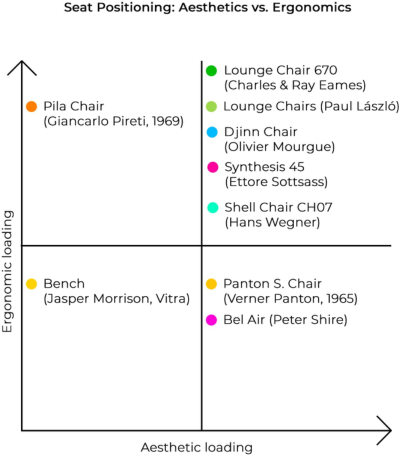
22–30 points – Morphologically loaded chair, with either aesthetic or ergonomic predominance This interpretation is accompanied by a graphical positioning on two axes:
X-axis →aesthetic load
Y-axis →ergonomic load This two-dimensional diagram allows for the placement of chairs within an interpretive morphological space, offering a synthetic overview of the form– function relationship in contemporary design.
Case Study: Analyzed Chairs To validate the proposed morphological grid, we selected nine modern chairs with high symbolic, historical, and functional value. These models range from functional minimalism to sculptural expressiveness, covering various stylistic currents (Modernism, Postmodernism, Scandinavian, Avant-Garde). Each model was evaluated using the grid based on aesthetic and ergonomic criteria, and their positions were represented in the following diagram (Figure 1):
Figure 1: Positioning of the eight analyzed chairs according to aesthetic and ergonomic load.
Visual Complexity and Aesthetic Value in Design: Between Hedonomics 213
Table 2: Positioning of the 9 analyzed chairs according to aesthetic and ergonomic load.
Table available in the original PDF paper.
Total Score Interpretation Observations
Model Aesthetics (1–5)
Ergonomics (1–5)
Panton S Chair (Verner Panton, 1965)
Iconic curved form, but rigid. Strong visual impact.
5 2 21 Balanced chair between aesthetics and ergonomics
Inspired by space-age forms. Comfortable, yet stylized.
4 4 24 Morphologically loaded chair, aesthetically or ergonomically dominant
Shell Chair CH07 (Hans Wegner)
Organic forms, gentle curves. Visual and physical comfort.
4 4 24 Morphologically loaded chair, aesthetically or ergonomically dominant
Lounge Chair 670 (Charles & Ray Eames)
A symbol of modern comfort. Advanced ergonomic design
4 5 27 Morphologically loaded chair, aesthetically or ergonomically dominant
Lounge Chairs (Paul László)
Sober aesthetics, but highly comfortable. Lounge adaptability.
3 4 21 Balanced chair between aesthetics and ergonomics
Bench (Jasper Morrison, Vitra)
1 2 10 Simplified chair with strict functional orientation
Robust and functionally clear, but lacks adjustability or advanced ergonomics.
RESULTS AND DISCUSSION
The analysis of the nine iconic chair models using the proposed morphological evaluation grid, (Table 2) reveals a coherent distribution across the three identified typologies: functional, aesthetic, and balanced. This distribution supports the thesis that the morphological load of form is not random but corresponds to clearly directed intentions in the design process.
214 Moga
Typological Distribution Chairs with predominantly functional load (score ≤13):
Bench (Jasper Morrison, Vitra).
Plia Chair – Extreme minimalism, focused on portability and utility.
Chairs balanced between aesthetics and functionality (score 14–21):
Synthesis 45 – Industrial, sober language with clear visual intentions.
Lounge Chairs – László – sober form but high comfort.
Panton Chair – although aesthetically iconic, its total score indicates marginal balance.
Chairs with accentuated aesthetic or ergonomic load (score ≥22):
Djinn Chair and Shell Chair – high-level balance with fluid forms and integrated functionality.
Eames 670 – a symbol of ergonomic and aesthetic refinement.
Bel Air – a pure example of postmodern sculptural experimentation.
CONCLUSION
This research highlights the relevance of morphological load as an indicator in product design analysis, with specific applicability to the study of chairs. Through the development and application of a semi-quantitative grid, it was demonstrated that the morphology of an object is never neutral, but rather reflects distinct functional, affective, and aesthetic intentions.
The results indicate the existence of three main typologies: Chairs with predominantly functional load, where the form is reductive and rationalized (e.g., Plia, Bench).
Chairs with predominantly aesthetic load, where the form assumes an expressive, symbolic, or even playful role (e.g., Bel Air, Panton).
Balanced chairs, which achieve a synthesis between aesthetics and functionality (e.g., Eames 670, Shell Chair).
The morphological positioning analysis allowed for a visualization of the conceptual distribution of these chairs, suggesting that the relationship between aesthetics and ergonomics is not one of opposition, but of functional co-implication.
The integration of contemporary theories such as embodied aesthetics, hedonomics, and affective ergonomics supports this vision: form is experienced through the body, in interaction with space and one’s own emotions.
The proposed methodology proves useful both as a research tool in design and as a pedagogical or analytical guide for art historians, designers, and critics. Moreover, it opens avenues for future extended applications, including those using AI-assisted tools or augmented visual analysis.
Visual Complexity and Aesthetic Value in Design: Between Hedonomics 215
REFERENCES
Alkholy, I. (2024). Theorizing the Chair: History, Culture, and Design. Evolutionary Studies in Imaginative Culture, 1751–1761. https://doi.org/ 10.70082/esiculture.vi.1553 Desmet, P., & Hekkert, P. (2007). Framework of product experience. International Journal of Design, 1(1), 57–66. Fernandes, A. S., Mariño, S. M., & Hernández, M. H. (2025). The Chair as
a Mediator of Complex Relationships Between Body and Object, Between Subject and their Space. Revista Foco, 18(2), e7662. https://doi.org/10.54751/ revistafoco.v18n2-030 Gallagher, S. (2005). How the Body Shapes the Mind. Oxford: Clarendon Press.
https://doi.org/10.1093/0199271941.001.0001 Griffero, T. (2014). Atmospheres: Aesthetics of Emotional Spaces. Routledge. Johnson, M. (2007). The Meaning of the Body: Aesthetics of Human Understanding.
University of Chicago Press. Knoll, C. (2007). The influence of visual judgment on physically perceived comfort using seating as an example. Technical University of Munich, Chair of Ergonomics. Doctoral dissertation. https://mediatum.ub.tum.de/doc/619306/ 619306.pdf Liu, W., Yu, R., & Xie, Y. (2022). Product semantics and emotional response in chair
design. International Journal of Industrial Ergonomics, 92, 103352. Locher, P. (2015). Contemporary experimental aesthetics: State of the art. Annals of the New York Academy of Sciences, 1337(1), 11–18. Maradei García, F., Galindo Estupiñan, Z., & Castellanos Olarte, J. (2016).
Evaluation of Comfort in Office Chair Design. Revista UIS Ingenierías, 16(1), 69–74. https://doi.org/10.18273/revuin.v16n1-2017007 Norman, D. A. (2004). Emotional Design: Why We Love (or Hate) Everyday Things.
Basic Books. Poon, S. (2017). The Role of Minimalist Aesthetics in Influencing Consumer Preferences for Furniture Design. New Design Ideas, Vol. 1, No. 1, 50–58. https://jomardpublishing.com/UploadFiles/Files/journals/NDI/V1N1/PoonS.pdf de Rouvray, A. (2006). Integrating emotional and sensory preferences in the design
of furniture: Proposal of an affective engineering method. Humanities and Social Sciences. Arts et Métiers ParisTech. English. ⟨NNT: 2006ENAM0063⟩. ⟨pastel- 00002196⟩. de Rouvray, A., Bassereau, J., Duchamp, R., Schneider, J., & Charbonneau, S. (2008).
Perception and Deception: How Quantity and Quality of Sensory Information Affect Users’ Perception of Office Chairs. The Design Journal, 11, 29–50. https://doi.org/10.2752/175630608X317896 Saffer, D. (2010). Designing for Interaction: Creating Smart Applications and Clever Devices. New Riders. Salvador, C. (2019). Human Interaction, Emotion and Sustainability: Designing
Wooden Children’s Furniture. In: Rebelo, F., Soares, M. (eds.) Advances in Ergonomics in Design. AHFE 2018. Advances in Intelligent Systems and Computing, vol. 777. Springer, Cham. https://doi.org/10.1007/978-3-319-94706- 8_63 Zhou, X., Zhang, W., & Liu, Y. (2023). Aesthetic ergonomics: Integrating usability and aesthetics in product design. Applied Ergonomics, 109, 103993. https://doi.org/10.1016/j.apergo.2023.103993 Zuo, L., & Jones, M. (2018). The role of product form in emotional response:
A systematic review. Design Studies, 56, 51–77.
LISTED IN THE AHFE DIGITAL BOOKSTORE CATALOGUE
Explore the complete digital volume
Human Systems Engineering and Design (IHSED2025): Future Trends and Applications
Read this individual research paper free through the original publisher, or explore the full digital proceedings book.
ISBN 978-1-964867-74-8
Explore this ISBN in the AHFE Bookstore ↗Listed in the July 2026 bookstore catalogue; search by ISBN to confirm current availability · Digital book purchase optional