Maria Moga, Dan Radu Moga (2024). Character Development: Bridging Digital and Traditional Drawing Techniques. In: Intelligent Human Systems Integration (IHSI 2024): Integrating People and Intelligent Systems. AHFE Open Access, vol. 119, pp. 619–626. https://doi.org/10.54941/ahfe1004527
Digital painting has some particularities that distinguish it from traditional drawing. These can have an influence on the ways, the stages a visual artist goes through to develop and stabilize a character. These features allow for a clearer ordering of the relationship between structure and function in character design, with a positive influence on the clarity and coherence of visual information.The working hypothesis of this study proposes a better use of digital applications in relation to the representation and structured development of the character. Digital applications allow the inclusion from early stages of synthetic shapes for the interior components that will ultimately determine and characterize the character. Elements of applied, artistic anatomy can find their place and role much more clearly using digital applications. Characters developed in this way will have a greater efficiency of graphic representation and expressiveness of the message.Thus, a system is created between the student and the graphics tablet. In this system, the student's creativity represents the input introduced in the digital subcomponent. The output is the character development stages digitally reproduced and understood.The verification of the hypothesis considered the characteristics of the complex system developed between the artist and the digital medium of representation. Summing them up they are:• much easier way to work at scale,• the depth of the drawing or the details can be much more easily modified according to the needs of the construction drawing,• the equivalence between the projective content of the student and the detailed content of the created character is achieved much more easily,• overlap of the planes and implicitly the internal and external anatomical structure• for fantastic and imaginary characters, truthfulness is replaced by an anatomical logic of the relationship between the external form and the internal structureAn assignment was administered to two groups of students. The first group of students chose to develop the theme using the traditional methods of concept drawing. Group two used the graphics tablet and digital applications. The proposed theme was the development of a character for which the relationship between skeletal volumes and body shapes should be highlighted, the mobility in the joints should be clear and the connection between the shape of the cranial volume and the expression of the physiognomy.The concepts obtained by the students in the development of the theme were compared using criteria, the most important of which are: the stability of the concept, the logic and coherence in the complementarity of the anatomical forms, the legibility of the drawing and the details, the degree of complexity of the character, the ability of the character to wear a message and to be expressive.The results confirmed the hypothesis and showed that the digital construction drawing is more advantageous. The constructive method in drawing using the digital support contributes to the realization of the character.In conclusion, in the search and identification phase of the concept, the observation drawing is not useful as it only describes and does not explain. The constructive drawing as a result of the student-digital environment interaction, is the one that proposes the character in all the explicit complexity of the connection between the internal anatomical structure and the external conformation.
The digital painting possesses several distinct characteristics that set it apart from traditional drawing. These aspects influence the working method and the stages an artist undergoes to develop and stabilize a character. They enable a clearer ordering of the relationship between the structure and function in character drawing, positively impacting the clarity and coherence of visual information.
We have been concerned with the differences between practices on tradi- tional media and digital painting to enhance students’ skills. The working hypothesis is represented by the advantage of the bidirectional method in structuring the character. Validation of the method was achieved by employ- ing digital tools compared to those used in traditional media. In the past two decades, studies and concerns that delineate the dynamic elements of the interaction between the human user and the working environment (traditional material/graphic tablet) have been published.
In 2000, Tzafestas argued for the significance of digital tools that lever- age the dexterity of traditional drawing. He referred to the potential for developing behavioral models and algorithms for regulating parameters in
digital painting, such as color, through the use of the brush line. In 2007, Chin and Tan reported on the results of an exploratory study on the impact of graphic tablets on users’ graphic synthesis capabilities. In their study, they highlighted the value of the tablet as a thinking tool, a teaching and learning instrument, and a platform for documenting design thinking. In 2008, Beryl Plimmer asserted the existence of a natural and intuitive interaction with the computer for tasks involving document markup and sketching. Usabil- ity testing for dominant pen-based software revealed a connection with the operating system. However, when users were more accustomed to the key- board and mouse, they tended to opt for this familiarity over the use of a pen.
Budiman et al., analyze the impact of hand drawing on cognitive capac- ity, asserting that today, more than ever, its significance needs to be upheld on practical grounds. Sitdhisanguan and Amornchewin introduced the con- cept of mobile learning, and in their study, they discussed the effectiveness of digital-supported learning.
The structuring of the character is significantly better supported in a bidi- rectional approach that involves developing the concept in two directions: – From the exterior of the character towards the interior, determining solid/skeletal volumes and skeletal references. – From the interior, back towards the external forms, by adding soft parts.
Continuing, we will refer to this approach as ‘out-in-out’ for simplification purposes.
Motivation, Description, Method The method “out-in-out” is utilized to stabilize character drawing and holds innovative characteristics within the discipline of Art Anatomy for the devel- opment of animation and gaming characters within our department. It’s well-known that initial efforts in the learning phase of character drawing are often characterized by an immediate lack of or delayed stabilization of the character’s morphology. Beginners are frequently tempted to alter the char- acter’s morphology with each subsequent representation, driven by the desire to perfect the character.
The beginner’s temptation lies in constantly attempting to improve the character with each representation. These successive representations encom- pass a range of poses, attitudes, body geometries viewed from different angles: anterior, posterior, lateral, semi-anterior profile, semi-posterior pro- file, and even superior or inferior perspectives. The “out-in-out”method pro- poses an intermediary solution for these successive representations through the use of interior-skeletal solid volumes.
The character’s morphology, obtained through a free discourse between vision and hand drawing, is broken down into solid volumes of the torso, cra- nial extremities, and according to the straightforward directions of the axes of the upper and lower limbs. To render these solid skeletal volumes, students are encouraged to employ ovoid forms and sections through ovoid shapes. The method involves the representation of volumes and the reconstruction of soft parts in the drawing, based on the previously obtained solid skeletal
Character Development: Bridging Digital and Traditional Drawing Techniques 621
volumes. Students are prompted to identify the solid references and rely on simple geometries for representation. These simple geometries facilitate a consistent solid structure, thereby ensuring stability for the character across successive representations.
We aim to verify the hypothesis by supporting the graphic process with the assistance of a tablet and specialized software. Digital applications enable the early inclusion of synthetic forms for the internal components that will ultimately determine the character. Applied anatomy and artistic anatomy elements can more clearly find their place and role using digital applica- tions. Characters developed in this manner will exhibit greater graphical representation efficiency and message expressiveness.
The hypothesis verification considered the characteristics of the com- plex system developed between the artist and the digital representation environment. In this creative system, the student’s creativity represents the input introduced into the digital subcomponent. The output consists of the character development stages, reproduced and understood at the digital level.
Summarizing the characteristics of the interaction between the student and the graphic tablet:
A much easier working scale.
Drawing depth or details can be more easily modified according to the needs of the construction drawing.
Sensory feedback from the pen, the digital drawing surface, roughness, and latency.
The equivalence between the student’s projective content and the char- acter’s detailed content is achieved much more easily.
Overlaying planes and consequently, the internal anatomical structure with the external structure.
For fantastical and imaginary characters, veracity is replaced with an anatomical logic of the relationship between the external form and internal structure.
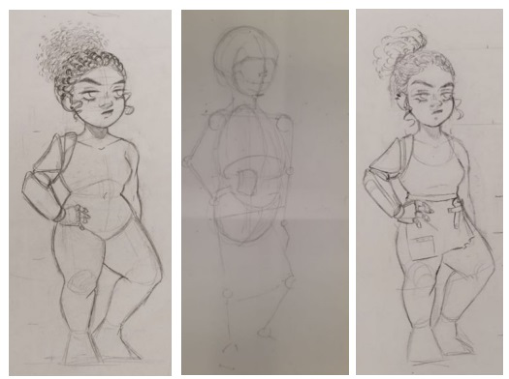
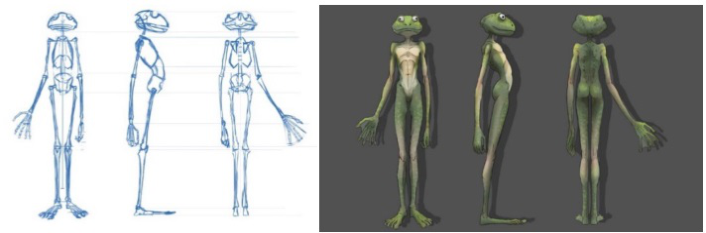
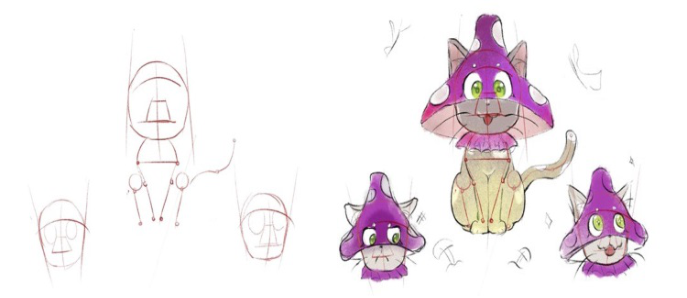
STUDY GROUP AND ASSIGNMENT ADMINISTRATION The study involved six first-year students enrolled in the graphic design spe- cialization. Three of them had prior experience in character drawing. All students were in the early weeks of their studies. All six students received the same task: to identify the formal premises for an animation or gaming char- acter (creating a character through sketching or construction drawing). The time allocated for responding to the task was 3 hours. The specific focus was the ‘out-in-out’ methodology. According to the teachings of the out-in-out method, students transitioned from the forms of soft, external parts to the shapes of internal skeletal volumes. This process continued with reconstruct- ing the external form by adding to the skeletal volumes to obtain a complete figure with a morphology closest to the initial concept. The entire out-in-out process was conducted twice: freehand on A3-sized drawing board - the tra- ditional method - and freehand on a graphic tablet - digital painting (Figure 1, Figure 2 and Figure 3). Classic materials such as drawing board and graphite were used, along with digital support. The digital tablet support was provided for models without a touch screen.
622 Moga and Moga
Figure 1: Transitioning from the forms of soft, external parts to the shapes of inter- nal skeletal volumes – hand drawing, traditional, graphite on paper. (Source: student work. Stages of character identification.)Figure 2: Transitioning from the forms of soft, external parts to the shapes of internal skeletal volumes – digital drawing, tablet. (Source: student work. Stages of character identification.)Figure 3: Transitioning from the forms of soft, external parts to the shapes of internal skeletal volumes – digital drawing, tablet. (Source: student work. Stages of character identification.)
Character Development: Bridging Digital and Traditional Drawing Techniques 623
RESULTS
A total of twelve responses to the task were obtained, with six in a traditional manner and six in a digital format. The final digital images were saved in JPG format with a resolution ranging between 200 and 300 DPI. Traditional representations were made on A3-sized drawing board.
Out of the responses, four attempted to initiate a character from the human body, while two created a zoomorphic concept. Photographs were taken dur- ing the task to capture the students’ working positions and postures. The work surfaces were horizontal, allowing the arrangement of both digital and traditional devices around each user. Students grouped themselves in the room according to their preferences, with no strict imposition regarding the organization of the workspace.
The resulting concepts were evaluated by three evaluators selected from among the doctoral students.
A questionnaire was administered to report on the subjective experience comparing traditional drawing with tablet-based drawing. The questions were directed at personal experience and expectations for future practices in graphic creation. The questionnaire had the role of verifying and validating the evaluations of the results and consisted of five questions:
1. Comparing traditional and digital methods, which was easier for you to depict the complete form of the character in your drawing? 2. Was building and positioning the solid-skeletal forms easier to accom- plish in the digital or traditional variant? 3. Between the two methods, which was easier for you to reconstruct the soft parts and the character’s attitude based on the solid volumes? 4. Express in one word the strong point and weak point of each of the two methods. 5. Which method will you use in the future to stabilize the character?
The students’ obtained concepts were evaluated using the following criteria:
Stability of the Concept
Logic and Coherence in the Complementarity of Anatomical Forms
Drawing Clarity and Detail
Character Complexity
Character’s Capacity to Convey a Message and Be Expressive Each criterion was assessed on a scale from one to five. A score of one represents the lowest value while five represents the highest for fulfilling the analysis criterion. Each criterion was evaluated for each piece of work by the three evaluators. Elements considered in the evaluation for each criterion were the following:
Evaluation of Concept Stability:
Constant Maintenance of Bone and Muscle Landmarks: Ensuring that these landmarks remain consistent, regardless of the angle of incidence or body posture.
624 Moga and Moga
Consistency in Segments Proportions: Maintaining the same proportions between segments delimited by landmarks in different poses. Stability cri- terion primarily focuses on the facial and physiognomic region, especially if derived from the human face.
Evaluation of Complementarity of Anatomical Forms
Logical Arrangement of Soft Tissue over Skeletal Forms: Ensuring the logical arrangement of soft tissue forms over skeletal forms.
Coherence in Postural Curve Sequences: Consistency in the sequence of postural curves.
Assessment of Drawing Clarity and Details
Visual Discrimination and Intentional Aesthetic Line Qualities: Evaluating the intentional and aesthetic nature of lines.
Measurement of Character Complexity
Presence of Body Volumes: Assessing the presence of trunk volumes, upper and lower limb volumes, and cranial extremities.
Inclusion of Clothing and Accessories: Evaluating the presence of clothing items and accessories.
Examination of Character’s Message and Expressiveness
Facial Dynamics in Different Poses: Assessing the dynamism of facial expressions in different poses.
Coherence between Expression and Postural Support: Evaluating the coherence between the character’s expression and the supporting posture.
These elements reflect the functional system in the evaluation process, con- sidering the student’s work within the digital working environment and their task completion.
Table 1. Students’ obtained concepts evaluation; by each evaluator (sum) and for traditional (T) and digital (D) drawings.
Table available in the original PDF paper.
Criterion Evaluator 1 Evaluator 2 Evaluator 3
T D T D T D
23 28 24 28 24 27
Stability of the Concept 24 28 23 27 25 28 Logic and Coherence in the Complementarity of Anatomical Forms Drawing Clarity and Detail 28 24 28 24 27 24 Character Complexity 27 25 24 23 28 24 Message and expression 24 23 27 28 24 23
Analysis of the questionnaire responses: Regarding the first question in the questionnaire, four out of the total students indicated that traditional drawing on paper is more useful and familiar for fully identifying the char- acter. However, the establishment and refinement of solid-skeletal volumes were found to be much easier on the digital platform. Four students in total
Character Development: Bridging Digital and Traditional Drawing Techniques 625
mentioned that recomposing the soft parts and character attitude is more easily accomplished digitally. The words used to describe the strengths of the digital platform were: speed, efficiency, ease, assistance, clarity, and reduced project completion time. For the strengths of traditional paper-based draw- ing, terms such as ease, skill, familiarity, and convenience were employed. Terms highlighting the weaknesses of the digital platform were: complexity, difficulty, unfamiliarity, heaviness, and cost. As for the weaknesses of tradi- tional drawing on paper, mentioned aspects included material consumption, excessive workspace, lack of precision, proportional approximation, transi- tioning from paper to digital medium, and lack of exercise in drawing. Among the six surveyed students, three stated they would use the traditional drawing method, while the other three preferred digital drawing.
Table 2. Questionnare content and and response sources.
Table available in the original PDF paper.
Corresponding questions
Students attitude and behavior personal experience Comparing traditional and digital methods, which was easier for you to depict the complete form of the character in your drawing? Was building and positioning the solid-skeletal forms easier to accomplish in the digital or traditional variant? Between the two methods, which was easier for you to reconstruct the soft parts and the character’s attitude based on the solid volumes? future practices in graphic creation
Express in one word the strong point and weak point of each of the two methods Which method will you use in the future to stabilize the character?
CONCLUSION
The out-in-out method, developed distinctly in the two manners, allows for an incursion into the fundamentals of character forms and morphology. The differentiated response of the students fuels the research we conducted, shar- ing both arguments for digital and traditional character drawing. Users felt more comfortable defining the skeletal, solid form digitally, considering that proportions and dimensions can be managed through layers, thus ensuring the continuity of these volumes.
The results obtained through initiated concepts and questionnaire evalua- tions lead to the conclusion of a shared practice in acquiring drawing skills. We remain convinced of the formative value of hand drawing through tra- ditional means, alongside the informative value of drawing on digital media. The formative and propaedeutic value brings the epistemic content of art academies, combined with the values encompassing construction, detailing, and expressiveness in drawing in its simplest forms: soft graphite on drawing paper.
The method of drawing on digital platforms offers advantages in develop- ing a system between the creator components (student-artist), a digital system
626 Moga and Moga
for transferring and modeling the drawing, where the input is the task, and the output is the creation presented informatively with the entire apparatus for calibrating precision in highlighting contrasts and details, aided by using layers.
The conducted research highlights the benefits of hand drawing for stu- dents lacking prior drawing experience. Students experienced in hand draw- ing find the digital support useful and appreciate it for achieving new and specific performances. In the phase of seeking and conceptualizing, drawing freely from imagination is useful for description but not for explanation and redundancy.
Constructive drawing, using the advantages of digital support as a result of the student-computer interaction, is what proposes the character in all the explicit complexity of the connection between internal anatomical structure and external conformation.
ACKNOWLEDGMENT
The authors would like to acknowledge Department of Design and Applied Arts, West University of Timis.oara, and the students involved in the study.
REFERENCES
Budiman, H., Numan, I., and Idham, N., C. (2019) From Observing to Imagining the Opportunity of Freehand Drawing in Digital Era, Proceedings of the EduARCHsia & Senvar 2019 International Conference (EduARCHsia 2019), Series: Advances in Engineering Research, DOI: 10.2991/aer.k.200214.029 Chin, C. S.and Tan, J. (2007). Use of SketchBook Pro with Tablet PC (Tab-Sketch™)
as a design thinking tool in the teaching and learning of design and technol- ogy. IN: Norman, E. W. L. and Spendlove, D. (eds.). The Design and Technology Association International Research Conference 2007, University of Wolverham- npton, Telford Campus, 4, 5, 6 July. Wellesbourne : The Design and Technology Association, pp. 11–20 Plimmer, B. (2008) Experiences with digital pen, keyboard and mouse usability. J Multimodal User Interfaces 2, 13–23. https://doi.org/10.1007/s12193-008-0002-4 Sitdhisanguan, K., Amornchewin, R (2016) A Comparative Study on Effectiveness of Using Tablet Computer and Traditional Pencil Paper to Enhance Children Writing Skill, International Technology, Education and Development Conference, 2016, DOI: 10.21125/inted.2016.1378 Tzafestas, E., S. (2000). Integrating drawing tools with behavioral modeling in digital
painting, Proceedings of the 2000 ACM workshops on Multimedia November 2000, Pages 39–42, doi.org/10.1145/357744.357756
LISTED IN THE AHFE DIGITAL BOOKSTORE CATALOGUE
Explore the complete digital volume
Intelligent Human Systems Integration (IHSI 2024): Integrating People and Intelligent Systems
Read this individual research paper free through the original publisher, or explore the full digital proceedings book.
ISBN 978-1-958651-95-7
Explore this ISBN in the AHFE Bookstore ↗Listed in the July 2026 bookstore catalogue; search by ISBN to confirm current availability · Digital book purchase optional