Liang-Ming Jia, Fang-Wu Tung (2023). Effects of art courses on older adults. In: Human Factors in Aging and Special Needs. AHFE Open Access, vol. 88, pp. 76–84. https://doi.org/10.54941/ahfe1003664
With the development of creative aging, art courses are seen as an important way to improve the physical and mental health of older adults. This study designed and developed two art courses (visual art, the association of colors and music) to understand their effects on older adults, including mood and participation experiences. A pretest-posttest by questionnaire (the Mood Assessment Scale) and participants’ feedback were adopted. The two art courses were conducted in two care stations in Taiwan. Thirty-two adults aged 50-90 participated in the two courses. The research team conducted paired sample t tests on the results of the questionnaire. The results showed no significant difference in the participants’ moods in the visual art course (p = 0.169). However, there was significant improvement in the associating colors and music course (p = 0.001), with a score of 4.28 (0.63) increasing to 4.75 (0.51). Concerning the feedback provided by the participants, this study found that course development with stakeholders’ communication helped develop a user-friendly course and that independent creation (relatively low difficulty) stimulated a sense of accomplishment for the older adults. On the other hand, the multi-sensory experience of the course and the group creation could enrich the course experience of older adults and positively impact their mood. It is hoped that the results can provide empirical and practical experience for designing future art courses for older adults.
According to the population projection report released by the NDC (National Development Council, 2022), Taiwan will enter a super-aged society (older adults accounting for more than 20% of the population) by 2025. Accordin- gly, the NDC also pointed out in the five major issues of Taiwan’s population in the future that an inclusive and autonomous aging society should be built to protect and improve the later life of older adults. With aging, physical health problems may increase disability and mortality (Schuch et al., 2016), and mental health problems may decrease well-being, cognitive functioning, and mood in older adults, such as depression (Strawbridge, Wallhagen and Cohen, 2002). It has therefore become an essential issue of concern to society how to deal with the physical and mental problems encountered in the aging process.
The United Nations Conference on Aging in 2002 proposed that “pro- viding opportunities, programs, and support to encourage older persons to participate or continue to participate in cultural, social life and lifelong
learning.” It advocated “providing information and access to facilitate the participation of older persons in mutual self-help, intergenerational commu- nity groups, and opportunities for realizing their full potential.” Accordingly, the development of creative aging based on art and culture provides an appro- ach to responding to the aging society (Cohen, 2001). Art courses could demonstrate the potential of older adults through creative expression, pro- mote active learning, and improve their physical and mental health. On the other hand, initiating art courses in the communities could enhance the social participation and quality of life of older adults, contributing to the development of the community and society as a whole (Hanna, 2006).
Among the art courses for older adults, visual arts and music activities are the most common courses (Schneider, 2018). In a systematic review of the effectiveness of the arts, it was reported that visual arts positively impact mood, depression, anxiety, trauma, distress, and quality of life in older adults (Uttley et al., 2015). Another review found that music activities could improve older adults’ moods and quality of life (Wang and Agius, 2018). In a rapid review (Fraser, Bungay and Munn-Giddings, 2014), scholars focused on the impact on well-being and quality of life of older adults in the com- munity who participated in art courses (e.g., visual arts, listening to music, singing, and dancing). They found that participation in art courses could improve older adults’ mood, engagement, and memory in a short period of time. On the other hand, scholars also proposed a combined audio-visual approach to art program development for older adults (Jia and Tung, 2022; Tung and Jia, 2023; Sandak, Gilboa and Harel, 2020). Therefore, this study designed and developed two art courses (one for visual art and the other for connecting colors and music) to explore the experience of older adults in the courses and the impact on their moods in a short period.
RESEARCH METHODS This study adopted action research. This method could help the researchers to survey the problems encountered in carrying out the activities and find ways and strategies to solve the problems that arose (Lewin, 1947). In this resea- rch, researchers serve as course designers, developers, implementers, and data collectors to enable the effective and smooth implementation of the course teaching or research team’s practical work and to conduct planned research, study, and reflection in this way. Specifically, it was divided into four pha- ses: planning, action, observation, and reflection. Firstly, we communicated with stakeholders to understand the needs of older adults to participate in art courses; subsequently, we conducted the design of courses. In the action phase, we invited older community adults to participate in our courses. In the observation phase, we observed the older adults’ participation process and learned the mood effects of the courses on them. Finally, we reflected on the courses based on the study results and the participants’ feedback.
Courses Design Nostalgic topics are often used in the design of courses for older adults (Flood and Phillips, 2007). Thus, after discussing with the stakeholders,
78 Liang-Ming and Fang-Wu
the research team planned to design a visual art course based on nostalgic topics—using children’s games to evoke childhood memories. On the other hand, the research team designed the other course based on the FEEL2 inte- ractive device (a tool for older adults to experience synesthesia of color and music) proposed by the scholars Jia and Tung (2022) to enrich the audio- visual experience of older adults and to facilitate their interaction in the course through collaborative creativity. The content of the two courses is presented in Table 1.
Course one (Childhood games) was divided into two events. The first event was “Stamp Painting,” in which the toy patterns in the stamps (developed by the research team) were used to evoke the memory of the older adults’ childh- ood games. Older adults were allowed to create paintings with stamps. Event two, “Marble Painting,” was held to teach the older adults the ways and means of action painting. They could improvise on canvas bags by shaking marbles to get a canvas bag with personal characteristics.
Course two (Compose music with colors) was divided into two event pha- ses. Event one, “Make a Mosaic Postcard,” introduced older adults to the Pointillists, allowing them to transform paintings into mosaic postcards with the colored round stickers. The second event, “Composing with Colors,” involved the older adults working in groups to transform the paintings into
Table 1. Two courses with their content.
Table available in the original PDF paper.
Courses (Duration)
1. Childhood games (Three hours)
2. Compose music with colors (Three hours)
Aims Evoke memories of older adults’ childhood Individual Individual + Group
Enrich the audio-visual experience of older adults Creation process Stamp Painting Make a Mosaic Postcard Event one
Materials Stamps for children’s games (self-developed), pigments
Event Two Materials Marbles, canvas bags, DIY paper trays, pigments
Paintings, FEEL2 interactive device
Effects of Art Courses on Older Adults 79
mosaic pieces and then experiencing the process of transforming the pieces into melodies by the FEEL2 interactive device.
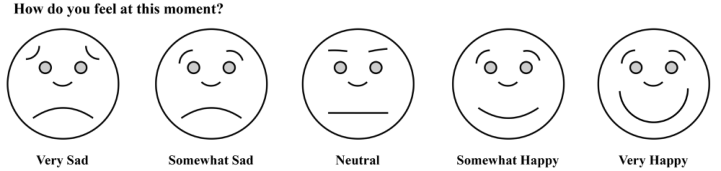
Data Collection and Analysis The Mood Assessment Scale (Smiley-Face Assessment Scale) was adopted to understand the impact of the different topic courses on the mood of older adults in this study (Pérez-Sáez et al., 2020). It is a quick, simple, and use- ful research tool (Lorish and Maisiak, 1986). The Mood Assessment Scale is a self-report tool that measures mood through the image response system (see Figure 1), with five faces with mood expressions accompanied by descri- ptive text ranging from very sad (coded as 1) to very happy (value of 5). This assessment of self-feedback is a brief, valid evaluative process designed not to perturb the experience by evoking attention to the physical and cogni- tive limitations imposed by the illness (Livingston, Fiterman Persin and Del Signore, 2016; Lorish and Maisiak, 1986). The questionnaire was distribu- ted at the beginning and end of each course, and participants were invited to indicate on a piece of A4 paper which face best reflected their current mood. The paired sample t test was applied for data analysis. In addition, partici- pants were invited to fill in their feelings and suggestions at the end of each course to understand their experience.
Implementation Sites and Participant Backgrounds The courses were conducted in two community care locations in Da’an District and Songshan District of Taipei. Community care locations provide a community-based learning center for older adults to continue learning and aging in the local community, allowing them to participate in activities close to their homes and harnessing the power of the community to address the issues of an aging society. In addition, various older adults have been allo- wed to participate in courses to prepare for retirement and integrate lifelong learning concepts to maintain active lifestyles and achieve a healthy aging society.
The sequences of the courses conducted at the two sites were reversed to avoid participant sequential effects influencing the study results. The cour- ses were conducted every Tuesday in April 2022 from 9:00 am to 12:00 am. This study recruited older adults to enroll voluntarily through site promotion. Forty older adults were enrolled (20 from each site), and 32 participants com- pleted the courses and the pretest and posttest of the questionnaire (missing
Figure 1: Mood Assessment Scale. (Modified from Pérez-Sáez et al., 2020).
80 Liang-Ming and Fang-Wu
Table 2. Basic information about the course participants.
Elementary School / Junior High School 10 (31.2%) High School / Vocational High School
13 (40.6%)
University or above 20 (62.5%) Living Style Living alone 4 (12.5%) Living with spouse (or cohabitant) only Living with family 14 (43.8%) Living with a caregiver 1 (3.1%)
6 from Da’an and 2 from Songshan). The basic information of the partici- pants is shown in Table 2. The highest percentage of participants was female (84.4%, n = 27); their age was mainly 71–90 years old (68.7%, n = 22); their education level was higher, with 93.7% (n = 30) having high school education or above; and the residence pattern with the highest percentage was living with family members (43.8%, n = 14).
RESULTS
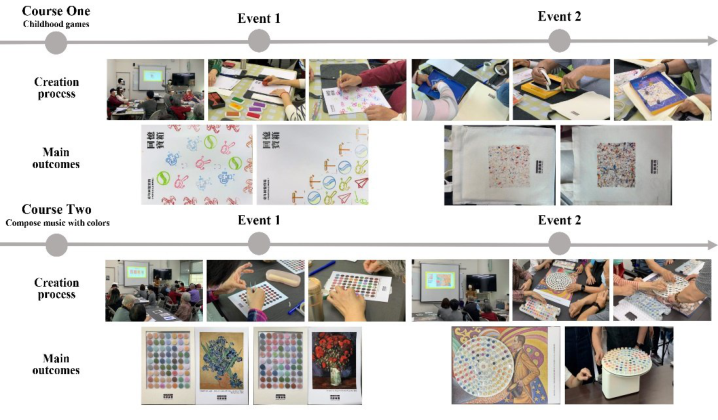
The research team employed video recording, photography, and observa- tion to document the participation process. As shown in Figure 2, the implementation process and results were as follows.
Course one: In the first event, the research team began by showing the older adults stamps made from the patterns of their childhood toys. Then they were taught the repetitive, rhythmic form of creation and allowed to use the stamps to create. In the second event, the research team introduced the knowledge of Action Painting and related representative works, allowing the older adults to improvise by shaking marbles on a canvas bag and receiving a personalized and practical canvas bag.
Course two: The research team introduced the older adults to Pointillist artists and related works in the first event. Then it allowed them to observe the paintings through a round hole board, paste the colored stickers into the corresponding holes, and complete a personalized mosaic postcard. In the second event, older adults were divided into groups (4-5 people per group). Each group chose a painting, observed it through a round hole board (which is also the turntable of the FEEL2 interactive device), and chose the corre- sponding colored cylinders to place on the board to complete a mosaic work. Finally, the mosaic works were placed in the FEEL2 interactive device, and
Effects of Art Courses on Older Adults 81
Figure 2: Implementation process and main outcomes of the two courses.Table 3. Results of paired sample t tests for the Mood Assessment Scale (two courses).
Table available in the original PDF paper.
Course Pre-test M (SD) Post-test M (SD) t df Sig. (2-tailed) One 4.66 (±0.48) 4.81 (±0.40) -1.41 31 0.169 Two 4.28 (±0.63) 4.75 (±0.51) -3.70 31 0.001***
***p < 0.001
the older adults listened to the melodies corresponding to the colors played by the device.
The research team conducted a paired-sample t test for the questionnaire results of the 32 participants. The results are shown in Table 3. Participants did not show a significant change in mood in Course one (p = 0.169), but the mean value still improved, from 4.66 (± 0.48) to 4.81 (± 0.40); participants showed a significant improvement in mood in Course two (p = 0.001), with the mean value increasing from 4.28 (± 0.63) to 4.75 (± 0.51).
DISCUSSION
According to the questionnaire results and participants’ feedback, the cour- ses proposed in this study gave older adults a favorable course experience. Both courses positively affected the mood of older adults. Course one did not show significant improvement but demonstrated a positive trend. Course two significantly improved the mood of participants.
In course one, the content on the topics of nostalgia was identified through communication with stakeholders (older adults and workers at community locations), which helped to evoke positive memories for the participants. This avoided the negative impact of unsuccessful nostalgia on older adults; for example, one participant stated:
82 Liang-Ming and Fang-Wu
“The course (one) was great; it was fun and brought back many memories of my childhood.” (P-4) In addition, through the course lectures, the older adults were guided to create independently. They could complete their works with personal chara- cteristics and could use their works (canvas bags) in their daily lives, which helped to enhance their creative experience; as Participant-9 said:
“(It was) a very meaningful activity, and it was very fulfilling to create by myself.”
Although there was no significant difference (p = 0.169) in the pretest and posttest results, there was still some improvement in the scores. Possible rea- sons for this include: (1) Most of the participants already had experience of art courses, so they were less emotionally affected in such relatively traditi- onal visual art courses; (2) The participants showed a favorable emotional state in the pretest, so there was little room for significant improvement; and (3) The sample size of the course was relatively small.
In Course two, there was a significant difference (p = 0.001) in the pretest and posttest results, which implied a significant improvement in the partici- pants’ mood during the course. The reason for this may be that the content of the course, which links colors and music, allowed the participants to experie- nce the development of the technology (including audio-visual experience and human-computer interaction), which enhanced their interest in participating. For instance, two participants commented: “(It was) an amazing aesthetic course that gave us a new and fascina- ting experience.” (P-16)
“It was very rare to learn such art courses that I could not access in my youth.” (P-30) On the other hand, the group creation in this course promoted communi- cation and interaction in the course; as Participant-16 mentioned:
“It was a new experience to create music in a collaborative way; we had more interaction during the course, and I went home and shared our creative process with my mother.”
CONCLUSION AND FUTURE IMPLICATIONS According to the results of the questionnaire and the feedback from the par- ticipants, this study found that discussing with stakeholders could lead to the development of appropriate course content and that a lower level of creative difficulty combined with independent creation could stimulate the seniors’ self-confidence and sense of accomplishment. Therefore, collaboration with stakeholders may be considered in developing future art courses for older adults, and the difficulty level could be reduced appropriately. Art courses that link colors and music seem more favored by participants than visual art courses and more able to mobilize participants’ moods and interest in par- ticipating, echoing scholars’ research (Fraser, Bungay and Munn-Giddings,
Effects of Art Courses on Older Adults 83
2014). Therefore, a combination of art forms could be considered in desi- gning future art courses for older adults. On the other hand, the group creation facilitated interaction and communication among the participants in course two so that both individual and group creation could be adopted in developing and designing future art courses for older adults.
The study was conducted in Taipei, the north of Taiwan. The results might be limited to that area. In addition, the number of participants in this study was 32. In the future, we may consider implementing the course in other locations and increasing the number of participants to validate and expand the results of this study. There are still many forms and content of art courses for older adults. In the future, different creation formats and content could be used to explore participants’ experience and the impact on short-term mood.
Funding: This research was supported by a grant from the University Social Responsibility (USR) Program, Taiwan Ministry of Education (Grant No.: 111O5005). Conflicts of Interest: The authors declare no conflict of interest.
ACKNOWLEDGMENT
The authors would like to acknowledge the research team members Chen- Ling Hung, Wei-Ju Chiu, Pei-Yu Chang, Chia-En Chen, Wei-Zhe Tzeng, Ryo-Wei Liu, and Chia-Hsuan Ku for their contribution to this study. The authors are also grateful to the staff, volunteers, and older adults of the Renai Christian Presbyterian Church and the Songshan Social University for Older Adults for their tremendous support.
REFERENCES
Cohen, G. D. (2001) The Creative Age: Awakening Human Potential in the Second Half of Life. New York: Harper & Collins. Flood, M. and Phillips, K. D. (2007) ‘Creativity in older adults: A plethora of
possibilities’, Issues in Mental Health Nursing, 28(4), pp. 389–411. Hanna, G. (2006) ‘Focus on creativity and aging in the United States’, Generations: Journal of the American Society on Aging, 30(1), pp. 47–49. Jia, L. M. and Tung, F. W. (2022) FEEL2: An Interactive Device for Older Adults
to Experience Synesthesia and Age Creatively. In the International Conference on Human-Computer Interaction 2022: Human Aspects of IT for the Aged Population (ITAP). (pp. 255–267). Lewin, K. (1947) ‘Frontiers in group dynamics: II. Channels of group life; social planning and action research’, Human relations, 1(2), pp. 143–153. Livingston, L., Fiterman Persin, G. and Del Signore, D. (2016) ‘Art in the moment:
evaluating a therapeutic wellness program for people with dementia and their care partners’, Journal of Museum Education, 41(2), pp. 100–109. Lorish, C. D. and Maisiak, R. (1986) ‘A brief, nonverbal method for assessing patient mood’, Arthritis & Rheumatology, 29(7), pp. 906–909. NDC (National Development Council). (2022) Compendium of Population Proje-
ction Charts - 2022 Edition. Available at: https://www.ndc.gov.tw/Content_List. aspx?n=81ECE65E0F82773F (Accessed: 14 October 2022).
84 Liang-Ming and Fang-Wu
Pérez-Sáez, E., Cabrero-Montes, E. M., Llorente-Cano, M. and González-Ingelmo, E. (2020) ‘A pilot study on the impact of a pottery workshop on the well-being of people with dementia’, Dementia, 19(6), pp. 2056–2072. Sandak, B., Gilboa, A. and Harel, D. (2020) ‘Computational Paradigm to Elucidate
the Effects of Arts-Based Approaches: Art and Music Studies and Implications for Research and Therapy’, Frontiers in Psychology. 11, pp. 1–20. Schneider, J. (2018) ‘The arts as a medium for care and self-care in dementia: arguments and evidence’, International journal of environmental research and public health, 15(6), 1151. Schuch, F. B., Vancampfort, D., Rosenbaum, S., Richards, J., Ward, P. B., Veronese,
N., and Stubbs, B. (2016) ‘Exercise for depression in older adults: a meta-analysis of randomized controlled trials adjusting for publication bias’, Brazilian Journal of Psychiatry, 38 (3), pp. 247–254. Strawbridge, W. J., Wallhagen, M. I. and Cohen, R. D. (2002) ‘Successful aging and well-being: Self-rated compared with Rowe and Kahn’, The gerontologist, 42(6), pp. 727–733. Tung, F. W., & Jia, L. M. (2023). Developing a community-based art program for
older adults that connects color and music. Educational Gerontology, 1–15. United Nations. (2002) Report of the Second World Assembly on Ageing: Madrid, 8–12 April 2002. Available at: https://unece.org/DAM/pau/MIPAA.pdf (Accessed: 1 October 2022). Uttley, L., Scope, A., Stevenson, M., Rawdin, A., Buck, E. T., Sutton, A., and Wood,
C. (2015) ‘Systematic review and economic modelling of the clinical effectiveness and cost-effectiveness of art therapy among people with non-psychotic mental health disorders’, Health Technology Assessment, 19(18), pp. 1–120.
LISTED IN THE AHFE DIGITAL BOOKSTORE CATALOGUE
Explore the complete digital volume
Human Factors in Aging and Special Needs
Read this individual research paper free through the original publisher, or explore the full digital proceedings book.
ISBN 978-1-958651-64-3
Explore this ISBN in the AHFE Bookstore ↗Listed in the July 2026 bookstore catalogue; search by ISBN to confirm current availability · Digital book purchase optional