Nanthawan Am Eam (2025). Development of Modern Prototype Water Filling Plant with Low Cost Automation Production System for Small and Micro Community Enterprise. In: Safety Management and Human Factors. AHFE Open Access, vol. 189, pp. 175–181. https://doi.org/10.54941/ahfe1006583
The purpose of the research is to design and develop a prototype water filling plant with a low-cost automatic production system. Based on the survey of problems and needs for the development of production systems of community enterprises. It was found that most of the community enterprises mainly operated manual production. The production volume is low and there is no production monitoring system. Community enterprises need automated production systems that are easy to use, easy to maintain and maintain, and display systems that can record data. Therefore, this research designed a low-cost automated production system based on ergonomic design principles for work safety and the Kararuri principle. The use of the principle of kararuri uses mechanical energy instead of electricity. The principle of gravity is used, especially in the part of capping bottles. Operators closed the lid with bare hands, causing fatigue and injury to the hands and fingers. The lid set consists of 3 parts: the lid kit. Lid Tightening Kit and Lid Clamping Kit. For bottle Cap Kit, there is a bucket for the lid as a stock. The number of caps per 1 tank is 1500 caps and the speed of conveying the caps to the rails for capping Rotate by motor 1.5 m/min and close the cap with about 2 seconds / 1 bottle. Bottle capping uses a karakuri system to reduce energy consumption. The speed of Conveying water bottles is at about 9 m/min. The lid from the lid inlet is lifted with a lid inclination. The lid is sorted with the center of mass, the lid flows to the lid feed chute. The mouth of the bottle hooks the cap and passes through the upper regulator, allowing the cap to stay on the water bottle to go to the next capping system. At the point where the lid is hooked, there is a cutting sensor set up to count the use of the lid. When the number of lids remaining is less than the minimum number set. The system will notify you to continue filling the lid. Drinking water bottles are conveyed through a line through the lid polishing process to tighten the lid that is closed. By tightening the cap, the cap is tightened one bottle at a time. Lid Screw Kit, it uses a motor with a tightening torque of 15.3 N.m and it takes about 2 seconds / 1 bottle to tighten. This research helps community enterprises to improve capping efficiency and reduce injuries from empty-handed capping.
Department of Agricultural Promotion report that small and micro community enterprise (SMCE) refers to community affairs related to the production of products. The provision of services or other services operated by a group of people who have a bond and have a common lifestyle and gather to operate such business in order to generate income and for the self- reliance of the family. Community and Inter-Community There are 2,797 registered community enterprises in the beverage production group, including bottled water, herbal drinks, cereal drinks, tea, and alcoholic beverages such as liquor, etc. (https://smce.doae.go.th/,8, 2022). Due to the problem of insufficient drinking water and the problem of cleanliness of drinking water, many community enterprises are interested in producing community drinking water to help community residents have clean drinking water. Setting up a community drinking water factory can also create jobs and income for people in the community. For example, the community of Chiang Mai province that gathers and operates in a cooperative-like manner. The community has a management system and employs community members to set up a drinking water production plant and bottled water. The problem and obstacle in the operation of community enterprise groups are the lack of knowledge and understanding in operation and management and lack of marketing skills and abilities (Kattiya, 2019).
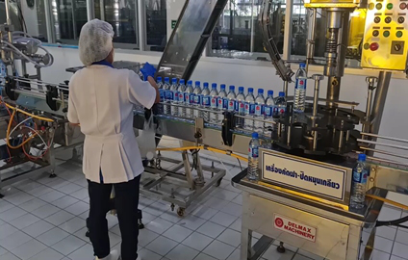
The Drinking Water Production Process of Community Enterprises The drinking water production process of most community enterprises is a simple production process that focuses on manual labor in production due to the limitation of investment costs in production machinery and equipment. The production process starts from using groundwater or tap water for filtration with carbon filtration or reverse osmosis systems, depending on the community enterprise chooses the filtration process. The next process is the disinfection process with UV rays. For bottles to be filled, bottles or buckets must be rinsed. The employee puts the bottle in the rinsing machine and turns on the water inside the bottle. Once the water bottle is rinsed, the staff will fill the water bottle with water. Most of the drinking water factories of community enterprises fill bottled water or bucket water with a hose system connected from a pipe. The staff opens the faucet to fill the water into the bottle through 4 to 6 filling heads.When the water is full, the operator will close the faucet, then close the bottle cap by hand and twist the bottle cap to screw it so that the bottle cap is completely closed as shown in Figure 1.
Closing the bottle cap with bare hands causes harm to the muscles of the worker, especially the hand and wrist area. In addition, it was found that there was a problem in the amount of drinking water production that was not enough to meet the needs of community enterprises. The drinking water production system of community enterprises still lacks appropriate production technology due to limitations in terms of costs and lack of knowledge and understanding of employees in the production process of community enterprises themselves.
In accordance with the promotion guidelines of the Department of Industrial Promotion to promote and develop a modern production system
Development of Modern Prototype Water Filling Plant 177
to promote the development of community enterprises to become small and medium industries. Therefore, the application of Low Cost Automation technology in the production process is very necessary. Fully automation systems are complex and expensive (Seifermann, 2014). In addition, Lay (2000) reported that automation systems lack flexibility, especially in terms of machine size and high maintenance costs.
Figure 1: Operator closes the bottle cap by hand.
Therefore, the automated production system seen not to be suitable for community enterprises. Furthermore, survey on the needs for the development of low-cost automated drinking water filling plants in Community Enterprises in Bangkok and metropolitan area 37 respondents. The survey results showed that Community enterprises need a low-cost production system. Machinery and equipment that can be purchased on the general market and are easy to maintain. Maintenance of machinery and equipment that can be maintained by community enterprises by themselves and the price of spare parts is not expensive. Community enterprise entrepreneurs can manage it on their own. There is no cost to call a technician to repair the machine. At present, the price of drinking water filling machine is diversified according to the production capacity of the machine. Some of the machines are imported from abroad where the machines are cheap, but there is a problem in terms of service and repair. Community enterprises cannot repair on their own.
Karakuri Design Karakuri means gravity, contraction or stretch, buoyancy Magnetic force manpower, etc. Karakuri uses gravity, tilted floors, peeling, pendulums, or springs, all of which do not use electrically powered equipment to drive the mechanism. Karakuri Kaizen is an activity in the manufacturing sector in which all employees are involved in creative initiatives to improve the efficiency of production lines.
The application of the Karakuri Kaizen principle can develop a factory production line of digital lean learning, as well as study and learn in structural design. The equipment and the mechanism to drive it in accordance with the machines currently in use. Reduce waste by automating at low cost
178 AmEam
and continue to develop and expand Karakuri Kaizen in the production line. Therefore, the purpose of this research is to design and develop a bottle capping machine using the principle of low-cost production system technology and karakuri design. Community enterprises can maintain themselves and are safe for users.
The Objective of Research Design and development of a prototype drinking water capping system with a low-cost automated production system for use in the production of drinking water and other bottled water.
Bottle Capping Machine Design Concept The prototype bottle capping machine has 5 working parts, including:
1. Bottle capping kit design: The water bottle capper can be adjusted in height to accommodate water bottles of different heights. The lid conveyor belt is lifted from the lid slot at an angle. The lid will be sorted by the center of mass. The lid will be conveyed with the required stents. The lid is conveyed with the required trough and flows to the lid feeding chute. The mouth of the bottle hooks the cap and passes through the upper lever to make the lid fit on the water bottle.
2. Capping unit: The bottle will be forced to stop in place by the pneumatic system, and the capping machine will move down to tighten. When the tightening is complete, the pneumatic system will allow the bottle to continue moving to the next process.
3. The structure set is made of stainless steel type material, can support the water tank. It has a water filling system and has extra wheels at the base for easy transport.
4. Lid screw head set: This kit has a top crank unit to adjust the vertical cap tightening distance according to the bottle size even higher. There is also a pneumatic system to control the cap head to move up and down according to the rhythm of the water bottle.
5. Water bottle clamping kit: When a water bottle comes to the tightening position. The clamping unit acts on the water bottle body so that the water bottle does not move while tightening. The kit can be adjusted vertically according to the changing height of the water bottle.
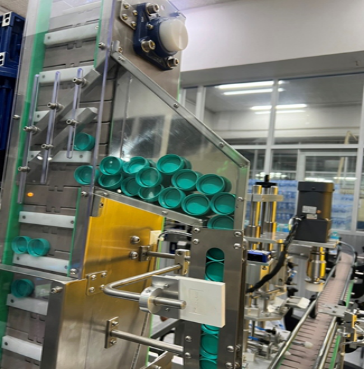
RESEARCH RESULT Bottle Capping System: For bottle Cap Kit, There is a bucket for the lid as a stock. The number of caps per 1 tank is 1500 caps per 1 tank and the speed of conveying the caps to the rails for capping rotate by motor 1.5 m/min and close the cap with about 2 seconds per 1 bottle. The bottle cap is closed using a karakuri system to reduce energy consumption. Conveying water bottles at a speed of about 9 m/min. The lid from the lid compartment is lifted with an inclination, the lid is sorted with the Center of mass, and then flows to the lid feed chute as shown in Figure 2.
Development of Modern Prototype Water Filling Plant 179
Figure 2: Bottle cap kit.
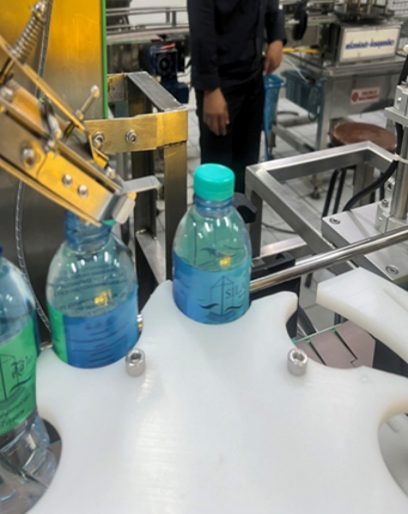
At this point, the mouth of the bottle will hook the cap and will pass through the upper control, making the cap on the water bottle to go to the next tightening system. At the point where the lid is hooked, there is a sensor set to count the use of the lid. When the number of lids remaining is less than the minimum set such as less than 300 lids, a notification will be given to continue filling the lids as shown in Figure 3.
Figure 3: Hooking cap.
180 AmEam
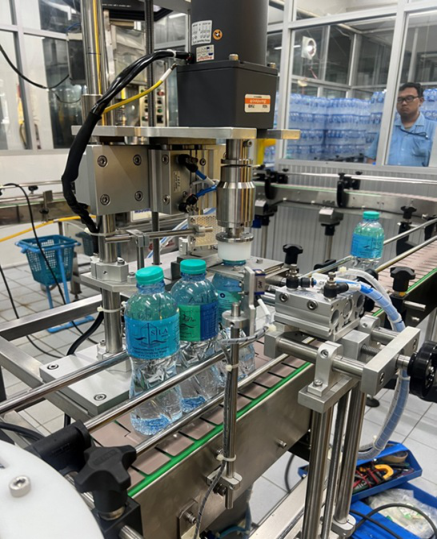
Drinking water bottles are conveyed through a line through the lid polishing process to tighten the lid that is closed. By tightening the cap, the cap is tightened one bottle at a time. For Lid Screw Kit, It uses a motor with a tightening torque of 15.3 N.m, and it takes about 2 seconds per 1 bottle to tighten as shown in Figure 4.
Figure 4: Tightening cap machine.
CONCLUSION
For the Bottle Cap Kit design and improvement, there is a bucket for the lid as a stock. The number of caps per 1 tank is 1500 caps per 1 tank and the speed of conveying the caps to the rails for capping Rotate by motor 1.5 m/min and close the cap in about 2 seconds per 1 bottle. Conveying water bottles at a speed of about 9 m/min. The cap from the cap slot is lifted by the inclination, the cap is sorted by the centre of mass, and then flows to the cap feed chute, from where the bottle mouth hooks the cap and passes through the upper presser, allowing the cap to stay on the water bottle to the next capping system. At the point where the lid is hooked, there is a cutting sensor set up to count the use of the lid. When the number of lids remaining is less than the minimum set, a notification will be given to continue filling the lids. Drinking water bottles are conveyed through a line through the lid polishing process to tighten the lid that is closed. By tightening the cap, the cap is tightened one bottle at a time. Lid Screw Kit It uses a motor with a tightening torque of 15.3 N.m, it takes about 2 seconds per 1 bottle to tighten.
Development of Modern Prototype Water Filling Plant 181
ACKNOWLEDGMENT
The authors would like to acknowledge Ministry of Higher Education, Science, Research and Innovation for support research fund.
REFERENCES
Department of Agricultural Promotion, 2006 website: https://smce.doae.go.th. Lay, G. (2000). Sackgasse Hochautomatisierung. Mitteilungen Fraunhofer Institut Sysremtechnik und Innovationsforschung, 22. Stefan Seifermann*, Jörg Böllhoff, Joachim Metternich and Amin Bellaghnach
(2014) Evaluation of Work Measurement Concepts for a Cellular Manufacturing Reference Line to enable Low Cost Automation for Lean Machining. Variety Management in Manufacturing. Proceedings of the 47th CIRP Conference on Manufacturing Systems. Procedia CIRP 17 (2014), 588–593. Suttada Kattiya, (2019). Marketing Channel Management of Community Enterprise Products Ban Lao Subdistrict, Mae Jai District, Phayao Province Proceedings of the 2nd National Symposium on Humanities and Social Sciences, Faculty of Humanities and Social Sciences Songkhla Rajabhat University.
LISTED IN THE AHFE DIGITAL BOOKSTORE CATALOGUE
Explore the complete digital volume
Safety Management and Human Factors
Read this individual research paper free through the original publisher, or explore the full digital proceedings book.
ISBN 978-1-964867-65-6
Explore this ISBN in the AHFE Bookstore ↗Listed in the July 2026 bookstore catalogue; search by ISBN to confirm current availability · Digital book purchase optional