Aina Ishikawa, Kohei Otake (2025). Analysis of consumer response to promotional posts by influencers. In: Ergonomics In Design and Kansai Engineering. AHFE Open Access, vol. 170, pp. 164–174. https://doi.org/10.54941/ahfe1006178
In recent years, an increasing number of companies have been utilizing social media marketing, a marketing activity that makes use of social media. Among them, “influencer marketing,” which utilizes influencers who have great influence over other users on social media to promote their products, has been attracting attention. On the other hand, there are studies that point out the risk that PR using influencers may be counterproductive in some cases, and the effects given by influencers may vary depending on the subject influencer (sender) and the user (receiver). Therefore, there is a need for more detailed research on the reactions of consumers when they encounter PR postings. This study aims to clarify the effects of influencer attributes and posted content on consumer behaviour based on an evaluation using conjoint analysis and eye-tracking data. First, we examined eight attributes related to the scale of influencers' follower counts and the content of their posts and generated multiple scenario posts based on an orthogonal array. We also generated fictitious influencer account profiles for each scale of influencers' follower counts. These scenario posts and account profiles were combined to generate a total of 16 conjoint cards, which were then used in an experimental study. Furthermore, an eye-tracking experiment was conducted to validate the effects of the factors identified through conjoint analysis. The analysis reveals that the size of the influencer is the most important factor influencing consumer preference. In addition, we found that PR posts by mega-influencers contribute to consumers' impressions of PR posts. Furthermore, the eye tracking data collected in the experiment revealed that the number of followers and self-introductions in the influencer's profile account tended to be watched closely, with minor differences depending on the size of the influencer.
In recent years, social media usage has rapidly increased worldwide. Among these platforms, Instagram, a photo-sharing SNS, has grown significantly since its launch in 2010, surpassing 400 million monthly active users in 2014 (OPT Co., Ltd., 2016). In Japan, users reached 8.1 million in 2015, expanding beyond young women to all age groups. As a result, businesses have increasingly adopted Instagram for advertising, with influencer marketing—leveraging influencers to promote products—gaining
Analysis of Consumer Response to Promotional Posts by Influencers 165
attention. Numerous studies have explored factors influencing consumer purchasing behavior. Kanda et al. (2013) analyzed information sources and dissemination across 39 product categories, showing that consumer purchasing models have evolved from AIDMA to AISAS and AIDEEES. They identified four information types: topical goods, non-word-of-mouth goods, experiential goods, and word-of-mouth goods, demonstrating that information flow varies by category. Their findings highlight the need for tailored communication strategies based on product characteristics.
As for research on influencers, studies have been conducted on identifying users who have a large influence on other users on social media and evaluating their influence (Kitajima et al., 2022). They identified mega- influencers and micro-influencers by constructing a consumer network using follower data of a cosmetics brand on Twitter. Research has also been conducted to assess the credibility of information disseminated by influencers (Kinyamu, 2022). In this study, the advertising effectiveness of celebrities was evaluated using the TEARS model, which is a model used to evaluate comprehensively from five perspectives: credibility, expertise, attractiveness, respectability, and familiarity. In addition, research has been conducted on the influence of PR posts by influencers on consumers (Cherry et al., 2021). They conducted a comparative study of the influence of influencer posts on purchase intention on Instagram compared to the posts of official corporate accounts for cosmetics. They hypothesized that posts by influencers promoting products would increase purchase intention, and conducted a chi-square test on purchase intention between the influencer group and the corporate account group. Although the results did not reach statistical significance at the 5% level, the study found that purchase intention in the influencer group was 11%, compared to 3% in the official corporate account group. This indicates that product PR posts by influencers on Instagram may contribute to increasing consumers’ purchase intentions.
Previous research has primarily examined the effectiveness of influencers in product PR on social media and the selection criteria for influencers. However, few studies have explored the impact of product PR posts by influencers across multiple scales. There is research (Shibuse, 2023) that investigated the impact of disclosure of commercial intentions, but it was limited to a comparison of celebrities and ordinary people. Further research is required to compare and analyze differences in the content of product PR posts across influencers of varying scales, including those with and without disclosure of commercial intent.
This study aims to elucidate the impact of variations in product PR post content across influencers with different follower count scales on consumer perceptions. Specifically, we designed a fictitious product PR scenario post using an orthogonal array and conducted a conjoint analysis. Additionally, we employ a Tobii screen-based eye tracker to collect consumer eye-tracking data when viewing the scenario posts and validate the conjoint analysis results.
166 Ishikawa and Otake
Evaluation of Influencers’ PR Posts Through Conjoint Analysis First, we examined eight attributes related to influencer size and post content and generated scenario posts based on an orthogonal array. Next, we conducted a conjoint analysis using the ratings of the scenario posts collected from the questionnaire survey. Conjoint analysis is a marketing technique that evaluates hypothetical products with varying levels of multiple factors to identify key drivers of consumer preferences and the minimum acceptable level.
First, we generated fictitious account profiles for multiple influencers, categorizing them into four levels based on size: mega-influencers, micro- influencers, nano-influencers, and general users. We generated account profiles based on the account profiles of real influencers on Instagram. Influencers are generally categorized by the number of followers they have, and each has its own characteristics. Mega-influencers (top influencers) include celebrities who are active on television and have hundreds of thousands to millions of followers. They are nationally known and can be expected to have a high degree of credibility and wide reach. Micro- influencers (middle influencers) are users who are active in specialized media and have a fan base. They have tens to hundreds of thousands of followers and have a large influence on a specific target audience. Although they do not engage in full-fledged professional activities, they often have connections with production companies and advertising agencies and accept work requests. Nano influencers (light influencers) are popular general users with 2,000 to 10,000 followers. Although the range of influence is narrow, they are characterized by a high degree of trust from their followers due to their proximity to general users. Unlike micro-influencers, nano-influencers are often not commissioned for work. We also included the characteristics of each of these influencers when generating account profiles. User-generated content (UGC) generated by general users has been demonstrated to have advertising effects, despite not being originally intended for promotional purposes (Arai et al., 2023). In this sense, it can be said that general users are also influencers who influence other users. In this study, we consider general users to be a type of influencer.
Additionally, we defined seven attributes related to the content of the submissions and the construction of scenario posts. Table 1 presents the details of the defined attributes and their respective levels.
Pictograms serve as a tool to convey emotions that are difficult to express through text. A survey of female university students revealed that positive pictograms in e-mails have the effect of increasing friendliness (Kitamura et al., 2009). However, the impact of pictograms may vary depending on recipient characteristics such as generation and social position, and their effect on men remains unverified.
The usefulness of benefit tags through influencer marketing has become clear (Shibuse, 2023). It is argued that indirectly expressing commercial intentions by using benefit tags such as #PR has a pronounced suppression effect on consumer distrust and a positive influence on purchase behaviour. On the other hand, disclosure of commercial intent by means of a benefit
Analysis of Consumer Response to Promotional Posts by Influencers 167
tag is an expression that is difficult for consumers to understand, and the necessity of considering rules for PR notations is appealed.
The same reason applies to textual expressions that remind consumers of the sender’s daily life: rather than clearly stating that a post is PR, it is more likely to be supported by consumers if the post is a casual PR that blends in with the sender’s fulfilling daily life, which general users may admire.
In addition, it has been shown that onomatopoeic expressions about the texture of food are effective (Kiyono et al., 2011). A survey conducted to verify the effect of onomatopoeia in conveying texture in word-of-mouth communication of food products indicated that the use of onomatopoeia makes it easier for consumers to imagine the target product in their word- of-mouth communication.
Some studies have demonstrated that sales quantity increases when discount information is displayed on POPs in actual stores (Kimura et al., 2009). Although it has been shown that the display of product discount information in physical stores is effective, the impact of such discounts on influencer marketing remains to be verified.
High engagement plays a crucial role in social media marketing. User interactions such as ‘Likes’ and ‘Shares’ on Instagram significantly influence post visibility and often drive activity among social media marketers.
Finally, the presence or absence of detailed information about the PR target can affect the credibility of the information: on Instagram, the sender’s information is mainly obtained from the account profile. When users do not recognize the influencer, information about the sender is limited, so detailed information about the PR target is likely to have a significant impact on the credibility of the information.
Table 1: Details of attributes and levels set.
Table available in the original PDF paper.
Target Attribute Level Account Profile Influencer Size Mega/Micro/Nano/ General Post content Emojis in captions Included/Excluded Explicit PR Included/Excluded Text evoking the sender’s daily life Included/Excluded Expression including onomatopoeia Included/Excluded Discount information on PR coverage Included/Excluded Text that encourages engagement Likes/Comments/
Shares/No Detailed information on PR coverage Included/Excluded We generated a total of 16 conjoint cards by combining these scenario posts with the account profiles of four influencers. The café category was selected as the PR target because it is widely used in daily life and presents a relatively lower selectivity as a research target compared to product categories such as cosmetics and skincare.
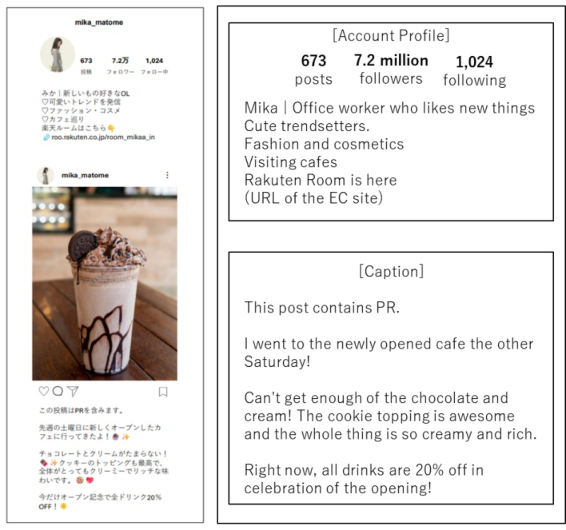
Next, we conducted a questionnaire survey using the conjoint cards we generated, collecting ratings on a five-point scale (with 5 being the highest rating). Figure 1 presents an example of a conjoint card. We designed three
168 Ishikawa and Otake
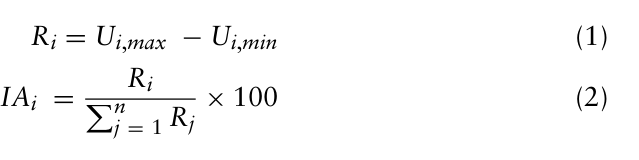
sets of conjoint cards with different display orders and randomly assigned them to respondents. Additionally, we included a survey question, “On a scale of 1 to 5, how interested (would you like to save the post?), please choose one of the following five options.”The survey was administered through an online form, and yielding a total of 34 responses were received. Of these, we included 30 valid responses in our analysis. Using the evaluation scores obtained from the survey, we performed a conjoint analysis by using the R conjoint package. The results obtained from the conjoint analysis are presented in Table 2. The relative importance of the partial utility values is also shown in Table 3. The calculation methods for the utility range of each attribute, denoted as Ri, and the relative importance, denoted as IAi, are presented in equation (1) and equation (2), respectively. Ui,max and Ui,min represent the maximum and minimum utility range values of each attribute i, respectively, while n represents the total number of attributes.
Equation reproduced from the original PDF.Figure 1: An example of the conjoint card used in the experiment and its contents (micro-influencers).
Analysis of Consumer Response to Promotional Posts by Influencers 169
Table 2: Results of conjoint analysis.
Table available in the original PDF paper.
Attribute Level Estimate t value p value Notes Intercept 2.8541 62.818 < 2e-16 *** Influencer Size Mega 0.2458 3.124 0.0018 ** Micro –0.1875 –2.383 0.0175 * Nano 0.0875 1.112 0.2667 Emojis in captions Include 0.1458 3.210 0.0014 ** Explicit PR include –0.1333 –2.935 0.0035 ** Text evoking the sender’s
Include –0.0166 –0.367 0.7139
daily life Expression including
Include –0.0041 –0.092 0.9269
onomatopoeia Discount information on
Include 0.1666 3.668 0.0002 ***
PR coverage Text that encourages
Likes –0.0125 –0.159 0.8738
engagement Comments –0.0291 –0.371 0.7110 Shares 0.0791 1.006 0.3149 Detailed information on PR
Include 0.208333 4.585 5.83e-06 ***
coverage Notes (p-value significance levels): *** p < 0.001, ** p < 0.01, * p < 0.05
Table 3: Relative importance of each attribute.
Table available in the original PDF paper.
Attributes Importance of Value Influencer Size 22.81 Emojis in captions 11.88 Explicit PR 10.44 Text evoking the sender’s daily life 7.29 Expression including onomatopoeia 6.95 Discount information on PR coverage 9.64 Text that encourages engagement 16.74 Detailed information on PR coverage 14.24
Table 2 indicates that mega-influencers exert a positive impact, contributing to consumer impressions. On the other hand, micro-influencers have a negative impact. Table 3 demonstrates that the relative importance of the partial utility of influencers is very high, indicating that the selection of influencers is a very important factor that influences consumer preferences in practice. These findings align with those of previous studies. The inclusion of detailed information about the PR target also exerts a positive effect, and the relative importance of the partial utility value is high (see Table 3). This suggests that consumers may perceive posts containing detailed information as more credible. Additionally, a negative effect was observed when explicitly disclosing that the post was a PR, highlighting the need for further discussion on PR disclosure methods. Statistically significant results were not found for sentences evoking the sender’s daily life or encouraging engagement.
170 Ishikawa and Otake
Verification by Eye Tracking Using a Screen-Based Eye Tracker Finally, we validate and discuss the reliability of the findings from the conjoint analysis by collecting eye-tracking data on consumer reactions to PR posts through experiments using a Tobii screen-based eye tracker. Eye-tracking has been demonstrated as an effective method for elucidating the relationship between consumers’ information processing and purchase decision-making (Maeda & Yoshioka, 2022).
The conjoint analysis revealed that influencer size is a key factor influencing consumer preferences. Additionally, the content of PR posts— particularly those including pictograms, discount information, and detailed information about the PR target—may be highly evaluated by consumers.
Accordingly, we conducted two separate experiments:
Experiment (1): The effect of influencer size on consumer perception.
Experiment (2): The effect of pictogram and discount information presence on the PR target.
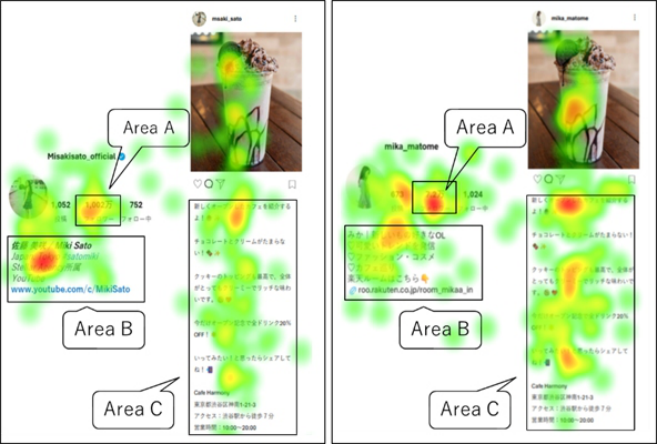
In experiment (1), we presented images combining the account profiles of four different levels of influencers (see left side of the presented Figure 2) and PR posts (see right side of the presented Figure 2). The content of all PR posts remained identical.
Figure 2: Heat map in experiment (1) (left side: mega-influencer, right side: micro-influencer).
In experiment (2), we presented PR postings that differed only in four conditions: the presence or absence of pictograms and the presence or absence of discount information (two attributes × two levels). All other attributes were standardized to the levels with the highest partial utility values from the conjoint analysis.
Analysis of Consumer Response to Promotional Posts by Influencers 171
To emphasize the text in the captions, we reduced the size of the product images within the PR posts, segmented each line of text, and expanded the line spacing. Additionally, we removed any information about the influencer from the top of the PR post. This experiment was conducted at Tokai University from January 27 to 31, 2025. The study included ten participants (five males and five females) who were informed about the experiment and provided their consent. Participants were instructed to ‘view the posted images on the PC screens as they normally would when using social media.’ Additionally, they were informed in advance that in Experiment (1), all posts on the right side of the displayed images were identical, and in Experiment (2), all product images in the displayed posts were identical.
Before commencing the experiment, calibration was performed to ensure accurate eye-tracking measurements. Calibration involves acquiring the subject’s eye position and geometric features to precisely compute eye gaze. In both experiments (1) and (2), the order of the displayed images was randomly varied for each participant. Additionally, a three-second interval was introduced between different conditions, during which a white screen was displayed. This served to reset cognitive processing, preventing carryover effects from the previous scenario, while also mitigating cognitive load and participants’ fatigue. We used Tobii pro lab, a dedicated analysis software, to generate a heat map of the gaze data from ten participants. The results indicated that, across all influencer sizes in Experiment (1), gaze duration was consistently high for follower count and self-introduction sections.
Figure 2 presents the heatmaps of the mega-influencers and micro- influencers in Experiment (1). In this figure, Area A represents the follower count, Area B includes the influencer’s self-introductory text and a brief account description, and Area C contains the captions (text) within PR posts. Comparing the two, gaze duration was notably higher for micro- influencers in Area A. Since micro-influencers are less well-known than mega-influencers, follower count may serve as a more critical information source for consumers. Conversely, in Area B, gaze duration was higher for mega-influencers than for micro-influencers. This suggests that consumers may be more interested in mega-influencers themselves rather than the information they provide. For Area C, the gaze duration was higher for micro-influencers than for mega-influencers, implying that consumers may be more engaged with the information conveyed by micro-influencers. Regarding differences in influencer size, consumers demonstrated greater interest in mega-influencers than in micro-influencers, supporting the validity of the conjoint analysis findings.
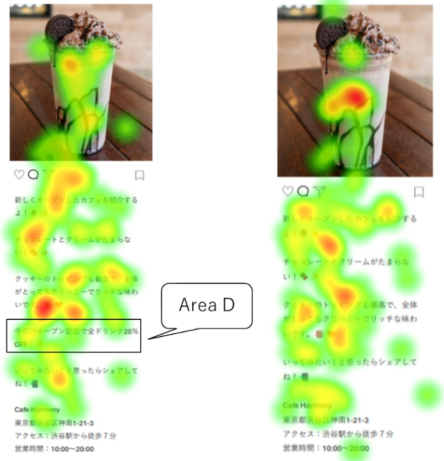
In experiment (2), no significant difference in gaze duration was observed based on the presence or absence of pictograms in the caption. However, a notable difference was found in gaze duration depending on the presence or absence of discount information related to the PR target (see Figure 3). In the postings on the left side of Figure 3, Area D contains texts related to discount information for PR, exhibiting a high concentration of gaze duration in its vicinity. Conversely, the captions in the postings on the right side of Figure 3 did not show any areas with a notably high gaze duration. These
172 Ishikawa and Otake
findings suggest that discount information in PR posts may effectively capture consumers’ attention.
Figure 3: Heatmap in Experiment 2 (left side: postings with discount information, right side: postings without discount information).
CONCLUSION
This study examined the influence of fictitious influencers on consumer perceptions using scenario posts on Instagram. The conjoint analysis revealed that influencer type is the most significant factor affecting consumer preference. Additionally, we found that mega-influencers positively contribute to consumer ratings of PR posts, whereas micro-influencers exert a negative influence. Regarding post content, the inclusion of pictograms in captions, discount information, and detailed information about the PR target was found to have a positive effect. Furthermore, screen-based eye-tracking experiments enabled us to analyze consumer reactions to influencer’s PR posts. The results suggest that consumers may be more interested in the influencers themselves, as they frequently fixate on the self-introduction sections within mega-influencers’ account profiles.
This study has several limitations and areas for future development. First, the use of fictitious influencers may not accurately reflect consumer familiarity and preference for real influencers. To obtain more precise insights into consumer behavior, future research should consider using influencers followed by the participants. Second, the study focused on a single product category, whereas previous research suggests that consumer preferences and communication methods vary depending on the product category (Kanda et al., 2013). Expanding the scope of different product categories would
Analysis of Consumer Response to Promotional Posts by Influencers 173
help generalize the findings. Third, some aspects of the study differ from Instagram’s actual specifications. To isolate the effects of influencer size and post content, elements such as hashtags and “likes” were intentionally omitted. Additionally, Instagram captions are typically truncated unless expanded, and profiles are not displayed in parallel, as they were in this study. Future research should incorporate these elements to enhance ecological validity. Finally, while this study used heat maps to visualize gaze patterns, a more detailed analysis using AOI (Areas of Interest) and controlled experiments could provide deeper insights into how consumers engage with PR posts. Future research should adopt such methods to refine the understanding of visual attention in influencer marketing.
ACKNOWLEDGMENT
We would like to express our sincere appreciation to the professors and students at Tokai University and Chuo University for their cooperation in this research. This research was supported by Grant-in-Aid for Scientific Research 24K05159 from the Japan Society for the Promotion of Science.
REFERENCES
Arai, Y. Shindo, M. (2023), “A Study on Advertising Effectiveness of Consumer Generated Videos: An Empirical Analysis of Creative Video Games for University Students”, Japan Marketing Academy Conference Proceedings vol. 12, pp. 307–314 (in Japanese). Cherry, Monet, M. Kato, T. (2021), “The impact of Instagram influencer posts
on purchase intent: Comparison verification with posting of official corporate accounts for cosmetics,” Proceedings of the 2021 National Conference of the Japan Society for Management Information Sciences, pp. 139–142 (in Japanese). Kanda, H. Toriyama, M. and Shimizu, S. (2013), “Changes in Information Sources and Information Dissemination Influencing Purchases: A Cross-Sectional Analysis of 39 Categories,” Journal of Marketing and Communications, Vol. 12, No. 1, pp. 3–24. (2013), “Changes in Information Sources and Information Dissemination Influencing Purchases: A Cross-sectional Analysis of 39 Sources”, Marketing Journal Vol. 32, No. 4 (in Japanese). Kimura, T. Ishihara, S. (2009), “A Study on the Effectiveness of POP Advertising
and In-Store Promotion Measures”, WBS Research Center, Waseda University, pp. 53–66. Kinyamu, Roselynn, K. (2022), “Influence of Celebrity Endorsements on Consumers’ Brand Equity: Case Study of Super Brands Companies in Kenya”, East African Journal of Business and Economics, Volume 5. Kitajima, Y. Otake, K. and Namatame, T. (2022),” Evaluation of Consumer Network
Structure for Cosmetic Brands on Twitter”, International Journal of Advanced Computer Science and Applications, Vol. 13, No. 2 (in Japanese). Kitamura, H. Sato, S. (2009), “Effect of pictograms in text-messaging on impression formation Kitamura H, Sato S. (2009), “Effect of pictograms in text-messaging on impression formation of female students”, The Japanese Journal of Research on Emotions, Vol. 17, No. 2, pp. 148–156 (in Japanese). Kiyono, S. Tamaoki, R. and Takiguchi, S. (2011), “The effect of onomatopoeia
on word-of-mouth communication of food products”, Journal of Agricultural Problems No. 183, pp. 79–84 (in Japanese).
174 Ishikawa and Otake
Maeda, H. Yoshioka, C. (2022) “Effects of quantity and quality of word of mouth on the Web on information overload and purchase decision making”, Bulletin of Kyoto Tachibana University, No. 48, p. 277–291 (in Japanese). OPT Corporation (Yamada, C. Ogawa, Y. and Ishii, R.) & Can-Do Series Editorial
Department (2016), “100 New Laws of Instagram Marketing: Technology to Draw Out ‘Want’ with Just One Photo”, Published by Impress Corporation, first edition published: March 21, 2016 (in Japanese). Shibuse, M. (2023), “The effect of commercial intent disclosure on consumer behavior: An empirical analysis focusing on the information source of functional appeals”, Yokohama School of Commerce, Vol. 46, No. 2, pp. 87–110 (in Japanese).
LISTED IN THE AHFE DIGITAL BOOKSTORE CATALOGUE
Explore the complete digital volume
Ergonomics In Design and Kansai Engineering
Read this individual research paper free through the original publisher, or explore the full digital proceedings book.
ISBN 978-1-964867-46-5
Explore this ISBN in the AHFE Bookstore ↗Listed in the July 2026 bookstore catalogue; search by ISBN to confirm current availability · Digital book purchase optional