Keiko Toya (2022). Consumer Acceptance for Using Personal Data. In: Human Factors, Business Management and Society. AHFE Open Access, vol. 56, pp. 313–322. https://doi.org/10.54941/ahfe1002283
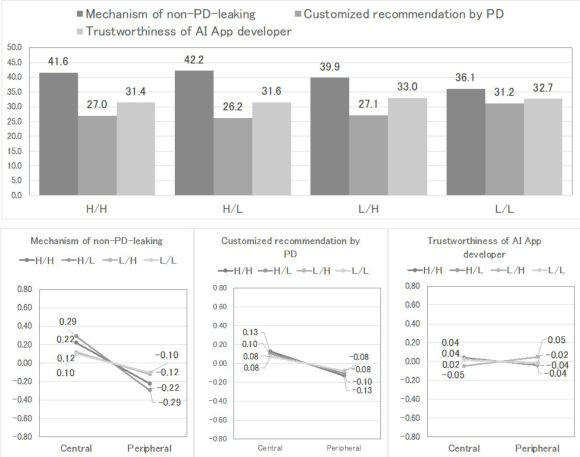
Research backgroundDigitalization has been accelerating by the COVID-19 pandemic. Some service fields are offered only via the face-to-face selling channel before starting using the remote channel. The proper use of customers' data, such as their lifestyles, preferences, and behavior history, makes these services more valuable for both customers and companies. However, currently the data utilization infrastructure, law and consumers’ knowledge is not established enough.HypothesesThis study aims to clarify the structure of consumer acceptance for their data usage by a survey in the medical fields. We verified the three hypotheses by using the conjoint analysis. H1. If people have a high knowledge and involvement in personal data, they use the Central route for no PD disclosure from their own devices. H2. If people have a high knowledge and involvement in medical care, they use the Central route for the benefits of personal data usage. It means better recommendations of clinics or hospitals.H3. If people have a high knowledge and involvement in PD or Medical Care, they use the central route for the trustworthiness of an AI application’s developer. It is related to both risk and benefit, which means No PD disclosure and recommendations. For conjoint analysis, we put the 3 attributes and the two levels. Level 1 represents the central route, and level 2 represents the peripheral route. Attribute1’s level1 explains the technology limiting PD use just inside their smartphones. Attribute1’s level2 explains that large companies highly evaluate and use this technology. Result of analysis and discussionWe made segments by PD and Medical knowledge and involvement into four segments. Segment 1 is high PD and high Medical Care, segment 2 is high PD - low medical care, segment 3 is low-high, segment 4 is low-low. All 4 segments place the highest emphasis on attribute 1, no personal data disclosure from their own devices. Look at the graph, the blue bar shows it. As for the direction of the preference, the central route is preferred by All 4 settlements, but it is more strongly preferred by HH and HL, those are the segments more interested in PD. There is no difference in the other two attributes.Regarding to the understanding of the explanation of attributes, no PD disclosure and recommendation, the segments that were more interested in medical care segments show a higher understanding. The segment HL, which is the most sensitive to the PD, shows the highest level of understanding of the trustworthiness of the AI application’s developer. Since many such application developers are small start-ups, it is difficult to determine their trustworthiness. That’s why this segment, which is sensitive and more skeptical to AI applications, has a higher understanding of this aspect. FindingsAll segments are weighted toward no PD disclosure, and prefer the central route for this attribute. The higher the knowledge and involvement in PD, the more the central route is preferred. The benefit concern segment understands the no PD discloser and recommendation. The PD sensitive segment understands the trustworthiness of companies.
The digitalization of society is accelerated by the COVID-19 crisis. With the evolution of technologies such as IoT and AI, services in fields that were previously only provided face-to-face can now be provided virtually. In order to make these services more valuable to individual customers, the appropriate use of personal data, such as customer lifestyles, preferences, and behavioral history, is considered to be effective. On the other hand, the legal system for the handling of personal data is still in the process of being established, and the knowledge and awareness of individual consumers are not yet mature enough. This study aims to clarify the structure of consumers’ acceptance for the use of personal data by focusing on financial and medical services, where the provision of personal data (hereinafter referred to as “PD”) is expected to make a significant contribution to the quality of services.
RITERATURE REVIEW Consumer Attitude Change and the Elaboration Prospect Model
According to the Elaboration Prospect Model (Petty and Cacioppo, 1986), people adopt two different information processing strategies, central proces- sing and peripheral processing, depending on their involvement in the subject and their degree of knowledge. Since elaborate information processing is
costly to the individual, the conditions of motivation and ability to perform it must be met. In central processing, when both involvement and know- ledge are high, the content is processed elaborately and logically, resulting in an attitude change. In peripheral processing, attitudinal change is caused by peripheral cues such as who the information source is, rather than the content itself. In the marketing field, this theory is applied to the creation of contents for advertisements, etc. When PD is involved, it is thought that there is an influence from two directions: involvement and knowledge of PD, and involvement and knowledge of the target product.
Consumer Attitude Towards the PD Use According to Alan F. Westin (2013), attitudes toward PD utilization can be divided into fundamentalist who are extremely reluctant to provide PD due to fear of risk, pragmatic who accept to provide in a compromise with rea- lity, and indifferent groups. According to a 2013 survey in the United States, fundamentalism, pragmatism, and indifference account for 10%, 64%, and 26%, respectively. In the case of Japan, according to a survey by the Ministry of Internal Affairs and Communications, the percentage of Japanese who are concerned about the provision of personal data is over 80%, which is higher than in Europe and the United States. This trend has been observed in other surveys as well. For example, of the 20 countries surveyed, Japan has the highest percentage of negative attitudes toward providing PD in exchange for services and products that are optimized for the individual based on per- sonal preferences (Ipsos, 2020). In other words, Japanese consumers are more sensitive to the risk side of PD utilization and less sensitive to the benefit side.
Toya (2022) indicates the following three factors to be considered when deciding whether to allow PD use. (1) Use of PD in the consumer’s own device: the data is used in the consumer’s own device (typically a smartph- one), not in the hands of a company; (2) To get appropriate information: the use of PD makes it easier for consumer to obtain more appropriate infor- mation; and (3) Reliability of the company: the companies that develop and provide services such as AI applications are reliable.
Conjoint Analysis Conjoint analysis is one of the methods in the field of marketing science. It is a method for calculating the direction and weight of individual preferences for product attributes while reducing the time and effort of responses for subjects by using orthogonal tables used in the design of experiments (Tver- sky, 1967; Tsuji, 2007). Although products usually have multiple attributes, consumers do not always use complex and information-processing-intensive strategy such as multi-attribute attitude models in their purchasing choices. Consumers may elaborate or simplify their information processing depen- ding on the importance of the target product to them. In a survey on product preference, asking questions about each attribute enforces a certain way of information processing, which is not in line with the behavior in real-life sele- ction situations. Since its development in the 1960s, many survey methods and statistical analysis methods have been proposed about conjoint analysis,
Consumer Acceptance for Using Personal Data 315
and it has been generally used not only for products but also for situations with multiple attributes. (Ikemoto & Yamaoka, 2010).
HYPOTHESIS Overview of the Target Service
We now provide an overview of our target service, which is an application for PD utilization, based on PDS (Personal Data Store) (Hashida, 2019). The application is a virtual PD application in the medical and financial fields, and users download the application to their own smartphone. In the financial field, the user is presented with suitable robot-investment stocks based on his or her income, asset status, and the purpose of using the funds. In the case of medical care, if you have a symptom but do not know the name of the disease and do not know which medical institution to go to, the app will suggest a likely name of the disease and the appropriate medical institution based on your symptoms and existing medical conditions. In both cases, the application does the matching in the smartphone without the platformer or service provider obtaining PD.
Hypothesis on the ELM According to the means-end chain model, a consumer purchases a product or service for fulfill their original purpose by it. (Olson and Reynolds 2001). If a consumer takes into consideration of purchasing product or service, and PD use is required as a prerequisite for purchase, the consumer consider the relative importance of both and make the final purchase decision.
As mentioned earlier, Japanese consumers tend to be more sensitive to the risk side of PD and less sensitive to the benefit side, and therefore, it is assu- med that they want to prevent the risk of misuse of PD. A system in which PDs are not centralized into a company or organization, such as the PDS, is effective in controlling risk, but it is not widely used and consumers are requi- red a certain amount of effort to understand the system. Therefore, only the segment of consumers who are highly involved in and knowledgeable about PDs is expected to process the information through the central route.
On the other hand, the consumer segment with high involvement and kno- wledge of the target product will process the benefit related information through the central route, because for them the benefits resulting from the use of PD are more important.
Since both risks and benefits are related to the AI application functions and thus to the company that developed the application, the segment with high involvement and knowledge of both PD and products, or either of them, is expected to process information about the reliability of the company that developed the application through the central route. The hypotheses are summarized below.
Hypothesis 1 Hypothesis 1.1: Consumers with high involvement and knowledge of PD will perform central information processing about how PD is used only within their own smartphones (the mechanism that PD does not leak).
316 Toya
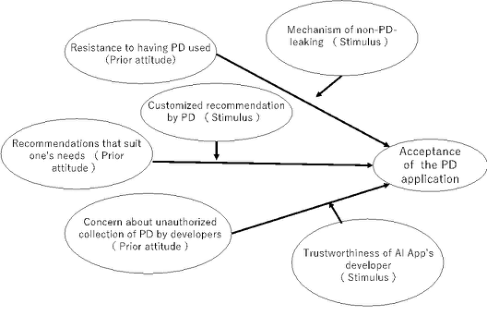
Figure 1: Hypothesis model of acceptance of PD application.
Hypothesis 1.2: Consumers with high involvement and knowledge of pro- duct will perform central information processing about being recommended a product that is more suitable for them (customized recommendation by PD).
Hypothesis 1.3: Consumers with low involvement and knowledge of PD and product will perform peripheral processing about the reliability of app development companies (trustworthiness of AI Apps developer).
Hypothetical Model of PD App Acceptance The degree of acceptance of PD applications is determined by three factors according to previous studies. Each consumer’s original attitude toward the three factors is stimulated by the information presented in the conjoint que- stions and result in the levels of acceptance of PD application. We made a hypothetical model in which a certain level of conviction would lead to a change in attitude toward acceptance of the PD application (Figure 1).
RESULT
The quantitative survey was conducted as an Internet survey in October 2021. The survey was conducted as an online survey in October 2021. In both the financial and medical fields, subjects with a certain level of involvement were screened in advance, because those who were completely indifferent would not be placed in the selection process in the first place and might not be able to understand the questions. The survey targets were 1,631 fina- ncial cases (out of 20,288) and 1,579 medical cases (out of 87,208). After a brief explanation of the assumed services, four products were presented in a random order based on the design of experiments, and the respondents were asked to rank their preferences from first to fourth. In addition to the conjoint part of the survey, the respondents were asked to answer the following questions on a 7-point Likert scale: anxiety about PD provision, conditions for trusting the service provider, degree of understanding of the explanation of the three conjoint attributes, and degree of acceptance of the service.
Consumer Acceptance for Using Personal Data 317
Table 1. Segments (Top: Financial service/ Bottom: Medical care).
Table available in the original PDF paper.
Segmentation by Factor Score Factor analysis (maximum likelihood method, oblique rotation) was condu- cted for involvement/knowledge of PD and involvement/knowledge of target products (financial service and medical care) respectively, and the subjects were divided into four segments based on positive or negative factor sco- res (Table 1). The results showed that the involvement/knowledge of PD and involvement/knowledge of products were divided into high-high, high-low, low-high, and low-low (hereinafter referred to as HH, HL, LH, and LL), and the presence percentages were 43.9%, 16.4%, 17.2%, and 22.6% in the financial service and 45.3%, 11.5%, 13.3%, and 29.8% in the medical care, respectively. The proportions of HL and LH with high knowledge and involvement in either PD or products were low at around 10%. The average factor scores for each segment are shown in Table 2.
Conjoint Result As a result of the conjoint analysis, the overall weight of each attribute is 40.2% for attribute (1), 27.8% for attribute (2), and 32.0% for attribute (3) for financial service, and 39.5% for attribute (1), 30.3% for attribute (2), and 30.2% for attribute (3) for medical care. Attribute (1) is the most important in both medical and financial fields.
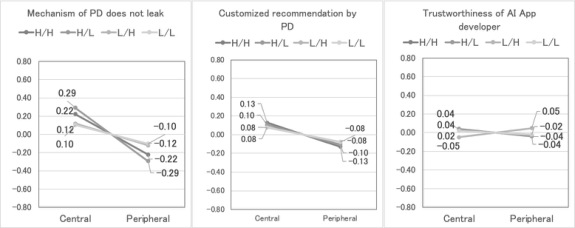
As shown in Figure 2, all segments place the most importance on attri- bute (1), intra-smartphone PD use, with HH having the highest importance. As for the direction of preference between the central and peripheral routes, all segments of attribute (1) prefer the central route to the peripheral route, but the segments with high product involvement and knowledge, HH and LH, have a stronger preference for the central route than the segments with low product involvement and knowledge. On the other hand, there was no
318 Toya
Figure 2: Conjoint analysis result of medical care.
significant difference between the central and peripheral route preferences of any of the segments to attribute (2), information suitable for oneself, and attribute (3), reliability of the company. The results are summarized below.
Hypothesis 1.1: Consumers with high PD involvement and knowledge of PD will perform central information processing about how PD is used only within their own smartphones→Accepted.
Hypothesis 1.2: Consumers with high involvement and knowledge of pro- duct will perform central information processing about being recommended a product that is more suitable for them→Rejected Hypothesis 1.3: Consumers with low involvement and knowledge of PD and product will perform peripheral processing about the reliability of app development companies→Rejected
PD Application Acceptance and Attribute Comprehension A hypothetical model was derived in which the acceptance of the PD appli- cation is formed from the interaction between the initial attitude toward the three attributes, the degree of acceptance of the explanation, and the effect of the degree of acceptance on the initial attitude.
The basic attitudes toward the three attributes were asked before the appli- cation was explained, and the degree of acceptance after the application was explained is shown as Base and After, respectively.
To test the model, multiple regression analysis was conducted. An overall model consisting of only parameters that were significant across the entire sample was established for both financial service and medical care, and this model was applied to each segment. In the overall model, there were four parameters that were significant only for the main effect in the financial
Consumer Acceptance for Using Personal Data 319
Figure 3: Conjoint analysis result of financial service.Table 2. Results of Multiple Regression (Financial service & Medical care).
Table available in the original PDF paper.
Financial service Medical care Items N = 1,631 N = 1,579 Base 1 PD input resistance −0.096*** −0.070*** After 1 Mechanizm of non-PD-leaking 0.194*** 0.174*** Base 2 Recommendation that suits one’s need 0.035* After 2 Custamized recommendation by PD 0.313*** 0.334*** Base 3 Concern about unauthorized PD −0.052** After 3 Trustworthyness of AI app’s developers 0.265*** Int 3 Interaction term: Base3 x Afetr3 0.292*** R 2 0.520 *** 0.555 ***
注:*p<0.05, **p<0.01, ***p<0.001
model, and six parameters that included the interaction effect in the medical model. In the medical model, the interaction between the developer’s concern about PD collection and the developer’s satisfaction with customer service was significant.
The adjusted R-square is 0.520 for financial and 0.555 for medical, which are sufficient to explain the results.
In Table 4, by segment, HH is the highest (Financial service: 0.65, Medical care: 0.645), LL is the lowest (F: 0.425, M: 0.393), and HL and LH are in between, which is common for financial service and medical care. It is reasonable to assume that the opposite is true for LL with low interest in both.
After 1 Mechanizm of non-PD-leaking 0.164*** 0.179** 0.176** 0.253*** 0.110** 0.279** 0.265*** 0.180** Base 2 Recommendation that suits one’s need 0.032 0.049 0.052 0.007 After 2 Custamized recommendation by PD 0.285*** 0.443*** 0.333*** 0.280*** 0.424*** 0.049** 0.416*** 0.209*** Base 3 Concern about unauthorized PD −0.073** 0.263 −0.078 0.023 After 3 Trustworthyness of AI app’s developers 0.342*** 0.104 0.295*** 0.216*** Int 3 Interaction term: Base3 x Afetr3 0.286*** 0.268** 0.169** 0.332*** R2 0.565*** 0.507*** 0.510*** 0.425*** 0.645*** 0.552*** 0.539*** 0.393***
Consumer Acceptance for Using Personal Data 321
Comparison between Financial Service and Medical Care For both financial service and medical, the segment composition was almost the same. In the analysis of the whole sample, the attributes of PD applica- tions (1), i.e., the fact that PD use is limited within the smartphone is the most important point, and the fact that the central route is preferred for its explanation, were common to both fields. This model seems to be a promi- sing candidate for an industry-independent generalization model. In terms of the level of understanding after the explanation of the application attribu- tes, the most influential factor on the acceptance of the application was the conviction of the explanation of the mechanism of recommending products suitable for oneself in both financial service and medical care. In this regard, it became clear that prior attitude had an impact on medical users, while prior attitude did not have an impact on financial service users, only the degree of understanding after the explanation. In addition, in financial service, the next most important factor was the conviction to the explanation about the reli- ability of the app developer, while in healthcare, the interaction between the prior attitude toward the app developer and the conviction to the explanation was important.
CONCLUSION
In this study, we clarified the consumers’ acceptance structure of PD use, using applications in financial service and medical care as examples.
Segments were categorized according to the level of involvement and knowledge of the PD and the target product, and then analyzed using the elaboration prospect model , the level of importance and the preference of the explanation method, and the influence of the prior attitude and the level of conviction of the explanation on the application acceptance.
As a result, it was found that it is important to provide precise information that the use of PD is limited to one’s own device, and this is especially evident in the segment with high involvement and knowledge of PD.
As for whether to use PD applications, it was found that it was most impor- tant to provide sufficient explanations that the application would provide information more suitable for the user, and that this was more important for the segment with higher involvement and knowledge of the product.
This structure is more evident in the segment with high involvement and knowledge of both PD and the target product, and is ambiguous in the segment with low involvement and knowledge of both.
In the case of financial service, only the conviction after the explanation is affected, and the influence of prior attitude is eliminated, but in the case of medical care, the influence of both remains. This means that prior attitudes toward medical care are difficult to change.
As a future issue, it is necessary to examine whether the reason why prior attitude is difficult to change is due to differences in sampling conditions or industry characteristics. In addition, the research target should be expanded to include other areas besides health care and financial service to verify its applicability.
322 Toya
REFERENCES
Ipsos Global Trends 2020 (25th January 2022 access) https://www.ipsos.com/sites/ default/files/ct/publication/documents/2020-02/ipsos-global-trends-2020-unders tanding-complexity.pdf Janssen, H., Cobbe, J. Norval, C., and Singh, J (2020). Decentralised Data Processing:
Personal Data Stores and the GDPR (December 28, 2020). International Data Privacy Law, 10(4), 356–384. Hashida, Koiti (2019). Decentralized Personal Data Store for Convenient, Cost- Minimizing, and Secure Utilization of Your Data. Proceedings of APSCIT 2019 Annual Meeting, Sapporo Convention Center, 2019–07-27. Olson, J. C., and Reynolds, T. J. (Eds.) (2001). Understanding consumer decision
making: the Means-End approach to marketing and advertising strategy. New Jersey: Routledge. Petty R.E., Cacioppo J.T. (1986) The Elaboration Likelihood Model of Persuasion.
In: Communication and Persuasion. Springer Series in Social Psychology. Springer, New York, NY. Toya, Keiko (2022). A Study of Consumer acceptability for Personal Data Service.
HICCS-55, Online. Tversky, Amos (1967). A general theory of polynomial conjoint measurement.
Journal of Mathematical Psychology, 4(1), 1–20, Westin, Alan F. “Civil Liberties Issues in Public Databanks”. Information Technology in a Democracy, edited by Alan F. Westin, Cambridge, MA and London, England: Harvard University Press, 2013, pp. 301-310. Ikemoto, Hiroyuki and T. Yamaoka (2010) A Study on the Effective Usage of
Full-profile Conjoint Analysis - An Approach Using Minimum Profile Cards and Incomplete Rank Ordered Data- Transactions of Japan Society of Kansei Engineering 9(2), pp. 215–225. Tsuji, Hiroshi and A. Sakurai, K. Yoshida (2007) Risk Factors on Offshore Software Development by Conjoint Analysis Journal of Information Processing Society of Japan 48(2), pp. 823–831.
LISTED IN THE AHFE DIGITAL BOOKSTORE CATALOGUE
Explore the complete digital volume
Human Factors, Business Management and Society
Read this individual research paper free through the original publisher, or explore the full digital proceedings book.
ISBN 978-1-958651-32-2
Explore this ISBN in the AHFE Bookstore ↗Listed in the July 2026 bookstore catalogue; search by ISBN to confirm current availability · Digital book purchase optional