Elizabeth Koumpan, Anna Topol, Christopher Hyland, Laurentiu Gabriel Ghergu (2025). AI in a Talent Hunt: Unlocking the Future of Recruitment. In: Creativity, Innovation and Entrepreneurship. AHFE Open Access, vol. 166, pp. 41–50. https://doi.org/10.54941/ahfe1006109
In today's rapidly changing hiring landscape, having the right HR tools is vital for achieving and maintaining a competitive advantage and attracting skilled and talented individuals. Artificial Intelligence, particularly Generative (Gen) AI, is an important asset that can enable a swift response to unforeseen changes and provide better insights when deployed correctly. This paper will explain how leveraging Large Language Models (LLMs) in talent services can significantly benefit an organization. We will also show how LLMs can enable different patterns that help build solutions to address complex user requests. The study proves how AI agentic systems designed for this use case can separate a complex request into smaller "chunks of actions" in which each task is optimized and potentially reassessed. The "collective" response from the system will enable the HR service specialist to make an informed decision in a shorter time. This work shows how introducing AI solutions improves user experience, achieves automation, and elevates recruiting team capabilities. At the same time, a key focus is placed on mitigating the risk of introducing AI within the recruiting technology stack. The paper focuses on the following knowledge domains: Recruitment, Talent and Skills Development, and Employee and HR services.
In today’s fast-paced economy, organizations are under tremendous pressure to adapt to the changing business demands as well as to optimize their strategies as they hunt for new talents. In a world where progress is driven by people and experience, finding or growing the right talent is a key. That is how HR plays a fundamental role in contributing to business growth and agility. To be competitive in talent acquisition and nurturing, organisations need to understand and cater for the changing talent landscape:
Automatically recommend talent development needs at the individual, functional, regional and organization levels.
Facilitate workforce to focus on high value tasks by data-driven insights.
Leverage digital twin and AI to recommend process priorities for workforce to concentrate and free up workforce from low-level tasks through real-time automation and frictionless process.
The rapid development of Artificial Intelligence (AI) and in particular Generative AI (Gen AI) technology applies to Human Resources (HR), where it is going to optimize the way in which organizations manage and recruit their workforce (Koumpan, 2024).
As per the Gartner study on evaluating hiring manager’s approach to on- boarding (McDonough, 2024), 79% of hiring managers say onboarding new hires is a valuable task but only 18% of them have enough time to discuss their performance expectations with their new hire in the first 90 days of employment. This suggests that there is a strong need for a high- quality delivery of the on-boarding process by identifying scalable strategies to reduce what managers cover. A space where cognitive solutions excel at delivering results.
In the field of talent management, over 76% of organizations perform a review once a year (Gartner, 2024) while 14% do it multiple times each year which suggests that a Gen AI solution can be leveraged as assistant on a recurrent basis (Zielinski, 2023) throughout the year to support hiring managers with this important Talent Requisition process. There are also clear benefits of the Gen AI-enabled HR process to the potential new candidate or onboarded new employee. They can benefit from a “digital guide” allowing for quick answers to common questions and a smoother integration into the company culture (e.g. questions about benefits, procedures, policies, training, etc.).
GEN AI IN TALENT ACQUISITION AND RETENTION Gen AI technology is impacting all aspects of recruitment and talent management in the HR industry. From an end-to-end perspective, a candidate will go through the following lifecycle when it comes to recruiting and talent management (see Table 1):
1. Requisition - the available jobs are posted for candidates 2. Screening - from the list of potential candidates, only a subset will be invited to the interview 3. Interviewing - candidates go through one or more assessment cycles 4. Offer - the selected candidate receives the job offer 5. On-boarding - the new employee is presented with the company processes 6. Career – the talent management identifies and deploys activities for a given employee.
AI in a Talent Hunt: Unlocking the Future of Recruitment 43
Streamline job posting Effortlessly create with AI-powered job creation, ensuring accurate and consistent job descriptions that attract top talent.
screening with AI-assisted skill validation, providing recruiters with accurate matches and actionable insights to make informed decisions.
top talent from internal candidate pools and social networks, leveraging AI-powered search and matching to identify the best fit for your job openings.
and post job requisitions with our automated solution, saving time and ensuring compliance with client ATS systems.
which Recruiter is best suited for the Job and assign it automatically, streamlining the screening process and reducing manual intervention.
Interview Assistant AI Offer Incentives AI
Job Offer Onboarding Seamless
Path Finder AI-Driven
Interviewer
Career Path
Incentives Recommendation
AI-Powered Job Offers
Candidate Experience
Transform the Optimizes
Streamlines the job Automates the
Empowers new hires
candidate engagement with AI-driven incentives, maximizing hiring success and reducing time-to-hire.
onboarding process, providing a seamless candidate experience and reducing administrative burdens, while ensuring compliance and accuracy.
offer process with AI-powered automation, ensuring compliance, efficiency, and a seamless candidate experience.
interview process with AI-powered conversations, choosing from assistive or autonomous options for a more efficient and effective candidate assessment
with AI-driven career guidance, providing personalized career paths, skills, and training opportunities to help them navigate their role and grow within the organization, and fostering a culture of continuous learning and development.
In the requisition phase of this process, Gen AI can be used to create the job posting, compare that job to historical jobs information and return a recommendation for which skills to remove, add, or replace because those skills are causing the SLA to be missed. Empowering hiring teams with AI-driven intelligence, automating end-to-end workflows, and unlocking data-driven insights, AI accelerates talent acquisition, streamlining processes, and elevating candidate experiences, powered by Gen AI.
An automated solution can be leveraged to effortlessly create and post job requisitions on various platforms, leveraging AI-powered job creation to ensure accurate and consistent job descriptions that support efficient screening and recruitment processes, compliant with local regulations and corporate policies as with the Applicant Tracking System (ATS) already in place. This automated portion of the HR process can be design as “human in the loop” operation when human intervention is needed. By automating the job requisition process, recruiters can focus on more strategic activities, such as sourcing and candidate engagement.
In the screening phase of the recruitment process, we can leverage AI-powered matching and prioritization to optimize the screening process, ensuring efficient and effective screening processes matching technology to identify the best fit for a given job opening. In the interview process, we
empower recruiters to streamline the interview process with AI-powered conversations, ensuring a more efficient and effective candidate assessment.
After the best candidate is identified, the experience that the candidate perceives in the offering phase can be optimized using AI-driven incentives, through integration with multiple data sources and ATS, creating a unified job offer profile, categorizing job openings based on skills, experiences, and qualifications.
Finally, as new hires join the company, artificial intelligence can be used for a variety of use cases like offering career guidance, providing personalized career paths and helping with the creation of training opportunities. All these have a very positive impact on the new hire experience, helping navigate within the organization while fostering a culture of continuous learning and development.
LLM AGENT PATTERN A Large Language Model (LLM) is leveraging a neural network to process natural language inputs in order to produce text-based responses or predictions. To interact with an environment a LLM is using an AI Agent which is a software application that takes the output text generated by an LLM and executes actions in the environment or APIs (Gutkowska, 2024). We have to keep in mind, that AI agents are not plugins, LLMs, knowledge bases, or API calls, but they use all these enabling assets as tools in their solution architecture. They have ability to choose what action to take in order to achieve a particular outcome. AI agents are capable to comprehend, predict, and respond based on training and input data. Main capabilities of AI agents include:
Perceiving and predictive modeling
Planning and decision making
Self-learning and continuous improvement
Executing and interacting
Personalizing and collaborating LLM based agents (Cheng et al., 2024) use LLMs as the primary component, enabling reasoning and planning abilities through techniques like Chain-of-Thought (CoT) (Wei, 2023), (Gadesha, 2024), task splitting, and interacting with each other. In LLM-based multi-agent systems (MAS) (Xinyi, 2024), agents are involved in collaboration, competition, and orchestration to execute tasks with different complexity levels. Agents also have memory enabling them to make decisions based on the previous experience.
Agents will work in collaboration with other agents and respond to actions and changes while optimizing for a top-level business goal such as optimal job requisition creation, best candidates matching, etc. These agents will complement and augment existing automated processes, learning from existing systems and human actions and doing things that can’t effectively be hard-coded. The evolution of generative AI is marked by the development of frameworks to enable the creation of AI teams, each with specialized roles, to tackle complex tasks and automate workflows, allowing users to define the
AI in a Talent Hunt: Unlocking the Future of Recruitment 45
roles and responsibilities of each AI agent, ensuring that the output is tailored to specific needs. This shift towards agentic AI represents a significant step forward in automating complex tasks and enhancing operational efficiency, offering solutions to a wide range of challenges. Agentic AI systems are composed of several interconnected components that work together to enable intelligent behaviour, with each component to play a crucial role, interacting seamlessly to achieve desired outcomes with perception, cognitive, action and learning models, ensuring that they act without bias and in full integrity.
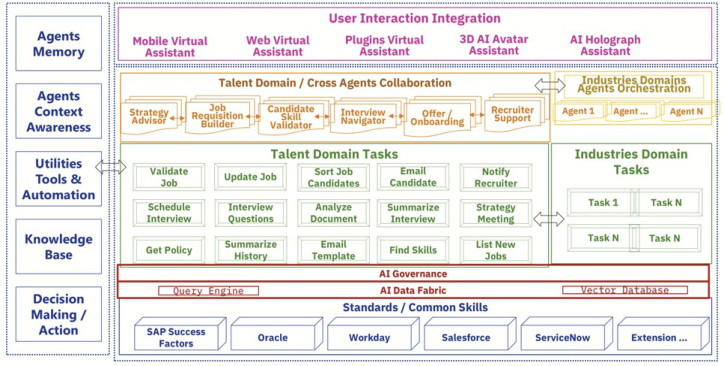
The data layer is the source of truth for the enterprise, this is the context that guides agents and their activity. Moving to a data platform allows multiple tools to access the analytic data at any time. Today’s data platform is not complete, and the challenge exist in bringing the data together in a way that speaks a common language of the business and is trusted so that action can be taken. Eventually, we envision agents from vendors that might exist in different applications today to talk to each other essentially in natural language with evolving concept of data mesh toward more flexible, decentralized data architectures and the integration of disparate data sources into a unified, harmonized platform. A high-level architecture, relevant to Talent domain is represented (see Figure 1):
Here are some relevant points on capabilities of a multi agent framework:
1. A Multi Agent System contains multiple independent agents, each capable of handling user requests. 2. The Multi Agent System should combine the capabilities of all the agents to create a greater feature set for the end user. 3. A master or supervisor agent can be used as a proxy to forward requests to sub agents and coordinate work between the agents. 4. Multi-agents’ cooperation: multiple agents work together to complete a common task or goal, and it is necessary to design a reasonable
cooperation mechanism and coordination strategy, such as task allocation, resource sharing, and action synchronization. 5. Multi-agents adaptive: multi-agent system can automatically adjust its execution structure according to the changes of the business scenario and its own operating conditions to adapt to new tasks requirements 6. Each agent may use code, traditional AI, or generative AI depending on the task being implemented. 7. AI data fabric enable data management and integration design that uses AI and machine learning to create a unified data environment, including automate data integration in real time.
In the future we see multi-agent system as network of agents with self- awareness, ability to independently interact with other agents coordinating, collaborating and competing, adapting behavior, and proactively working on the tasks, making independent or ‘team’ decisions for the next best action. The evolutionary part of this system is it’s built on top of existing cloud and on-premises systems with deep connections into these critical operational applications as well as the historical systems of analytic truth. An agentic framework will be built to connect multiple agents that are working together toward a business outcome, defined by business goals. This is much more sophisticated and useful than retrieval-augmented generation, or RAG. We envision agents doing work on behalf of a human supervisor and working in concert with other agents, learning over time and cooperate with other agents to solve complex tasks.
In our example, the user request in natural languages is first processed by an AI driven collaboration layer/supervisor agents’ network which has the purpose of selecting the correct AI LLM agent, best suited to answer the specific question or tackle the user provided objective. When deciding on the correct routing of the user provided text, the corresponding Agent can launch specific tools (agent based) which can extract additional information from enterprise systems like ATS, knowledge bases, databases, filesystems and the world wide web to execute specific task. Each AI agent is specialized on a specific domain or task which enables the execution of business flows for complex objectives. For a specific goal, a series of AI agents can execute subtasks for which the combined output will render specific progress towards the end result. The output of each AI agent execution will be stored in memory and once the chain of tasks generated by the agent network is executed, the final response for the human user is constructed by combining the results from the memory and all agents input. Specific to Talent Domain, the solution can be build implementing a pattern which uses a set of connectors to integrate with very specific enterprise systems. Output validation plus design of guardrails leading to a deployment of trusted AI systems is critical.
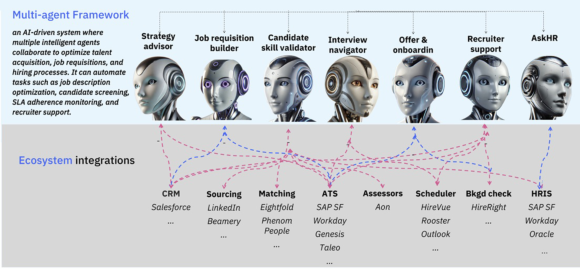
List of talent AI agents (see Figure 2) includes the following:
AI in a Talent Hunt: Unlocking the Future of Recruitment 47
1. Strategy Advisor - an advisory agent that integrates data from HR systems, and leverages historical analysis of roles, past problems, candidate flow and sourcing strategies. Strategy advisor may engage additional agents that collect industry trends, such as in-demand skills, salary benchmarks to provide recruiters with real time labor market insights. 2. Job Requisition builder - automate the creation of job descriptions and requirements, using NLP and Gen AI to refine job descriptions based on historical SLA data. Removes problematic skills, add required and suggests alternatives. This agent predicts whether a job requisition will meet or miss its SLA, continuously updating hiring managers on job fill probability. 3. Candidate skill validator - evaluates incoming resumes against job. descriptions, using embeddings to score candidate-job fit; develop an AI-powered screening agent assignment engine that analyzes task requirements and assigns the most suitable screening agent, pooling suitable candidates from various sources (internal and external pools), automating candidate categorization. It generates a shortlist of recommended candidates with a confidence score, analyzes shortlisted candidates for fit and suggests alternative candidates. 4. Interview Navigator - leverage AI-powered onboarding, prepare interview templates with explainability for AI recommendations, ensuring trust in the decision-making process. 5. Offer and Onboarding - AI-powered solution integrates with multiple data sources to create a unified job offer profile, categorizes job openings based on skills, experiences, and qualifications, streamlining the job offer process and improving the candidate experience. On boarding document verifier - help an onboarding specialist review documents uploaded by the candidates - without manual check. 6. Recruiter support – provides conversational AI support for recruiters. Answers queries about job requisitions, candidate pools, and hiring trends. 7. Ask HR - support employees with real time responses to employee queries, linked to organizational policies, helping to organize work
schedule, answer questions related to career growth, new skills building, payroll, salary and provide structure to reduce manual workload.
To support a Talent Multi-Agent Framework, the Data Fabric/Data Mesh should be designed to provide decentralized, scalable, and real-time data access across various hiring-related domains. Each domain in the data mesh has its own data products, exposed via APIs or event-driven systems (see Table 2).
Data ingestion, processing, transformation, storage and cataloging with data access layer are important components of data architecture to support AI analytics layer to train and deploy models as microservices for SLA predictions, job optimization, and candidate-job matching.
Let us review a potential set of integrations for import and export of data which would be commonly encountered when employing the AI Agent Pattern:
Human Resource Information Systems - collecting employee data, obtain update on employee profiles as well as benefits information. The LLM agent can leverage this integration to learn about the organization’s structure and workforce actions like vacation time, turnover over rates and specific areas where improvements can be delivered. The LLM solution can reduce administrative burdens by automating time-off requests, ensuring compliance with company policies and regulations by offering personalized recommendations on specific HR processes and improve the overall efficiency of the workforce.
Various systems that collect feedback – improving employee engagement and ultimately increasing the retention rates, the LLM based solutions can integrate with various employee engagement systems which collect feedback in order to identify trends, sentiment as well as areas for improvement on various topics including HR specific processes and policies.
Performance management systems – providing personalized recommendations to managers of the company using automated cognitive system, ensuring policy compliance as well as increased performance and accountability on the HR processes. This approach brings additional benefits including better employee development plans and more effective talent management. The LLM can retrieve and analyze performance reviews, employee goals for the year and create personalized conversation guidance (talking points) for each employee.
AI in a Talent Hunt: Unlocking the Future of Recruitment 49
Recruitment management systems – assisting with candidate sourcing, interview preparation and screening. It can also collaborate in real time with hiring managers by providing them feedback on the candidate. Potential benefits of this data source for the agent include enhancing recruitment efficiency while also improving the candidate experience as well as more accurate predictions on weather a candidate is a good match.
There are also cross-cutting concerns which need to be taken into account when implementing the LLM Agent Pattern like data quality standardization, security and ethical implementations. Ensuring that data is accurate and standardized across the enterprise would greatly increase the speed of adoption for these types of cognitive systems. From a security standpoint it is important to implement robust set of rules in terms of authentication and authorization given that HR data is usually highly confidential and protected by various international laws like GDPR, PIPEDA, LGPD and others. Continued focus an ethics concerns and related bias mitigation activities is required especially when it comes to shortlisting and parsing candidates.
CONCLUSION
Artificial Intelligence and especially Generative Artificial Intelligence is disruptive for many industries and often has been only deployed as multiple of simple proof-of-concept entablements. However, for the HR domain, it is already at the right maturity level and has been deployed in part at scale in multiple companies today. This adoption offers many benefits of speed, experience and quality to both candidates as well as company staff members involved in the recruitment process, including hiring managers and recruiters.
To implement advanced cognitive solutions which can tackle complex HR objectives, we need the leverage multiple LLMs and Agents. This is best achieved by using a coordination component as best described in the “LLM Agent Pattern” which represents a standardize way in which cognitive technology can be used in a business context to address questions and take actions validated by human users in the training, inference or interoperability testing process. Agentic solutions and specifically LLM-based agent patterns, are designed to act autonomously, making decisions and taking actions towards a specific goal.
As the agentic AI is rolled out across the enterprises the role of the human and agentic (digital) systems will be evolving. Key desire is to strike a balance based on the optimal use of these two types of agents. For example, human agents will be responsible for complex problem-solving. Humans will retain the final say in situations that require deep empathy, ethical considerations, or nuanced decision-making (Harrison, 2024), for example handling escalations, and managing emotionally charged or high-stakes interactions. On the other hand, the AI or agentic systems will continue to assist with routine, repetitive, and time-consuming tasks, managing simpler transactions, and handling initial customer/user interactions. Thes agentic systems will operate within certain guardrails or patterns set by humans. That is why understanding of where the “hand-off” between agentic system and
human agents needs to exist is so important as we build patterns. It needs to be clear when the human has to authorize actions and when the AI agent can manage the decision.
As we transition into the 2030s, we believe the emergence of intelligent, multi-agent network and collaboration will play a major role in Talent Domain. These systems will be designed for Humans with the focus on the outcome and user natural workflow and experience. AI Agents will provide broad capability and contextual memory, ensuring exceptional user experience thru the power of a hybrid workforce, where AI and people work together. These systems will be trustworthy, with focus on AI governance.
ACKNOWLEDGMENT
The authors would like to acknowledge Samit Narula, Jian Dong Yin, Kat Miller, Robert Enright, Tom Mason, Shilpa Marathe and Jean-Stephane Payraudeau for their contributions to the IBM talent multi-agent framework and support for this publication.
REFERENCES
Cheng, Yuheng. et al. (2024). Exploring large language model based intelligent agents: Definitions, methods, and prospects. arXiv 2401.03428, https://arxiv.org/ abs/2401.03428. Gadesha, Vrunda. Kavlakoglu, Eda. (12 August 2024). What is chain of thoughts (CoT)? IBM Website: https://www.ibm.com/think/topics/chain-of-thoughts. Gartner (6 March 2024). Performance Management Benchmarks: Performance
Ratings. Gartner website: https://www.gartner.com/en/documents/5252963. Gutkowska, Anna. (3 July 2024). What are AI agents? IBM website: https:// www.ibm.com/think/topics/ai-agents. Harrison, S. (Dec. 16, 2024). How Agentic AI is Empowering Human Agents
and Redefining Service Standards, by COGNIGY, CX Today website: https://www.cxtoday.com/contact-center/how-agentic-ai-is-empowering-human- agents-and-redefining-service-standards/. Koumpan, Elizabeth. Mcowen, Lynda. (2024). Revolutionizing Talent: The Path in 21st Century Workforce Transformation. In: Vesa Salminen (eds) Human Factors, Business Management and Society. AHFE (2024) International Conference. AHFE Open Access, vol 135. AHFE International, USA. http://doi.org/10.54941/ ahfe1004932 Li, X., Wang, S., Zeng, S. et al. (2024), A survey on LLM-based multi-agent systems:
workflow, infrastructure, and challenges. Vicinagearth 1, 9 (2024). https://doi.org/ 10.1007/s44336-024-00009-2 McDonough, Caitlyn. (2024). Make onboarding work better through hiring managers, Gartner HR Symposium, XPO website: https:// www.gartner.com/en/conferences/na/hr-symposium-us/sessions/detail/ 3459161-Make-Onboarding-Work-Better-Through-Hiring-Manager. Wei, Jason. Xuezhi Wang. Schurmans, Dale. Bosma, Maartin. Ichter, Brian. Xia, Fei.
Chi, Ed. Le, Quoc. Zhou, Denny. (2022). Chain-of-Thought Prompting Elicits Reasoning in Large Language Models. arXiv:2401.03428, https://arxiv.org/abs/ 2201.11903). Zielinski, Dave. How HR is using generative AI in performance management.
Read this individual research paper free through the original publisher, or explore the full digital proceedings book.
ISBN 978-1-964867-42-7
Explore this ISBN in the AHFE Bookstore ↗Listed in the July 2026 bookstore catalogue; search by ISBN to confirm current availability · Digital book purchase optional