Elizabeth Koumpan, Lynda Mcowen (2024). Revolutionizing Talent: The Path in 21st Century Workforce Transformation. In: Human Factors, Business Management and Society. AHFE Open Access, vol. 135, pp. 74–83. https://doi.org/10.54941/ahfe1004932
In a world where progress is driven by people and experience, having the right workforce with a strong HR and Talent strategy is key to business growth and business agility. Building and retaining this talent requires the enterprise to cater to the changing talent landscape with a comprehensive talent agenda to attract, develop and retain the right resources for their workforce. In order to achieve these objectives, it is important for the enterprise to develop and scale new digital and data savvy skills while balancing user-centricity with an industry solution orientation that starts with talent acquisition and continues on through the employee lifecycle. This transformational journey to enhance the employee experience and improve productivity includes elements such as talent acquisition (attraction, recruiting and interviewing, onboarding…), personalized career development, personalized retention practices (motivation, feedback, recognition, opportunities…) and predicting critical events (new technology burst such as Gen AI…) while maintaining a solution that addresses all required regulations. This includes creating tools that assist in evaluating and assessing new legislative texts, identifying overlap with existing regulations, locating any red flags (e.g. executive liability) and preparing recommended output.In this paper we will explain how the use of Large Language Models and Gen AI can create the capabilities in talent transformation utilizing the enterprises base infrastructure to support enhancements in employee experience and productivity throughout the different stages of the employee lifecycle. Implementing this technology in conjunction with human expertise will ensure that these initiatives align with the organization's specific goals and values, ethical considerations, transparency, and accountability that are crucial when deploying AI in HR and talent management.We will share our architectural patterns that we have used as a foundation for building a holistic talent transformation framework, that any enterprise can adapt and combine to suit their specific needs and goals in managing and optimizing their workforce in the 21st century.
In today’s rapidly changing technology landscape with the introduction of Gen AI we are seeing a profound impact on the economy. Gen AI has the capability to perform intellectual tasks beyond the capabilities of humans. While the full-fledged implementation is still in its early stages the poten- tial economic impacts are significant. With Gen AI systems, businesses can automate complex tasks, enhance decision making processes and optimize
Revolutionizing Talent: The Path in 21st Century Workforce Transformation 75
operation. This can result in increased productivity, cost reductions and improved resource allocations. Examples of this include in healthcare Gen AI can assist in diagnosis or suggest treatment plans leading to faster and more accurate medical decisions or in manufacturing Gen AI can lead to advanced robotics and automation improving production rates and product quality. This impact can be seen across industries and job roles.
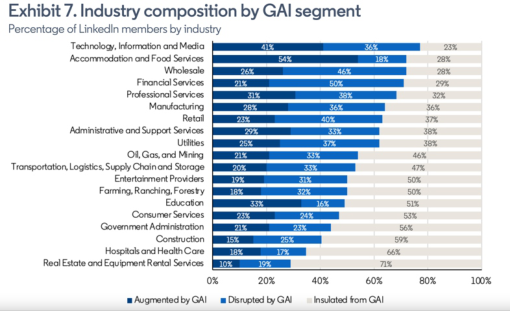
Figure 1: Industry composition by gen AI segment (LinkedIn economic graph, 2023).
This has the potential to disrupt labor markets and transform the nature of work, while certain low skill jobs might be replaced by AI systems the emer- gence of Gen AI is also expected to create new jobs that focus on managing and developing AI technologies. Job roles that involve manual labor or data processing such as assembly line work, data entry or customer support are at a higher rate of being automated. This could lead to the displacement of these job roles and potential job loss in the affected sector. However, it is impor- tant to note that Gen AI will also create new job opportunities. Along with the new job roles managing and developing AI technologies, job roles that involve training, fine tuning and maintaining will be necessary. Job roles that involve creativity, problem solving, critical thinking and/or emotional intelli- gence are less likely to be fully automated and most likely will be enhanced or grow. The workforce will require new skills to work effectively leading to an increased demand for specialized training programs and education. This shift in the labor market may create both challenges and opportunities for indi- viduals and organizations. Reskilling and Upskilling of the workforce will be instrumental in successful adoption.
It is crucial to address the potential concerns that arise with the widespread adoption, such as ethical considerations, privacy issues and the potential for job displacement. These all must be carefully managed. Regulators, poli- cymakers, researchers, and industry leaders need to collaborate to ensure responsible AI development and deployment addressing the potential risks while maximizing the economic benefits.
The impact of Gen AI on the economy is expected to be transformative it has the potential to enhance productivity, reshape the labor market, drive
76 Koumpan and McOwen
innovation and fuel economic growth however careful planning, regulation and collaboration will be necessary to harness the full potential and navigate its challenges effectively.
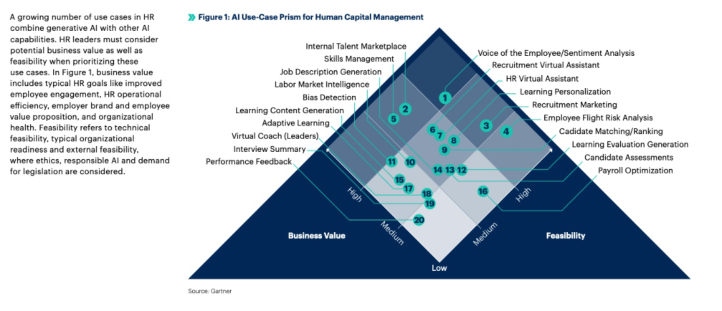
Gen AI adoption into Talent Services can lead to better candidates, bet- ter employee satisfaction, better analytics allowing organizations to identify strengths and weaknesses within their workforce and business practices. In the table below Talent Services use cases have been identified based on busi- ness value and feasibility. In this paper we will outline how using LLM and Gen AI can create some of these cases in collaboration with human expertise to ensure these initiatives align with the organization’s goals.
Figure 2: AI use-case prism for human capital management (Gartner: HR leaders monthly November/December 2023).
Gen AI Impact on Talent Generative AI – “Gen AI” is a disruptive technology that can create ‘new original material’- like images, text, video, audio or help you to understand existing ones. Generative AI models, by learning patterns and structures from large datasets, create a basis for generating new data that resembles the origi- nal training data. This foundational model can then be fine-tuned or adapted for specific tasks, such as image-to-image translation, data augmentation, or content generation. The integration of General Artificial Intelligence (Gen AI) has a significant impact on talent transformation, workforce needs, and the methods used to attract new talent. There are multiple aspects of how AI influence new way of thinking and new Talent requirements:
Talent Transformation – where we need to have new skills development, focused on AI, data analysis, machine learning, and automation. We need to promote the need for continuous learning and upskilling programs to adapt to evolving technologies and roles within the workforce. There will be new job roles centered around AI development, implementation, maintenance, and data-driven decision-making.
Workforce Needs- We see continuous increases the demand for profes- sionals with expertise in AI, data science, programming, and analytics, necessitates a blend of technical expertise with soft skills such as criti- cal thinking, problem-solving, creativity, and adaptability. And another
Revolutionizing Talent: The Path in 21st Century Workforce Transformation 77
important aspect on ability to integrate AI solutions across diverse busi- ness functions.
Attracting New Talent – offering opportunities for career advancement and professional development in emerging technology fields.
Work Environment and Culture - encourages a culture of collaboration between AI systems and human employees, fostering a dynamic work environment, drawing individuals from diverse backgrounds, including those with technical expertise and others interested in learning about AI applications in various industries.
Talent Retention - provides ongoing learning opportunities, making work- places attractive for individuals seeking career growth. Engages talent by involving them in innovative projects leveraging AI, fostering a sense of purpose and contribution.
Ethical and Responsible AI Adoption - attracts talent interested in con- tributing to ethical and responsible AI development and deployment, encouraging the inclusion of diverse perspectives in AI development, promoting a more inclusive and comprehensive approach.
Gen AI significantly impacts talent acquisition and retention strategies by emphasizing the need for a technologically adept workforce capable of leveraging AI capabilities effectively. Organizations investing in Gen AI initiatives attract talent keen on being part of an innovative, tech-driven envi- ronment that fosters growth and offers opportunities to make meaningful contributions to cutting-edge advancements.
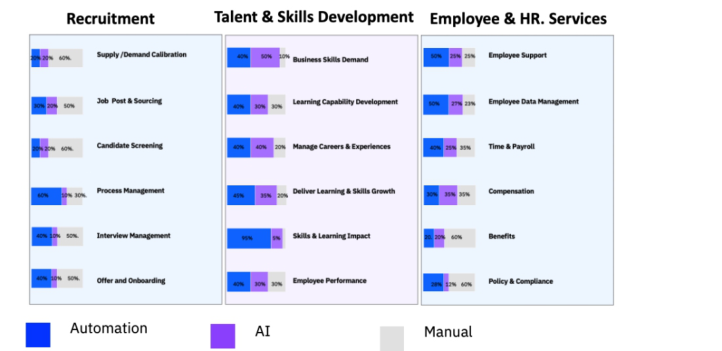
As you can see in Figure 3 below, a lot of current existing activities across different Talent Domain can be easily automated. Industry observers predict that AI will significantly automate tasks and augment human capabilities, revolutionizing business models and society. Generative AI as an extremely powerful tool for enhancing efficiency and effectiveness, allowing humans to concentrate more on the innovative aspects of their work.
Figure 3: Talent transformation areas (IBM internal: Gen AI initiative - talent transfor- mation 2023).
78 Koumpan and McOwen
Imagine, using AI, we will create a competitive and rules-based offering by synthesizing market data, organizational compensation guidelines and business rules, collective bargaining agreement rules, internal compensation comparisons, etc. By automating the administrative data validation, com- pensation analysis, offer calculations and documentation preparation we can increase the speed from hiring decision to offer extension, providing recruiters with draft offers that are compliant, accurate and include ready insights they can leverage during offer extension. This will create an advan- tage in the market for any organization by reducing the time between the hiring decision and offer extension, ensuring offers are competitive within each of their markets and compliant by leveraging a variety of data and intel- ligence, and by enabling recruiters to deliver a best in class experience that exceeds candidate expectations as it relates to timely and specific offer com- munication via the best communication channel for the candidate’s particular situation.
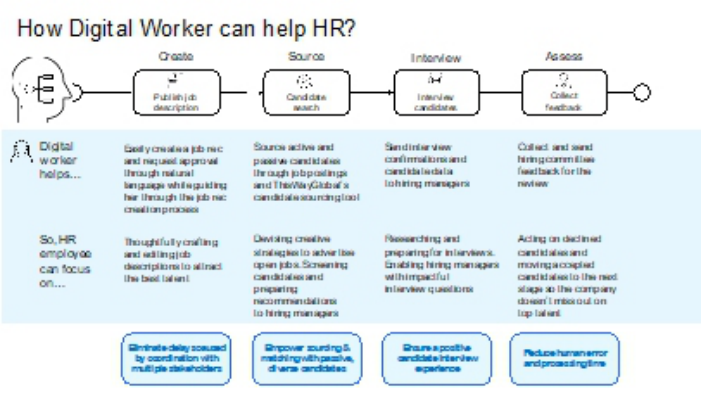
In Figure 4 below, you can see an enhanced candidate hiring process with Digital Worker participation, which augments human manual activi- ties, reducing overall time and allowing Humans to move their focus to more intelligent work.
Figure 4: How digital worker can help HR? (IBM internal: Gen AI initiative - talent transformation 2023).
Enterprises are now adopting talent intelligence solutions that are special- ized in candidate sourcing, interview management, employee onboarding, learning & development, payroll automation. These are mostly AI enabled and this space is being dominated by start-ups while established HCM plat- forms still lag behind. The industry is ready to adopt very point solutions with LLMs trained on company policies, data & industry trends.
Revolutionizing Talent: The Path in 21st Century Workforce Transformation 79
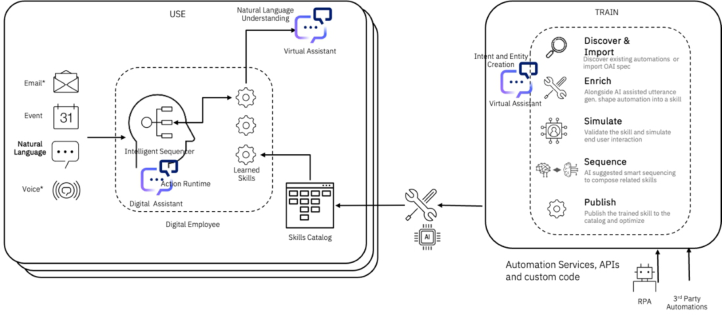
Figure 5: Logical conversational AI framework (IBM internal: Gen AI initiative - talent transformation 2023).
Digital Workers are virtual employees that emulate the skill sets of human workers and automate business functions. A digital worker can perform com- plex tasks that might otherwise be repetitive and time-consuming for the staff. Digital workers today are helping HR staff craft job descriptions, generate lists of candidates and contact them. They’re helping customer support teams approve exceptions and schedule follow-up meetings. When it comes to the process of allocating fair and equitable job promotions, HR professionals can turn to digital workers to help gather employee data so they can focus on using that data to make the best promotion decisions.
Knowledge workers engage Digital Worker through conversational AI to automate, manage and optimize work.
Digital Worker receives the request, matches the best skill and sequences for the tasks based on the user’s intent and context.
Skills catalog is an ever-expanding directory of applications and specific tasks available.
Skills are digital automations that wrapper integrations to apps, sys- tems, workflow, or AI models.
HR employees are enabled to connect with their most frequently used busi- ness applications such as Salesforce, SAP, and Workday to quickly access and act upon the information that is needed.
Models responds to question in natural language, generates content in natural language, extracts entities, facts and information form text, creates summaries of natural language, classifies text (for example: Sentiment, group).
Builders build, discover, import, and train skills for use in everyday processes and workflows, bringing in automation from various tools including third party. Custom skills can leverage a variety of technologies,
80 Koumpan and McOwen
like robotic process automation (RPA), application programming inter- face (APIs), and application integration tools to automate work across the systems already used.
LLM Patterns Generative AI is the next great innovation in Artificial Intelligence that builds on Foundation Models (with unlabeled data) to support business use cases such as extraction, classification, text generation, summarizing, Q&A for Natural Language Processing (NLP) or even coding language tasks. There will eventually only be a few foundation LLM models because of the expense and energy to train them, but many, many different fine-tuned models at different levels of granularity. We see a next stage in experimentation & adop- tion with the popularity of RAG. Context & personalization are becoming key pillars around which much interest and focus is being seen to make Gen AI more specific to businesses and their human resources structure. There are different design patterns – from simple to complex in using LLMs. We will describe one of them – Next Generation Agents, that help optimize the potential of Generative AI.
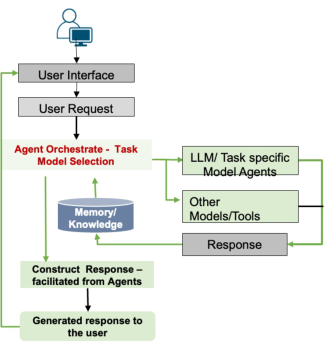
We have a set of Agents that will engage the right model to execute and combine the narrative/ model orchestration based on the specific task –with the right regulatory requirements and compliance based on specific geography.
Figure 6: LLM agent pattern (IBM internal: gen AI initiative - talent transformation 2023).
LLM agents’ orchestration where user request is broken into tasks, with calling LLM “task agents” and other tools until request is completed.
Recursively calling different agents that are connected to APIs, LLMs /foundational models, and other different tools to accomplish a user task.
Each “agent” is specialized on specific domain/task and subtask, enabling business workflows for complex tasks.
Revolutionizing Talent: The Path in 21st Century Workforce Transformation 81
· Retrieving and using information from other sources, such as databases, file systems and the web. · Effectively using prompts and the outputs to achieve the objectives. · error handling and fault tolerance.
‘Agent Orchestrate’ facilitates iteratively and autonomously calls and engage selective agents based on the user input.
· Task-specific enterprise assistants agents using models tuned for spe- cific HR business functions (and others).
Each agent will generate specific output/response, saving always previous interactions in the memory.
Agent’s responses are provided to the ‘Agent Orchestrate’ that will analyze and construct/generate the summarized response, that will be provided to the user.
CONCLUSION
Gen AI plays a crucial role in the future of Talent Services by facilitating an improved user experience from a candidate, employee and HR specialist standpoint that allows the right person to be identified for the right job with the right skill set and career projection. This in turn allows Talent Services to facilitate its critical role in driving Gen AI in the workforce to enhance the entire organization.
Talent Services utilize talent acquisition, recruiting and hiring to drive the capabilities required by Gen AI in the workforce as the organization adopts the new technologies. Recruitment agencies or human resource departments can help identify and attract candidates who possess the required expertise in AI related domains they can utilize algorithms and AI power tools to effi- ciently search for suitable candidates to assist in building a skilled workforce to drive Gen AI initiatives.
Skill development is another crucial aspect of Talent Services that con- tributes to the integration of Gen AI in the workforce. By equipping indi- viduals with the necessary skills Talent Services can bridge the gap between the demand for AI talent and the available workforce as well as enhance the adoption of Gen AI in current job roles. The interaction of AI technolo- gies may require individuals to adapt their skill sets or explore new career paths; Talent Services can offer guidance counseling and resources to help employees navigate these transitions effectively. They can provide insights into emerging job roles highlight skill gaps and suggest relevant upskilling opportunities facilitating career growth and ensuring a smooth transition amidst the changing landscapes of work driven by Gen AI.
Talent Services will also play a role in promoting diversity and inclusion, they can actively work to address concerns around bias by promoting diverse hiring practices encouraging the involvement of underrepresented groups and fostering an inclusive work environment. This can contribute to the responsi- ble and ethical implementation of Gen AI technologies and ensure a fair and equitable workforce.
82 Koumpan and McOwen
By leveraging Talent Services effectively organizations can build a skilled and diverse workforce capable of harnessing the potential of Gen AI to drive innovation and economic growth.
ACKNOWLEDGMENT
The authors would like to acknowledge Cynthia Boales, Vimal Dimpi, Adri- ana Gamboa, Divine Gomez, Christopher Hyland, Kurt Krause, Samit Narula, Janice Salchert, Sachin Varma and Wendy Wick for their support.
REFERENCES
Ammanath, B. (2023). Utilizing AI to Transform Talent Management. AI Ignition Episode 16 (Podcast). Barth, J. (2023, July 20). HR Tech Check: What’s Happening With AI Regulations?
HR Executive. Retrieved from <https://hrexecutive.com/hr-tech-check-whats-ha ppening-with-ai-regulations/>. Bersin, J. (September 8, 2023). The Role of Generative AI in HR Is Now Becoming Clear. The Josh Bersin Website. Retrieved from <https://joshbersin.com/2023/09/ the-role-of-generative-ai-in-hr-is-now-becoming-clear/>. Bersin, J. (December 18, 2023). AI is Transforming Corporate Learning Even Faster
Than I Expected. The Josh Bersin Website. Retrieved from <https://joshbersin.com /2023/12/ai-is-transforming-corporate-learning-even-faster-than-i-expected/>. Bersin, J. (2023). Understanding AI in HR: A Deep Dive. Chui, M., Yee, L., Hall, B., Singla, A., & Sukharevsky, A. (023). The State of AI in 2023: Generative AI’s Breakout Year. McKinsey Global Institute. Retrieved from <https://www.mckinsey.com/capabilities/quantumblack/our-insights/the-st ate-of-ai-in-2023-generative-ais-breakout-year#talent>. Buytendijk, F. (November/December 2023). Generative AI for the Workplace.
Gartner: HR Leaders Monthly. Retrieved from <https://emt.gartnerweb.com/ngw /globalassets/en/human-resources/documents/trends/hr-leaders-monthly-novem ber-december.pdf>. Chui, M., Hazan, E., Roberts, R., Singla, A., Smaje, K., Sukharevsky, A., Yee, L., & Zemmel, R (2023). The Economic Potential of Generative AI: The Next Productivity Frontier. McKinsey Global Institute. Retrieved from <https://www.mckinsey.com/capabilities/mckinsey-digital/our-insights/the-econ omic-potential-of-generative-ai-the-next-productivity-frontier#introduction>. Kimbrough, K., & Carpanelli, M. (August 23, 2023). Preparing the Workforce for
Generative AI: Insights and Implications. LinkedIn Economic Graph. Retrieved from <https://economicgraph.linkedin.com/content/dam/me/economicgraph/en-u s/PDF/preparing-the-workforce-for-generative-ai.pdf>. Koumpan, E., McOwen, L., Narula, S. & Gomez, D. (2023). IBM Internal: Gen AI initiative - Talent Transformation. Lucas, E. (December 11, 2023). Armed With AI, Workers Are Apply- ing To More Jobs. It’s Upping The Competition. Forbes. Retrieved from <https://www.forbes.com/sites/emmylucas/2023/12/11/armed-with-ai-work ers-are-applying-to-more-job-its-upping-the-competition/?sh=6f7db3fb7fdc>. Matos, A. (2023). Transforming Talent Acquisition Through The Power Of Automa-
tion and Artificial Intelligence. Harvard Business Review Analytic Services. Retrieved from <https://hbr.org/resources/pdfs/comm/paradox/TransformingTale ntAcquisitionThroughThePowerOfAutomationAndArtificialIntelligence.pdf>.
Revolutionizing Talent: The Path in 21st Century Workforce Transformation 83
Manyika, J., Lund, S., Bughin, J., Robinson, K., Mischke, J., & Mahajan, D. (2016).
Independent Work: Choice, Necessity, and the Gig Economy. McKinsey Global Institute. Retrieved from <https://www.mckinsey.com/featured-insights/employm ent-and-growth/independent-work-choice-necessity-and-the-gig-economy>. Poitevin, H., & Den Hamer, P. (3Q 2023). What Generative AI Means For Your Talent Strategy. Gartner Business Quarterly. Retrieved from <https://emt.gartnerweb.com/ngw/globalassets/en/human-resources/documen ts/trends/what_generativei_means_for_your_talent_strategy.pdf>. Sears, J., & Smallwood, M. (2023, October 9). How Artificial Intelli- gence Can Augment A People-Centered Workforce. EY. Retrieved from <https://www.ey.com/en_sg/workforce/how-artificial-intelligence-can-augme nt-a-people-centered-workforce>. Sidana, S. (2023, October 25). 4 uses for generative AI in talent management.
Forbes. Retrieved from <https://www.forbes.com/sites/forbeshumanresource scouncil/2023/1025/4-uses-for-generative-ai-in-talent-management/?sh=27a 3624947eb>.
LISTED IN THE AHFE DIGITAL BOOKSTORE CATALOGUE
Explore the complete digital volume
Human Factors, Business Management and Society
Read this individual research paper free through the original publisher, or explore the full digital proceedings book.
ISBN 978-1-964867-11-3
Explore this ISBN in the AHFE Bookstore ↗Listed in the July 2026 bookstore catalogue; search by ISBN to confirm current availability · Digital book purchase optional