Sara Mostowfi, Jung Hyup Kim, Ching-yun Yu, Siddarth Mohanty, Fang Wang, Danielle Oprean, Kangwon Seo (2025). Enhancing Student Learning: The Impact of Continuous Metacognitive Monitoring Feedback in Location-Based Augmented Reality Environments. In: Intelligent Human Systems Integration (IHSI 2025): Integrating People and Intelligent Systems. AHFE Open Access, vol. 160, pp. 687–695. https://doi.org/10.54941/ahfe1005875
With the growing need for augmented reality (AR) technology, understanding and optimizing study behaviors in AR learning environments has become crucial. However, one major drawback of AR learning is the absence of effective feedback mechanisms for students. To overcome this challenge, we introduced metacognitive monitoring feedback. Additionally, we created a location-based AR learning environment utilizing a real-time indoor tracking system to further enhance student learning. This study focuses on the positive impact of metacognitive monitoring feedback in a location-based AR learning environment. Our hypothesis posits that regularly providing students with feedback on their metacognitive monitoring within this new AR learning system positively influences their metacognitive awareness. The study's findings confirm that frequent exposure to such feedback significantly enhances the Metacognitive Awareness Inventory (MAI) scores. Participants who received continuous feedback demonstrated a significant increase in MAI scores compared to those who received feedback only once after the lecture. This improvement is achieved by influencing student calibration and directly enhancing their metacognitive awareness.
Metacognitive strategy is a pivotal concept in educational research, with numerous studies showing that its implementation can significantly enhance learning outcomes (Dunlosky and Metcalfe, 2008). Metacognition serves as the comprehensive mechanism enabling individuals to oversee, manage, and guide their learning through the effective use of declarative, procedural, and conditional knowledge. Declarative Knowledge refers to the essential
facts and information a learner must know to engage in critical thinking about a subject. Such knowledge encompasses understanding the ‘what’ of a topic, including information about one’s own abilities and resources as a learner. This type of knowledge can be acquired through methods such as presentations, demonstrations, and discussions. Procedural Knowledge involves understanding how to carry out specific tasks or procedures. It not only requires knowing the steps of a process but also understanding when these steps should be applied in different contexts. Students often gain procedural knowledge through activities like discovery learning, cooperative learning, and engaging in problem-solving tasks (Klang et al., 2021; Wang and Wu, 2022). Conditional Knowledge relates to recognizing the appropriate contexts in which to apply certain skills or processes. This type of knowledge involves understanding the ‘when’ and ‘why’ behind the use of different learning strategies, effectively combining declarative and procedural knowledge based on the situation at hand. The conditional form of knowledge is typically developed through simulations and scenario-based learning (Battista, 2017).
Metacognition encompasses the learner’s self-regulation of cognitive functions during the learning process, which involves strategies for planning, managing information, monitoring comprehension, debugging, and evaluating. As outlined by Schraw and Dennison (1994), these components include:
Planning: The initial phase of learning involves setting goals and allocating necessary resources before the learning process begins.
Information Management Strategies: These are techniques and sequences of actions aimed at enhancing the efficiency of information processing, such as organizing data, expanding on information (elaborating), summarizing key points, and focusing selectively on critical elements.
Comprehension Monitoring: This is the ongoing evaluation of one’s understanding and the effectiveness of the strategies employed.
Debugging Strategies: These are methods applied to identify and rectify errors in understanding or performance.
Evaluation: This stage involves reflecting on and analyzing the outcomes of the learning activity and the success of the strategies used once the learning episode has concluded.
Bransford et al. (2000) indicated that learners who are aware of metacognition tend to use better strategies and achieve better results than those who are not aware. This awareness helps them organize, supervise, and evaluate their learning, improving their performance. Understanding one’s own thinking processes, using strategies, and knowing when to use them form the basis of the knowledge, including declarative, procedural, and conditional knowledge. Additionally, regulating cognition involves understanding how to plan, use strategies, monitor progress, correct misunderstandings, and evaluate learning experiences.
Students typically rely on their self-assessed learning confidence when determining the allocation of study time. Their confidence levels influence the amount of time they allocate to topics they perceive as less comprehensible
Enhancing Student Learning: The Impact of Continuous Metacognitive Monitoring 689
to enhance their learning performance. In traditional face-to-face engineering learning, students can gauge the accuracy of their confidence judgments through interactions with peers and instructors. However, when it comes to augmented reality (AR)-based learning, students encounter difficulties developing these monitoring skills due to the limited interaction and feedback. To address this challenge, we aim to develop an effective metacognitive feedback mechanism within an AR learning system to understand and evaluate students’ study behaviors. This study investigates the impact of feedback on metacognitive monitoring in an AR learning environment. We hypothesize that consistently providing students with feedback on their metacognitive processes within an AR learning context will positively influence their metacognitive state.
In the context of education, feedback is any information given to a student following their response to evaluate their performance or advancement in their learning (Turda et al., 2021, Narciss et al., 2014). According to research, students learn more efficiently when they receive feedback, making it an essential teaching tool (Guo et al., 2014). Narciss and Sosnvsky (2014) describe several feedback types that are frequently utilized in computer- based learning, such as elaborated feedback, answer-until-right, multiple- try feedback, knowledge of response, and knowledge of correct response. According to Narciss (2008) and He et al. (2023), elaborated feedback should provide useful problem-solving techniques and more material to close comprehension gaps between students’ present understanding and the intended level. Shute (2008) argues that in addition to the right answer, extended feedback can also include incorrect comments, further examples, or general suggestions. Similarly, extended feedback can include extra background information, offer cognitive or metacognitive cues, or clarify why an answer is accurate (Golke et al., 2015). Elaborated feedback’s main goal is to promote students’ deeper cognitive engagement with the subject matter (Wang et al., 2019). Hence, effective metacognitive feedback can encourage students to engage in self-regulation, which involves setting goals, monitoring progress, and adjusting strategies as needed. This active engagement in their own learning process can lead to a deeper understanding and retention of the material. Also, it will help them understand how to improve and create a more personalized learning experience.
In this study, we compared two formats of metacognitive monitoring feedback and how this feedback affects student metacognitive awareness levels (experiments #1 and #2). To measure metacognitive awareness level, Schraw and Dennison (1994) developed the Metacognitive Awareness Inventory (MAI), a commonly used tool for assessing metacognitive awareness. The MAI evaluates cognitive comprehension and process management, encompassing declarative, procedural, and conditional knowledge, as well as planning and evaluation (Harrison and Vallin, 2018). In the MAI, participants traditionally respond to propositions with true or false answers, employing a true-false format for their responses.
The comparison between experiments #1 and #2 demonstrated a positive influence on student learning behavior in AR settings. The findings underscore the significance of feedback timing and delivery method. It
690 Mostowfiet al.
indicates that continuous, contextually relevant feedback is crucial for enhancing learning potential and fostering metacognitive development in AR learning environments.
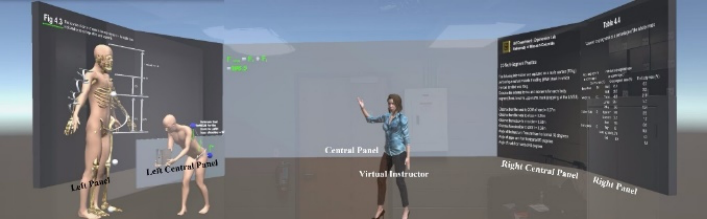
DEVELOPING LOCATION-BASED AUGMENTED REALITY LEARNING SYSTEM For this study, we developed fifteen 3D scenes using the Unity Game Engine (see Figure 1), with seven modules in lecture 1, and eight modules in lecture 2. Lecture 1 covers the introduction to biomechanics and shows students how to draw force and moment on different body segments (comprised of an introduction to basic biomechanics knowledge including definitions, concepts of force and moment, static equilibrium, multiple link examples, and center of mass); and lecture 2 which is more challenging than lecture 1 (comprised of a review of lecture 1, free body diagrams on hand, upper arm, lower arm, and trunk segments).
Figure 1: 3D virtual objects created within AR modules developed using unity (Pulipati et al., 2024).
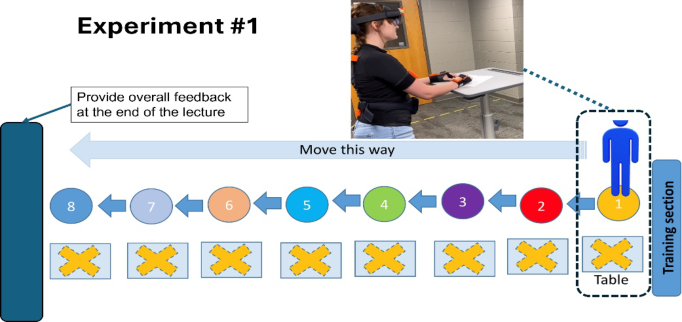
The primary distinctions between experiments #1 and #2 are the mode of question presentation to students and the feedback mechanism. In experiment #1 (refer to Figure 2), students solved problems presented on printed paper and received feedback with the results only at the end of each lecture (Mostowfi et al., 2023).
Figure 2: Experiment #1 set up.
Enhancing Student Learning: The Impact of Continuous Metacognitive Monitoring 691
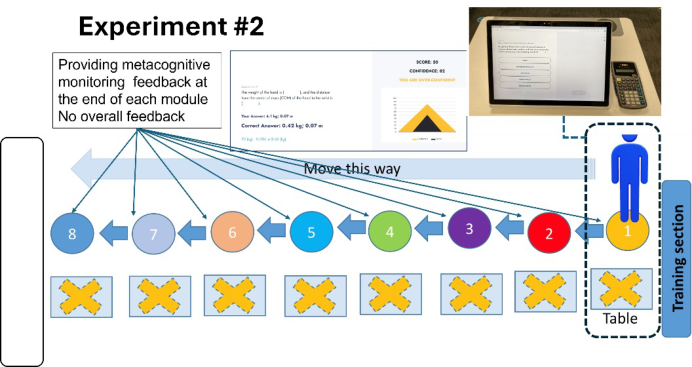
However, in experiment #2 (see Figure 3), student confidence levels and performance are assessed via a monitor screen rather than on paper. Within the metacognitive monitoring feedback system (Kim, 2018), students receive real-time performance and confidence level results after each module.
Figure 3: Experiment #2 set up.
RESULTS
In the experiment #1, 31 students participated, while 20 individuals took part in the experiment #2. The experiments were conducted as between- subject experiments. All participants had no prior knowledge that could have influenced their metacognitive rating. ANOVA was done between lecture #1 in both experiments #1 and #2 to see how both lectures were different based on the experiment. There was a weak significant MAI difference for Information Management Strategies between experiments #1 and #2 in lecture #1 (see Table 1).
Table 1. Comparisons between experiments #1 and #2 in lecture #1.
Table available in the original PDF paper.
MAI Experiment N Mean SD Error F P-value Declarative Knowledge
Then, experiments #1 and #2 were compared in terms of lecture 2. Significant differences in MAI scores were noted between experiments #1 and #2, specifically in the Planning, Comprehension Monitoring, and Debugging strategies for lecture #2 (see Table 2).
Table 2. Comparisons between experiments #1 and #2 in lecture #2.
Table available in the original PDF paper.
MAI Experiment N Mean SD Error F P-value Declarative knowledge
Table 2 indicates that students’ MAI scores significantly improved in planning, comprehension monitoring, and debugging strategies. This suggests that metacognitive monitoring feedback can help students set and achieve specific learning objectives. The planning involves determining which aspects of the material in each module require focused attention and identifying the most critical panel for obtaining the necessary information to respond to the question. For comprehension monitoring, students
Enhancing Student Learning: The Impact of Continuous Metacognitive Monitoring 693
could continuously assess their understanding through the metacognitive monitoring feedback. This offers guidance on how students may need to modify their focus on the AR content, particularly if they encounter confusing concepts or if their retention of information is not meeting expectations. For debugging strategies, students might pinpoint deficiencies in their knowledge or abilities through metacognitive monitoring feedback in the AR setting. This might involve focusing more on the virtual instructor’s movements, taking notes, or going back to review the AR modules to resolve any confusion (Kim et al., 2023).
AR immerses students in a rich, yet potentially overwhelming, information environment. To navigate this effectively, students must adopt efficient strategies, such as organizing the learning material they will encounter, note-taking, and summarizing essential details from AR experiences. These techniques are vital for improving and refining their study strategies. Our results indicate that feedback on metacognitive monitoring can have beneficial effects on these techniques for students. Also, it highlights the clear advantages of assisting students in planning, managing, and distributing their cognitive resources throughout AR learning. Observations from the AR lectures reveal that students progressively learned to self-plan and strategize on addressing questions from the initial module to the last. This process allows students to engage in metacognition, essentially allowing them to “think about their learning process.”
According to Zhou et al. (2023), humans are flexible in the allocation of cognitive resources, which can be allocated to important new stimuli according to task requirements. In experiment #2, students received metacognitive monitoring feedback, enabling them to self-monitor and track their progress through each module independently. This metacognitive monitoring, a strategy that evaluates learners’ confidence in relation to their actual performance, has aided students in understanding the rationale behind their chosen answers. Through reflection on their reasoning, students could more accurately gauge their confidence levels and gain deeper insights into their decision-making process.
Previous research has also shown that students exposed to metacognitive feedback demonstrated increased self-efficacy in the AR learning context, suggesting that the feedback tool not only heightens their awareness and attentiveness during learning activities but also promotes self-reflective practices regarding confidence assessments. Since students assess their study strategies, students often base their judgment on outcomes rather than on how well their strategies fulfilled various learning objectives, such as the ability to interconnect concepts (Sabel and Victor, 2017). By having metacognitive monitoring feedback, students could reflect on both their understanding and their metacognition level after each module. They could personally observe their growth in metacognitive awareness and usage.
In conclusion, the provision of metacognitive monitoring feedback in AR learning environments significantly enhances students’ ability to effectively plan, monitor, and adjust their learning strategies, leading to improved comprehension and metacognitive awareness. This research highlights the importance of feedback timing and method, suggesting that continuous,
694 Mostowfiet al.
contextually relevant feedback is essential for maximizing learning potential and metacognitive development within immersive educational settings. Regarding the limitations of the current study, it remains unclear why similar results were not observed in lecture #1. We observed a statistically weak but significant difference in the MAI related to information management strategies between experiments #1 and #2 in lecture #1. However, no significant variances were noted in other aspects. This disparity may be attributed to the differing complexity levels between lecture #1 and lecture #2. Lecture #1 was intentionally structured to be less challenging than lecture #2. This intentional design aimed to provide more declarative knowledge and less constructive feedback due to the introductory nature of lecture 1. Consequently, this might have led to a weaker metacognitive monitoring feedback effect when the lecture content was less demanding.
Another limitation is the sample size. To improve the strength and applicability of our results, it will be essential to conduct experiments using a more evenly distributed sample size and a wider range of age groups. This would provide a more comprehensive understanding of the impact of metacognitive feedback across different demographics.
ACKNOWLEDGMENT
This research is supported by NSF IIS-2202108.
REFERENCES
Battista, A. 2017. An activity theory perspective of how scenario-based simulations support learning: A descriptive analysis. Advances in Simulation, 2, 1–14. Bransford, J. D., Brown, A. L. & Cocking, R. R. 2000. How people learn,
Washington, DC: National academy press. Dunlosky, J. & Metcalfe, J. 2008. Metacognition, Sage Publications. Golke, S., Dörfler, T. & Artelt, C. 2015. The impact of elaborated feedback on text comprehension within a computer-based assessment. Learning and instruction, 39, 123–136. Guo, W., Chen, Y., Lei, J. & Wen, Y. 2014. The effects of facilitating feedback on
online learners’ cognitive engagement: Evidence from the asynchronous online discussion. Education Sciences, 4, 193–208. Harrison, G. M. & Vallin, L. M. 2018. Evaluating the metacognitive awareness inventory using empirical factor-structure evidence. Metacognition and Learning, 13, 15–38. He, J., Liu, Y., Ran, T. & Zhang, D. 2023. How students’ perception of feedback
influences self-regulated learning: The mediating role of self-efficacy and goal orientation. European Journal of Psychology of Education, 38, 1551–1569. Kim, J. H. 2018. The effect of metacognitive monitoring feedback on performance in a computer-based training simulation. Applied ergonomics, 67, 193–202. Kim, J. H., Yu, C.-Y., Seo, K., Wang, F. & Oprean, D. The Effect of Virtual Instructor
and Metacognition on Workload in a Location-Based Augmented Reality Learning Environment. Proceedings of the Human Factors and Ergonomics Society Annual Meeting, 2023. SAGE Publications Sage CA: Los Angeles, CA, 1550–1555.
Enhancing Student Learning: The Impact of Continuous Metacognitive Monitoring 695
Klang, N., Karlsson, N., Kilborn, W., Eriksson, P. & Karlberg, M. Mathematical problem-solving through cooperative learning—the importance of peer acceptance and friendships. Frontiers in Education, 2021. Frontiers Media SA, 710296. Mostowfi, S., Kim, J. H., Yu, C.-Y., Seo, K., Wang, F. & OPREAN, D. The effect of metacognitive judgments on metacognitive awareness in an augmented reality environment. International Conference on Human-Computer Interaction, 2023. Springer, 347–358. Narciss, S. 2008. Feedback strategies for interactive learning tasks. Handbook of
research on educational communications and technology. Routledge. Narciss, S., Sosnovsky, S., Schnaubert, L., Andrès, E., Eichelmann, A., Goguadze, G.
& MELIS, E. 2014. Exploring feedback and student characteristics relevant for personalizing feedback strategies. Computers & Education, 71, 56–76. Pulipati, V., Kim, J. H., Wang, F., Mostowfi, S., Oprean, D. & Seo, K. Utilizing Motion Capture to Quantify Physical Workload in Augmented Reality Learning Environments. Proceedings of the Human Factors and Ergonomics Society Annual Meeting, 2024. SAGE Publications. Sabel, C. F. & Victor, D. G. 2017. Governing global problems under uncertainty:
Making bottom-up climate policy work. Climatic Change, 144, 15–27. Schraw, G. & Dennison, R. S. 1994. Assessing metacognitive awareness. Contemporary educational psychology, 19, 460–475. Shute, V. J. 2008. Focus on formative feedback. Review of educational research, 78, 153–189. Turda, E. S., Ferent, P., Claudia, C. & Sebastian Turda, E. 2021. The impact of
teacher’s feedback in increasing student’s self-efficacy and motivation. European Proceedings of Social and Behavioural Sciences, 104. Wang, Y.-P. & Wu, T.-J. 2022. Effects of online cooperative learning on students’ problem-solving ability and learning satisfaction. Frontiers in Psychology, 13, 817968. Wang, Z., Gong, S.-Y., Xu, S. & HU, X.-E. 2019. Elaborated feedback and learning:
Examining cognitive and motivational influences. Computers & Education, 136, 130–140. Zhou, H., Yan, W., Xu, J., Ma, Y., Zuo, G. & Shi, C. 2023. Allocation of cognitive resources in cognitive processing of rhythmic visual stimuli before gait-related motor initiation. Frontiers in Neuroscience, 17, 1145051.
LISTED IN THE AHFE DIGITAL BOOKSTORE CATALOGUE
Explore the complete digital volume
Intelligent Human Systems Integration (IHSI 2025): Integrating People and Intelligent Systems
Read this individual research paper free through the original publisher, or explore the full digital proceedings book.
ISBN 978-1-964867-36-6
Explore this ISBN in the AHFE Bookstore ↗Listed in the July 2026 bookstore catalogue; search by ISBN to confirm current availability · Digital book purchase optional