Charlotte Haid, Gia-phong Tran, Johannes Fottner (2025). Explainability in AI-Based Scheduling. In: Intelligent Human Systems Integration (IHSI 2025): Integrating People and Intelligent Systems. AHFE Open Access, vol. 160, pp. 256–266. https://doi.org/10.54941/ahfe1005831
As digitalization becomes more widely used in factories, preference-based shift planning is evolving into an important tool for human-centered work in various workplaces. Human-centered shift planning not only increases the efficiency of work, but above all considers the individual's preferences for certain shifts or activities and thereby empowers human workers. However, the planning algorithm used in previous work is based on AI and the algorithm is not able to explain why certain decisions in scheduling were made. The aim of this publication is to use AI-based shift scheduling as an example to make AI systems comprehensible for everyone and thus increase the transparency of the system as well as the user’s trust. Starting from psychological research, we developed a user-friendly explanatory model, that consists of four parts: Starting section, what-if-scenarios, educational classroom and FAQs. A user survey was then conducted to test the effectiveness of the model. The results show that most respondents find the model intuitive and understandable, although they have different preferences for explanations. This study provides insights into the design of explanations for shift planning systems and examines the effects of different explanatory approaches. It thus is the foundation for further research and development in this area.
Digitalization and automation in production and logistics provide a large amount of data about processes and subsequently offer potential for process optimization. These data can be used as a base for decision-making via data analysis or Artificial Intelligence (AI) algorithms. AI-based decision support systems are increasingly in use in logistics (Owczarek, 2021). But with the advantages of AI algorithms like fast process analysis or object detection, there is the disadvantage of non-explainability on how the decision was made for these algorithms (Yampolskiy, 2020). This so-called field of Explainable AI (XAI) is currently a large research focus of AI.
As digitalization becomes more widely used in factories, preference-based shift planning is evolving into an important tool for human-centered work in various workplaces. Shift scheduling is an indispensable task and is present in various workplaces like production or logistics centers, where pickers are assigned to pick shifts. Ernst et al. describe shift scheduling compactly as the process of constructing work timetables for its staff so that an organization can satisfy the demand for its goods or services (Ernst et al., 2004). In contrast to other approaches in production and logistics that use employee data from
smart watches or other tracing solutions, human-centered scheduling does not focus on performance in the first step, but the integration of employee preferences for tasks or shifts. The increased collection of data, such as employee performance monitoring via smart watches, can cause stress and impair creativity, especially as workers demand more individualized tasks (Haid et al., 2022). Human-centered scheduling can increase the efficiency of production and logistics areas in the long term by having more satisfied workers, who tend to stay longer in the same company.
In previous work, a solution based on Constraint Programming (CP) was implemented for preference-aware shift planning problems (Haid et al., 2022). It aims to create shift schedules that reflect workers’ preferences and needs. The CP-algorithm does not provide any explanation on how the schedule was constructed; it just shows the schedule as result. This practical implementation has revealed challenges like limited transparency and understanding of the underlying AI algorithms, leading to potential employee dissatisfaction or refusion of using the scheduling system. This skepticism and intransparency motivate to enhance the existing solution with XAI.
In this research, we present CP-based solutions for scheduling problems, which try to explain their solution procedure. We then present our work on AI-based scheduling shortly as a base for the explanation models. Within these, we present four possible ways to increase transparency and explainability: get-started, what-if-scenarios, educational game and theory classroom. In the final evaluation we show results of possible users on the use of our methodology.
RELATED RESEARCH Constraint Programming is a subfield of Artificial Intelligence algorithms for optimization problems, finding feasible – but not necessarily optimal – solutions by reducing the possible solutions stepwise. Explaining Constraint Programming solutions is already part of the research done in informatics as well as social sciences. In the following, four exemplary publications on explaining CP-algorithms are analysed, to have a base for our own work later.
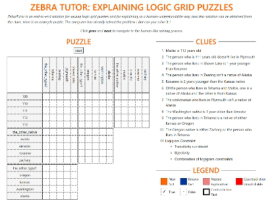
Bogaerts et al. investigate the problem of explaining CP problems stepwise using a logic grid puzzle (see Figure 1). In this puzzle, relationships between a set of items must be deduced using provided clues. The solution requires a systematic application of the clues to eliminate possibilities and derive a solution that satisfies the constraints. The explanatory model proposed is a combination of visualization and text. A solution step is marked in colour in the grid and the corresponding inference method is highlighted. This allows the user to understand how the solver gradually solves the puzzle and how the solver infers new knowledge until a complete solution of the CP problem is achieved (Bogaerts et al., 2020).
The approach lacks easy and comprehensible tutorials, which makes it difficult for beginners to use. While it guides users to one unique solution, it fails to account for problems with multiple solutions. It is not possible to enter own clues, try partial solutions, or collaborate with the AI, thereby missing
out on dynamic collaborative learning and problem-solving. Additionally, the lack of contrastive explanations and the missing possibility to adjust problem parameters limit its versatility in different problem scenarios (Bogaerts et al., 2020). Ghoniem et al. take a different approach. Focus is on the visualization of CP-problems with matrix-based graphs. The goal is to enlighten CP-solvers and their complex dynamics as well as to explore relations between constraints and variables. The researchers use constraint graphs and explanation graphs to make the model more transparent for educational purposes. Matrix-based graphs offer advantages in highlighting symmetries and displaying missing and established links. In this explanatory approach, there are gaps regarding human-centeredness. While the visualization graphs are meaningful for experts who are familiar with the structures of CP, they are not designed for laymen (Ghoniem et al., 2004).
The approach by Jussien and Ouis focuses on providing user-friendly text- based explanations. The presented method organizes problem constraints hierarchically in a tree structure, with users represented as nodes in this hierarchy to determine their comprehension level (see Figure 1). The explanations are generated by projecting low-level constraints onto the user’s comprehension level. Furthermore, user input is translated into low-level interactions with the solver, allowing the removal of all or just the constraints mentioned in the explanation. This tailors explanations to user understanding (Jussien and Ouis, 2001).
Unlike the other approaches, this approach provides user-friendly text- based explanations. Like the other works, however, the emphasis on optimization or consideration of preferences is missing here. There is also no possibility for interactive collaboration.
Freuder et al. explored configuration problems of the n-queens problem, using an interactive system and took preferences into account. In the problem, n chess queens are placed on a chess board such that no two queens threaten each other. A stepwise solving along with visualization was implemented (see Figure 1). The interface supports real-time decision-making for users by using values to express preferences for queen placements in each square. As users place queens, the system adjusts these values in real time, displaying the impact on the overall solution. A text explanation is output of a console, explaining the effects of each move in natural language. While this approach provides interactive insights into the n-queens problem, it has limitations. For instance, it does not compare user placements to optimal AI placements computed by the solver. Thus, the system does not offer a contrastive perspective (Freuder et al., 2003).
In another close work by Sqalli and Freuder, natural language explanations in CPs are investigated. They claim that pure text-based explanations are not very meaningful and satisfactory for humans. By incorporating explanation generation directly into various inference methods, they can generate textual explanations that are more human-friendly. They use predefined templates linked to specific events, such as the reduction of a variable domain. Furthermore, when tested on logic puzzles, their text-based explanation methods yielded solutions of similar quality to those in the source
Explainability in AI-Based Scheduling 259
booklets, mainly using explanation length as a quality measure. However, the researchers note some limitations. Further areas could be investigated beyond logic puzzles, e.g., more complex scheduling problems. Additionally, their explanations were often twice as long as those in the source booklets, indicating the possibility of further improvement to shorten them. Last, ‘what-if’ scenarios could be further explored, providing a contrastive view (Sqalli and Freuder, 2003).
Figure 1: Logic grid puzzle interface by Bogaerts et al., text-based system by Jussien and Ouis, visualisation of n-queens problem by Freuder et al.
In addition to the studies already presented, other examples exist to make CP problems understandable. The selected studies show different approaches to explain CP-based problems, which are compared in Table 1. Bogaerts et al. aim for a user-friendly approach with a single viable solution, made for end users and for simplicity of explanations. They achieve this through visual representation and text-based elements, which they combine in a GUI. In contrast, Ghoniem et al. take an expert-centered approach, focusing on visualizing a specific CP solution as a matrix-based graph. The approach does not offer any opportunity for interaction but provides visualization as an ‘end product’. Jussien and Ouis target end users with their hierarchical text- based explanations, though their approach excludes optimization. Freuder et al. distinguish themselves by addressing both feasibility and optimization in their explanations, using a combination of visualisation and text. Although this approach is considered an optimization function, it lacks the possibility of creating contrastive explanations.
Overall, while each study provides unique solutions and media of explanation, there is a collective gap in offering contrastive explanations and a varying focus on optimization. In addition, no study considers the use case of preference-aware human-centered shift planning.
In this paper, our goal is to contribute to the existing research gap on XAI approaches for scheduling systems to increase transparency and interpretability. Furthermore, we investigate how the applied XAI approaches affect end users’ perception of the shift scheduling system.
Table 1. Comparison of the presented approaches from literature.
Table available in the original PDF paper.
Publication User-Friendliness Target Audience Interactivity Medium of Explanation
High End users, laymen No Visualization + text
Bog-2020 High End users, laymen Yes Visualization + text Gho-2004 Low Experts, developers No Visualization Jus-2001 High End users, laymen No Text Fre-2003, Sqa-2003
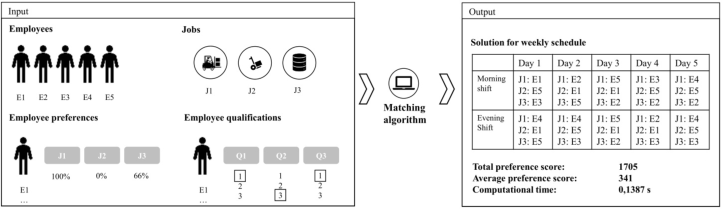
SHIFT SCHEDULING Preference-based scheduling is a promising approach towards the human- centered scheduling of tasks and shifts in every shift-working area. In Haid et al. we designed an algorithmic assignment of employees to available jobs based on given preferences (Haid et al., 2022). The algorithmic assignment is solved by a constraint programming satisfiability solver (CP-SAT) (fml, 2024). We described matching constraints, the matching process, and solved two application examples (Haid et al., 2024). Figure 2 shows the matching process: five employees can give up to three preferences in this small example and are scheduled to three jobs based on their qualifications. In a theoretical, upscaled example with 100 employees, the algorithm scheduled employees to jobs in a calculation time of one minute.
Figure 2: Schematic sketch of the scheduling process.
The scheduling system is intended to support managers or workers doing the shift scheduling currently manually and not to replace the schedulers. The manual matching can take some hours per week – with algorithmic– supported scheduling this can be done in a few minutes. Even rescheduling on short-notice cases caused e.g. by illness can be done in a few minutes. With algorithmic scheduling comes the challenge of explaining the scheduling. What was before done by experience and subjective feeling of the scheduling person, is done now by an AI-based algorithm. As a person can find explanations for his or her scheduling behavior, it is not that simple for an algorithm.
To explain the actions of the algorithm, we started with understanding the steps the CP-SAT solver is taking in the code and trying to prepare it in an understandable way for users. It turned out, the solver is extremely complicated and long and preparing the steps transparently would be too complicated for laymen to understand in detail. Even on a higher level of
Explainability in AI-Based Scheduling 261
explanation, we didn’t see any added value in explaining the steps of the code. That’s why we turned our research and started to use explanations models as in literature, to help users understand the principle of scheduling. These explanation models are presented in the following section.
EXPLANATION MODELS For our use case, the explanation of CP-based human-centered scheduling, we implemented a web interface called scheduling. AI with four different sections of explanations for possible users. The four independent explanation models all have the same goal: to make the human-centered scheduling approach understandable. A user can choose one or more of the models to get insights into the scheduling process. The models were implemented as a web interface but are shown here as screenshots of the web application. Not all elements as well as the interactivity with the user can be shown using these excerpts.
Users enter the web application via the welcome page. There, the general topic is introduced and access to the other sections linked. When developing the welcome page, the focus was on simplicity, so that the presentation is very straightforward, simple, and equipped with many images and icons. The user is then guided through the sections with a sidebar on the upper left side.
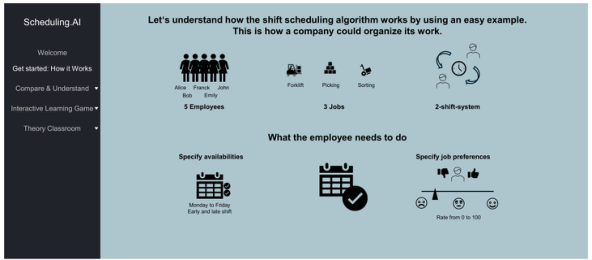
Get-Started The get-started section is the first page of our website and contains an infographic that continuously describes the general functional principle of shift planning (see Figure 3). The infographic can be scrolled down and compactly illustrates the shift planning system with simple example input data. The role of employee preferences, the existence of hard and soft constraints and the generation of solutions using AI are presented. We use icons and text for the explanations in this section. Infographics are visually engaging content that emphasize graphical elements to present information appealingly and memorably, often allowing the reader open- ended exploration (Wang et al., 2019). Designed for clarity and engagement, we use straightforward language, intuitive icons, and a logical flow. At the infographic’s conclusion, users are guided to the other sections.
Figure 3: Get-started section of the website.
What-If-Scenarios The what-if-scenarios aim to provide a contrastive view of the shift planning system for users. Users can change problem parameters and immediately see the effect on the algorithm’s solution. The component visually contrasts two scenarios for easy comparison. Users have the option to view scenarios from an individual employee’s perspective, changing their problem parameters like weekly availability and job preferences. The data is entered using interactive elements such as a checkbox table for the availabilities and sliders for the preferences. The preferences are then displayed in a spider plot in real time. Additionally, the component informs users whether the problem is solvable with the specified data. If there are several ‘good’ shift schedules, the component can display them all. The user can then toggle through the solutions and display each one individually. The user’s own shift assignments are shown in green.
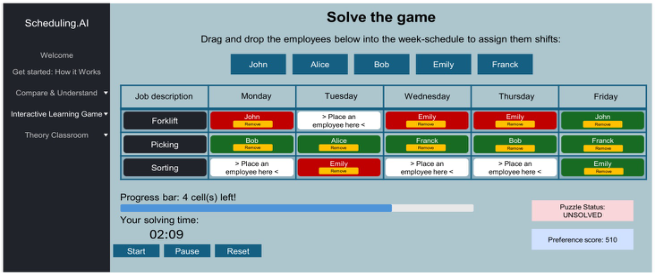
Educational Game The educational game uses the gamification approach and aims to demonstrate the difficulties of manual shift planning as well as the advantages of AI-supported planning. This is illustrated by a game-like approach in which users are asked to solve a simple shift planning problem themselves by dragging and dropping employees into a shift plan (shown in Figure 4). Thereby, the user has the role of a shift planner and can understand the complexity of the problem with this interactive approach. The rules of the game are shown graphically and in text form, hard constraints are displayed in text and colored red if the corresponding hard constraint is violated. The game features a stopwatch and displays the points earned for the solution, incorporating typical gamification elements like point collection and adding a sense of urgency to the task (El-Assady et al., 2019). The game ends when a feasible solution is found, with time and solution quality measured by calculating the overall preference score. Once the problem has been solved manually, the user’s solution can be compared with AI-generated solutions from our solver. This comparison includes the plan and the time taken to solve it. For such simple problems, the CP-SAT solver typically finds optimal solutions in milliseconds. This enables human-to-AI comparison.
Figure 4: Educational game with simple scheduling example.
Explainability in AI-Based Scheduling 263
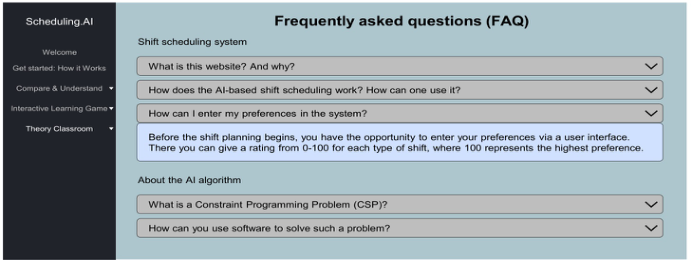
Theory Classroom This component utilizes the verification strategy of a flipped classroom. It includes a frequently asked questions (FAQ) section and a quiz section. The FAQ is intended to clarify existing questions in a question-and-answer format and consists of 16 questions and answers. Answers are displayed by collapsing and expanding (Figure 5). The second section, the quiz, is designed to assess the collected knowledge. As it is purely about imparting theoretical knowledge, we describe this component as theory classroom. The quiz contains 10 questions, which are displayed in random order. The user must answer all questions one after the other by clicking on the correct solution(s). After going through the questions, the complete solution and the number of correct answers the user gave is displayed.
Figure 5: FAQ section of the website.
EVALUATION XAI model development brings the risk that explanations are based primarily on the developer’s understanding, emphasizing the potential disconnect between developer intuitions and actual real-world utility (Pazzani et al., 2022). We conducted a survey, to get first insights into user’s understanding of the system. The survey was done online with 34 participants, which represented partly, but not completely, the possible end users of production workers. In the survey, the participants had to understand the scheduling problem first with an example, then made a walkthrough of the website and returned to the survey after each section. Completing the survey took on average 19 minutes. The survey had in total 26 questions, of which the first seven were on demographical data and background knowledge regarding AI. The other questions focused on the content and effectiveness of the explainability model based on the proposal of Hoffman et al. (2018). To understand what explanation method helps the users best, we present the two corresponding questions of the survey (see Figure 6).
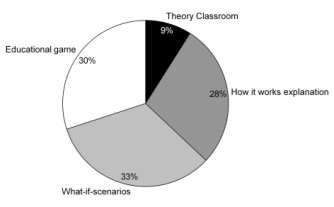
Which Feature Most Effectively Helped You Understand How the AI Works?
Participants displayed mixed opinions on the most helpful feature for understanding the AI system, with the Get-Started, What-If Scenarios, and
Educational Game sections each being favoured by roughly a third of the participants. This indicates a balanced preference across the features. However, the Theory Classroom section, preferred by only 9%, was perceived as less effective.
Figure 6: Evaluation of question 1 (left) and question 2 (right); 34 participants.
Which Explanation Style Did You Find Most Useful for Understanding AI?
Visualizations emerged as the preferred explanation style, with 47% of participants finding them most useful, especially in the What-If scenarios and Educational Game. Interactive explanations appealed to 26% of participants. Text-based explanations and contrastive methods were less popular, chosen by 15% and 12% respectively. This diversity in preferences emphasizes the need for varied explanation styles to suit different learning approaches.
Further insights on the study were an increased confidence in AI-generated shift schedules, reported by 79% of the participants. This response highlights the success in enhancing transparency and trust in the scheduling system. Participants showed different perspectives on the importance of a full understanding of the system: only 67% found this to be important. The practical effectiveness of AI-generated schedules was favoured over in-depth understanding of the algorithm. The survey also highlighted the importance of the shift planner’s role in understanding and explaining the AI system. The necessity of this understanding for adapting schedules and providing explanations was recognized by 79% of participants. This finding suggests future XAI models to be more aligned with the shift planners’ understanding. As the website and the corresponding user interfaces were only designed as prototypical work, there is still potential in designing user interfaces to explain the scheduling system. The aim of our work was to implement different explanation strategies and get feedback on the effectiveness of these strategies which were described before.
CONCLUSION
With the approach presented here on explainability of scheduling systems, our aim was to take a first step towards designing explainable AI systems. After the initial idea of delving deep into the CP algorithm and explaining it step by step turned out to be impractical and far too complicated for
Explainability in AI-Based Scheduling 265
the end user, we developed a new approach based on proposals in the literature. Design guidelines from cognitive psychology were consulted and implemented in the use case of shift scheduling. The user is offered four different ways of finding out about the system. These four options are the get-started section, the what-if-scenarios, the educational game and the theory classroom. We conducted a small user study, to get feedback on the four implementation options. The four options scored differently in the study, with the educational game and the what-if-scenarios being the most convincing. Based on the approach presented, further research can be carried out with a better user interface or a larger study with more users evaluating the explainability approaches. This approach also gives ideas for XAI implementations explaining other systems–as ChatGPT and other AI- tools are currently starting to emerge in this field of implementation, a highly interesting topic for further research.
REFERENCES
Bogaerts, B.; Gamba, E.; Claes, J.; Guns, T. (2020) “Step-Wise Explanations of Constraint Satisfaction Problems”, in: Frontiers in Artificial Intelligence and Applications, Vol. 325 (2020), pp. 640–647. El-Assady, M.; Jentner, W.; Kehlbeck, R.; Schlegel, U.; Sevastjanova, R.; Sperrle, F.;
Spinner, T.; Keim, D. (2019): “Towards XAI: Structuring the Processes of Explanations”, in: Human-Centered Machine Learning Perspectives Workshop, 2019. Ernst, A.; Jiang, H.; Krishnamoorthy, M.; Sier, D. (2004) “Staff scheduling and rostering: A review of applications, methods and models”, in: European Journal of Operational Research, Jg. 153 (2004), No. 1, S. 3–27. fml (2024): github repository of the chair tum-fml – chair of material handling,
material flow, logistics. https://github.com/tum-fml/, last called on 30.09.2024 Freuder, E. C.; Likitvivatanavong, C.; Moretti, M.; Rossi, F.; Wallace, R. J. (2003) “Computing Explanations and Implications in Preference-Based Configurators”, in: Goos, G. (Ed.): Recent Advances in Constraints. Springer Berlin Heidelberg, pp. 76–92. Ghoniem, M.; Jussien, N.; Fekete, J.-D. (2004) “VISEXP: Visualizing Constraint
Solver Dynamics Using Explanation”, in: FLAIRS, Vol. 4. Haid, C., Berchtel, O., Wagner, N., Fottner, J. (2024) “Development of humancentered scheduling in logistics”, in: Logistics Journal, No. 20, 10/2024. Haid, C., Stohrer, S., Unruh, C., Büthe, T., Fottner, J. (2022) “Accommodating
Employee Preferences in Algorithmic Worker-Workplace Allocation”, in: Human Factors in Management and Leadership 55, 2022, p. 79. Hoffman, R. R.; Mueller, S. T.; Klein, G.; Litman, J. (2018): “Metrics for Explainable AI: Challenges and Prospects”, 2018. Owczarek, D. (2021) “The Trend of AI in Logistics and Supply Chains - Applications,
Advantages, and Challenges”, Available at https://nexocode.com/blog/posts/ai-in- logistics/. Pazzani, M.; Soltani, S.; Kaufman, R.; Qian, S.; Hsiao, A. (2003): “Expert-Informed, User-Centric Explanations for Machine Learning”, in: Proceedings of the AAAI Conference on Artificial Intelligence, Vol. 36 (2022). No. 11, pp. 12280–12286. Sqalli, M.; Freuder, E. (2003) “Inference-Based Constraint Satisfaction Supports
Explanation”in: Proceedings of the National Conference on Artificial Intelligence, Vol. 1 (2003), pp. 318–325.
Wang, Z.; Wang, S.; Farinella, M.; Murray-Rust, D.; Henry Riche, N.; Bach, B. (2019) “Comparing Effectiveness and Engagement of Data Comics and Infographics”, In: Proceedings of the 2019 CHI Conference, Brewster, S. (Ed.): pp. 1–12. Yampolskiy, R. V. (2020) “Unexplainability and Incomprehensibility of AI”, Journal of Artificial Intelligence and Consciousness, vol. 07, no. 02, pp. 277–291.
LISTED IN THE AHFE DIGITAL BOOKSTORE CATALOGUE
Explore the complete digital volume
Intelligent Human Systems Integration (IHSI 2025): Integrating People and Intelligent Systems
Read this individual research paper free through the original publisher, or explore the full digital proceedings book.
ISBN 978-1-964867-36-6
Explore this ISBN in the AHFE Bookstore ↗Listed in the July 2026 bookstore catalogue; search by ISBN to confirm current availability · Digital book purchase optional