Pia Vollmuth, Hanna Hüttner, Johannes Fottner (2025). Evaluating Changeable Production Logistics: A Multicriteria Approach. In: Human Aspects of Advanced Manufacturing, Production Management and Process Control. AHFE Open Access, vol. 184, pp. 37–47. https://doi.org/10.54941/ahfe1006448
In the ever-evolving production landscape characterised by various disruptions and uncertainties, the role of production logistics in ensuring operational efficiency is paramount. The increasing challenge is that production, and with it, the supplying production logistics must adapt to dynamic and unpredictable changes due to climate change, pandemics and other global conflicts. In the practice of many manufacturing companies, external consulting firms plan production logistics. They develop various planning alternatives, which are then evaluated by the company's internal teams based on multiple criteria. However, cost factors usually override the evaluation and changeability is not sufficiently considered. The traditional focus solely on economic viability is no longer sufficient. A paradigm shift towards considering resilience, sustainability, and social aspects is imperative. These considerations are the cornerstones of Industry 5.0 which can be achieved through changeability.By emphasising the concept of changeability - the ability to undergo significant structural changes in response to unpredictable internal and external influences - this research contributes to a deeper understanding of the strategic imperatives in modern production logistics environments. It highlights the importance of embracing change and fostering resilience while addressing economic, sustainability and social concerns. This paper addresses the challenge of evaluating and selecting appropriate strategies to enhance changeability in production logistics while considering these multifaceted dimensions.While product changes and their effects have already been widely studied in research on a factory level, production logistic-side change management is still in its infancy. Most Publications such as those by Hernández or Heger deal with the evaluation of changeability on the level of factory planning. Although production logistics is a critical component in the value chain of manufacturing companies, little research deals specifically with the assessment and evaluation criteria of the changeability of production logistics. Closing this gap in the literature is the focus of this publication, and it opens up the possibility of gaining new insights in this area. This publication aims to develop a method for evaluating planning alternatives in production logistics that does not focus exclusively on economic indicators but, above all, considers the changeability of the system. In addition, further evaluation criteria, such as sustainability and social aspects, are included to enable the most comprehensive possible evaluation of the given alternatives.The structure of this research consists of three parts. First, based on a literature review, an overview of definitions and approaches for the multicriteria evaluation of production logistics changeability is presented. Second, a concrete procedure to evaluate changeability is developed, and third, it is applied in production logistics.Thus, the presented measure is one efficient response to the ever-changing business environment of production logistics and offers a multi-criteria evaluation approach for changeable production logistic processes.
INTRODUCTION AND RELEVANCE In the ever-evolving production landscape characterised by various disruptions and uncertainties, the role of production logistics in ensuring operational efficiency is paramount. The increasing challenge is that production, and with it, the supplying production logistics must adapt to dynamic and unpredictable changes due to climate change, pandemics and other global conflicts.
In the practice of many manufacturing companies, external consulting firms plan production logistics (Klug, 2018). They develop various planning alternatives, which are then evaluated by the company’s internal teams based on multiple criteria. However, cost factors usually override the evaluation and changeability is not sufficiently considered (Schulte, 2017). The traditional
focus solely on economic viability is no longer sufficient. A paradigm shift towards considering resilience, sustainability, and social aspects is imperative. These considerations are the cornerstones of Industry 5.0 (Huang et al., 2021; Vogel-Heuser and Bengler, 2023) which can be achieved through changeability.
By emphasising the concept of changeability - the ability to undergo significant structural changes in response to unpredictable internal and external influences (VDI 5201) - this research contributes to a deeper understanding of the strategic imperatives in modern production logistics environments. It highlights the importance of embracing change and fostering resilience while addressing economic, sustainability and social concerns.
This paper addresses the challenge of evaluating and selecting appropriate strategies to enhance changeability in production logistics while considering these multifaceted dimensions.
While product changes and their effects have already been widely studied in research on a factory level, production logistic-side change management is still in its infancy (Drabow and Woelk, 2004; Hawer, 2020; Kaucher et al., 2021; Erlach et al., 2022). Although production logistics is a critical component in the value chain of manufacturing companies, little research deals specifically with the assessment and evaluation criteria of the changeability of production logistics. Closing this gap in the literature is the focus of this publication, and it opens up the possibility of gaining new insights in this area.
This publication aims to develop a method for evaluating planning alternatives in production logistics that does not focus exclusively on economic indicators but, above all, considers the changeability of the system. In addition, further evaluation criteria, such as sustainability and social aspects, are included to enable the most comprehensive possible evaluation of the given alternatives.
FUNDAMENTALS Changeability in Production Logistics
In the uncertain and constantly changing environment of the 21st century, it is becoming increasingly difficult to reliably assess future developments, so flexibility in limited solution corridors alone is not enough to survive in today’s global competition (Drabow and Woelk, 2004; Dürrschmidt, 2001). This problem can be solved by changeability. It enables an appropriate and forward-looking (re-)action to unforeseeable events (Zäh et al., 2004). To be changeable, a suitable combination of flexibility and responsiveness is necessary (Reinhart et al., 2002; Cisek et al., 2002). Responsiveness is described as the ability of a system to adapt quickly and with little effort to unforeseeable situations (Drabow and Woelk, 2004). On the other hand, flexibility is determined as a passive ability to change to known influences and with restrictive scopes of action. Westkämper et al. distinguish between versatility and changeability. While versatility only considers technical aspects, changeability also includes social subsystems (Westkämper and Zahn, 2009; Heinecker, 2006).
Evaluating Changeable Production Logistics: A Multicriteria Approach 39
Hernández distinguishes between technical, spatial and organisational changeability. Technical changeability encompasses all technical systems and their ability to be reconfigured. Spatial changeability covers the ability to expand and reduce the space, while the organisational dimension refers to the ability to change the organisational structure and its processes.
A system is described as capable of change “if it has process, structural and behavioural variability that can be used in a targeted manner. Systems capable of change can make anticipatory interventions in addition to reactive adjustments. These activities can respond to changes in the system as well as to changes in the environment” (Westkämper and Zahn, 2009).
The change potentials are designed to be implemented if necessary and only trigger costs and time expenditure during implementation (Cisek et al., 2002; Nyhuis et al., 2008). Changeable systems are, therefore, solution-neutral and do not specify a particular direction of change, whereby the framework of possible changes is preconceived (Cisek et al., 2002; Zäh et al., 2004).
Change enablers can be characterised as a property or function that supports the ability of a system or organisation to transform and cope with change (Hernández Morales, 2002). The literature usually refers to the five primary enablers of change: universality, mobility, scalability, modularity and compatibility (Wiendahl et al., 2024; Hernández Morales, 2002). These five primary enablers can be subdivided to enable differentiation and detailing (Hawer, 2020; Pachow-Frauenhofer, 2012; Vollmuth et al., 2024).
Increasing the changeability of existing systems is often associated with investment costs (Hernández Morales, 2002). The aim is to enable a fast and cost-effective conversion process and minimise possible additional investments. The aim is to find the best possible balance between the necessary change capability and the lowest possible system life cycle costs.
Multicriteria Decision Making For evaluating planning alternatives in production logistics, a structured approach and considering various criteria from different areas, such as economic efficiency, sustainability, social aspects or changeability, are essential. The various evaluation criteria partly depend on or contradict each other, resulting in a conflict of objectives.
Evaluating alternatives to solve problems with multiple objectives requires multi-attribute decision-making methods (MADM). A change that leads to an improved achievement of one objective can make it more difficult to achieve another. In addition, objectives may have different units and are, therefore, difficult to compare. Some objectives can be evaluated quantitatively, others qualitatively (Zimmermann and Gutsche, 1991). MADM can be divided into various sub-categories. One category is the utility based techniques with examples like Analytic Hierarchy Process (AHP) or the utility analysis (Danesch et al., 2018).
The AHP, according to Saaty, is a method for evaluating alternatives, representing the ranking of these alternatives (Saaty, 1977). Analytic means that the decision problem is broken down into smaller, independent sub- problems (single objective decision-making problems) to analyse them
separately. The results are then summarised to identify the best possible solution for the overall problem. Pairwise comparisons enable the inclusion of both tangible and intangible evaluation criteria. The AHP utilises a hierarchical structure in which the individual elements are linked linearly (Saaty, 1990; Saaty, 1977; Gärtner et al., 2024).
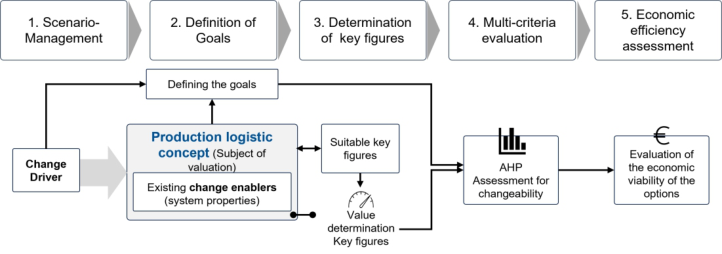
METHOD FOR EVALUATING PRODUCTION LOGISTICS The procedure of the evaluation method is shown schematically in Figure 1. This section provides an overview of the method. The individual steps are described in more detail in the following chapter.
Scenario management is applied as a first step to determine the most critical drivers of change and the areas of production logistics in which changeability is essential. Next, based on the identified change scenarios and overarching corporate goals, the specific objectives of production logistics are derived. Evaluation criteria can be deducted from the identified objectives, which are then used to evaluate the various alternatives. To determine the performance of the options available for selection concerning the evaluation criteria, it can be helpful to simulate production and the production logistics alternatives. The multi-criteria evaluation is then carried out according to the AHP, which was identified as suitable for multi-criteria decision methods. As companies must first and foremost be economically viable to be successful in the long term, a profitability test of the alternatives is then carried out to demonstrate that the selected alternative is financially viable. During the entire process, care must be taken to ensure that the results and justifications are documented wholly and comprehensibly to make the decision-making process understandable and transparent and to be able to justify decisions in the event of subsequent queries (Fottner et al., 2022).
Figure 1: Schematic process of evaluating planning scenarios in production logistics.
Scenario Management To determine a sensible dimensioning of changeability, it is necessary to systematically consider and estimate future developments with the help of futurology methods—considering various possible futures and trends
Evaluating Changeable Production Logistics: A Multicriteria Approach 41
results in future-proof and resilient production logistics (Kaucher et al., 2021). Kaucher et al. investigate the suitability of different approaches to support the planning of factories that can better cope with future challenges. They showed that the scenario technique, particularly scenario management according to Gausemeier et al., is suitable for this purpose (Kaucher et al., 2021; Gausemeier et al., 1998). In the first step, the production logistic system is considered in its current state and factors that influence future development are determined (Gausemeier et al., 1998). From these influences, the relevant key factors are defined with the help of a relevance analysis based on pairwise comparison (Gausemeier et al., 2017).
In the subsequent step, up to three possible future developments are worked out for each key factor, based on which different scenarios are created. Based on the results, meaningful goals for future production logistics can be determined (Gausemeier et al., 2017, 1998).
Identification of Goals Formulating specific goals is an essential step in planning a successful company and its production logistics (Lindemann, 2009). Goals specifically for production logistics can be derived from the organisation’s overarching goals.
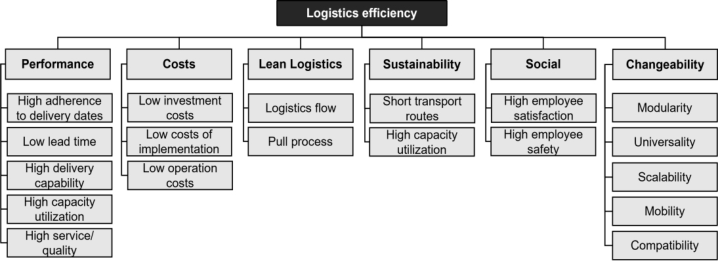
The overarching goals in logistics traditionally include increasing logistics performance and reducing logistics costs. These can be expanded to include the dimensions of lean logistics, sustainability, social issues and changeability. A comprehensive presentation of possible goals of production logistics can be found in Figure 2.
Figure 2: Logistics goals.
In this work, the performance-related goals are divided into the sub-goals of high adherence to delivery dates, short lead times, high delivery capability, high capacity utilisation and high service and quality.
As described, the logistic costs are subdivided into investment, implementation and operation costs. The traditional goals of performance and costs are to be supplemented by further relevant areas.
Lean processes are based on the value stream and are characterised by their effectiveness, efficiency and waste avoidance. The extent to which lean logistics objectives are achieved can be determined, for example, by the logistical flow or the implementation of the pull principle (Dörnhöfer, 2017).
Environmental and ecological goals are also important, as they are increasingly demanded by the public (Hohmann, 2022). Traditional logistical processes negatively affect the environment due to energy consumption, space requirements, emissions of pollutants and waste generation (Arnold et al., 2008). Regarding production logistics, ecological goals relate to efficient resource use and reduced emissions, which can be measured using the CO2 equivalent. A sustainable flow of goods results from short transport routes and high plant capacity utilisation (Hohmann, 2022). Furthermore, changeability can enhance the life span of production logistic systems through well-planned solution neutrality of the systems and retrofit options and thus reduce the environmental impact (Wünnenberg et al., 2022).
The human factor is a critical success factor for companies and their ability to change. The success of integrating new technologies and processes is highly dependent on employee acceptance. For this reason, the involvement of employees is essential for the ability of a company and its production logistics to react quickly (Fottner et al., 2022). A company’s and its employees’ willingness to change is essential for a successful change process. Not only the acceptance but also the active participation of employees supports change. Due to the importance of employees for a company, employee safety and satisfaction are among the social goals of a company.
In addition, there is also the ability to change due to the increasing demands and the turbulent environment of companies. The changeability of a system can be characterised using the five change enablers described in the previous section.
Key Figures Various evaluation criteria and their key figures can be identified to check whether the set goals have been achieved. The evaluation criteria can be derived from the goals and requirements of a system. They are used to evaluate alternative options for action in the field of change, as they offer the possibility of simplifying and comparing complex processes and structures.
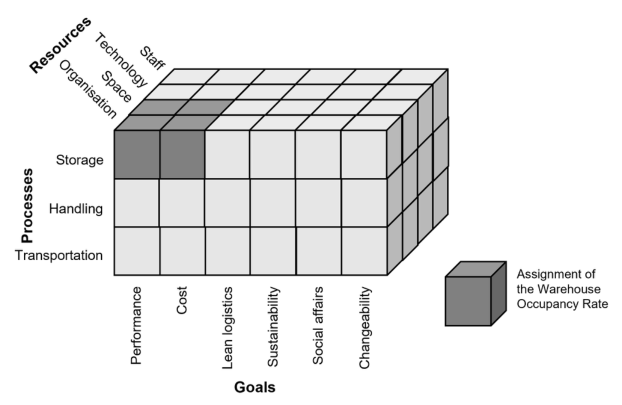
Nyhuis and Wiendahl point out that a subdivision of production logistics makes sense due to its complexity and diversity (Nyhuis and Wiendahl, 2012). The evaluation criteria are structured along three dimensions, as shown in Figure 3. As the evaluation criteria can be derived from the goals of production logistics, these goals form one dimension. From the process point of view, the production logistics can also be subdivided into the subsystems of transportation, handling and storage (Hohmann, 2022). Furthermore, the system can be viewed from the resources dimension and subdivided into organisation, space, technology and staff categories (Heger, 2007). The selection of evaluation criteria directly influences the evaluation and selection of planning variants. By prioritising or neglecting specific criteria, the orientation of the decision-making process is precisely controlled. More
Evaluating Changeable Production Logistics: A Multicriteria Approach 43
than 110 possible evaluation criteria from the literature and practice were collected. The criteria were assigned to the dimensions of goals, processes and resources, as seen in the example of the warehouse occupancy rate in Figure 3.
Figure 3: Classification of the evaluation criteria according to the three dimensions; exemplary categorisation of the warehouse occupancy rate.
Multicriteria Decision Making The aim of evaluating planning alternatives in production logistics is to determine the best possible alternative. Many goals and criteria must be considered, and an evaluation is only possible through a combination of several quantitative and qualitative key figures, some of which conflict with each other (Dürrschmidt, 2001). Multi-criteria evaluation methods offer the possibility of evaluating different alternatives based on several criteria.
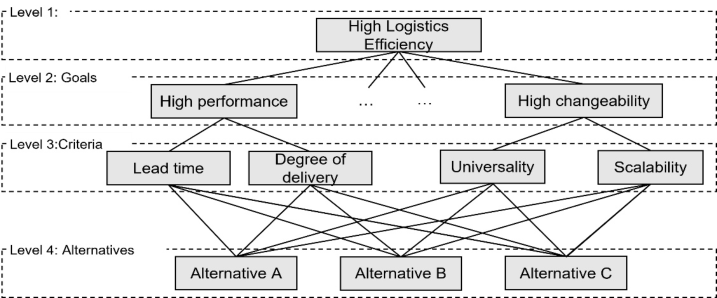
The decision hierarchy is structured for this purpose, as illustrated in Figure 4. The first level is the overarching objective, which can be subdivided into goals. The level of the evaluation criteria follows this. The different alternatives form the lowest level.
The AHP is carried out using a simplified example in which three planning alternatives (A-C) are to be compared based on the selected goals of performance and changeability, each with two evaluation criteria.
Subsequently the evaluation of the alternatives is caried out using AHP. In the first step, the weightings of the performance and changeability goals are determined by pairwise comparisons and presented in a matrix. The local priority is then determined by determining the eigenvector and normalizing it to 1. The same methodology is applied to both the evaluation criteria (step two) and the alternatives (step three), whereby the alternatives are evaluated separately for each evaluation criterion. A consistency check is carried out for
each matrix to ensure the logical consistency of the pairwise comparisons and evaluations. Finally, the global priorities of the alternatives are determined in step four, which shows which alternative is the preferred alternative, taking into account the selected evaluation criteria.
Figure 4: AHP hierarchy.
Profitability Calculation When evaluating logistics systems, financial objectives are often the main focus due to their importance for the existence of the company (Grinninger, 2013; Baur and Blasius, 2022). Economic efficiency is also evaluated since the development or change of production logistics is associated with investments and capital commitment. Investment appraisal methods compare and evaluate the economic efficiency of different planning alternatives (Fottner et al., 2022). Since changeable systems can represent a higher investment than inert systems at the time of purchase but save costs in the long term, it is essential to consider a system life cycle. The net present value method shows the financial success of an investment by discounting the cash inflows and outflows to a specific point in time. However, only actual costs are considered, not imputed costs such as depreciation. The net present value can be calculated using Formula (1) (Fottner et al., 2022):
T X NPV0 = −I0 +
CFt (1 −i)t (1) t = 0 The discounted payment surpluses (Cashflow (CFt) as the difference between incoming payments and outgoing payments, discounted with discount rate i) of the period under consideration T, are added to the initial investment (I0). A positive net present value indicates the profitability of an investment.
When applying the method, it is essential to consider the forecast scenarios and the associated change and conversion costs. Formula (2) calculates the
Evaluating Changeable Production Logistics: A Multicriteria Approach 45
minimum total costs (TC) of change over a system’s life cycle (Zwißler and Gebhardt, 2013).
I X
X X
J X
min{E
= CCO +
pxj · CPCxj} (2)
TCgk
Equation reproduced from the original PDF.
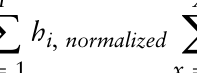
The total costs include the conversion process costs (CPC) and conversion object costs (CCO), accumulated over the object’s or system’s useful life. The probability of occurrence for the conversion frequency (hi, normalized) depends on the future scenarios (j) and their likelihood of occurrence (pxj). The aim is to identify the optimal combination of change enablers to keep costs as low as possible (Zwißler and Gebhardt, 2013).
DISCUSSION AND FURTHER RESERACH This work aimed to develop a procedure for evaluating planning alternatives in production logistics and to enable the evaluation of changeable production logistics. The developed method comprises a total of six steps.
A procedure has been developed that enables a comprehensive evaluation of alternatives to be carried out and offers the possibility of considering different planning objectives. Not only is the changeability of a system considered differentiated, but other goals such as profitability or sustainability and social aspects are also included. A company’s production logistics is a pervasive system, so it can be challenging to evaluate the entire system. For this reason, the evaluation criteria are broken down into transport, handling and storage processes.
The evaluation of changeable production logistics also continues to pose a challenge. As both too much and too little changeability are associated with increased costs for a company, estimating the optimum level of changeability required is essential. This is based on the forecast of future developments and is therefore associated with significant uncertainties. Consequently, assessing the necessary changeability of production logistics is a particular challenge. In addition, changeability is a system characteristic that is difficult to grasp and measure. Based on existing approaches, this study proposes to evaluate changeability based on the changeability enablers. Future research efforts are required to improve the measurability of changeability further.
ACKNOWLEDGMENT
This article was written as part of a cooperation between the Chair of Materials Handling Material Flow Logistics (Prof. Dr.-Ing. Johannes Fottner) at the Technical University of Munich and MAN Truck & Bus SE in Munich. We thank them for their support. The opinions and findings expressed in this paper are those of the authors and do not necessarily reflect the institutions views.
REFERENCES
Arnold, Dieter/Isermann, Heinz/Kuhn, Axel/Tempelmeier, Horst/Furmans, Kai (2008). Handbuch Logistik. Berlin, Heidelberg, Springer Berlin Heidelberg. Baur, Nina/Blasius, Jörg (Eds.) (2022). Handbuch Methoden der empirischen
making methods for project portfolio management: a literature review. Int. J. Management and Decision Making, 17 (1), 75–94. Dörnhöfer, Martin (2017). Entwicklung eines modularen Kennzahlensystems für die Automobillogistik im Kontext der schlanken Logistik. Dissertation. Garching, Technische Universität München. Drabow, Gregor/Woelk, Peer-Oliver (2004). Wandlungsfähige Fabrik der Zukunft.
Zeitschrift für wirtschaftlichen Fabrikbetrieb 99 (3), 90–94. Dürrschmidt, Stephan (2001). Planung und Betrieb wandlungsfähiger Logistiksysteme in der variantenreichen Serienproduktion. Dissertation. München, Technische Universität München. Erlach, Klaus/Berchtold, Marc-André/Gessert, Stephan/Kaucher, Christian/Ungern- Sternberg, Roman (2022). Flexibilität, Wandlungsfähigkeit und Agilität in der Fabrikplanung. Zeitschrift für wirtschaftlichen Fabrikbetrieb 117 (7-8), 442–447. Fottner, Johannes/Galka, Stefan/Habenicht, Sebastian/Klenk, Eva/Meinhardt, Ingolf/
Schmidt, Thorsten (2022). Planung von innerbetrieblichen Transportsystemen. Berlin, Heidelberg, Springer Berlin Heidelberg. Gärtner, Quirin/Bianchi, Alessandro/Mulrav, Harsh/Reinhart, Gunther (2024).
Combining the analytical hierarchy process, fuzzy expert systems, and the exponential risk priority number for the holistic evaluation of innovation projects in manufacturing. Production & Manufacturing Research 12 (1). Gausemeier, Jürgen/Fink, Alexander/Schalke, Oliver (1998). Scenario Management: An Approach to Develop Future Potentials. Technological Forecasting and Social Change 59, 111–130. Gausemeier, J./Pfänder, T./Lehner, A. (2017). Strategische Unternehmensführung
mit Szenario-Management. In: Dieter Spath/Engelbert Westkämper/Hans-Jörg Bullinger et al. (Eds.). Neue Entwicklungen in der Unternehmensorganisation. Berlin, Heidelberg, Springer Berlin Heidelberg, 97–109. Grinninger, Jürgen (2013). Bewertung von Logistiksystemen. In: Willibald A.
Günthner/Julia Boppert (Eds.). Lean Logistics. Berlin, Heidelberg, Springer Berlin Heidelberg, 59–67. Hawer, Sven (2020). Planung veränderungsfähiger Fabrikstrukturen auf Basis unscharfer Daten. Dissertation. München, Technische Universität München. Heger, C. L. (2007). Bewertung der Wandlungsfähigkeit von Fabrikobjekten.
Dissertation. Hannover, Leibniz Universität Hannover. Heinecker, Markus (2006). Methodik zur Gestaltung und Bewertung wandelbarer Materialflusssysteme. Zugl.: München, Techn. Univ., Diss., 2006. München, Utz. Hernández Morales, Roberto (2002). Systematik der Wandlungsfähigkeit in der
Giovannini, E (2021). Industry 5.0, a transformative vision for Europe. Luxembourg, Publications Office of the European Union.
Evaluating Changeable Production Logistics: A Multicriteria Approach 47
Kaucher, Christian/Rauch, Sebastian/Erlach, Klaus (2021). Planung zukunftsrobuster Fabriken. Zeitschrift für wirtschaftlichen Fabrikbetrieb 116 (11), 752–756. Klug, Florian (2018). Logistikmanagement in der Automobilindustrie. Grundlagen der Logistik im Automobilbau. 2nd ed. Berlin, Springer Vieweg. Lindemann, Udo (2009). Methodische Entwicklung technischer Produkte. Berlin,
Heidelberg, Springer Berlin Heidelberg. Nyhuis, Peter/Reinhart, Gunther/Abele, Eberhard (Eds.) (2008). Wandlungsfähige Produktionssysteme. Heute die Industrie von morgen gestalten. TEWISS. Nyhuis, Peter/Wiendahl, Hans-Peter (2012). Logistische Kennlinien. Berlin, Heidelberg, Springer Berlin Heidelberg. Pachow-Frauenhofer, Julia (2012). Planung veränderungsfähiger Montagesysteme.
Zugl.: Hannover, Univ., Diss., 2012. Garbsen, PZH Produktionstechnisches Zentrum. Reinhart, G./Berlack, J./Effert/C./Selke, C. (2002). Wandlungsfähige Fabrikgestaltung. Zeitschrift für wirtschaftlichen Fabrikbetrieb 97 (1-2), 18–23. Saaty, Thomas L. (1977). A scaling method for priorities in hierarchical structures.
Journal of Mathematical Psychology 15 (3), 234–281. Saaty, Thomas L. (1990). How to make a decision: The Analytic Hierarchy Process.
European Journal of Operational Research 48, 9–26. Schulte, Christof (2017). Logistik. Wege zur Optimierung der Supply Chain. 7th ed.
München, Verlag Franz Vahlen. Thommen, Jean-Paul/Achleitner, Ann-Kristin/Gilbert, Dirk Ulrich/Hachmeister, Dirk/Jarchow, Svenja/Kaiser, Gernot (2020). Allgemeine Betriebswirtschaftslehre. Umfassende Einführung aus managementorientierter Sicht. 9th ed. Wiesbaden, Springer Fachmedien Wiesbaden. Vogel-Heuser, B./Bengler, K. (2023). Von Industrie 4.0 zu Industrie 5.0 – Idee,
Konzept und Wahrnehmung. HMD Praxis der Wirtschaftsinformatik 60 (6), 1124–1142. Vollmuth, P/Bethäuser, L/Brungs, F/Fottner, J (2024). From Traditional to Transformable Production Logistics – Measures for Successful Transformation. In: Freitag/ Kinra/ Kotzab et al. (Eds.). Dynamics in Logistics. Cham, Springer Nature Switzerland, 211–222. Westkämper, Engelbert/Zahn, Erich (2009). Wandlungsfähige Produktionsun- ternehmen. Das Stuttgarter Unternehmensmodell. Berlin u.a., Springer. Wiendahl, Hans-Hermann/Reichardt, Jürgen/Nyhuis, Peter (2024). Handbuch Fabrikplanung. Konzept, Gestaltung und Umsetzung wandlungsfähiger Produktionsstätten. 3rd ed. München, Hanser Verlag. Wünnenberg, M./Vollmuth, P./Xu, J./Fottner, J./Vogel-Heuser, B. (2022). Transformability in Material Flow Systems: Towards an Improved Product Development Process. In:. Matt/ Vidoni/ Rauch. Managing and Implementing the Digital Transformation. Cham, Springer International Publishing, 3–14. VDI 5201. Wandlungsfähigkeit, 2017. Berlin. Zäh, M./Müller, N./Pratsch, M./Sudhoff, W (2004). Methodik zur Erhöhung der
Wandlungsfähigkeit von Produktionssystemen. Zeitschrift für wirtschaftlichen Fabrikbetrieb 99 (4), 173–177. Zimmermann, H./Gutsche, L. (1991). Multi-Criteria Analyse. Einführung in die Theorie der Entscheidungen bei Mehrfachzielsetzungen. Berlin/Heidelberg, Springer. Zwißler, Frank/Gebhardt, Marcel (2013). Vorgehen zur kostentechnischen Beurteilung wandlungsfähiger Gestaltungsalternativen. Zeitschrift für wirtschaftlichen Fabrikbetrieb 108 (5), 315–319.
LISTED IN THE AHFE DIGITAL BOOKSTORE CATALOGUE
Explore the complete digital volume
Human Aspects of Advanced Manufacturing, Production Management and Process Control
Read this individual research paper free through the original publisher, or explore the full digital proceedings book.
ISBN 978-1-964867-60-1
Explore this ISBN in the AHFE Bookstore ↗Listed in the July 2026 bookstore catalogue; search by ISBN to confirm current availability · Digital book purchase optional