Akiko Kondo, Satoshi Togawa (2025). Relationship between Attitudes toward Tourism Interaction and Motivations for Migration. In: Intelligent Human Systems Integration (IHSI 2025): Integrating People and Intelligent Systems. AHFE Open Access, vol. 160, pp. 147–156. https://doi.org/10.54941/ahfe1005820
Japan's declining population, falling birthrates, and rapid aging of society are long-term and rapid. This has made it difficult for some regions to even sustain themselves. Under these situations, the increase and decrease in the number of people in a region and the interactions that bring them to the region have a significant socioeconomic impact on each region. Therefore, it is necessary to elucidate the mechanisms of movement, such as tourism and migration. This study focuses on tourism interaction and population migration, and aims to clarify the relationship between attitudes and motivations related to movement. Specifically, the following contents will be analyzed. Regarding attitudes toward tourism and motivations for population movement, a questionnaire will be used to analyze the importance of each item in terms of tourism interaction and migration, as well as the importance of each item in the selection of tourist destinations. In addition to the previous analysis of attitudes toward tourism, a covariance structure analysis will be conducted to clarify the relationship between each factor and the factors. A cluster analysis will be conducted on the relationship between awareness of tourism and motivations for migration targeting each of the factors. This will elucidate the relationship based on the results of how they are categorized.The results show that there is a high degree of commonality between the two movement ideas of tourist interaction and migration, including a preference for stability and a preference for activity. It is quantitatively revealed that people are willing to make moves such as tourism and migration according to each person's preferences. It is quantitatively revealed that people are willing to make moves such as tourism and migration according to their individual preferences.
Population decline in Japan is long-term, rapid, and unstoppable. Within Japan, many people are migrating, and the impact of this migration on local communities is manifold. Migration is related to the increase or decrease of the local population, which, as residents, has a significant socioeconomic impact on those areas. In addition, tourism interaction differs from settlement in that it involves a medium- to short-term stay in the area being visited. This is because tourism has a wide range of impacts, including on local employment and economy, as well as on local vitality. Under these situations, there is a need to elucidate the mechanisms of these movements.
This study aims to clarify how attitudes and motivations related to movements are related to each other. In other words, tourism interaction and migration are both movements of people between regions, and we will clarify what people think about these movements. This is the basic analysis in clarifying the behavioral mechanism of human mobility. Specifically, the following analyses will be conducted. Regarding attitudes toward tourism and motivations for migration, we will analyze the importance of each item in tourism and migration, as well as the importance of each item in the selection of tourist destinations, using a questionnaire. In addition to the previous
analysis of attitudes toward tourism, a covariance structure analysis will be conducted to clarify the relationship between each factor and the factors. A cluster analysis will be conducted on the relationship between awareness of tourism interaction and motivations for migration, targeting each of the factors. This will elucidate the relationship based on the results of how they are categorized.
EXISTING STUDIES AND CHARACTERISTICS OF THIS STUDY We review existing studies on tourism interaction and migration, which are closely related to this study, and summarize the characteristics of this study.
First, with regard to tourism interaction, some studies have analyzed the structure of tourism behavior using factor analysis and logit models; the impact of the pandemic under COVID-19 on tourism-related firms was clarified using a logit model (Haisheng et al., 2021). Another study was also found to identify mobility factors using tourism information publication status and transportation convenience for inbound tourism (Kondo et al., 2017). Kondo et al. (2024) found that the effects of tourism factors on behavior were revealed by a factor analysis of tourism and the impact of each factor on behavior.
In addition, a number of studies have identified migration mechanisms; Zenou (2010) analyzed the relationship between urban employment growth and regional transportation and migration. The results show that urban transportation improvements can increase urban employment despite inducing migration from rural areas. Andris et al., also found that although intercity migration is modeled in terms of job availability, wages, etc., these do not capture the diversity of information flows and social networks within a city. Therefore, they explored the possibility of using migration network degree to distinguish cities that are attractive to migrants Kondo et al. (2010) developed a population mobility model that takes into account inter-regional interactions. In this study, they constructed an interaction model based on the interregional utility disparity theory and the profit maximization theory of firms for tourism and business interactions, respectively. Furthermore, by introducing them explicitly into the migration model, the relationship between interregional migration and interregional interaction is clarified.
As described above, research results on tourism interaction and migration are diverse. However, there are no results that clarify the relationship between them, focusing on the ideas that motivate and cause people to move, such as attitudes toward tourism interaction and motivations for migration. By clarifying the relationship between these two from this perspective, we will also examine the influence of people’s ideas on their behavior.
TOURISM INTERACTION AND MIGRATION IN JAPAN This section examines the current status of tourism interaction and domestic migration in Japan based on long-term time-series data. For tourism interaction, we use “International Travelers in Japan” data published by Japan National Tourism Organization (JNTO). For the number of
Relationship Between Attitudes Toward Tourism Interaction and Motivations 149
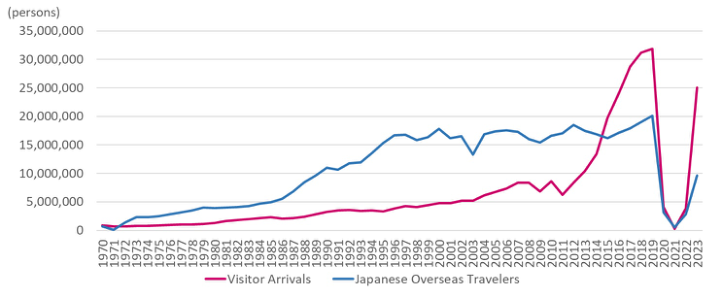
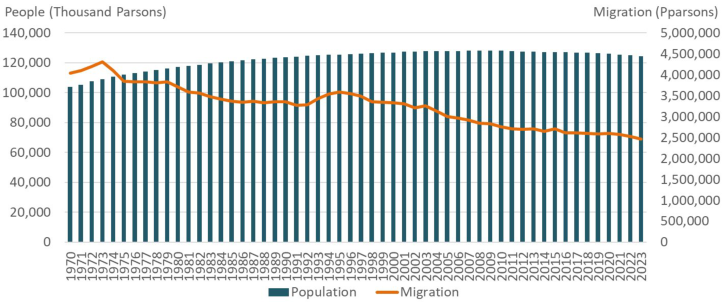
migrations, data from the “Annual report on the internal migration in Japan derived from the basic resident registers”provided by the Ministry of Internal Affairs and Communications (MIC) will be used, and for the total population, data from the “Population estimates; Long-term time-series data” provided by the MIC. Population estimates: Population as of October 1 of each year. Figure 1 shows the number of foreigners visiting Japan and the number of Japanese leaving Japan, and Figure 2 shows the population and migration in Japan.
Figure 1: The number of visitor arrivals and Japanese overseas travelers in Japan.Figure 2: The population and migration in Japan.
Combined with the global expansion of demand for overseas travel, the number of inbound tourists to Japan has shown steady growth, and in 2015, the number of inbound tourists to Japan exceeded the number of Japanese leaving the country. In recent years, the number of inbound tourists has been increasing year by year, meaning that the impact of inbound tourism in Japan on each region is becoming increasingly significant. However, with the global spread of COVID-19 infection, restrictions on international travel
150 Kondo and Togawa
and growing resistance to travel have become global conditions, and the number of inbound tourists to Japan has plummeted. The current decline in the number of inbound tourists had serious repercussions on many fronts in Japan. Today, inbound tourism has surpassed the pre-pandemic level, and domestic tourism is also on the road to recovery.
OUTLINE OF THE QUESTIONNAIRE In this study, a questionnaire was conducted to determine attitudes toward tourism and each factor in tourism objectives and destination selection, as well as motivations for migration. Web-based questionnaires were conducted twice, in March and June 2023, covering the entire country in Japan. A summary of the results and the distribution of respondents are shown in Table 1. The results of these two surveys will be added together for further analysis. In the questionnaire, respondents were asked to respond to each item by selecting from the following six options. The options were “1: Very important (2 points),” “2: important (1 point),” “3: Neutral (0 point),” “4: Not very important (-1 point),” “5: Not important (-2 points),” and “6: Other (0 point). The number in parentheses () is the score used to score the responses. Not indicated at the time of the question.
Table 1. Questionnaire summary.
Table available in the original PDF paper.
Period | March 13, 2023–March 20, 2023 Number of Responses: 1,101
Period | June 28, 2023–June 29, 2023 Number of Responses: 1,036
Characteristic Sample Characteristic Sample
Characteristic Sample Characteristic Sample
Gender Occupation Male 547 Public employee 42 Female 554 Executive 16 Age group Company employee(clerical) 144 Under 15 88 Company employee(technical) 89 15–19 170 Company employee(other) 114 20–29 172 Self-employee 43 30–39 170 Freelance 37 40–49 170 Housewife/ Househusband 128 50–59 161 Part-time job 118 Over 60 170 Student 260 Other 110
Gender Occupation Male 518 Public employee 35 Female 518 Executive 14 Age group Company employee(clerical) 121 Under 15 0 Company employee(technical) 114 15–19 172 Company employee(other) 138 20–29 174 Self-employee 37 30–39 174 Freelance 9 40–49 172 Housewife/Househusband 119 50–59 172 Part-time job 150 Over 60 172 Student 194 Other 105
ATTITUDE TOWARD TOURISM INTERACTION In this study, the respondents were asked about their attitudes toward tourism interactions, with respect to the importance of tourism objectives and attractions. For each of these items, respondents were asked to choose from the six options described above. The results of these responses have already been published (Kondo et al., 2024). Table 2 shows the results of the factor analysis conducted using the results of those responses. For the factor extraction method, the maximum likelihood method was applied, and for the rotation method, the Promax method with oblique rotation was employed. In this case, χ2= 1144, with a significance probability p<0.0001.
Relationship Between Attitudes Toward Tourism Interaction and Motivations 151
Table 2. Results of factor analysis of tourism attraction importance.
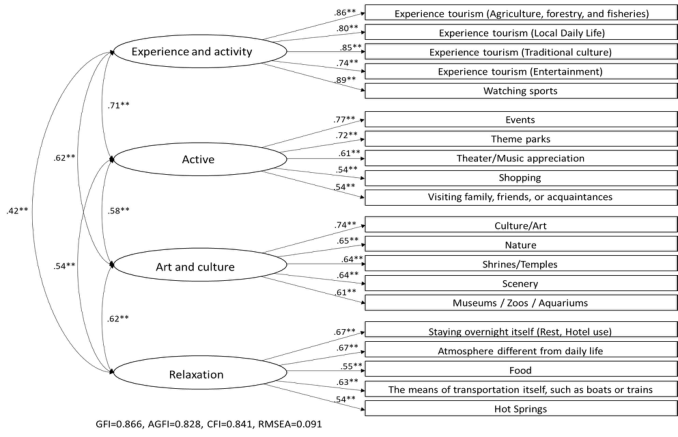
From the pattern matrix of the factor analysis, the first factor represents “experience/activity” the second factor represents “active” the third factor represents “art/culture” and the fourth factor represents “relaxation” respectively. Based on the results of the factor analysis, an attempt was made to model the relationship between the four extracted factors and the latent variables. The results of the structural equation model are shown in Figure 3.
Figure 3: Attitude structure mode of the importance tourism attractions.
152 Kondo and Togawa
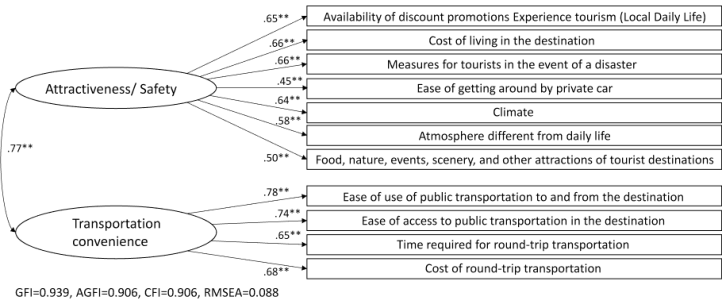
TOURISM DESTINATION SELECTION FACTORS As with the tourism objectives and attractions, we asked the respondents to answer questions about the level of importance when choosing a tourist destination. Using the results of those responses, a factor analysis was conducted, and the results are shown in Table 3. The factor extraction method is also the same. In this case, χ2= 530, with a significance probability of p<0.0001. From the pattern matrix of the factor analysis, the first and second factors represent “attractiveness and safety” and “transportation convenience” respectively. Based on the results of the factor analysis, an attempt was made to model the relationship between the two extracted factors and latent variables. The results of the structural equation model are shown in Figure 4.
Table 3. Attitude structure model of the importance of deciding on a tourist destination.
Table available in the original PDF paper.
Factor Variables Factor1 Factor2
attractiveness and safety
Availability of discount promotions Experience tourism (Local Daily Life) .699 −.032 Cost of living in the destination .663 .025 Measures for tourists in the event of a disaster .572 .101 Ease of getting around by private car .545 −.096 Climate .532 .133 Atmosphere different from daily life .500 .091 Food, nature, events, scenery, and other attractions of tourist destinations .322 .221 transportation convenience Ease of use of public transportation to and from the destination −.190 .991 Ease of access to public transportation in the destination .085 .668 Time required for round-trip transportation .167 .517 Cost of round-trip transportation .271 .447
Figure 4: Attitude structure model of the importance of deciding on a tourist destination.
Relationship Between Attitudes Toward Tourism Interaction and Motivations 153
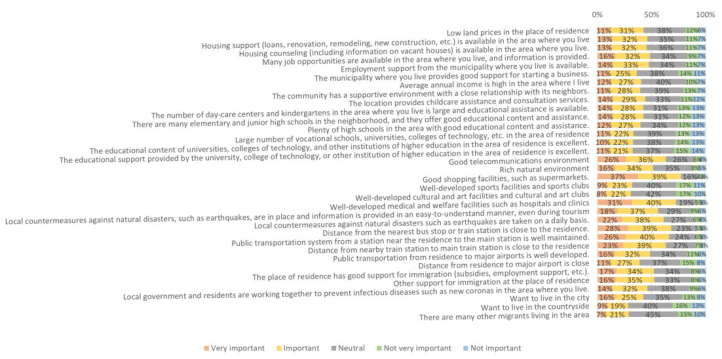
MOTIVATIONS FOR MIGRATION As with tourism objectives and attractions, respondents were asked and responded to questions about the importance of these factors when choosing a place to live. Figure 5 shows the distribution of the level of importance when choosing a place to live. The results of those responses have already been published (Kondo et al., 2024). Using these results, a factor analysis was conducted, and the results are shown in Table 4. The same method of factor extraction was used. In this case, χ2= 4224, with a significance probability p<0.0001. From the pattern matrix of factor analysis, the first factor represents “work/ housing” the second factor represents “education/ childrearing” the third factor represents “nature/ culture” the fourth factor represents “convenience of living” and the fifth factor represents “urbanity” respectively.
Figure 5: Importance of motives in choice of place to live.Table 4. Factor analysis of the importance of motives for choosing a place to live.
Table available in the original PDF paper.
Factor Variables Factor1 Factor2 Factor3 Factor4 Factor5 .901 −.013 −.185 .029 −.034 Many job opportunities are available in the area where you live, and information is provided.
.857 −.044 −.036 −.007 −.057
work/housing
Employment support from the municipality where you live is available.
.808 −.036 −.038 .035 .045
Housing counseling (including information on vacant houses) is available in the area where you live.
.773 −.008 −.084 .082 .088
Housing support (loans, renovation, remodeling, new construction, etc.) is available in the area where you live.
.632 .052 .177 −.192 −.126
The municipality where you live provides good support for starting a business.
Low land prices in the place of residence. .534 .017 .013 .033 .089 Average annual income is high in the area where I live .512 .115 .110 −.082 −.178 (Continued)
154 Kondo and Togawa
Table 4. Continued Factor Variables Factor1 Factor2 Factor3 Factor4 Factor5
Table available in the original PDF paper.
−.026 .926 −.081 .085 .135
There are many elementary and junior high schools in the neighborhood, and they offer good educational content and assistance.
−.045 .906 −.030 .090 .172
education/ childrearing
The number of day-care centers and kindergartens in the area where you live is large and educational assistance is available.
−.011 .891 −.025 .023 .001
Plenty of high schools in the area with good educational content and assistance.
.018 .797 .052 −.069 −.227
The educational content of universities, colleges of technology, and other institutions of higher education in the area of residence is excellent.
−.012 .792 .101 −.131 −.233
Large number of vocational schools, universities, colleges of technology, etc.in the area of residence.
.018 .791 .031 −.016 −.157
The location provides childcare assistance and consultation services. .050 .791 .023 .053 .162 The educational support provided by the university, college of technology, or other institution of higher education in the area of residence is excellent.
nature/ culture
−.116 −.040 .430 .378 −.269
Want to live in the countryside −.096 .021 .746 −.217 .087 There are many other migrants living in the area .029 −.004 .693 −.135 −.068 Well-developed cultural and art facilities and cultural and art clubs −.034 .004 .659 .012 −.123 Distance from residence to major airport is close −.037 −.070 .631 .091 −.272 Rich natural environment −.046 .012 .624 .077 .121 Well-developed sports facilities and sports clubs −.025 .049 .571 .034 −.116 Public transportation from residence to major airports is well developed.
.299 .100 .371 .022 .054
The community has a supportive environment with a close relationship with its neighbors.
.274 −.018 .350 .258 .009
The place of residence has good support for immigration (subsidies, employment support, etc.).
Other support for immigration at the place of residence. .284 −.005 .305 .269 −.002 −.003 −.011 −.178 .864 −.216 Public transportation system from a station near the residence to the main station is well maintained.
−.010 .004 −.169 .818 −.308
Distance from the nearest bus stop or train station is close to the residence.
−.045 −.030 −.076 .779 −.292
convenience of living Distance from nearby train station to main train station is close to the residence
−.010 .040 .038 .711 .037
Well-developed medical and welfare facilities such as hospitals and clinics
.052 .033 .127 .612 .056
Good shopping facilities, such as supermarkets. −.021 −.008 −.037 .707 .010 Local countermeasures against natural disasters such as earthquakes are taken on a daily basis in an easy-to-understand manner, even during tourism
.086 .033 .100 .572 .118
Local countermeasures against natural disasters, such as earthquakes, are in place and information is provided Good telecommunications environment .140 .145 .018 .434 .035 urbanity There are many other migrants living in the area −.004 −.026 .104 .227 −.379
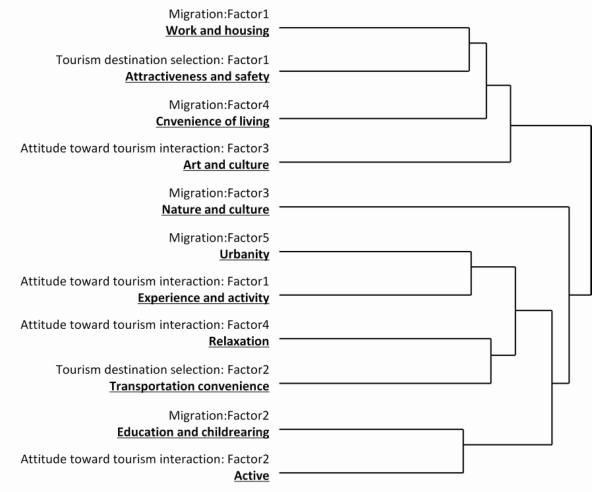
RELATIONSHIP OF EACH ATTITUDE TO TOURISM INTERACTION AND MIGRATION The purpose of this study is to clarify the relationship between people’s awareness of tourism interaction, such as the purpose and attractiveness of tourism and the decision of where to visit, and their awareness when choosing a place to live. Thus, a cluster analysis of the 11 factors extracted as a result of each factor analysis conducted thus far will be conducted to clarify how each awareness and motivation can be categorized. The results of the cluster analysis are shown in Figure 6.
Relationship Between Attitudes Toward Tourism Interaction and Motivations 155
Figure 6: Results of cluster analysis of attitudes toward tourism interaction and motivations for migration.
CONCLUSION
In this study, we focused on tourism interaction and migration, and analyzed them with the aim of clarifying how attitudes and motivations related to movement are related to each other. Regarding attitudes toward tourism interaction, four factors were identified: “experience/activity,” “active,” “art/culture,” and “relaxation.” Regarding the choice of tourist destination, the results consisted of two factors: “attractiveness and safety” and “transportation convenience. Regarding the motivation for migration, the results consisted of five factors: “work/housing,” “education/childrearing,” “nature/culture,” “convenience of living,” and “urbanity”. A cluster analysis was conducted to see how these relationships could be classified and similarities confirmed. The results revealed that the two movement ideas, tourism interaction and migration, have many items in common. These results quantitatively revealed that people are willing to move for tourism and migration according to their personal preferences.
ACKNOWLEDGMENT
This work was supported by JSPS KAKENHI Grant Numbers 22H03854, 21K02844.
REFERENCES
Andris, C. M., Cook, C. (2015) using migration degree to distinguish post-industrial U. S. cities, Proceedings of 14th International Conference on Computers in Urban Planning and Urban Management, Paper-230, pp. 1–23.
156 Kondo and Togawa
Haisheng Hu, Yang Yang, Jin Zhang (2021). Avoiding Panic during Pandemics: COVID-19 and Tourism-related Businesses, International Journal of Tourism Management, Vol. 86, 104316. Japan National Tourism Organization. (1970–2023). “International Travelers in
Japan”. Juan L. Nicolau and Francisco J. Mas (2006). The Influence of Distance and Process on the Choice of Tourist Destinations: The Moderating Role of Motivations, International Journal of Tourism Management, Vol. 27, 1–22. Kondo, A., Kondo, A. (2010). Development of migration and interaction models between regions in consideration of their mutual relationship, Selected Proceedings of the 12th World Conference of Transportation Research, pp. F2- 1650-22 Kondo, A., Kondo, A., Togawa, S. (2017). Current situation of inbound tourism in
Japan and inbound tourist behavior model, Proceedings of the 15th International Conference on Computers in Urban Planning and Urban Management, pp. 1–19. Kondo, A., Togawa, S. (2024). A basic study of the influence of tourism awareness on behavior, Proceedings of Intelligent Human Systems Integration, Vol. 119, pp. 823–829. Kondo, A., Togawa, S. (2024). Migration factors and trends in Japan with
experiencing a pandemic, Collected Papers for Presentation in the 61th Annual Meeting of the Japan Section of the RSAI, pp. 1–8. The Ministry of Internal Affairs and Communications. (1970-2020). “Annual report on the internal migration in Japan derived from the basic resident registers” The Ministry of Internal Affairs and Communications. (2021-2023). “Population
Estimates; Long-term time-series data”, “Population Estimates: Population as of October 1 of each year”.
LISTED IN THE AHFE DIGITAL BOOKSTORE CATALOGUE
Explore the complete digital volume
Intelligent Human Systems Integration (IHSI 2025): Integrating People and Intelligent Systems
Read this individual research paper free through the original publisher, or explore the full digital proceedings book.
ISBN 978-1-964867-36-6
Explore this ISBN in the AHFE Bookstore ↗Listed in the July 2026 bookstore catalogue; search by ISBN to confirm current availability · Digital book purchase optional