Satoshi Togawa, Akiko Kondo, Kazuhide Kanenishi (2024). Design of Learning History Retention Framework using Blockchain Infrastructure to Ensure Reliability of Learning Logs. In: Intelligent Human Systems Integration (IHSI 2024): Integrating People and Intelligent Systems. AHFE Open Access, vol. 119, pp. 248–254. https://doi.org/10.54941/ahfe1004489
Learning analytics has been actively pursued in the field of learning assistance field. The spread of LMSs such as Moodle and Canvas LMS has realized the acquisition of a large amount of learning history. Furthermore, an educational assistance system does not consist of only a single LMS. Multiple educational assistance services generate their own learning histories.A Learning Record Store (LRS) exists to collect and analyze these learning logs in an integrated manner. OpenLRW and Learning Locker exist as LRS implementations. In order to avoid losing the large number of learning records generated by LMSs, key value stores (KVS) such as MongoDB are generally used for data persistence in LRSs. For architectural reasons, KVS allows duplicate registration of stored data. Therefore, unlike SQL-based databases, KVS persistence does not guarantee consistency. If consistency is not maintained in the persistence of learning history, it is difficult to ensure the reliability of the stored learning history. If the stored learning history is not reliable, the reliability of the analysis results using learning analytics cannot be ensured.Changes in the world situation can impede stable system operation and cause a loss of learning logs. As of May 2023, about 20% of Ukrainian territory is occupied by Russia and the war is still going on. Conflict and war destroy many buildings, infrastructure, and communication networks. Climate change is causing increasingly severe disasters. In Japan, special heavy rainfall warnings are issued every year, mainly in western Japan. Special warnings are intended to be issued when there is a threat of a once-in-a-decade catastrophe. Matthew Rodell et al. suggest that more frequent, more severe, and more extensive droughts and floods will occur if global warming continues.The severity of a disaster, whether man-made or natural, can cause more damage than the availability of the cloud service that serves as the system operation infrastructure. Catastrophic damage to the system operation infrastructure will cause a loss in the generated learning history. The loss of the learning history causes a loss of continuity in the learning history, and consequently, the reliability of the learning history is compromised. We must ensure that the learning history of learners, which cannot be recovered once it is lost, is stored and maintained even in multi-hazard situations.In this study, we designed a learning history retention framework based on blockchain technology to ensure the reliability of learning history. In order to store and retain the learning history, we apply the decentralized autonomous blockchain technology to enable the detection of learning history inconsistencies in the LRS. A framework for ensuring the availability of the learning history was studied against the factors that cause the loss of the learning history, regardless of whether it is caused by human or natural disasters. In this paper, we describe the design of a blockchain mechanism for learning history retention, and describe a learning history retention mechanism that is linked to an existing LMS. We also describe the design and effectiveness of a prototype system implemented for validation.
Learning analytics has become popular in the field of learning support. The use of LMS platforms, such as Moodle and Canvas, has resulted in the cre- ation and collection of a vast number of learning history. These histories show how frequently learning materials are used, how many points learn- ers obtained on their tests, and trends in their performance. Additionally, LMS records also include data on how often and when users access the LMS platform itself. Today’s education support system includes more than just an LMS. In a broader view, attendance and grade management systems are also part of the support services, each generating their own histories.
A Learning Record Store (LRS) exists to collect and analyze these learning histories in an integrated manner. OpenLRW and Learning Locker exist as LRS implementations. In order to avoid losing the large number of learning histories generated by LMSs, key value stores (KVS) such as MongoDB are generally used for data persistence in LRSs. For architectural reasons, KVS allows duplicate registration of stored data. Therefore, unlike SQL-based databases, KVS persistence does not guarantee consistency. If consistency is
Design of Learning History Retention Framework Using Blockchain Infrastructure 249
not maintained in the persistence of learning history, it is difficult to ensure the reliability of the stored learning history. If the stored learning history is not reliable, the reliability of the analysis results using learning analytics cannot be ensured.
Changes in the world situation may hinder the stable operation of the sys- tem as well as the educational support environment, which in turn may cause the loss of learning histories. On February 24, 2022, Russian forces began their invasion of Ukraine. As of May 2023, approximately 20 percent of Ukraine has been occupied by Russia, and the war is still ongoing. Conflicts and wars devastate many buildings, infrastructure, regional transportation networks, and telecommunications networks. The outbreak of war threat- ens the very existence of not only the occupied territories but also the nation itself. Obviously, this has a major impact on the continuity of social life itself.
Additionally, climate change is causing increasingly severe disasters. In Japan, special heavy rainfall warnings are issued every year, mainly in west- ern Japan. Basically, special warnings are intended to be issued when there is a threat of a once-in-a-decade catastrophe. Matthew Rodell et al. suggest that more frequent, more severe, and more extensive droughts and floods will occur if global warming continues (Forbes News, July 18, 2023).
The severity of a disaster, whether man-made or natural, can cause more damage than the availability of the cloud service that serves as the sys- tem operation infrastructure. Catastrophic damage to the system operation infrastructure will cause a loss in the generated learning history. The loss of the learning history causes a loss of continuity in the learning history, and consequently, the reliability of the learning history is compromised. We must ensure that the learning history of learners, which cannot be recovered once it is lost, is stored and maintained even in multi-hazard situations.
In this study, we designed a learning history retention framework based on blockchain technology to ensure the reliability of learning history. In order to store and retain the learning history, we apply the decentralized autonomous blockchain technology to enable the detection of learning history inconsis- tencies in the LRS. A framework for ensuring the availability of the learning history was studied against the factors that cause the loss of the learning his- tory, regardless of whether it is caused by human or natural disasters. In this paper, we describe the design of a blockchain mechanism for learning his- tory retention, and describe a learning history retention mechanism that is linked to an existing LMS. We also describe the design and effectiveness of a prototype system implemented for validation.
CURRENT STATUS AND ISSUES OF LEARNING RECORD STORE ENVIRONMENT Generally, learning history is generated by an LMS such as Moodle (Moodle LMS, 2001) or Canvas (Canvas LMS, 2015). This includes the learner’s login and logout status on the LMS, his or her efforts on assign- ments, and the results of tests provided on the LMS. Learning history is the history of the learner’s use of the LMS and is basically generated continuously and sequentially.
Learning Analytics, which aims to clarify the relationship between learning behaviour and learning outcomes by analysing learning history, has also been actively pursued, and Learning Record Store (LRS) has been proposed as a framework for storing learning history for Learning Analytics.
Learning Locker (Learning Locker, 2013) is a concrete implementation of LRS that uses MongoDB (MongoDB, 2009) as its data store infrastruc- ture. MongoDB is a document-oriented database that can easily handle large amounts of data. To ensure redundancy in MongoDB, the Sharding and Replication functions are available. Sharding function is basically imple- mented for workload load balancing. The Replication function replicates the data set written to the primary server to the secondary server. To achieve data retention for the purpose of ensuring availability for the server hard- ware running MongoDB and availability for disaster recovery, it is necessary to configure a MongoDB cluster with the replication function enabled.
Document-oriented databases such as MongoDB store data in a key-value store (KVS) format for persistence. When reading data, the corresponding value can be retrieved by specifying a key. If a key that already exists is speci- fied and data is written, the value corresponding to the key is overwritten by the new value. Thus, the stored data set does not have a complex data struc- ture. These characteristics make KVS highly suitable for parallel processing in large clusters. MapReduce (Dean, 2009) uses KVS as a processing target to achieve fast extraction of computational results from large data sets.
LRS performs learning analysis based on a large amount of accumulated learning history. In order to clarify learner characteristics, etc., the results of learning analysis are prioritized for understanding trends. For this rea- son, it is more important to present trends, such as learning trends, than to ensure the authenticity of missing data or details of the learning history used in the learning analysis. The importance of the trend is more important than the missing data or the detailed authenticity of the learning history used in the learning analysis. Of course, data retention by KVS is appropriate for this purpose. This is because understanding the learning trend is more important than duplicate registration or loss of learning history.
However, a problem arises when extracting characteristics and learning tendencies for individual learners. The characteristics of KVS that allow for duplicate enrolment and missing data in the dataset are not suitable for the analysis and understanding of individual learner learning tendencies. The characteristics of KVS that allow for duplicate enrolment in a dataset and the characteristics of KVS that allow for missing data introduce errors when analysing and understanding individual learner learning trends. In order to realize personalized learning, which aims to provide learners with appro- priate learning methods according to the results of learning analysis. These errors cause fluctuations in learning coaching.
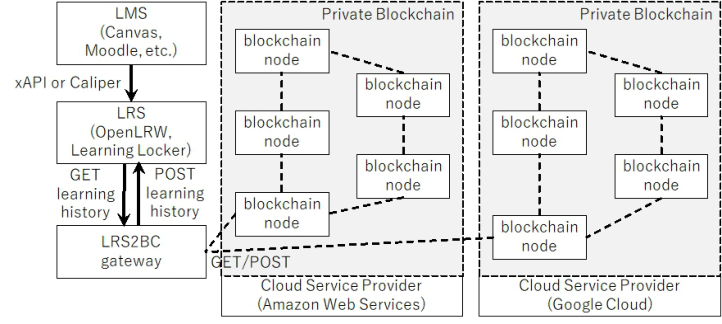
DESIGNING LEARNING HISTORY RETENTION FRAMEWORK USING BLOCKCHAIN TECHNOLOGY In this section, we describe a blockchain-based learning history store. Figure 1 shows the concept of the proposed framework. LMSs such as Can- vas LMS and Moodle are implemented an interface to export learning history
Design of Learning History Retention Framework Using Blockchain Infrastructure 251
to the LRS. The data integration interface between LMS and LRS is real- ized as Experience API (xAPI) (Experience API, 2013) and Caliper Analytics (Caliper Analytics, 2015), it is implemented as a RESTful API. The RESTful API enables data transmission and reception using the GET/POST methods on HTTP. For this reason, HTTP communication is required to send and receive data via the RESTful API.
LRSs such as Learning Locker and OpenLRW receive learning history via RESTful APIs such as xAPI and Caliper Analyrics. This enables the centralization of learning history output from multiple LMSs.
Figure 1: Blockchain based learning history retention framework.
The LRS to Blockchain gateway (LRS2BC) is part of the proposed frame- work. The LRS2BC gateway implements the POST and GET methods of the HTTP method. The POST method registers learning history via the REST API. The GET method retrieves the registered learning history. Using these methods, LRS2BC retrieves the learning history from the LRS.
One way to implement a blockchain network is to use a blockchain infras- tructure that is already in operation, such as Ethereum (Ethereum, 2015). This can be achieved through the framework of Decentralized Applications (Dapps) based on smart contracts. However, many Dapps have already been implemented on the Ethereum platform, and it takes a considerable amount of time to update the blockchain. In addition, since the Dapps are implemented in a public environment, privacy concerns remain. In a private blockchain, the number of nodes that can participate in the blockchain is limited. This allows for a closed blockchain network, which means that the participants can be controlled. The private blockchain network eliminates privacy issues. The generated blockchain network is used only as a learn- ing history store. It is therefore free from interference by other applications. Hyperledger Fabric (Hyperledger Fabric, 2015) can be used as a framework to build a private blockchain.
Private blockchain peer nodes are implemented on cloud services such as AWS. Depending on the blockchain framework implementation, peer nodes are often implemented on Docker (Docker, 2013) containers. Therefore, the
same blockchain can theoretically be configured on any cloud service by running the Docker container on a virtual machine provided by the cloud service. On the other hand, Amazon Managed Blockchain and Oracle Cloud infrastructure Blockchain Platform can easily realize a distributed ledger with tamper-resistance. Depending on the implementation of each blockchain plat- form, different blockchain platforms can be linked together. This allows nodes to be horizontally distributed across multiple cloud service providers, so that if one cloud service provider suffers a service outage, the running private blockchain will not lose its functionality. In addition, an indepen- dent blockchain network using different cloud service providers would allow for the detection of differences in the recorded ledger data. This would pro- vide the functionality necessary to verify the integrity of the learning history recorded in the blockchain.
EXPERIMENTAL USE AND RESULTS In this section, we describe the implementation of a prototype system built to verify the effectiveness of the proposed framework, and we describe experimental use and results. In a related study (Togawa, 2023), as a counter- measure against the risk of losing learning history in the event of a large-scale disaster, we implemented our own virtualization infrastructure, Docker and Hyperledger Fabric nodes were implemented on the virtual machine Amazon Elastic Compute Cloud (EC2 instance) on AWS. This implementation method minimizes the technical dependency on the AWS platform. Usually, building a blockchain node with a proprietary implementation requires a great deal of effort. For this reason, we attempted to implement the node using Amazon Managed Blockchain in this implementation.
Table 1 shows the environment used to build the prototype implementation.
Table 1. Component specifications of prototype implementation.
Table available in the original PDF paper.
Item Specification Amazon Managed Blockchain instance type bc.t3.small vCPU amount 2 Memory size 2 Gbytes Hyperledger Fabric version v2.5.0 Learning Locker version v7.1.1
An EC2 instance was created on an AWS Virtual Private Cloud (VPC) and Learning Locker was implemented as the LRS. The private blockchain was created using Hyperledger Fabric. Five blockchain peer nodes were gen- erated and deployed for functional validation. Although the design was to implement a blockchain network on each of the different cloud platforms. In this case, two blockchain networks were implemented on the same cloud platform for functional verification. To verify the minimum functionality, Learning Locker and the blockchain network were placed on the same VPC.
Design of Learning History Retention Framework Using Blockchain Infrastructure 253
It was verified that the generated transactions were recorded in the ledger according to the chain code script as smart contracts.
In this evaluation experiment, a dual blockchain network is configured on a single cloud platform. A single VPC is configured on a single cloud platform. In other words, both LRS and blockchain networks are configured on a single VPC. In the future, we will verify whether redundancy can be ensured by implementing a blockchain network configured on multiple cloud service providers.
CONCLUSION
In this paper, we explain the possibility of data inconsistency in the learn- ing history persistence mechanism in the LRS, and the risk of losing learning history due to changes in global conditions such as regional conflicts and cli- mate change. We also explained the risk of learning history loss due to global changes in circumstances such as regional conflicts and climate change. The need to ensure the authenticity of learning history due to these factors is dis- cussed, and a proposal and concept for a learning history store using a private blockchain is presented. Finally, we described the results of an evaluation experiment to verify the effectiveness of the proposed system.
In the future, we will improve the design of the private blockchain that constitutes the learning history store and implement the private blockchain as a dual blockchain on Amazon Managed Blockchain and Oracle Blockchain Platform Cloud Service. We plan to implement this system to improve its availability.
ACKNOWLEDGMENT
This work was supported by JSPS KAKENHI Grant Numbers 21K02844, 22K12292.
REFERENCES
Caliper Analytics (2015). IMS Global Learning Consortium, Caliper Analytics Website: https://www.imsglobal.org/activity/caliper, Accessed October 24, 2023. Canvas LMS (2015). Canvas LMS Website: https://www.instructure.com/en- au/canvas, Accessed October 20, 2023. Dean, J., Ghemawat, S. (2009). MapReduce: simplified data processing on large clusters, Communications of the ACM, Volume 51, Issue 1, 107–113, https://doi.org/10.1145/1327452.1327492 Docker (2013). Docker Inc., Docker Website: https://www.docker.com/, Accessed
October 29, 2023. Ethereum (2015). Ethereum Website: https://ethereum.org/, Accessed October 29,
2023. Experience API (2013). xAPI Website: https://xapi.com/, Accessed October 24, 2023. Forbes News (July 18, 2023), “Here’s Why Flooding Could Get More Intense As Planet Warms—As Northeast U. S. Recovers From Brutal Rain”, Forbes Website: https://www.forbes.com/sites/darreonnadavis/2023/07/18/heres-why-flooding- could-get-more-intense-as-planet-warms-as-northeast-us-recovers-from-brutal- rain/?sh=77555919336b.
g-record-store/, Accessed October 25, 2023. Mongo DB (2009). MongoDB Website: https://www.mongodb.com/, Accessed October 22, 2023. Moodle LMS (2001). Moodle Website: https://moodle.org/, Accessed October 20,
2023. Togawa, S., Kondo, A., Kazuhide, K. (2023). Designing a Learning History Storing Framework with Blockchain Technology for Against Multi Hazards, Proceed- ings of 14th AHFE International Conference on Human Factors in Design, Engineering, and Computing for All, 6 pages, in press.
LISTED IN THE AHFE DIGITAL BOOKSTORE CATALOGUE
Explore the complete digital volume
Intelligent Human Systems Integration (IHSI 2024): Integrating People and Intelligent Systems
Read this individual research paper free through the original publisher, or explore the full digital proceedings book.
ISBN 978-1-958651-95-7
Explore this ISBN in the AHFE Bookstore ↗Listed in the July 2026 bookstore catalogue; search by ISBN to confirm current availability · Digital book purchase optional