Yu-Hsiu Hung, Bo-Wei Chen (2024). Development of a Dynamic Visual Acuity Training Software Based on Baseball Situations to Improve Users' Dynamic Visual Ability. In: Human Factors in Design, Engineering, and Computing. AHFE Open Access, vol. 159, pp. 927–934. https://doi.org/10.54941/ahfe1005659
Dynamic visual acuity (DVA) is crucial for successful baseball batting, as it enables players to quickly assess the ball’s trajectory and adjust their swing timing in a short period of time. This study involved interviews with 19 baseball coaches and players from four collegiate teams, as well as questionnaire distribution and a literature review, revealed that visual training is underutilized in baseball from youth to professional levels. Existing training products often lack customization to individual abilities and struggle to translate training effect to on-field performance. Recent advances in virtual reality (VR) have been applied to baseball training, but issues such as motion sickness remain. To address these gaps, this study developed a dynamic vision training software with three modes: (1) Simulation Mode, (2) Track Blocking Mode, and (3) Texture Contrast Mode. The software adjusts difficulty based on an 80% accuracy threshold and focuses on training players to recognize fine details, such as the seams on a fast-moving ball. To evaluate the software's effectiveness, 18 non-athletic participants were recruited and divided among the three training modes. Each group underwent a pre-test, completed eight training sessions, and finished with a post-test. Results showed an overall improvement in personal ability rating, with statistical significance in the Simulation and Track Blocking Modes, but not in the Texture Contrast Mode, possibly due to eye fatigue in one participant. The study demonstrates that this software allows teams to flexibly schedule training and enhances real-world performance more effectively than other visual training tools.
Athletes want to perform well in competitions, so improving performance is a common goal. Past research has linked dynamic visual acuity to performance in ball sports such as volleyball, basketball, baseball, softball, motorsports, and catching tasks with dynamic visual acuity being defined as the ability to recognize the details of fast-moving objects (Uchida et al., 2012). Dynamic visual acuity is an important ability for baseball batters because it takes about 0.4 seconds for the ball to reach home plate after being thrown, and batters need to assess the rotation and direction of the ball in order to decide whether or not to swing the bat (Clark et al., 2012), and (Palidis et al., 2017) also
pointed out that there is a strong correlation between dynamic visual acuity and professional standards.
On the other hand, visual perceptual abilities such as dynamic vision improve with past experience. This process, known as perceptual learning, occurs during motion perception and when participants are subjected to motion stimuli without moving their eyes and since playing athletes are subjected to repetitive motion stimuli during training, repetitive stimuli may improve their perception of moving objects, independent of eye movements (Uchida et al., 2012).
The current visual training can be divided into four categories, the first category is the use of physical products for visual training, for example, the University of Cincinnati uses Brock string, Eyeport, Near Far Training and other physical products to train visual ability (Clark et al., 2012), which can be trained to Eye Tracking, Depth Perception, Visual Concentration, etc. The disadvantage of this type of training is that it is not possible to provide adapted training according to the ability of the athlete. The second type of visual training software is based on psychology, e.g., Krasich et al. (2016) used Nike Sensory Station (NIKE, Inc., Oregon, USA) to measure various visual perceptual abilities and visual motor abilities, which included nine sport-related psychometric tasks such as eye-hand coordination, eye- motor coordination, and eye-motor coordination, etc. The second type of visual training software is based on psychology, such as Krasich et al. (2016) used Nike Sensory Station (NIKE, Inc., Oregon, USA) to measure various visual perceptual abilities and visual motor abilities. The disadvantage of this type of training is that it does not match the real training environment of the athletes, and the similarity between the training screen and the real stadium should be considered when designing the training program (Raab When designing training programs, the similarity between the training screen and the real stadium should be considered (Raab et al., 2019). The third category is VBT training (video-based training), VBT training uses videos to present stimuli to which athletes need to perceive a response (Larkin et al., 2015), and researchers have pointed out that VBT training needs to maintain validity as much as possible (Silva et al., 2021), and in order to do so, when designing a training program, the To maintain validity, the proximity of the video simulation environment to real life must be taken into account (Raab et al., 2019), and current VBT training often suffers from discrepancies with the real environment. In order to pursue the realism and make the training representative, therefore VR technology is beginning to be ap-plied to baseball training, for example, Pagé et al., (2019) used VR virtual reality to present edited video clips of basketball matches to the subjects to train their visual perception, and head-mounted display devices are required to use VR virtual reality, which may cause dizziness to the users (Faure et al., 2020).
In summary, the existing visual training equipment does not fully meet the training needs of the team, and there is still a chance for improvement, so the development of a dynamic visual training software that meets the stadium situation and can provide adaptive training, in order to confirm the impact of the software developed in this study, 18 subjects were recruited to use the software developed in this study to train and test the feasibility of this training
Development of a Dynamic Visual Acuity Training Software Based 929
software. The training data collected and analyzed in this study can be used by future teams or related researchers to develop training systems.
LITERATURE REVIEW
The Importance of Dynamic Vision Acuity in Sports Performance Dynamic Visual Acuity (DVA) refers to the ability to resolve details of a dynamically moving object when the head is fixed, or to resolve details of a static object when the head or body is rotating. This ability is important in many ball sports, and there have been many studies confirming that professional athletes generally have better dynamic vision than non-athletes, and that there is a strong correlation between athletic performance and dynamic vision.
Research on Existing Visual Training Equipments
1) Brock String: The brock string training is a classic visual training aid consisting of a rope and 5 colored balls. Athletes hold the end of the rope next to their nose and stretch the rope parallel to the ground in the distance. The athlete focuses back and forth on the different colored balls on the rope for 1 minute.
2) Eyeport: Eyeport (The Exercise Your Eyes, Dove Canyon, CA) is a digital version of the Blooger Vision Training that has different colored lights. Athletes place it on their nose and their eyeballs move horizontally and vertically in response to the light movements, which helps warm up the eye muscles.
3) Near Far Training: Near far training requires the subject to focus their attention on two different cards at a distance of approximately 18 inches and 10 feet. The athlete focuses back and forth on the cards and counts how many cycles they can do in time.
4) Saccades: Saccades is when the focus of the eyes moves quickly from one object to another. Random letter cards will be hung on the wall and athletes will be asked to stand at different distances and read the cards in the order they see them.
5) Nike Sensory Station: Nike Sensory Station (NIKE, Inc., Oregon, USA) is an assessment system that includes a series of psychometric tasks that the user is guided through by videos. The system includes nine competency tests that are important to athletic performance.
6) Video-Based Training: VBT training methods include watching game film sequences, time blocking, and motion sequence blocking. This method accelerates the development of cognitive skills, making it the most common way to develop an athlete’s anticipation and decision-making skills.
7) Virtual Reality: Virtual reality (VR) is a widely used technology and is gaining more and more attention from sports players, especially in team sports, because it can simulate the situation on the field easily and quickly. However, there are still limitations to the use of VR, one of which is that the use of VR for training requires head-mounted displays, which can make the
930 Hung and Chen
user dizzy, and the second is that the equipment is too expensive for non- professional baseball teams to afford.
METHOD
Research Structure The study was divided into three phases. The first phase was the research phase, in which the researcher interviewed the coaches and players of Group A and Group B of tertiary institutions in order to study the current training menu and visual training methods, and searched for the relevant literature on visual training and sports cognitive training in order to determine the design parameters of the future training software. The second stage is the design stage, which aims to develop the training software and formulate the training tasks. The third stage is the validation stage, in which the participants use the training software developed in this study to conduct training, collect data, and analyze them to verify whether they are effective or not.
Contextual Inquiry and JTBD Survey In order to understand the current hitting training of baseball batters and whether or not there is any enhancement of visual ability, this study interviewed the coaches and players of four college baseball teams and designed a questionnaire based on the interviews. The results of the questionnaire indicated that baseball batters are prone to misinterpreting a good ball as a bad ball, which leads to poor hitting performance. In an interview with Coach Kung Wing-tang of the Taiwan Beer Baseball Team, the coach mentioned the importance of dynamic vision: “A good and mature baseball batter will keep his eyes on the rotation and trajectory of the ball as soon as the ball leaves the pitcher’s hand, in order to determine how the ball is going to enter the base. “Baseball players who can’t follow the ball with their eyes can’t perform well even if they have good batting ability and skills.”
Equipment
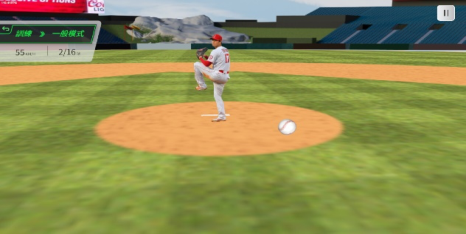
1) Dynamic Visual Acuity Training Software Design: The core concept of the software developed in this study is to practice recognizing the seam patterns on a fly ball from far away and answering correctly, and the software automatically adjusts the difficulty level according to the answer rate. From the previous literature, it is known that this kind of sports cognitive training using TV monitors requires the simulated environment to be as close as possible to the real ballpark environment, and therefore, the pitcher’s mound, the pitcher’s plate, the softball bag, and so on, are drawn in the simulation screen.
There are three training modes in this software, the basic “Realistic Mode” simulates a pitcher throwing a fly ball from a distance on the field, and the other two are the “Track Blocking Mode” and the “Texture Contrast Mode”. The Track Blocking Mode masks the trajectory of the back end of the fly ball to simulate the distraction of the batter, and this masking of visual information has been used extensively to train visual abilities (Paull &
Development of a Dynamic Visual Acuity Training Software Based 931
Glencross, 1997). This method of masking visual information has also been used extensively for training visual abilities (Paull & Glencross, 1997), while the texture contrast mode halves the number of red stitches on a baseball and reduces the contrast to simulate the wear and tear on the leather of the ball. Osborne et al. (1990) showed that making the cues on the baseball more visible resulted in a better hitting performance, therefore, the reduction of contrast in the present study made the training more difficult.
Figure 1: Actual training screen.
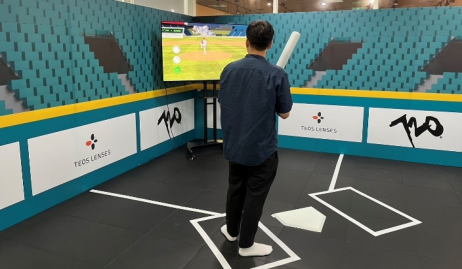
2) Venues and TV monitors: The location of the experiment was chosen in the Hwameei Optical Factory, and the experiment was kept free from noise and light interference as much as possible. A 4K, 65-inch monitor (Panasonic TH-65MX800) with a 120 Hz refresh rate was used to consider the visual ability of the human eye and the sense of immersion, and it was decided that the 4K, 65-inch TV should be installed at least 2 meters away from the test subject.
Figure 2: Actual training situation.
Participants Eighteen participants without visual training were recruited and divided in three modes: simulation, track blocking, and texture contrast.eye and the sense of immersion, and it was decided that the 4K, 65-inch TV should be installed at least 2 meters away from the test subject.
932 Hung and Chen
Procedure The length of training was determined by looking at the training period, number of balls, and number of sets in the literature for similar training content (Kohmura et al., 2019), and the final definition of the training period was two weeks, four times a week, five rounds each time, and 16 balls in each round, and the criterion for advancement was also determined by looking at the literature, which states that a cognitive motor response with a task success rate of 80% is the criterion of an expert, and therefore, according to the literature, the criterion for advancement is 80% (Guadagnoli & Lee, 2004). Therefore, according to the literature, 80% was used as the criterion for advancement, and training 16 balls to 13 balls was used for advancement (Guadagnoli & Lee, 2004), and ball speed was in-creased by 3 each time advancement was made, and there were pre-tests and post-tests. In the pre- test, all subjects were tested in the simulation mode, and when the subject reached 8–12 ball pairs, the ball speed was defined as his/her basic ability value. In the post-test, the simulation mode was tested with the last ball speed of the training period, and the ball speed was increased by 3 when he/she answered 13 ball pairs, and if he/she ended up with fewer than 13 ball pairs in two consecutive attempts, the ball speed would be the post-test result. To avoid wrong press, distraction, too slow press and no promotion. When training, you should hold the bat controller in your hand and simulate the batting action of a player standing up.
RESULT
After 8 sessions of training, the pre-test and post-test data of the three modalities were analyzed using the Wilcoxon rank-sum test statistical method to verify the effectiveness of the individual training. The simulation and track blocking modalities were effective in training (P<0.05), whereas the texture contrast modality did not have a statistically significant effect (P>0.05), and the reason for this was that this modality had the most difficulty in recognizing the most difficult modality, with the least amount of visual information, as compared to the other two modalities. The reason for this is that this mode has the least visual information compared to the other two modes and is the most difficult mode to recognize.
CONCLUSION
In this study, we developed a dynamic vision training software that meets the actual situation of the stadium and adapts to the training. Firstly, we investigated the current training situation of the college and university first division teams through a pulse interview, and then based on the results of the interview and the past related research, we set the design specifications and parameters to develop a prototype of the dynamic vision training software, and then recruited eighteen subjects to conduct the training, and provided the recommendations for the operation and design of the dynamic vision training software.
Development of a Dynamic Visual Acuity Training Software Based 933
Table 1. Pre-test and post-test results and statistical analysis.
The contribution of this study is threefold: (1) According to the experimental results of this study, the dynamic vision training software developed in this study can effectively enhance the dynamic vision of the test subjects. (2) It can make the team more flexible when making training plans because the system does not require a lot of manpower and large venues for training, and there is no risk of injury due to training, so it is suitable for players who need to reduce the physical load during the tournament period or for those who need to reduce the physical load due to injuries. (3) Task- oriented training provides simulated images that are similar to the situation on the court and provides adaptive training, which can be converted to real court performance compared to other visual training.
REFERENCES
Clark, J. F., Ellis, J. K., Bench, J., Khoury, J., & Graman, P. (2012). High-performance vision training improves batting statistics for University of Cincinnati baseball players. PLoS One, 7(1), e29109. https://doi.org/10.1371/journal.pone.0029109 Faure, C., Limballe, A., Bideau, B., & Kulpa, R. (2020). Virtual reality to assess and
train team ball sports performance: A scoping review. Journal of Sports Sciences, 38(2), 192–205. https://doi.org/10.1080/02640414.2019.1689807 Guadagnoli, M. A., & Lee, T. D. (2004). Challenge point: a framework for conceptualizing the effects of various practice conditions in motor learning. J Mot Behav, 36(2), 212–224. https://doi.org/10.3200/JMBR.36.2.212-224
934 Hung and Chen
Gutierrez Diaz del Campo, D., Gonzalez Villora, S., Garcia Lopez, L. M., & Mitchell, S. (2011). Differences in Decision-Making Development between Expert and Novice Invasion Game Players. Perceptual and Motor Skills, 112(3), 871–888. https://doi.org/10.2466/05.10.11.25. Pms.112.3.871–888 Kohmura, Y., Nakata, M., Kubota, A., Aoba, Y., Aoki, K., & Murakami, S. (2019).
Effects of Batting Practice and Visual Training Focused on Pitch Type and Speed on Batting Ability and Visual Function. J Hum Kinet, 70, 5–13. https://doi.org/ 10.2478/hukin-2019-0034 Krasich, K., Ramger, B., Holton, L., Wang, L. L., Mitroff, S. R., & Appelbaum, L.
G. (2016). Sensorimotor Learning in a Computerized Athletic Training Battery. Journal of Motor Behavior, 48(5), 401–412. https://doi.org/10.1080/00222895. 2015.1113918 Larkin, P., Mesagno, C., Spittle, M., & Berry, J. (2015). An evaluation of video-based training programs for perceptual-cognitive skill development. A systematic review of current sport-based knowledge. International Journal of Sport Psychology, 46(6), 555–586. https://doi.org/10.7352/ijsp.2015.46.555 Osborne, K., Rudrud, E., & Zezoney, F. (1990). Improved curveball hitting through
the enhancement of visual cues. Journal of Applied Behavior Analysis, 23(3), 371–377. https://doi.org/10.1901/jaba.1990.23-371 Pagé, C., Bernier, P. M., & Trempe, M. (2019). Using video simulations and virtual reality to improve decision-making skills in basketball. Journal of Sports Sciences, 37(21), 2403–2410. https://doi.org/10.1080/02640414.2019.1638193 Palidis, D. J., Wyder-Hodge, P. A., Fooken, J., & Spering, M. (2017). Distinct eye
movement patterns enhance dynamic visual acuity. PLoS One, 12(2), Article e0172061. https://doi.org/10.1371/journal.pone.0172061 Paull, G., & Glencross, D. (1997). Expert perception and decision making in baseball.
International Journal of Sport Psychology, 28(1), 35–56. <Go to ISI>://WOS: A1997WU35900004 Raab, M., Bar-Eli, M., Plessner, H., & Araújo, D. (2019). The past, present and future of research on judgment and decision making in sport. Psychology of Sport and Exercise, 42, 25–32. https://doi.org/10.1016/j.psychsport.2018.10.004 Silva, A. F., Ramirez-Campillo, R., Sarmento, H., Afonso, J., & Clemente, F. M.
(2021). Effects of Training Programs on Decision-Making in Youth Team Sports Players: A Systematic Review and Meta-Analysis. Frontiers in Psychology, 12, Article 663867. https://doi.org/10.3389/fpsyg.2021.663867 Uchida, Y., Kudoh, D., Murakami, A., Honda, M., & Kitazawa, S. (2012). Origins of Superior Dynamic Visual Acuity in Baseball Players: Superior Eye Movements or Superior Image Processing. PLoS One, 7(2), Article e31530. https://doi.org/10. 1371/journal.pone.0031530
LISTED IN THE AHFE DIGITAL BOOKSTORE CATALOGUE
Explore the complete digital volume
Human Factors in Design, Engineering, and Computing
Read this individual research paper free through the original publisher, or explore the full digital proceedings book.
ISBN 978-1-964867-35-9
Explore this ISBN in the AHFE Bookstore ↗Listed in the July 2026 bookstore catalogue; search by ISBN to confirm current availability · Digital book purchase optional