Nandhini Giri, Erik Stolterman (2024). Design Maturity Frameworks and Enjoyable Design Processes. In: Human Factors in Design, Engineering, and Computing. AHFE Open Access, vol. 159, pp. 501–506. https://doi.org/10.54941/ahfe1005616
Maturity frameworks provide a structure for assessing key performance metrics of an organization and provide guidelines for assessment and growth in various areas of an organization.Design maturity frameworks focus more on a human-centered approach in assessing the human motivational factors that create enjoyable and sustainable workplace practices. Identifying factors that improve or inhibit the productivity of processes can help individuals and organizations design better workplace experiences. This presentation will introduce audience to the theoretical foundations of design maturity frameworks and suggest ways to build a human-centered model that is built around enjoyable and sustainable design processes, customized for individual and organizational growth. Participants will learn • Concepts of maturity frameworks and stages of design expertise • Identify issues with existing design processes at an individual and/or organizational level • Discuss practical solutions and develop a customized maturity framework for enjoyable and sustainable workplace experiencesThe session aims at identifying human factors that motivate individuals and organizations in developing design processes that generate enjoyable and sustainable workplace experiences. The content of the session will benefit novice to experienced professionals and managers to rethink their own professional practices in terms of design expertise development and motivational processes at workplace.Session Structure: • This session will include both presentations and practical work • The presentations introduce concepts of design maturity and expertise development in professional practices • Presentations will be followed by individual exercises and group discussions to identify motivational factors and productivity inhibiting factors at workplaceTarget Audience: The session is designed for novice to experienced professionals in the academic and professional fields who are interested in learning more about design maturity frameworks and guidelines to apply these structures in their professional practices. The presentation provides guidelines to adopt design practices and human-centered processes at individual and organizational levels. Target audience roles include: Designers, Managers, Developers, Researchers, Educators
In the recent years, an increasing number of organizations are adopting a design mindset to navigate through technological, economical, and market shifts (Enkel et al., 2011; Jorg, 2009; Vallerand et al., 2017). One of the major organizational initiatives that is part of this design transformation is the adoption of maturity models, to make organizations more design-focused and user friendly. Maturity frameworks provide a structure for assessing key performance metrics of an organization (Merholz & Skinner, 2016) and provide guidelines for assessment and growth in various areas of an organization. Design maturity frameworks suggest ways to adopt a designerly mindset in the various operations of the organization including processes, practices, products, and people.
This paper presentation/workshop session introduces audience to some of the major theoretical foundations of design maturity models and their implications for organizations. Open discussions encourage participants to discuss and analyse existing maturity models and their implications for organizations. The main aim of the session is to open a conversation about maturity models, critique, reflect and develop an agenda for transformative models and frameworks that (re) define design maturity for assessing and providing guidelines for design practitioners, managers, researchers, and organizational stakeholders.
The session focuses on three sub-themes that relate to the various assessment areas of maturity models. Design adoption in the organization’s key areas of processes, practices, products, and people is a key discussion topic. Questions on the efficiency of existing maturity models in achieving this can lead to several discussion threads and contributions to ongoing research on maturity models. How can maturity models provide a roadmap for design professionals in organizations – this is another significant topic that can lead to guidelines for professional mentoring programs and pedagogical contributions. Designers’ experiences at workplace are a very less researched topic. Use of maturity models as a human-centred approach to identifying designerly ways of making workplace design practices more enjoyable and sustainable for designers is the concluding discussion theme for the session.
BACKGROUND
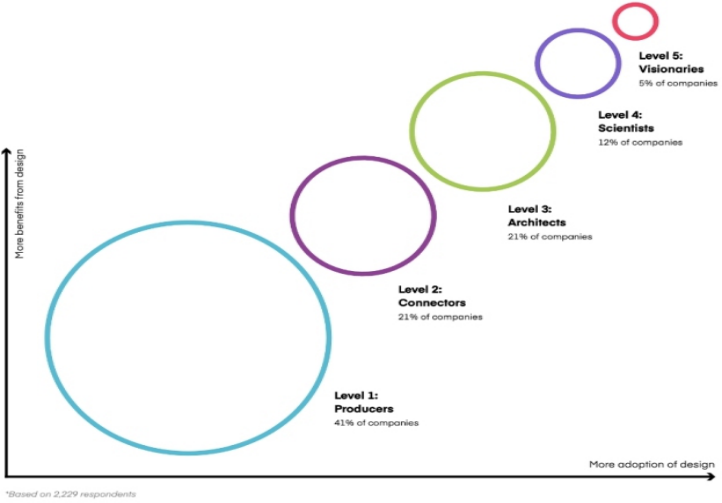
Design maturity frameworks have been developed in fields that include software and information technology management (Poppelbub & Rogliner, 2011) that serve as instruments for better positioning of institutions and for finding better solutions for change. Maturity models have a wide range of functions and assessments. Design maturity models in particular focus on the adoption of design in key organizational structures. Figure 1 shows one such model developed by Invision for design maturity. The model shows the percentage distribution of organizations that focus on visual form and function, collaborative processes and integrated tools, scaled approaches, data-driven strategies and visionary categories.
Figure 1: Design maturity model by Invision (Invision, 2018).
Design Maturity Frameworks and Enjoyable Design Processes 503
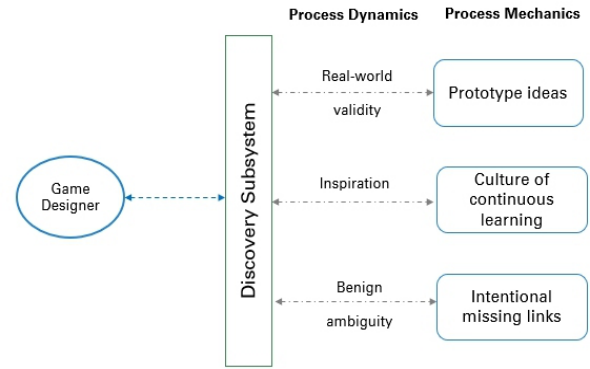
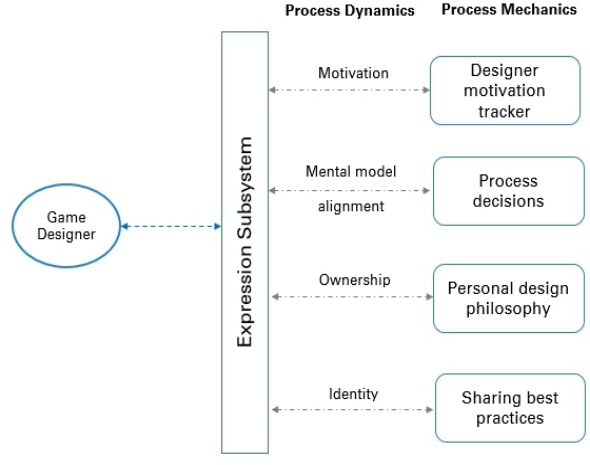
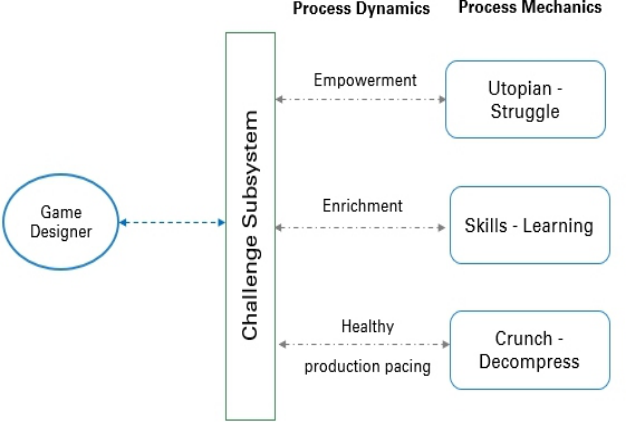
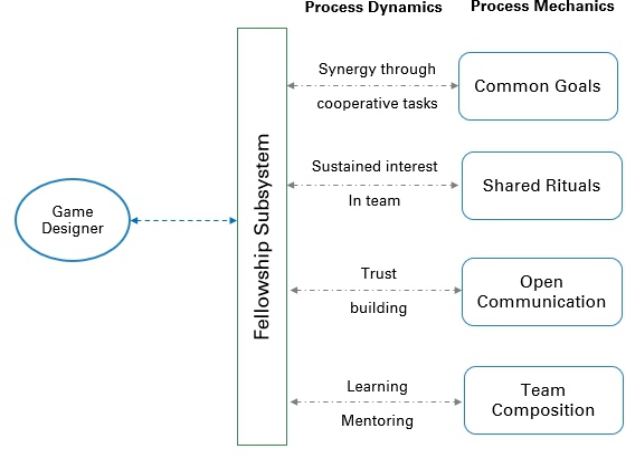
The ramifications in the field of design necessitate a discussion on the current maturity models and also incorporate design solutions that focus on the designerly experiences in workplace environments. Enjoyability and sustainability are key factors that we consider as significant experiences. The following figures 2 – 5 provide a framework for gamifying the workplace environment by introducing playful interventions for improved work experiences. The figures below depict subsystems that allow gamified interaction with designers and the process leading to aesthetic experiences of discovery, expression, challenge and fellowship (Giri & Stolterman, 2020).
Figure 2: Gamified subsystem of discovery for process enjoyability and sustainability.Figure 3: Gamified subsystem of expression for process enjoyability and sustainability.
504 Giri and Stolterman
Figure 4: Gamified subsystem of challenge for process enjoyability and sustainability.Figure 5: Gamified subsystem of fellowship for process enjoyability and sustainability.
SESSION DETAILS AND LEARNING OUTCOMES The workshop aims at identifying human factors that motivate individuals and organizations in developing design processes that generate enjoyable and sustainable workplace experiences. The content of the session will benefit
Design Maturity Frameworks and Enjoyable Design Processes 505
novice to experienced professionals and managers to rethink their own professional practices in terms of design expertise (Giri, 2021) development and motivational processes at workplace.
Workshop Structure This session will include topic presentations, individual and group activities, practical work and follow-up discussions. The presentations introduce concepts of design maturity and expertise development in professional practices. Presentations will be followed by individual exercises and group discussions to identify motivational factors and productivity inhibiting factors at workplace.
The session is designed for novice to experienced professionals in the academic and professional fields who are interested in learning more about design maturity frameworks and guidelines to apply these structures in their professional practices. The session provides guidelines to adopt design practices and human-centered processes at individual and organizational levels. The target audience roles include designers, managers, developers, researchers and educators. Here is a breakdown of the one-hour tutorial session:
Topic presentation introducing concepts of design maturity and expertise development in professional design practices (10 mins).
Group discussion on existing maturity models, opportunities, and limitations (10 mins).
Group activity on session subthemes (3 activities x 10 mins each).
Group discussion on an agenda for developing design maturity frameworks (10 mins).
Session co-chair will run the in-person session, present the topics, and facilitate the activities and discussions. The Co-chairs will produce a concluding document from the workshop session. Conversation transcripts from the in-person session, any recording, images and screenshots from the individual/group activities will be interpreted and analysed for writing the concluding document. We plan to create an online community through Slack or Discord to continue conversations and plan to publish the findings in journal and report format for researchers and professional designers.
CONCLUSION
This workshop session seeks to introduce the audience to the topic of maturity models as instruments for design transformation in their own organizations and individual design practices. We hope that the topics covered in this session will lead to fruitful discussions and a collaborative agenda for identifying opportunities and implementation strategies to make workplace practices more enjoyable and sustainable. Future work will include empirical studies that test the effectiveness of these models and frameworks.
506 Giri and Stolterman
REFERENCES
Enkel, E., Bell, J., & Hogenkamp, H. (2011). Open innovation maturity framework.
International Journal of Innovation Management, 15(06), 1161–1189. Giri, N. (2021). An Enjoyable Approach to Design Expertise in Gaming and Interactive Entertainment Industry Practices (Doctoral dissertation, Indiana University). Giri, N., & Stolterman, E. (2020). Systems Approach to Designing an Enjoyable
Process for Game Designers. In HCI International 2020–Late Breaking Papers: Cognition, Learning and Games: 22nd HCI International Conference, HCII 2020, Copenhagen, Denmark, July 19–24, 2020, Proceedings 22 (pp. 669–687). Springer International Publishing. Giri, N., and Stolterman, E. (2022) An analysis of design maturity models used in design organizations, in Lockton, D., Lenzi, S., Hekkert, P., Oak, A., Sádaba, J., Lloyd, P. (eds.), DRS2022: Bilbao, 25 June - 3 July, Bilbao, Spain. https://doi.org/ 10.21606/drs.2022.276. Invision. (2018). The New Design Frontier. Retrieved from https://www.invisionap
p.com/designbetter/design-maturity-model/ Jörg, B. (2009). Maturity Models for IT Management-A Procedure Model and its Application/Jörg Becker, Ralf Knackstedt, Jens Pöppelbuß. Business & Information Systems Engineering, 1(3), 213–222. Merholz, P., & Skinner, K. (2016). Org design for design orgs: Building and managing
in-house design teams. “ O’Reilly Media, Inc.”. Pöppelbuß, J., & Röglinger, M. (2011). What makes a useful maturity model? A framework of general design principles for maturity models and its demonstration in business process management. Vallerand, J., Lapalme, J., & Moïse, A. (2017). Analysing enterprise architecture
maturity models: a learning perspective. Enterprise Information Systems, 11(6), 859–883.
LISTED IN THE AHFE DIGITAL BOOKSTORE CATALOGUE
Explore the complete digital volume
Human Factors in Design, Engineering, and Computing
Read this individual research paper free through the original publisher, or explore the full digital proceedings book.
ISBN 978-1-964867-35-9
Explore this ISBN in the AHFE Bookstore ↗Listed in the July 2026 bookstore catalogue; search by ISBN to confirm current availability · Digital book purchase optional