Juan Roquette, Fernando Alonso, Pilar Salazar (2022). Human-Centered Design since the Degree Kickoff: from Alumni Experience to Designer & User Experience. In: Human Dynamics and Design for the Development of Contemporary Societies. AHFE Open Access, vol. 25, pp. 104–111. https://doi.org/10.54941/ahfe1001377
This article seeks to investigate the new paradigms of digital form and their application to the design process as a way to integrate service design from the very beginning of the process. It addresses a review of the generation of design in the key of "activity of conformation of open strategies". The aim is to open a deep reflection that allows an evolution of the understanding of the discipline of design linked to the outdated definition of "task of formalization of finished objects", which is widespread and still widely assumed. It is undeniable that engineering, urban planning, architecture, graphic design, product design, experience design and fashion design all share a common objective: all of them, in the end, can be considered as "service design".Indeed, each of the modalities of contemporary design and creation involves providing conceptual and oper-ational responses to needs (functional, aesthetic, symbolic, structural, social, individual). In short, creative activity consists of interpreting requirements and constraints in the most creative and efficient way possible. Design is not so much concerned with the need to produce "finished" objects, whether tangible or intangible. Contemporary design aims to create "formal laws", flexible and open, that can be applied according to the changing scenarios posed by today's users. To design digitally today is to create logical structures of data, algorithms and open results. This article rais-es the possibility of designing -from the genesis of the design- by integrating data referring to users and their algo-rithms as the basis of the formal, diagrammatic or structural law of the design solution. From clear mathematical rules and their parameterization, we propose the generation of the base structure of the "digital contemporary design"; from the exposition of data to the generation of “empty form”. In order to that, a preliminary reflection on the Technical drawing / CAD / BIM is proposed as well as describing the languages of the contemporary Design project (data and algorithms necessary for the construction of the form by topological transformations on simple forms). This is a con-temporary way of understanding the generation of the “empty form”. A "prepared" and "structured" format for the subsequent acquisition of successive layers of information (user data) that would trigger the "virtual twin" of the de-sign. Designing by means of topological transformations is an essential exercise in the foundations of digital culture: working with this type of algorithm is the main work of CAD programs. The conception of contemporary design must increasingly take into account the digital era, which constitutes the paradigm of our culture. The ideation and formalization of the actions that define design, architecture, urbanism and the physical environment, go through the management of formal operations within information systems that com-bine identity, visuality, materiality, measurement, financing, parameterization, industrialization, construction mainte-nance and, of course, interaction with users and systems. This phenomenon once again highlights the importance of geometry and drawing as fundamental disciplines that sustain the solid foundations of design education in the Univer-sity.Finally, the article addresses the urgency of defining new methodologies for the design process to ensure that design does not remain a mere "cultural response" to the technical advances produced by science, nor is it a purely intuitive process that proposes images but dispenses with the technical language of its time. We defend the activity of design as a purely contemporary task, which must be generated with the languages and methodologies of our current (and future) time, and for which it must have the possibility of integrating data and adapting to them with flexibility. In this way, any kind of design can be considered "service design" because it will "serve" effectively, avoiding the unnecessary iterations pursued by the LEAN system, which make human actions on reality inefficient and unsustaina-ble. Such a design would prevent the industry from having to generate an overabundance of designs and then discard the inadequate ones (by natural selection, through trial and error, dictated by the market and by user needs).Keywords: Design Training · Design Methodologies · Human-centered Design · Alumni experience · Designer experience ·User Experience · Service Design · Form · Contemporary Design process
Creative activity consists of interpreting requirements and constraints (functi- onal, aesthetic, symbolic, structural, social, individual) in the most genuine and efficient way possible. Contemporary design aims to create ‘formal laws’, flexible and open, that can be applied according to the changing scenarios posed by today’s users. Nowadays we can even be helped with digital tools. To design digitally today is to create logical structures of data, feedback algo- rithms and open results. This article raises the possibility of designing -from the genesis of the design- by integrating data referring to users and their algo- rithms as the basis of the formal, diagrammatic or structural law of the design solution. From clear mathematical rules and their parameterization, we pro- pose the generation of the base structure of the digital contemporary design; from the description of data to the generation of form.
Human-Centered Design since the Degree Kickoff 105
The conception of contemporary design must increasingly take into account the digital era, which constitutes the paradigm of our culture. The ideation and formalization of the actions that define design, architecture, urbanism and the physical environment, go through the management of formal operations within information systems that combine identity, visua- lity, materiality, measurement, financing, parameterization, industrialization, construction maintenance and, of course, interaction with users and systems. This phenomenon once again highlights the importance of geometry and dra- wing as fundamental disciplines that sustain the solid foundations of design education in the University.
THE LATE DRIFT OF DESIGN Late modernity left a commonly accepted vision of creative manifestations as an expression of the spirit of the age. As a reaction against the consti- tutive abstraction of modernity, postmodern critical tendencies resorted to moralistic conjectures to justify a theoretical and sociological approach. Spe- culative assumptions, external to design, were revered with the intention of giving transcendence to it. Thus, the form of the object ceased to be the test of its aesthetic consistency; this was relegated to external frameworks to its specific constitution. This phenomenon would not have been of major significance but for its consequences for the professional practice in design. Simplifying, this situation translates into various types of architecture that define our contemporary landscape:
On the one hand, there are bland and repetitive pieces of architecture that could be considered as mere ‘utilitarian constructions’ which blindly comply with technical & planning regulations. This phenomenon is indeed the result of a way of teaching design and architecture at the University: In technical subjects, the student would be learning from the almost automatic compli- ance with exhaustive regulations and the blind following of well-defined protocols. Anything that goes beyond that is not even considered as a cre- ative possibility. In a world marked by users’ guarantees and demands, it is taught how to deliver expedient solutions in order to avoid unnecessary civil liabilities that are not duly covered by legal protection.
On the other hand, in design workshops there is a common tendency to identify the seed of projects with a narrative cryptic product, full of prejudices and longings (the ‘idea’). Students are confident that their verbiage is enough to support the rest of the design; would only be missing a radical ‘outfit’ to dress the main ‘accents’ of their story. Even the dullness of the functional programs do not justify bizarre formal decisions. On the contrary, physical distribution tortures the functional program to get it into shape at all costs.
EXPLICIT VS PARAMETRIC FORMS As an antidote to this all, the current magisterium of modernity, which is already part of our tradition, seems a sensible pedagogical basis. It would be advisable to let the student act ‘on conventions’ when designing (Piñón, 2005), that is, to start from well-contrasted design case studies that stand out
for their cultural sense and formal consistency. Using modern conventions as initial templates (logical structures) would stimulate the imagination, not as a vaporous quality of eccentric romantics but as a faculty of visual/functional knowledge. We could let these structures evolve and be alive by using a digital mindset.
Moreover, composition based on the ‘integration of parts’ and its pro- gressive modification over time has given rise to the ‘typological evolution’ and has been precisely the basis for the teaching of architecture: it implies a way of thinking specific to the discipline that provides instruments and contents proper to its specific field of knowledge (Capitel, 2009). Designers would need more models not as frozen final forms but as gathered know- ledge about the nature of projects that will lead to accurately capturing design (Dorst, 2017).
While approaching a project, we should keep an open-form mindset and escape from prefix/static shapes or explicit geometry: such as mere ‘shoe- boxes’ or also whimsy ‘complicated’ forms (Gramazio 2008). The classical sequence of an architectural project design may be outdated. It is factual that making explicit drawings from the very beginning, will lead to a repetitive task while adding layers of information. Whereas architectural representation advanced techniques let us the opportunity to program open-parametric- geometry systems that can be valuable to the very end of the project (Krish, 2011). Improvements in technical controls have forced designers/architects to increase design processes and invest a great deal of time and energy in the cor- rect definition of projects. This encourages hyper-specialization and dilutes the role of designers and their contribution of value to the project. A logical system or structured parametric geometry, can facilitate the workflow betw- een the main architectural projects and the specific parts. Leach, Turnbull y Williams profoundly theorized about this emerging notion of ‘digital mate- riality’; and there is a close link between digital technology and its impact on new methods of artisanal production as a fundamental component of new tectonic languages in Architecture (Veliz, Jabi, Gomaa, Chatzivasileiadis, Ahmad, Wardhana, 2019).
UP-TO-DATE DESIGN Little new work is built and much pre-existence is refurbished. It could be said, not only metaphorically but literally, that homo 4.0 inhabits the ruins bequeathed to him by the late modernity (Calduch, 2009). The architect’s and designer’s main task today is often to provide habitability and functionality to the buildings we have inherited from the second half of the twentieth cen- tury. Those were built under expiration date, by means of non-biodegradable industrial materials of little durability/maintenance and with little capacity to reintegrate into the natural cycle of the environment.
What is being built now should not belong culturally to the latest twentieth century. Those were perishable and iconic buildings with high cost over- runs due to their lack of functional definition. ‘All-purpose’ big boxes are still being built, oversized in space and materials to be able to adapt to the
Human-Centered Design since the Degree Kickoff 107
demands of their possible future users. This attitude is no longer affordable, contrary to sustainability.
Nor can we leave the multiplicity of interior spaces of the building as a direct translation of users’ requests at the mercy of ‘interior design’, understood as ornamentation or final decoration surrounding the world of comfort, the world of personal taste or the media image linked to marketing. Today’s physical environment is thus polarized into two split categories: hard architecture, which is relegated only to infrastructure, structure and exterior façade (skin, ducts and bones); and soft architecture, which is interior design, unrelated to the main conception of the building itself. Today it is no longer possible to design based on ‘shoeboxes’ fitted together from the outside and then embed a functional program in them by all means.
The architecture & design of our time should be conceived by means of using our day skills and tools. Whether little or much is designed and built, it has to be sustainable. Its raison d’être and its execution should have justi- fication in itself. In that sense architecture should follow the same path that the world of design has taken.
Industrial production is strictly focused on what is needed and not one iota is granted to superficiality or whimsy. Industrial production tends tow- ards additive manufacturing, i.e. using techniques that leave no residue and ensure that the form produced is as perfectly suited to the needs of each case as possible. This is precisely what lean architecture procedures are based on and should not be considered as an option but as a must today. Everything that is superfluous or unnecessary should be avoided in order to make processes more efficient. Strictly what is necessary is produced: optimized.
ARCHITECTURE AS USER-CENTERED DESIGN Where centuries ago there was a single formal style, now there are a multi- tude of possible responses, which leads to a vision of bewilderment and an overabundance of information that can lead to paralysis and the sensation of crisis. The important thing is to be clear about the aims of architecture, its means, its objectives, its meaning. Going to the bottom and developing an intellectual capacity for analysis, criticism and inductive, deductive and abductive reasoning (Peirce, 1867), along with knowing the world around us in all its variants (from the current needs of human beings and our planet to the development of new materials or digital tools) could be a starting point for a teaching program in schools of architecture. Efforts should be more directed to the study and knowledge of the essence of the discipline, linked to the identification of the vital needs of the person, their experience as a user of architecture. To arrange the user as the center of the stakeholders map, and to follow service design methodology (Mari Holopainen, 2010) could bring all data needed to implement in this new architectural project mindset. In short, service design could make a real and necessary answer to the architectural user-centered project.
In architecture there are already good examples of this search for the user’s experience. For example, the modern tradition has bequeathed us the work
by Hans Scharoun or also that by Hugo Häring in Germany in the first half of the 20th century. Both linked to functionalist expressionist, they offer orga- nic proposals made from the part, from the response to the problems of each space, as we can see in Scharoun’s Girls’ High School, in which the forma- lization of each classroom responds to the learning needs of the students, or in Häring’s Gut Garkau agricultural complex, where spaces meets the requirements of each function.
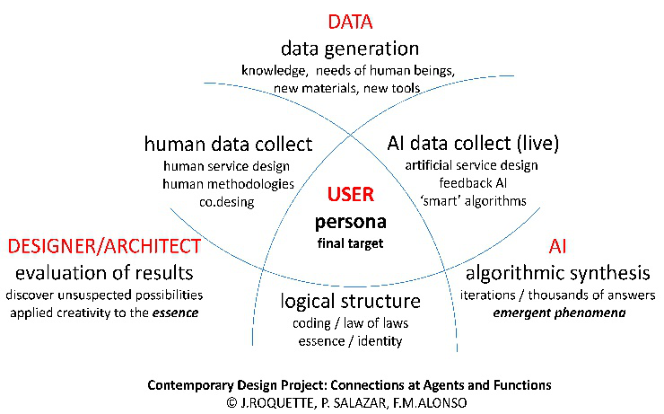
DESIGN AS MATERIALIZED PHENOMENOLOGY Based on the previous analysis, we can propose a way to improve archite- cture, facing it as a materialization of experiences. Architecture could become a ‘manifestation’ of data that reflects daily internal reality, the life of users. Since experience by definition is something personal, the following possi- bilities are proposed for working with it: (a) Data collection and analysis (or interpretation of quantitative/qualitative experiences) This also implies a process of user co-design. b) Algorithmic synthesis (or work with such data and evaluation of results).
In the 1970s, Austrian architect Christopher Alexander put forward his theory of ‘Pattern language’ (Alexander, 1977), with which he identifies the common needs of human beings and seeks to satisfy and support them through architecture. He studies the experiences of users in a building and draws conclusions that make each space respond to the real needs of the people who will use it. This method is based on taking advantage of the com- mon knowledge of previous successful experiences with similar problems, and adapting flexible solutions to the new circumstances that require them in each moment and situation in a collaborative way.
We understand that the work of the architect would be not only the iden- tification of these needs and the proposal of solutions, but also the work of unifying all the different solutions, all the ‘patterns’, so that the whole design has harmony and unity. In other words, a good designer is someone who brings order (open formal law) and also instills meaning (detailed laws). We could say that architects are authors of a ‘law of laws’ for each building. He subordinates some over others, he relates them, taking into account each and every one, to achieve a coherent building as a whole and valuable in each of its parts. We find similar references in the world of legislative power in coun- tries with a democratic, parliamentary or constitutional tradition. The ‘Law of Laws’ in Anglo-Saxon countries makes it possible to define and ensure a framework of stability with few guidelines.
In the field of architecture we could name as an example, within the limita- tion of this, the Seattle library by Rem Koolhaas (2004), in which a program dispersed in different platforms finally acquires a unitary form, through the covering with glazed planes of each of its parts, generating a sculptural buil- ding easily identifiable and with a powerful formal law. The role of the architect appears both as the person who decides which experiences to take into account and how they will condition the project, and as the fundamental agent who thinks about the essence or identity of a project; the idea or law that will order the whole.
Human-Centered Design since the Degree Kickoff 109
Artificial intelligence simplifies all the processes of data collection, data analysis and order, but it will be the architect who will make the decisions about the rules of the game. This first step, the collection and analysis of pos- sibilities, until now occupied a huge amount of project time, whereas, thanks to the development of digital tools, we can reduce all the processes, leaving the architect the most intrinsic part of it, the ability to creatively decide and order. In addition, digital tools offer us the possibility of analyzing a mul- tiplicity of options that we could not even have dreamed of before, making innovative solutions appear, even disconcerting at first, but which can make us rethink the project constraints.
CREATIVITY: LOGICAL STRUCTURES & DATA Mario Carpo (2017) refers to the current digital architecture with a nua- nced focus that describes the use of digital tools as more than new ways of doing, rather a ‘completely new science’ whose ‘methods’ give a new way of thinking. Our goals are logical structures capable of producing thousands of answers. The main law of the ‘whole’ has to rule over the particular laws of the ‘parts’. Humans (human intelligence) define: Genotypes or general laws (intuitions, algorithms), add limits on those genotypes; select data (Subje- ctive/Objective); Obtains results and discriminates the good ones from the disposable ones; find ‘appropriate’ + ‘unexpected’ results that open doors to the creative field. We have to design relationships that connect Data and Users. The core of the project and its definition will be in the generation of these relationships by ‘programming algorithms’, the provision of ‘signifi- cant data’ and the ‘evaluation of results’, which will be more ‘strategies’ than methodologies. The formal identity of the projects would thus include con- sideration of their maintenance, expansion, recycling, and the complete life cycle of physical reality. Digital twins are now a must at projecting. Simula- tion is our best asset. In this way, the creative processes would also be lean: efficient and sustainable.
In this way, artificial intelligence is presented as a great tool that would grant greater fields of action to the creative. It would discover new fields, new unsuspected possibilities to develop results unimaginable until now due to the lack of data processing and comparative analysis of the same in real time. The architect’s job would then be to ‘produce’ algorithms, ‘Select’ what data to measure, ‘obtain’ that data, ‘produce’ and ‘evaluate’ results, and ‘gene- rate’ the architecture from those results. The ‘right’ and ‘unexpected’ is the ‘flagship’ object/product of artificial intelligence. In short: thanks to artificial intelligence, architects and designers will be able to apply their talent to the crucial part: the generation of the architectural system, the rule compiling architectural algorithm. Artificial intelligence is going to highlight the blind areas of knowledge to open new paths to the future of design (Krish, 2010).
CONCLUSION
If creativity could be applied strictly to what is important, teaching in arch- itecture and design schools would have to be applied mainly to promote
Figure 1: Contemporary design project diagram.
creativity supported by knowledge of what is essential, with the help of Generative Design Methods (GDM). This would have at least the follow- ing benefits. GDM can help lead from object to user, improving architectural projects by creating parametric flexible geometry related to data and users. Contemporary digital design may create flexible and open ‘formal laws’ that can be applied according to the changing scenarios posed by today’s users. GDM frees designers from wasting time by losing valuable informa- tion among the techniques, which allows them to concentrate their creativity on what is essential. This enhances the importance of geometry and draw- ing as fundamental disciplines that sustain the solid foundations of design education in the University.
GDM can suggest new unsuspected routes for the development of crea- tivity. Scientists themselves are beginning to recognize that genuinely new things can emerge from the combination of old things, and that the resulting whole of computation can be much more than the sum of its parts. In fact, advanced artificial intelligence has begun to throw up emergent phenomena: unexpected and invisible to humans but for the technical support (Du Sautoy, 2020). The transformative creativity related to complex artificial intelligence does not work ex nihilo; it is a logical alteration of the emerging systems. Although we only can talk about applied artificial intelligence, we could also talk about human creativity applied or supported by artificial intelligence tools. And it is really helpful at the early steps of projects, to foster the desi- gner’s creativity linked to dynamic laws that operate in the depths of reality and parameters that reflect specificities hitherto hidden from the designer’s view. Thus, we offer a new conception for the Contemporary Design Project (Fig. 1).
A futurist, Raymond Kurzweil, who deals with artificial intelligence said: ‘In 2050 a single personal computer may have the same capacity as the whole
Human-Centered Design since the Degree Kickoff 111
population of the world’. Probably he meant the data processing speed, not the manual creation of values (Legény et Al., 2014). As the master of modern architecture in America warned almost one century ago: ‘The machine is the architect’s tool - whether he likes it or not. Unless he masters it, the Machine has mastered him.’ (Wright, 1928). It is time to take off the blindfold and contemplate new hopeful landscapes for design thanks to the AI.
REFERENCES
Capitel, A.(2009). La arquitectura compuesta por partes. Barcelona: GG. Christopher, A. (1977). A pattern language. Oxford: Oxford University Press. Calduch, J. (2009). El declive de la arquitectura moderna: deterioro, obsolescencia, ruina. Palapa, Vol. IV. No. II [09]. July-Dec 2009. pp. 29–43. Carpo, M. (2017). The second digital turn: design beyond intelligence. Cambridge,
MA: The MIT Press. Deniz, B. And Açalya, A. (2017). Simulating Craftwork in Contemporary Architecture, The Journal of Modern Craft. Dorst, K.(2017). Notes on Design. How Creative Practice Works. Amsterdam: BIS. Du Sautoy, M. (2020). Creativity Code: Art and Innovation in the Age of AI.
Harvard: The Bleknap Press. Gramazio, F. and Kohler, M. (2008). Digital Materiality in Architecture. Baden: Lars Müller Publishers. Kaminer, Tahl (2011). Architecture, Crisis and Resuscitation. The Reproduction of
Post-Fordism in Late-Twentieth-Century Architecture. London: Routledge. Krish, S. (2011). A practical generative design method. Computer Aided Design 43 (2011) 88–100. Legény, J; Špaˇcek, R. (2014) Trapped by crisis: the plight of architects in Europe.
Global Journal of Engineering Education. Vol.16, No.1, 2014. Wiete. Peirce, Charles S. (1867). On the natural classification of arguments. Proceedings of the American Academy of Arts and Sciences 7, 261–287. Piñón, Helio (2005). La forma y la mirada. Buenos Aires: Nobuko. Veliz Reyes, A.; el Al. (2019). Negotiated matter: a robotic exploration of craft-
driven innovation, Architectural Science Review. Wright, F.Ll. (Author); Devane, A.; and Gutheim, F.A. (editors) (1975). In the Cause of Architecture: the Architecture and the Machine (1928), Frank Lloyd Wright: essays. New York: Architectural Record.
LISTED IN THE AHFE DIGITAL BOOKSTORE CATALOGUE
Explore the complete digital volume
Human Dynamics and Design for the Development of Contemporary Societies
Read this individual research paper free through the original publisher, or explore the full digital proceedings book.
ISBN 978-1-958651-01-8
Explore this ISBN in the AHFE Bookstore ↗Listed in the July 2026 bookstore catalogue; search by ISBN to confirm current availability · Digital book purchase optional