Na Tian (2024). Ming Dynasty Shipbuilding Technology from the Chronicle of Longjiang Shipyard. In: Human Factors in Design, Engineering, and Computing. AHFE Open Access, vol. 159, pp. 339–348. https://doi.org/10.54941/ahfe1005599
This study analyzes the shipbuilding techniques of gongjiang, the types of ships, and the materials, labor, and management systems used in their production, in order to clarify the institutional factors that influenced the development of shipbuilding technology in the Ming Dynasty in China. Research Perspective: This study examines the shipbuilding technology and management systems of the Ming Dynasty in China from the perspective of traditional Chinese design theory. Research Method: This study uses hermeneutics as the core method, combined with interdisciplinary research. Research Conclusion: "Longjiang Shipyard Records" provides a comprehensive perspective for studying the shipbuilding industry in the Ming Dynasty. Among them, the theoreticalization of shipbuilding technology and the systematization of the shipbuilding industry management system are the internal driving forces that promote the development of shipbuilding technology in the Ming Dynasty in China, and are the most intuitive manifestation of the technological development characteristics of gongjiang in the Ming Dynasty under the core ideas of Zhou Yi and Zhou Li .
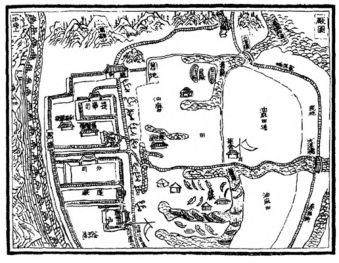
The Longjiang Shipyard in Nanjing, China, was an important official shipyard during the Ming Dynasty, built in the early years of Emperor Hongwu’s reign (approximately the end of the 14th century). It is located near Longjiang Pass in the Gulou District of Nanjing City and is vast in scale, divided into two parts: the southern part is called the front yard and the northern part is called the back yard. The Longjiang Shipyard played an important role in the shipbuilding industry during the Ming Dynasty, especially during Zheng He’s voyages to the Western Seas, where most of Zheng He’s treasure ships were built at the Longjiang Shipyard. These ships were large in scale, well-equipped, and had a strict navigation organization. In the mid-Ming Dynasty, the Longjiang Shipyard began to decline, with a
decrease in the number of gongjiang and the gradual loss of shipbuilding technology. Despite this, the ruins of the Longjiang Shipyard still provide valuable information for studying ancient Chinese shipbuilding technology.
Chronicle of Longjiang Shipyard is an important classic written by Li Zhaoxiang in the Ming Dynasty, completed in the thirty-second year of the Jiajing era (1553). This book meticulously records the history, scale, and shipbuilding conditions of the Nanjing Longjiang Shipyard. The term “Chronicle” refers to “narratives” or “records,” representing a systematic documentation of various aspects of the Nanjing Longjiang Shipyard. Li Zhaoxiang, who once oversaw the Longjiang Shipyard, included numerous materials about the shipyard in his book, which is divided into eight volumes: Training Code, Boat and Canoe, Government Affairs, Establishment, Finance,Reform,Assessment and Literature.
The fundamental form of the traditional Chinese design theory system is the Kaogongology design philosophy centered around the systems of Zhou Yi and Zhou Li. The Zhou Yi system primarily emphasizes the natural concept of Yin and Yang, while the Zhou Li system highlights the artificial concept of the Five Elements, which pertains to social order. These are the most fundamental and essential ideas in Chinese culture, both of which are indispensable and collectively referred to as Yin-Yang and Five Elements philosophy. This paper uses this as the fundamental logic to explore the institutional factors influencing the development of shipbuilding technology in the Chronicle of Longjiang Shipyard, focusing on the theoreticalization of shipbuilding technology and the systematization of the shipbuilding industry management. Of course, there are many other aspects that are not discussed in detail here.
Figure 1: The map of the site of Longjiang Shipyard (Li, 2019).
THEORETICALIZATION OF SHIPBUILDING TECHNOLOGY This chapter will thoroughly discuss the theoretical underpinnings of shipbuilding technology from three perspectives: production quota, equipment quantity, and graphical representation. The main content encompasses two aspects: the types and specifications of ships, and the internal and external structural design of ships.
Ming Dynasty Shipbuilding Technology From the Chronicle of Longjiang Shipyard 341
Vessel Type and Specification According to the Chronicle of Longjiang Shipyard, the scale of shipbuilding during the Ming Dynasty reached the zenith of ancient Chinese shipbuilding history. This was exceedingly rare in traditional Chinese society, where handicraft workshops and material warehouses complementing the shipyards were also fully equipped.Many large-scale ships were constructed under these conditions, and correspondingly, the larger the ship, the higher the demand for skilled gongjiang. Specifically, this book categorizes the ship types built during the Ming Dynasty in China into three major groups and twenty-seven types, including the preparatory large yellow ship, large yellow ship (flat and shallow), small yellow ship, four-hundred-ton warship, two- hundred-ton warship, one-hundred-and-fifty-ton warship, one-hundred-ton warship, three-plank ship (rowing boat), floating bridge ship, four-hundred- ton patrol ship, two-hundred-ton single-stamp patrol ship, two-hundred- ton sand patrol ship, Jiujiang-style sentry ship, Anqing-style sentry ship (Dashengguan sentry ship), light and shallow convenient ship, Jinshuihe fishing boat, Houhu No. 1 floor ship, Houhu No. 2 floor ship, Houhu flat ship, pumping seat ship, fast ship, centipede ship, sea ship, and two- ended ship. These ship types demonstrate the diversity and advancement of shipbuilding technology during the Ming Dynasty. Ship parameters are recorded using the measurement system of the Ming Dynasty in China. In designing ship types, various scales and parameters are determined according to the ship’s functions, including ship length, beam, and depth, among others. Specific details are as follows:
Table 1. Types, specifications, and diagrams of ships. (Li, 2019).
Table available in the original PDF paper.
Ship Diagram
Serial Number
Ship Type Captain (cun)
Ship Depth (cun)
Ship Width (cun)
793 150 62
1 Prepare Dahuang Ship
2 Dahuang Ship 840 144 53
795 150 52
3 Small Dahuang Ship
895 65 60
4 400-ton Warship
(Continued)
342 Tian
Table 1. Continued
Table available in the original PDF paper.
Ship Diagram
Serial Number
Ship Type Captain (cun)
Ship Width (cun)
Ship Depth (cun)
608 126 45
5 200-ton Warship
550 101 36
6 150-ton Warship
492 81 37
7 100-ton Warship
395 84 31.5
8 Three-board Ship
602 105 46
9 Floating-bridge Ship
680 156 52
10 400-ton Patrol Ship
587 120 40
11 200-ton Patrol Ship
610 123 42
12 200-ton Sand Patrol Ship
370 67 27
13 Jiujiang-style Sentinel Ship
341 64 24
14 Anqing-style Sentinel Ship
560 100 34
15 Light and Shallow-draft Boat
(Continued)
Ming Dynasty Shipbuilding Technology From the Chronicle of Longjiang Shipyard 343
Table 1. Continued
Table available in the original PDF paper.
Ship Diagram
Serial Number
Ship Type Captain (cun)
Ship Width (cun)
Ship Depth (cun)
223 40 1.5
16 Jinshuihe Fishing Boat
505 110 206
17 Houhu No.1 Building Boat
428 84 202
18 Houhu No.2 Building Boat
19 Houhu Boat 392 71 203
20 Split Seat Ship 757 156 47
21 Clippers —— —— ——
22 Centipede Boat 800 160 ——
23 Sea Vessel —— —— ——
—— —— ——
24 Two-headed Ship
Ancient Chinese ships were primarily constructed from wood, with the type of wood used differing according to the ship’s design and construction, predominantly including nanmu, fir, and pine. Besides the hull, ships also necessitated decoration and caulking, utilizing other materials like jute, hardware, and pigments. The following provides a brief analysis of the shipbuilding material system, centered on the Chronicle of Longjiang Shipyard regarding the wood requirements and standards for warships. These
344 Tian
three trades account for the largest timber consumption in shipbuilding, encompassing nearly all the wood utilized in the process.
Table 2. Standards for the use of wood materials in different ship types. (Li, 2019).
Decoration Work Department Nanmu (veneer) 13.23000 zhang
Structural Design of Ships The structural design of ships encompasses both the external and internal structural designs. The design of a ship’s structure and dimensions is a crucial determinant of its hull form.
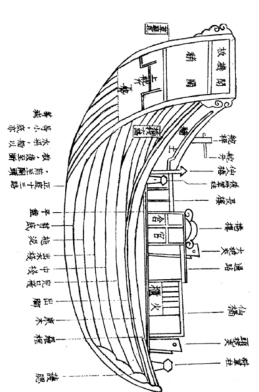
The design of a ship’s external structure encompasses dimensioning its bottom, sides, and upper surface. According to historical records, ship bottoms consist of the main bottom and the side bottoms. The main bottom is the section that keeps the ship afloat on the water surface. The side bottoms, located at the very bottom of the ship’s sides, connect the bottom planks of the ship to the side planks, consisting of two plates joined together. The ship’s sides are primarily constructed from rectangular planks, also referred to as “stack”. The hull comprises various parts including the mud-pulling stack, water-exiting stack, middle stack, finishing stack, and foot-exiting stack, arranged from bottom to top, culminating at the beam near the ship’s side. The primary upper surface of the ship is the deck, which is not a regular rectangular shape but extends from the bow to the stern on both sides. For instance, in a 400-ton warship, the deck features components such as the dare hall, lo frame, flat plate, head plate, tail plate, and lion head, according to Ming Dynasty shipbuilding terminology.
Ming Dynasty Shipbuilding Technology From the Chronicle of Longjiang Shipyard 345
The sizing of the ship’s bottom is derived from its classification. The tallest is composed of 13 wooden boards, with the number dropping by 2 for each lower category. The lowest category has a floor made of 7 boards. The sizing of the ship’s bottom is an odd number, influenced by the traditional Chinese philosophy of Yin and Yang and the Five Elements centered on “Yi”. Odd numbers represent “Yang”, while even numbers are associated with “Yin”. In traditional Chinese thought, water is considered Yin, and to support a ship, it must be balanced by “Yang”. Hence, the ship’s bottom is designed with only odd numbers, ensuring the vessel’s safety as it sails on water.
Table 3. Quantity of wooden boards used at the bottom of different ship types. (Li, 2019).
Table available in the original PDF paper.
Ship Type Number of Main Bottom Planks (pcs) 400-ton warship 13 200-ton warship 11 150-ton warship 9 100-ton warships 7 Three-board boat 7
The internal structure of ships primarily consists of watertight compartments, which partition the ship into various-sized cabins, using bulkheads as the primary support and isolation structure. It is widely acknowledged in the academic community that China was among the earliest nations in the world to utilize watertight compartments, with designs tracing back to the Tang Dynasty. The cross-section of a watertight compartment primarily consists of the bulkhead, base beam, and surface beams beneath the bulkhead. Some ships also feature two side frame plates to bolster their robustness. Watertight compartments serve two functions: firstly, to enhance the ship’s anti-sinking capabilities, and secondly, to maintain the hull’s lateral strength. Significant differences exist in the approaches taken by Chinese and Western ship structures to enhance lateral pressure resistance. The lateral strength of ancient Chinese ships primarily depended on extensive bulkheads and surface beams beneath the deck, whereas ancient Western ships relied on numerous ribs to fortify the hull’s interior. According to the internal structure of ships during the Ming Dynasty, the “crossbeam” was the central component. In the Ming Dynasty’s ship internal structure, the “crossbeam” served as the primary component. Crossbeams were constructed to enhance the hull’s lateral strength and came in many varieties. For warships, crossbeams typically comprised the following sections: the stem, the dragon mouth, the first masthead, the second masthead, the third masthead, the masthead’s port, the masthead’s face, the sturdy foot, the primary storage, the secondary storage, the tertiary storage, the superstructure, the main storage compartment, the secondary storage compartment, the tertiary storage compartment, the waterproof barrier, the galley, the foot brace, the bracing beam, the cantilever beam,
346 Tian
the tiered beam, the curved beam, the straight beam, and the compartment beam.
Figure 2: Schematic diagram of hull structure (Li, 2019).
SYETEMATIZATION OF SHIPBUILDING MANAGEMENT Shipbuilding in China originated during the Qin and Han dynasties, with early explorations into standardized management. Following significant developments during the Sui and Tang, and Song and Yuan dynasties, a comprehensive standardized shipbuilding management system was established during the Ming dynasty.
Highly Refined Organizational Structure In ancient China, gongjiang constituted the primary technical force in creation. The Ming Dynasty featured a distinct gongjiang system: gongjiang were categorized as rotating or resident, distinguished by their service models. The primary distinction between the two concerned their service duration and conditions. Rotating gongjiang served a three-year cycle, including a three-month stint in the capital (1386), which was later adjusted to a one- to-five-year rotation based on their craft type (1393). Resident gongjiang, however, were required to serve for a significantly longer period, ten days a month.
According to the Chronicle of Longjiang Shipyard, the shipyard boasted a highly refined organizational structure. It employed key officials including those in charge and supervisory roles, alongside fifth-grade officials from the Ministry of Works, such as the deputy minister, chief, supervisor, and assistant commander. The shipyard employed nearly 100 lower-level leaders, including compartment leaders and workshop heads. Shipbuilders and gongjiang hailed from various provinces including Zhejiang, Jiangxi, Huguang, Fujian, and Jiangsu, with both resident and rotating gongjiang. The meticulous division of labor involved four compartments, with each compartment subdivided
Ming Dynasty Shipbuilding Technology From the Chronicle of Longjiang Shipyard 347
into ten households, each led by a head who oversaw ten households. One compartment housed shipwood, shuttle, oar, and rope gongjiang; the second housed shipwood, iron, and cable gongjiang; the third was dedicated to hull gongjiang; and the fourth to palm and canopy gongjiang. Additionally, there were officials in charge of the imperial palace, the imperial horses, spice, watchmen, bridge workers, footmen, shipbuilders, tenants, and upper-level leaders.
Meticulous Division of Gongjiang The immense task of shipbuilding necessitates the involvement of numerous gongjiang, organized into specialized roles. The division of gongjiang’s roles is a fundamental prerequisite, as specialized collaboration markedly boosts the industrial economy’s production efficiency. The variety of tasks required in shipbuilding demands a high level of specialization, with each trade dedicated to distinct phases of the shipbuilding process, ultimately enhancing the efficiency of the shipbuilding endeavor. There are over thirty distinct shipbuilding trades, augmented by miscellaneous assistants in actual operations. Variations in the ship types under construction result in the employment of differing numbers and types of gongjiang. For instance, the “Longjiang Shipyard Records” details the principal trades required for the construction of five major ship types produced by the Longjiang Shipyard.
The Yellow Boat, designated for royal use with significant protocol and hierarchy, demands meticulous attention during its construction, employing the most diverse workforce, totaling 36 categories including miscellaneous roles. The War Cruiser, tasked with military security including river and sea defense, employs about 21 categories of workers. The Lake Boat, used for official daily operations, employs about 10 categories. It should be noted that the employment categories for the aforementioned ship types are derived from comprehensive statistical principles based on broad ship category classifications. Even within a specific ship category, there may be various models, each requiring different types of workers.
Table 4. Meticulous division of Gongjiang. (Li, 2019).
Table available in the original PDF paper.
Ship Type Job Types Huang ship Woodworking, decoration, carving, hull construction, ironwork, upper ironwork, canopy construction, ropework, upper ropework, cablework, bamboo work, painting, five-color painting, makeup carving, gold plating, flag making, drum making, shell work, tassel making, spinning, dyeing, tailoring, tin decoration, double-line work, washing work, chair threading, barrel work, copper work, sounding copper work, casting work, as well as boat wood sawyers, decoration sawyers, spring ash, tearing hemp, pulling diamond, picking up boards and other miscellaneous workers. Battle patrol ship
ship woodwork, decoration work, carving and inlay work, cabin work, iron work, upper iron work, canopy work, rope work, cable, calligraphy, painting, five-ink painting, flag making, drum making, shell craft, tassel craft, spinning craft, dyeing, tin decoration, and double-thread craft. Additionally, there are boat wood sawyers, decoration sawyers, and other miscellaneous workers. Hu boat Boat woodwork, decoration work, cabin work, iron work, canopy work, rope work, paint work, five ink work, boat wood sawyers, decoration sawyers, and other miscellaneous workers.
348 Tian
CONCLUSION
This paper primarily explores the institutional factors influencing the development of the Ming Dynasty’s shipbuilding industry through the lens of traditional Chinese design theory, without delving into the specifics of ship engineering construction. This focus is evident in two key aspects. First, the theoretical development of shipbuilding technology. Historically, China has emphasized empiricism in technological advancement, with core techniques predominantly held by gongjiang who passed them on through personal instruction, thereby constraining the ancient Chinese shipbuilding industry’s growth and innovation. The “Longjiang Shipyard Records” marked a shift from an empirical to a theoretical framework in shipbuilding technology. Second, the establishment of a systematic shipbuilding management. The implementation of specialized division of labor and management systems provided vital support and assurance for the Ming Dynasty’s shipbuilding industry.
REFERENCES
Jie Z. (2019). Analysis on the Social Motive Force of Shipbuilding Technology in the Ming Dynasty. Shanxi University. Linlin L. Zhiming X. (2020). Official Records of Nanjing in Ming Dynasty. JIANGSU
LOCAL CHRONICLES Volume 06, pp. 89–93. Ping Z. Xiongsheng Y. (2018). Internal Control on the Chinese Traditional Culture.
JOURNAL OF MANAGEMENT WORLD Volume 34, No.2. pp. 161–175. Qichang Z. (2022). Culture of Gongjiang. People’s Publishing House, Beijing. Qiu K. (2022). Historical Value and International Impacts of Li Zhaoxiang’s Chronicle of Longjiang Shipyard. NATIONAL MARITIME RESEARCH Volume 01. pp. 79–94. Zhaoxiang L. (2019). Chronicle of Longjiang Shipyard. Nanjing Publishing House,
Nanjing.
LISTED IN THE AHFE DIGITAL BOOKSTORE CATALOGUE
Explore the complete digital volume
Human Factors in Design, Engineering, and Computing
Read this individual research paper free through the original publisher, or explore the full digital proceedings book.
ISBN 978-1-964867-35-9
Explore this ISBN in the AHFE Bookstore ↗Listed in the July 2026 bookstore catalogue; search by ISBN to confirm current availability · Digital book purchase optional