Kenneth Nemire (2024). Evaluation of the Risky Behaviors of AV Rideshare Vehicles in San Francisco. In: Human Factors in Design, Engineering, and Computing. AHFE Open Access, vol. 159, pp. 2185–2191. https://doi.org/10.54941/ahfe1005786
Background. Autonomous vehicle (AV) technology has been touted as a means to reduce traffic accidents because computers always pay attention to road conditions and are never intoxicated, which are responsible for most traffic accidents. However, research has been mixed regarding whether AVs actually are involved in fewer collisions than vehicles driven by human operators. Much research has shown that most collisions involving AVs have been collisions in which they have been rear-ended by other vehicles. While this research has suggested that such rear-end collisions are caused by improper maneuvers by the AV or short following distances by the human driver, there has been no research identifying the types of AV behaviors that may result in rear-end collisions. Properly identifying such behaviors would be useful for determining what measures may be most effective in mitigating risks of collisions. Methods. To help identify AV behaviors that may contribute to rear-end collisions, we examined incidents involving AV rideshare vehicles in San Francisco, California in 2023. Descriptions of these incidents were provided in an online database that had been gathered from multiple media sources. Most of these media incident reports were not of collisions, but of incidents that could cause collisions, and therefore could be considered near-miss or potential incidents. Research has shown that evaluating near-miss incidents can provide valuable information for how to reduce the risk of injury incidents. There were 343 separate and verified incidents described in the media. The latter included 18 collision incidents. Results. The results indicated that most of the media-reported incidents (65%) involved AVs that were stopped or stalled in intersections or travel lanes when they had the right of way or exhibited other unexpected or erratic behavior such as sudden lane changes. Such unexpected behavior can result in emergency responses from human drivers, including emergency braking that may result in rear-end collisions. The media reports also included descriptions of a substantial number of incidents (21%) in which the AV committed the types of errors performed by human drivers such as illegal left turns, failing to yield to pedestrians, blocking crosswalks, and running red lights. AV manufacturers claim that AVs will reduce accidents by eliminating the type of human behavior that causes accidents such as inattention and willingly violating traffic laws. These incidents show that AV manufacturers have failed to prevent these human-type behaviors. Discussion. The results are discussed according to basic human factors principles that must be followed to design AVs that may have the best chance of success in truly reducing AV traffic accidents.
Autonomous vehicle (AV) technology has been touted as a means to reduce traffic accidents because computers always pay attention to road conditions and are never intoxicated, which are responsible for most traffic accidents (Chougule et al., 2024; Novat et al., 2022; Petrovi’c, Mijailovi’c and Peši’c, 2020). However, research has been mixed regarding whether AVs actually are involved in fewer collisions than vehicles driven by human operators (Goodall, 2021; Novat et al., 2022; Teoh and Kidd, 2017; Torok, 2023). Much research has shown that most collisions involving AVs have been collisions in which they have been rear-ended by other vehicles (Boggs, Wali and Khattak, 2020; Chougule, 2024; Goodall, 2021; Wang, 2020). While this research has suggested that such rear-end collisions are caused by improper maneuvers by the AV or short following distances by the human driver (Lee et al., 2024; Petrovic et al., 2020), there has been little research identifying the types of AV behaviors that may result in rear-end collisions. Properly identifying such behaviors would be useful for determining what measures may be most effective in mitigating risks of collisions such as by improving the accuracy and reliability of the geo-positioning information provided to the AV sensors, modifying the AVs’ heavy braking interventions, and training AVs to recognize unusual conditions such as construction zones and emergency vehicles.
While currently, most crashes involving AVs occur at low speeds and result in minimal damage, there are efforts to create AV commercial trucks, which are much larger vehicles and will eventually travel at freeway speeds (Bishop, 2023). It is imperative that AV technology becomes much more accurate and reliable before we unleash it on the driving public.
METHODS
To help identify AV behaviors that may contribute to rear-end collisions, we examined incidents involving AV vehicles in San Francisco, California in 2023. These incident reports were provided in an online database that had been gathered from multiple media sources and that included only incidents in which the AV was operating autonomously and was considered at fault for the incident (https://www.safestreetrebel.com/conesf/). Most of these media incident reports were not of collisions, but of incidents that could cause collisions, and therefore could be considered near-miss or potential collision incidents. Evaluating near-miss incidents can provide valuable information for how to reduce the risk of collisions and injury incidents (Dingus et al., 2006; Larsson, Dekker and Tingvall, 2010; Park, Kim and Kim, 2023; Sanders, 2015).
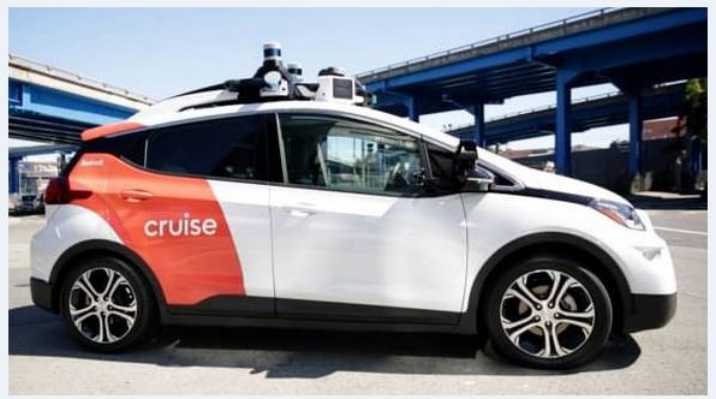
Our analyses included incidents involving Cruise (Figure 1; https://www.getcruise.com/) and Waymo (https://waymo.com/waymo-one- san-francisco/) driverless taxis because they constituted all of the incidents in the San Francisco database, and a Cruise AV had been involved in a serious pedestrian collision in San Francisco in October 2023 (Cano, 2024; Evers and Bosa, 2023; Howland and Krishner, 2023). There were 343 separate and verified incidents described in the media and in San Francisco Fire
Evaluation of the Risky Behaviors of AV Rideshare Vehicles in San Francisco 2187
Department “Unusual Occurrences” reports. The San Francisco database included 18 collision incidents.
Figure 1: Exemplar Cruise AV in San Francisco (Adapted from Evers and Bosa, 2023).
RESULTS
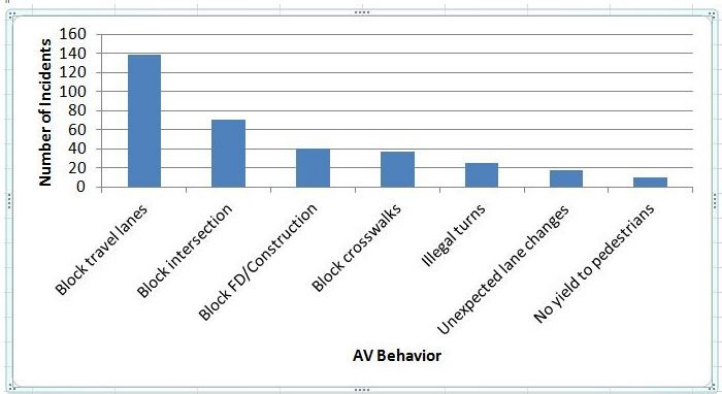
The results shown in Figure 2 indicated that most of the media-reported incidents (71%) involved AVs that were stopped or stalled in intersections or travel lanes or crosswalks when they had the right of way. Another 12% if incidents involved interference with fire department emergency tasks and construction sites. And 16% of incidents involved other unexpected or erratic behavior such as sudden lane changes, failure to yield to pedestrians, illegal turns, sudden braking and running red lights. Such unexpected behavior can result in emergency responses from human drivers, including emergency braking that may result in rear-end collisions. Note that the media reports included descriptions of a substantial number of incidents (16%) in which the AV committed the types of errors performed by human drivers such as illegal left turns, failing to yield to pedestrians, and running red lights. AV manufacturers claim that AVs will reduce accidents by eliminating the type of human behavior that causes accidents such as inattention and willingly violating traffic laws. These incidents show that AV manufacturers have failed to prevent these human-type behaviors.
2188 Nemire
Figure 2: Number of incident in each category of hazardous AV behavior.
DISCUSSION
The most numerous risky behaviors (83%) exhibited by AVs were stopping and stalling in intersections, travel lanes, crosswalks and fire department emergency scenes. This behavior in road traffic can certainly result in rear-end and other types of collisions like broadside collisions. Stalling and stopping appear to be a result of at least several issues including communication errors, failure to recognize and adapt to unusual conditions, and programming that dictates what actions the AV will take if they do not know what to do such as stopping (Bindman, 2023).
Communication Errors. AV stalling and stopping can be due to communication errors and failures (Neelakandan and Cano, 2023; Templeton, 2022). For example, if Cruise cloud servers fail to communicate with an AV, the AV is programmed to stop. Clearly this behavior can cause rear-end collisions. The media reports also indicated that with some stalls, a human is required to travel to the AV and correct the problem or drive it away. Such a solution can leave the stalled AV in traffic for a longer time and increase the chances for a collision. Another fail-safe behavior besides stopping in traffic is required that does not rely on cloud communication and removes the AV from traffic. One option is to provide localized control to the AV when communications have failed, and allow the vehicle to complete its current task before safely parking or before returning to base.
Unusual Conditions. AVs may have difficulty detecting unusual road hazards such as emergency scenes or construction sites, which can cause the vehicle to stall or crash. Current AV technology needs to improve to allow more robust object and scene recognition in chaotic urban environments. Consequently, more sophisticated object and scene recognition algorithms need to be developed that can accurately and reliably identify objects, people and vehicles in complex scenes.
Evaluation of the Risky Behaviors of AV Rideshare Vehicles in San Francisco 2189
Programming. Another category of risky AV behaviors that was associated with AV incidents in San Francisco was erratic behavior (16%) like illegal turns, failure to yield to pedestrians, sudden braking, and running red lights. These are all behaviors often exhibited by human drivers as well. Fortunately, this category of risky behaviors represents a small percentage of incidents in our study, which suggests that AV companies have made great improvements in this area. However, this category still represents a substantial percentage of incidents. One of the purported benefits of AVs are that they can reduce traffic accidents because they do not suffer from human problems such as inattention and intoxication, which are responsible for most traffic accidents (Chougule et al., 2024; Novat et al., 2022; Petrovic et al., 2020).
AVs do not Eliminate Human-Type Driving Errors. Mueller et al., 2020 identified five categories of human driver-related causal factors of crashes: “(1) sensing/perceiving (i.e., not recognizing hazards); “(2) predicting (i.e., misjudging behavior of other vehicles); “(3) planning/deciding (i.e., poor decision-making behind traffic law adherence and defensive driving);
“(4) execution/performance (i.e., inappropriate vehicle control); and “(5) incapacitation (i.e., alcohol-impaired or otherwise incapacitated driver).”
The AV industry claims that AVs will not suffer from such problems. However, as indicated above, one of the reasons AVs can stall and stop in traffic and in unusual situations is because they are confused by the visual scene (“sensing/perceiving), fail to recognize road hazards, and do not know how to respond. So they stop. More sophisticated object and scene recognition algorithms need to be developed that can accurately and reliably identify objects, people and vehicles in complex scenes.
AVs also appear to have difficulty predicting the behavior of other vehicles as well as pedestrians, with the latter resulting risky behaviors such as failure to yield to pedestrians, and in some cases running over their dogs (an object perception problem). One way to do this is to provide alternate communication systems. For example, Shetty et al. (2021) discuss how information gaps created by occlusions, traffic violations and behavior prediction uncertainty can increase the chances of collisions and that alternate communication strategies can help resolve the issues by using infrastructure-to-vehicle (I2V) and vehicle-to-vehicle (V2V) communication. For example, I2V communication could complete information gaps by helping AVs communicate with other when occlusions or traffic violations occur at intersections.
Poor decision-making (“planning/deciding) and execution and performance problems also are evident in these AV risky behaviors such as making sudden lane changes and executing sudden stopping.
While presumably AVs cannot be incapacitated by drug or alcohol consumption, they can be incapacitated in other ways, such as the communication problems described above.
Identifying the specific risky AV behaviors should be useful for determining what measures may be most effective in mitigating risks of collisions such as by improving the accuracy and reliability of the geo-positioning information
2190 Nemire
provided to the AV sensors, modifying the AVs’ heavy braking interventions, and training AVs to recognize unusual conditions such as construction zones and emergency vehicles.
ACKNOWLEDGMENT
The author thanks Daniel Nemire for assistance with data collection. Address correspondence to Kenneth Nemire, knemire@HFEconsulting.com.
REFERENCES
Bindman, A. (2023). “‘Incompetent’ driverless cars are wreaking havoc on San Francisco”. SF Gate, 26 June. Available at: https://www.sfgate.com/tech/articl e/cruise-waymo-driverless-cars-san-francisco-18132953.php. (Accessed: 28 June 2024). Bishop, R. (April 26, 2023). AV in the trenches: What will it really take to get automated trucks on the road? Forbes, 26 April. Available at https://www.forbes.com/sites/richardbishop1/2023/04/20/av-in-the-trenches -what-will-it-really-take-to-get-automated-trucks-on-the-road/. (Accessed: 28 June 2024). Boggs, A. M., Wali, B. and Khattak, A. J. (2020). Exploratory analysis of
automated vehicle crashes in California: A text analytics & hierarchical Bayesian heterogeneity-based approach. Accident Analysis & Prevention, 135, art. no. 105354. Cano, R. (2024). One crash set off a new era for self-driving cars in S. F.
Here’s a complete look at what happened. San Francisco Chronicle, 8 February. Available at https://www.sfchronicle.com/projects/2024/cruise-sf-collision-timeli ne/. (Accessed: 28 June 2024). Chougule, A., Chamola, V., Sam, A., Yu, F. R. and Sikdar, B. (2024). A comprehensive review on limitations of autonomous driving and its impact on accidents and collisions. IEEE Open Journal of Vehicular Technology, 5, pp. 142–161. Dingus, T. A., Neale, V. L., Klauer, S. G., Petersen, A. D. and Carroll, R. J. (2006). The
development of a naturalistic data collection system to perform critical incident analysis: An investigation of safety and fatigue issues in long-haul trucking. Accident Analysis & Prevention, 38, pp. 1127–1136. Evers, A. and Bosa, D. (2023). Why San Francisco’s robotaxi rollout has been such a mess. CNBC, 4 November. Available at https://www.cnbc.com/2023/11/04/why- san-franciscos-robotaxi-rollout-has-been-such-a-mess.html. (Accessed: 28 June 2024). Goodall, N. (2021). Potential crash rate benchmarks for automated vehicles.
Transportation Research Record, 2675(10), pp. 31–40. Goodall, N. (2021). Comparison of automated vehicle struck-from-behind crash rates with national rates using naturalistic data. Accident Analysis and Prevention, 154, art. no. 106056. Howland, L. and Krishner, T. (2023). GM’s Cruise recalling all 950 robotaxis
after SF pedestrian dragging incident. ABC7 News, 8 November. Available at https://abc7news.com/cruise-autonomous-cars-gm-recall-sf-robotaxi-softwar e-update/14026840/. (Accessed: 28 June 2024). Larsson, P., Dekker, S. W. A. and Tingvall, C. (2010). The need for a systems theory approach to road safety. Safety Science, 48, pp. 1167–1174.
Evaluation of the Risky Behaviors of AV Rideshare Vehicles in San Francisco 2191
Lee, C. K. H., Leung, E. K. H., Tse, Y. K. and Tsao, Y.-C. (2024). Investigating collision patterns to support autonomous driving safety. Enterprise Information Systems, 18(2). Mueller, A. S., Cicchino, J. B. and Zuby, D. S. (2020). What humanlike errors
do autonomous vehicles need to avoid to maximize safety? Journal of Safety Research, 75, pp. 310–318. Neelakandan, L. and Cano, R. (2023). Cruise blames Outside Lands for driverless car traffic fiasco in San Francisco. San Francisco Chronicle, 13 August. Available at https://www.sfchronicle.com/bayarea/article/robotaxi-backup-18293208.php. (Accessed: 28 June 2024). Novat, N., Kidando, E., Kutela, B. and Kitali, A. E. (2022). A comparative study
of collision types between automated and conventional vehicles using Bayesian probabilistic inferences. Journal of Safety Research, 84, pp. 251–260. Park, J.-I., Kim, S. and Kim, J.-K. (2023). Exploring spatial associations between near-miss and police-reported crashes: The Heinrich’s law in traffic safety. Transportation Research Interdisciplinary Perspectives 19, art. no. 100830. Petrovi’c, D., Mijailovi’c, R., and Peši’c, D. (Jan. 2020). Traffic accidents with
autonomous vehicles: Type of collisions, manoeuvres and errors of conventional vehicles’ drivers. Transportation Research Procedia, 45, pp. 161–168. Sanders, R. L. (2015). Perceived traffic risk for cyclists: The impact of near miss and collision experiences. Accident Analysis and Prevention, 75, pp. 26–34. Shetty, A., Yu, M., Kurzhanskiy, A., Grembek, O. Tavafoghi, H. and Varaiya, P.
(2021). Safety challenges for autonomous vehicles in the absence of connectivity. Transportation Research Part C: Emerging Technologies, 128, p. 103133. Templeton, B. (2022). Cruise robotaxis keep stalling on SF Streets, How upset should we be? Forbes, 8 July. Available at https://www.forbes.com/sites/bradtem pleton/2022/07/08/cruise-robotaxis-keep-stalling-on-sf-streets-how-upset-shoul d-we-be. (Accessed: 28 June 2024). Teoh, E. R. and Kidd, D. G. (2017). Rage against the machine? Google’s self-driving
car versus human drivers. Journal of Safety Research, 63, pp. 57–60. Török, A. (2023). Do automated vehicles reduce the risk of crashes–Dream or reality?
IEEE Transactions on Intelligent Transportation, 24(1), pp. 718–727. Wang, L. (2020). How many crashes can connected vehicle and automated vehicle technologies prevent: A meta-analysis. Accident Analysis and Prevention, 136, art. no. 105299.
LISTED IN THE AHFE DIGITAL BOOKSTORE CATALOGUE
Explore the complete digital volume
Human Factors in Design, Engineering, and Computing
Read this individual research paper free through the original publisher, or explore the full digital proceedings book.
ISBN 978-1-964867-35-9
Explore this ISBN in the AHFE Bookstore ↗Listed in the July 2026 bookstore catalogue; search by ISBN to confirm current availability · Digital book purchase optional