Jiayan Yu, Weina Qu, Yan Ge (2026). Humanization or intellectualization? How autonomous vehicles’ mental capacities impact human’s driving behaviors. In: Advances in Human Factors of Transportation. AHFE Open Access, vol. 224, pp. 389–399. https://doi.org/10.54941/ahfe1007867
Compared to human-driver vehicles (HVs), people are less tolerant for autonomous vehicles (AVs) with abnormal behaviors and more inclined to conduct dangerous driving behaviors. Previous studies have shown that the anthropomorphic design of AVs influences drivers’ attitudes and behaviors, but no studies have explored the underlying mechanism. Moral sense may play an important role in human’s attitude toward different anthropomorphic AVs. By attributing different mental capacities to AVs, this study investigated the mediation effect of moral disengagement and subsequent behavior when facing different anthropomorphic AVs. An intellectualized AV with agency capacities and a humanized AV with experience capacities were set as a two level of mental capacities, an within-subject variable. 347 drivers imagined driving on the road alongside different AVs exhibiting abnormal driving behaviors and validly responded to the scales measuring moral disengagement, annoyance, anger, and following behaviors. The results showed that when facing AV with experience capacities, drivers reported less moral disengagement, negative emotions, and negative driving behaviors, compared to AV with agency capacities. Moreover, moral disengagement mediated the relationship between AVs’ mental capacities and all driving behaviors; while the mediating effects of negative emotions were significant in part of the models. Overall, this study revealed that compared with intellectualized AV, human driver showed more moral sense and safe behaviors when interacting with humanized AV, providing new insights for AV designers and manufacturers.
With the rapid development of autonomous driving technology, the number of autonomous vehicles (AVs) on roads will increase. In the near future, mixed traffic will become common, with roadways shared by conventional human-driver vehicles (HVs) and AVs. Hence, interactions with AVs will be inevitable for human drivers, and such new trends are likely to bring new challenges to road safety.
The blurred moral sense and negative driving behaviors of human drivers when they interact with AVs may be the problems. In the context of mixed Received January 28, 2026; Revised April 12, 2026; Accepted April 26, 2026; Available online July 20, 2026
traffic, human drivers may conduct dangerous driving behaviors towards AVs such as merging lanes at close range, showing a loss of moral sense, and they even exhibit moral disengagement, making excuses for such behaviors, such as “AVs are expected to have additional safety features”, which has aroused relevant manufacturers’ concerns (Paschalidis & Chen, 2022). Comparisons of human’s responses towards AVs and HVs provided stronger evidence for the existence of such “bullying”. If the victims bullied by other vehicles are AVs instead of HVs, people are more accepting and less likely to perceive risk, negative affect, and immoral judgement (Liu et al., 2022). When human interacts with the vehicles, if AVs and HVs exhibit the same abnormal driving behaviors or cause accidents, human drivers tend to exhibit more negative responses towards AVs, such as more blame, anger and distrust (Li et al., 2021; Liu & Du, 2022; Young & Monroe, 2019); the intention to bully (Liu et al., 2020); and aggressive driving behaviors (Lee et al., 2021), which may also be related to the weakened moral sense and pose threats to traffic safety. For instance, if traffic slows because of an AV constantly changing lanes, rather than an HV does, human drivers are more likely to honk, overtake in a dangerous way, or conduct other negative driving behaviors.
To alleviate aforementioned problems, studying the influencing factors and underlying mechanisms may be a breakthrough point. User factors are beyond our control, but design factors are changeable for manufacturers and hold great application value. How to intervene drivers’ moral sense and driving behaviors by modifying AV design? To answer this, this study focused on the anthropomorphic design of AVs, which has been demonstrated to affect drivers’ responses.
Anthropomorphism is “the attribution of human characteristics or traits to nonhuman agents” (Epley et al., 2007, p. 865). Anthropomorphic design of AVs has been found to elicit positive responses from drivers (e.g., Waytz et al., 2014; Young & Monroe, 2019) but has also been considered a threat (Yogeeswaran et al., 2016; Złotowski et al., 2017). The effects of anthropomorphism in different dimensions may explain such contradictions. According to mind perception concept (Gray et al., 2007), people judge object to have a mind and anthropomorphize it as if it has mental capacity. Agency and experience capacity are its two dimensions, involving the capacities of planning and acting and the capacities of sensing and feeling, respectively. Applying it to the context of AVs, high-agency AV or high-experience AV can trigger different mind perceptions from human drivers, i.e., product intellectualized or humanized anthropomorphic profiles in human drivers’ eyes, and cause their different responses; therefore, the question how human drivers react to intellectualized and humanized AVs arises.
Furthermore, regarding the mechanisms, past studies have suggested a potential mediating effect of negative emotions (Lee et al., 2021), but the correlation between AVs’ mental capacities and anger is controversial (Li et al., 2021; Nachmann et al., 2020; Young & Monroe, 2019). Hence, more evidence needs to be explored, and there may exist other mediators. Drivers’ dangerous driving behaviors towards AVs may be related to their restructured moral cognitions, such as regarding their behaviors as an incentive for manufacturers to improve AVs. Such process is moral disengagement,
Humanization or Intellectualization? 391 which refers to individuals’ restruction of cognitions of inhumane conduct into judging the conduct to be benign or worthy, denial of their personal agency in situations that cause harm, downplaying the injurious effects, or attributing blame to the victims (Bandura, 2002). This concept has been applied in the AV context (Paschalidis & Chen, 2022) and has shown a better ability to predict aggressive driving than anger (Cleary et al., 2016; Swann et al., 2017). Hence, the present study proposes it as another possible mediator.
The current study aimed to explore the impacts of AVs’ mental capacities (agency and experience) on human drivers’ behaviors under various driving scenarios, trying to answer whether intellectualized or humanized AVs are more likely to induce positive driving behaviors from human drivers, and also explored the underlying psychological mechanism. Moral disengagement and negative emotions (anger, annoyance) were proposed as possible mediators. The following hypotheses are proposed: H1. Compared to high-experience AV, if high-agency AV drives abnormally, more moral disengagement, annoyance, anger and negative driving behaviors and fewer positive driving behaviors will be induced.
H2. Moral disengagement, annoyance, and anger mediate the effect of AVs’ mental capacities on driving behaviors.
H3. The mediating effect of moral disengagement is stronger than that of annoyance and anger.
METHOD
Participant Drivers with more than one-year driving experience were recruited online. After excluding the participants who failed the conscientiousness questions (e.g., “This question is to check whether you are responding carefully. Please choose the first option”), 347 valid questionnaires were obtained. The final sample included 215 males and 132 females from China. Their ages ranged from 21 to 57 (M = 31.29, SD = 5.59), and their driving years ranged from 1 to 23 (M = 6.51, SD = 3.02).
Study Design The within-subject independent variable was AVs’ mental capacities (two levels: agency and experience). The dependent variables were moral disengagement, annoyance, anger, and driving behaviors. The mediating effects of moral disengagement, annoyance, and anger between AVs’ mental capacities and driving behaviors were tested. Moral disengagement was measured under two mental capacities, independent of driving scenarios; while annoyance, anger, and driving behaviors triggered by AV behaviors were measured under each scenario.
Materials
Manipulation of AVs’ mental capacities: To manipulate the mental capacities of AVs, descriptive texts of two driving robots (Nachmann et al., 2020) were
presented to the participants. Agency is the capacity for planning and acting, so the high-agency driving robot named “ZX-21” has outstanding agency capacities, such as memory, moral judgement, gesture recognition, and self- control. Experience is the capacity to sense and feel, so the high-experience driving robot named “Q” has emotional and social capabilities such as feeling pride, fear, happiness, pain and hunger. To check the manipulation, two multiple-choice questions about ZX-21’s and Q’s features were set to test participants’ understandings. For instance, the option “ZX-21 will feel embarrassed when it fails to complete the task” cannot be checked. Those who answered wrongly were not able to continue. At the end of the questionnaire, another question was set, asking which robot could feel emotions, to double check the effectiveness of the manipulation.
Scenario development and measurements of emotions and driving behaviors: Referring to the multidimensional driving style inventory (MDSI; Taubman-Ben-Ari et al., 2004) and the self-driving car version of the Propensity for Angry Driving Scale (Self-Driving Car PADS; Lee et al., 2021), this study focused on drivers’ six types of driving behaviors when they were faced with AVs on the road, including negative driving behaviors (angry, high- velocity, risky) and positive driving behaviors (careful, patient, prosocial). Three scenarios were designed for each of the six driving behaviors, forming a total of 18 scenarios. For each scenario, questions assessing corresponding driving behaviors, annoyance, and anger were presented in turn, referring to Lee et al. (2021). Taking a scenario examining angry driving behavior as an example, the participants were told that ZX-21 (or Q) constantly brakes and accelerates in front of them, and were asked to rate their angry driving tendency (e.g. honk horn, flash headlights…), anger and annoyance on a 5-point Likert scale (1 = not at all, 5 = very much). Final scores were the average scores in three corresponding scenarios.
Measurement of moral disengagement: The moral disengagement scale adapted to the context of AVs by Paschalidis and Chen (2022) was translated into a Chinese version. It has 21 items and is scored using a 6-point Likert scale (1 = strongly disagree, 6 = strongly agree). Final scores were the average scores of all the items. The participants’ moral disengagement when facing high-agency and high-experience driving robot were measured, and the scale showed good reliability (high-agency: α = 0.96, high-experience: α = 0.92).
Procedure The questionnaires were distributed online. The participants were informed that all the information would be used only for scientific research and their participations were voluntary. At the beginning, the participants were asked to imagine driving a car themselves on the road and encountering two types of AVs driven by a high-agency robot (ZX-21) or a high-experience robot (Q). Test describing the two robots were presented to manipulate AVs’ mental capacities, and the participants were asked to determine which claims about robots’ functions were true after each text to check the manipulation. Only all the answers were correct were the participants allowed to continue, filling in the moral disengagement scales for two types of AVs. Then the participants
Humanization or Intellectualization? 393 would be confronted with 18 driving scenarios which investigated six driving behaviors towards AVs, and evaluated their annoyance, anger, and driving behavior tendency. The sequence of scenarios was counterbalanced. At the end of the questionnaire, the effectiveness of manipulation was double checked, and the demographic information were collected.
Statistical Analysis Descriptive statistics and t tests comparing the effects of agency and experience capacities were performed using SPSS 23. MEMORE 2.1, a macro program in SPSS for two-condition within-subject design (Montoya & Hayes, 2017), was used to examine the mediators between AVs’ mental capacities and driving behaviors.
RESULTS
Descriptive Statistics and Impacts of AVs’ Mental Capacities The descriptive statistics results of human drivers’ moral disengagement, annoyance, anger, and driving behaviors in the presence of AVs with different mental capacities are shown in Table 1. All the variables were normally distributed.
To test the impacts of AVs’ mental capacities on the aforementioned variables, t tests were performed. The results showed that different mind perceptions caused by the high-agency AV and the high-experience AV led to significant differences (see Table 1) in human drivers’ moral disengagement, and their annoyance, anger, and driving behaviors when they were faced with abnormally driving AVs, supporting H1. The high-agency AV caused significantly greater moral disengagement, annoyance, and anger of human drivers than the high-experience AV (ps ≤ .002). Regarding different driving behaviors, human drivers exhibited more positive driving behaviors (ps < .001) and less negative driving behaviors (ps ≤ .025) towards the high- experience AV than the high-agency AV.
Table 1: The results of descriptive statistics [M (SD)] and t tests (N = 347).
Table available in the original PDF paper.
Variable Scenario AVs’ Mental Capacities t p Agency Experience
Mediator Models of Driving Behaviors To explore how AVs’ mental capacities impact driving behaviors, the mediating roles of moral disengagement, annoyance, and anger were examined. Model 1 in MEMORE 2.1 was implemented with 5000 bootstrap samples and a 95% bias-corrected bootstrap confidence level. Y = Yagency − Yexperience. Table 2 displays the results of parallel multiple mediator models, supporting H2.
Table 2: Parallel multiple mediator models: moral disengagement, annoyance, and anger in the prediction of driving behaviors from AVs’ mental capacities (N = 347).
Table available in the original PDF paper.
Scenario Path Effect SE 95% CI Angry driving X → moral disengagement → Y 0.08 0.02 [0.039, 0.137] X → annoyance → Y 0.10 0.03 [0.045, 0.159]
X → anger → Y 0.28 0.05 [0.200, 0.381] X → Y (total effect c) 0.38 0.07 [0.247, 0.512] X → Y (indirect effect c’) −.08 0.04 [−.158, 0.004]
High−velocity driving X → moral disengagement → Y 0.06 0.03 [0.016, 0.121] X → annoyance → Y 0.15 0.04 [0.089, 0.242] X → anger → Y 0.09 0.04 [0.027, 0.175]
X → Y (total effect c) 0.26 0.06 [0.149, 0.373] X → Y (indirect effect c’) −0.04 0.04 [−0.128, 0.042] Risky driving X → moral disengagement → Y 0.08 0.03 [0.024, 0.147]
X → annoyance → Y 0.07 0.04 [0.002, 0.143] X → anger → Y 0.18 0.05 [0.092, 0.291] X → Y (total effect c) 0.47 0.06 [0.339, 0.593]
X → Y (indirect effect c’) 0.15 0.05 [0.043, 0.250] Careful driving X → moral disengagement → Y −0.06 0.03 [−0.119, −0.008] X → annoyance → Y −0.04 0.04 [−0.120, 0.030]
(Continued)
Table 2: Continued.
Table available in the original PDF paper.
Scenario Path Effect SE 95% CI X → anger → Y −0.02 0.04 [−0.097, 0.052] X → Y (total effect c) −0.10 0.05 [−0.191, −0.013]
X → Y (indirect effect c’) 0.02 0.05 [−0.074, 0.115] Patient driving X → moral disengagement → Y −0.08 0.04 [−0.163, −0.017] X → annoyance → Y −0.10 0.03 [−0.169, −0.037]
X → anger → Y −0.12 0.04 [−0.206, −0.066] X → Y (total effect c) −0.35 0.06 [−0.470, −0.236] X → Y (indirect effect c’) −0.04 0.05 [−0.134, 0.047]
Prosocial driving X → moral disengagement → Y −0.10 0.03 [−0.160. −0.051] X → annoyance → Y −0.08 0.03 [−0.153, −0.036] X → anger → Y −0.01 0.02 [−0.042, 0.027]
X → Y (total effect c) −0.30 0.05 [−0.399, −0.207] X → Y (indirect effect c’) −0.11 0.04 [−0.198, −0.024]
Notes: X = AVs’ mental capacities, Y = particular driving behaviors. Paths with significant effects are shown in bold.
The total effects in all the models were significant. When moral disengagement, annoyance, and anger were incorporated, main findings about the indirect effects were (1) moral disengagement, annoyance, and anger fully mediated the influence of AVs’ mental capacities on angry, high-velocity, and patient driving behaviors; (2) moral disengagement was the only mediator in the model of careful driving behaviors; (3) moral disengagement, annoyance, and anger partially mediated the influence of AVs’ mental capacities on risk driving behaviors; and (4) moral disengagement and annoyance were partial mediators between AVs’ mental capacities and prosocial driving behaviors. In summary, moral disengagement was the most stable mediator.
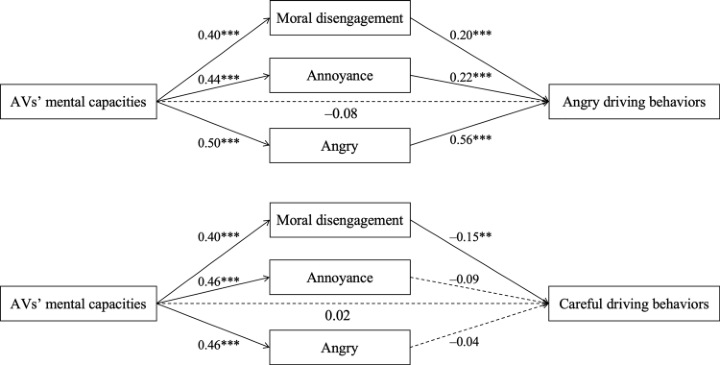
When distinguishing between positive and negative driving behaviors, key findings emerged. Incorporating the mediators, AVs’ mental capacities positively predicted the mediators, and the mediators positively predicted negative driving behaviors and negatively predicted positive driving behaviors, suggesting that moral disengagement, annoyance, and anger could explain why the high-agency AV induced more negative driving behaviors and fewer positive driving behaviors than the high-experience AV. Figure 1 shows two examples of mediator models.
Furthermore, pairwise comparisons of specific indirect effects in each model were examined. Regarding angry driving behaviors, the indirect effect through anger was significantly stronger than those through moral disengagement (estimate = −0.20, SE = 0.05, 95% CI [−0.307, −0.112]) and annoyance (estimate = −0.19, SE = 0.05, 95% CI [−0.301. −0.087]). For prosocial driving behaviors, the indirect effect through anger was significantly weaker than those through moral disengagement (estimate = −0.09, SE = 0.04, 95% CI [−0.167, −0.029]) and annoyance (estimate = −0.07, SE = 0.04, 95% CI [−0.171, −0.012]). In addition, for high-velocity driving behaviors,
the indirect effect through moral disengagement was marginally smaller than that through annoyance (estimate = −0.09, SE = 0.05, 95% CI [−0.197, 0]). To summarize, the mediating effect of anger was susceptible to driving scenarios, greater than those of the other two mediators on angry driving behaviors, but was not even significant on careful and prosocial driving behaviors.
Figure 1: Mediator models for negative (top) and positive (bottom) driving behaviors.
DISCUSSION
Based on the mind perception concept, the present study investigated the impacts of AVs’ mental capacities on human drivers’ moral disengagement, annoyance, anger, and driving behaviors under different driving scenarios and further tested the underlying mechanisms.
First, AVs’ mental capacities were found to affect driving behaviors. Compared with high-experience AVs, high-agency AVs elicited more negative driving behaviors and fewer positive driving behaviors. This suggests that AVs perceived as more humanized may be more conducive to road safety than the intellectualized profile. One possible explanation for the fact that high-agency AVs aroused more negative driving behaviors is that anthropomorphized robots with strong agency may evoke a sense of threat when they outperform humans in tasks (Yogeeswaran et al., 2016). Although some previous studies reported no differences in aggressive driving tendencies across AVs’ mental capacity conditions (Lee et al., 2021; Nachmann et al., 2020), discrepancies may arise from differences in how mental capacities were conceptualized and operationalized across studies. Importantly, the present study extends prior work by examining not only negative but also positive driving behaviors.
Regarding the underlying mechanisms, moral disengagement has the mediating effect in all the models, indicating that it plays a more stable role than negative emotions in explaining how AVs’ different mental capacities
Humanization or Intellectualization? 397 shape other drivers’ behaviors, partially supporting H3. Previous studies on the influencing factors of moral disengagement in driving contexts mainly focused on human drivers’ traits, such as personality and driving style (Paschalidis & Chen, 2022), overlooking the AV design factors. The present finding that AVs with high experience capacities induced lower levels of moral disengagement than those with high agency capacities enriched the relevant research. The mind perception framework provides a possible explanation: agency is linked to moral agency, whereas experience is linked to moral patiency (Gray et al., 2007). Moreover, agency is often perceived as closely tied to automation level (Frischknecht, 2021), which may lead drivers to expect additional safety features from AVs and thus facilitate moral disengagement when negative outcomes occur. For the relationships between moral disengagement and driving behaviors, the results of this study revealed that moral disengagement positively predicted negative driving behaviors but negatively predicted positive driving behaviors, consistent with previous findings (Paschalidis & Chen, 2022).
Compared with moral disengagement, negative emotions did not act as mediators in each model, and their mediating effects may be affected by the driving scenario. Past studies on the relationship between mental capacities and negative emotions have yielded mixed results. Some studies found that experience capacities or mentalistic descriptions reduced irritation and anger (Nachmann et al., 2020; Young & Monroe, 2019), consistent with the present study, while others reported greater anger if AVs lacked agency or perceptual-cognitive abilities (Lee et al., 2021; Li et al., 2021). These mixed results may be explained by the U-shaped or nonlinear relationship between AVs’ mental capacities and drivers’ anger (Li et al., 2021), which resembled the uncanny valley (Mori et al., 2012). Mixed results may also derive from drivers’ ambivalent attitudes that robots are frenemies. As the level of robot mind got higher, such attitudes would be stimulated (Dang & Liu, 2021). The results that negative emotions predicted various driving behaviors were in line with past findings (Ge et al., 2017; Huo et al., 2023; Kovácsová et al., 2016).
Admittedly, this study has some limitations. First, the within-subject design might have led to fatigue effects. Second, the reliance on questionnaire-based scenario descriptions limits ecological validity, as self-reported responses may not fully reflect real-world driving behavior. Future research should consider using driving simulators or more immersive methods. Third, the experimental material did not mention whether there were human drivers or passengers in the AVs. Given that automation levels may affect moral judgments and emotions (Bruno et al., 2023), future research should take this factor into account.
CONCLUSIONS AND IMPLICATIONS This study revealed that when drivers interacted with AVs, their perceptions that AVs have experience capacities induced lower levels of moral disengagement, negative emotions, and negative driving behaviors than their perceptions that AVs have agency capacities. Hence, a humanized profile of AVs tends to improve road safety. Moreover, moral disengagement, annoyance, and
anger mediated the relationship between AVs’ mental capacities and driving behaviors, and moral disengagement was the most stable mediator.
This study underscores the importance for AV designers and manufacturers to consider anthropomorphic features and to develop more experience capacities for AVs. These recommendations may be conducive to reducing human drivers’ moral disengagement, thereby curbing negative driving behaviors towards AVs and ultimately improving road safety.
ACKNOWLEDGMENT
This study was supported by the National Natural Science Foundation of China (Grant Nos. 32071066, 32271132, 32471132).
REFERENCES
Bandura, A. (2002). Selective moral disengagement in the exercise of moral agency. Journal of Moral Education, 31(2), 101–119. https://doi.org/10.1080/ 0305724022014322 Bruno, G., Spoto, A., Lotto, L., Cellini, N., Cutini, S., & Sarlo, M. (2023). Framing
self-sacrifice in the investigation of moral judgment and moral emotions in human and autonomous driving dilemmas. Motivation and Emotion, 47, 781–794. https://doi.org/10.1007/s11031-023-10024-3 Cleary, J., Lennon, A.J., & Swann, A. (2016). Should we be aiming to engage drivers more with others on-road? Driving moral disengagement and self-reported driving aggression. Proceedings of the 26th Canadian Multidisciplinary Road Safety Conference. Canadian Association of Road Safety Professionals, Canada, pp. 1–16. Dang, J., & Liu, L. (2021). Robots are friends as well as foes: Ambivalent
attitudes toward mindful and mindless AI robots in the United States and China. Computers in Human Behavior, 115, 106612. https://doi.org/10.1016/j. chb.2020.106612 Epley, N., Waytz, A., & Cacioppo, J. T. (2007). On seeing human: A three-factor theory of anthropomorphism. Psychological Review, 114(4), 864–886. https:// doi.org/10.1037/0033-295X.114.4.864 Frischknecht, R. (2021). A social cognition perspective on autonomous technology.
Computers in Human Behavior, 122, 106815. https://doi.org/10.1016/j.chb.2021. 106815 Ge, Y., Zhang, Q., Zhao, W., Zhang, K., & Qu, W. (2017). Effects of trait anger, driving anger, and driving experience on dangerous driving behavior: A moderated mediation analysis. Aggressive Behavior, 43(6), 544–552. https://doi.org/10.1002/ ab.21712 Gray, H. M., Gray, K., & Wegner, D. M. (2007). Dimensions of mind perception.
Science, 315(5812), 619. https://doi.org/10.1126/science.1134475 Huo, D., Ma, J., & Chang, R. (2023). The development and application of the drivers’ attitudes of right-of-way questionnaire (DARQ). Transportation Research Part F-Traffic Psychology and Behaviour, 94, 67–82. https://doi.org/10.1016/j. trf.2023.01.020 Kovácsová, N., Lajunen, T.J., & Rošková, E. (2016). Aggression on the road:
Relationships between dysfunctional impulsivity, forgiveness, negative emotions, and aggressive driving. Transportation Research Part F-traffic Psychology and Behaviour, 42, 286–298. http://dx.doi.org/10.1016/j.trf.2016.02.010
Humanization or Intellectualization? 399 Lee, Y., Momen, A., & LaFreniere, J. (2021). Attributions of social interactions:
Driving among self-driving vs. conventional vehicles. Technology in Society, 66, 101631. https://doi.org/10.1016/j.techsoc.2021.101631 Li, T., Wang, L., Liu, J., Yuan, J., & Liu, P. (2021). Sharing the roads: Robot drivers (vs. human drivers) might provoke greater driving anger when they perform identical annoying driving behaviors. International Journal of Human-Computer Interaction, 38, 309–323. https://doi.org/10.1080/10447318.2021.1938392 Liu, P., & Du, Y. (2022). Blame attribution asymmetry in human-automation
cooperation. Risk analysis, 42(8), 1769–1783. https://doi.org/10.1111/risa.13674 Liu, P., Du, Y., Wang, L., & Da Young, J. (2020). Ready to bully automated vehicles on public roads? Accident Analysis and Prevention, 137, 105457. https://doi. org/10.1016/j.aap.2020.105457 Liu, P., Zhai, S., & Li, T. (2022). Is it OK to bully automated cars? Accident Analysis
and Prevention, 173, 106714. https://doi.org/10.1016/j.aap.2022.106714 Montoya, A. K., & Hayes, A. F. (2017). Two-condition within-participant statistical mediation analysis: A path-analytic framework. Psychological methods, 22(1), 6–27. https://doi.org/10.1037/met0000086 Mori, M., Macdorman, K.F., & Kageki, N. (2012). The Uncanny Valley [From
the Field]. IEEE Robotics & Automation Magazine, 19(2), 98–100. https://doi. org/10.1109/MRA.2012.2192811 Nachmann, K., Pillot, B., Moore, P., & Wiese, E. (2020). Driving with robots: Mind perception and propensity for aggressive driving. Proceedings of the Human Factors and Ergonomics Society Annual Meeting, 64(1), 1965–1970. https://doi. org/10.1177/1071181320641473 Paschalidis, E., & Chen, H. (2022). Moral disengagement mechanisms in interactions
of human drivers with autonomous vehicles: Validation of a new scale and relevance with personality, driving style and attitudes. Transportation Research Part F-Traffic Psychology and Behaviour, 90, 196–219. https://doi.org/10.1016/j. trf.2022.08.015 Swann, A., Lennon, A.J., & Cleary, J. (2017). Development and preliminary validation of a scale of driving moral disengagement as a tool in the exploration of driving aggression. Transportation Research Part F-traffic Psychology and Behaviour, 46, 124–136. https://doi.org/10.1016/j.trf.2017.01.011 Taubman-Ben-Ari, O., Mikulincer, M., & Gillath, O. (2004). The multidimensional
driving style inventory—scale construct and validation. Accident Analysis and Prevention, 36(3), 323–332. https://doi.org/10.1016/S0001-4575(03)00010-1 Waytz, A., Heafner, J., & Epley, N. (2014). The mind in the machine: Anthropomorphism increases trust in an autonomous vehicle. Journal of Experimental Social Psychology, 52, 113–117. https://doi.org/10.1016/j.jesp.2014.01.005 Yogeeswaran, K., Złotowski, J., Livingstone, M., Bartneck, C., Sumioka, H., &
Ishiguro, H. (2016). The interactive effects of robot anthropomorphism and robot ability on perceived threat and support for robotics research. Journal of Human- Robot Interaction, 5(2), 29–47. https://doi.org/10.5898/JHRI.5.2.Yogeeswaran Young, A.D., & Monroe, A.E. (2019). Autonomous morals: Inferences of mind predict acceptance of AI behavior in sacrificial moral dilemmas. Journal of Experimental Social Psychology, 85, 103870. https://doi.org/10.1016/j.jesp.2019.103870 Złotowski, J., Yogeeswaran, K., & Bartneck, C. (2017). Can we control it?
Autonomous robots threaten human identity, uniqueness, safety, and resources. International Journal of Human-Computer Studies, 100, 48–54. http://dx.doi. org/10.1016/j.ijhcs.2016.12.008
LISTED IN THE AHFE DIGITAL BOOKSTORE CATALOGUE
Explore the complete digital volume
Advances in Human Factors of Transportation
Read this individual research paper free through the original publisher, or explore the full digital proceedings book.
ISBN 979-8-950676-00-0
Explore this ISBN in the AHFE Bookstore ↗Listed in the July 2026 bookstore catalogue; search by ISBN to confirm current availability · Digital book purchase optional