Kimberly Perkins (2024). Enhancing Flight Deck Resilience and Optimizing Risk Mitigation: A Sociotechnical Approach. In: Human Factors in Design, Engineering, and Computing. AHFE Open Access, vol. 159, pp. 1968–1976. https://doi.org/10.54941/ahfe1005764
The flight deck operates as a sociotechnical system where the interplay between human operators and technical components is essential for safety. Socio-processing capacity encompasses the cognitive, communicative, and collaborative abilities of pilots to manage information, coordinate with crew members, and make informed decisions. Effective aviation safety models depend on seamless collaboration, where pilots can openly admit mistakes, seek help, and provide feedback. However, research indicates that pilots may shift from clear communication to silence when the flight deck environment lacks psychological safety, undermining the Threat and Error Management (TEM) model's efficacy. This paper argues that enhancing pilots' socio-processing capacity through advanced interpersonal skills training and fostering a culture of psychological safety can bolster the resilience of the flight deck. Such improvements not only enhance risk mitigation but also lead to reduced risk and increased safety.
The flight deck is inherently a sociotechnical system (Carayon, 2006; Carayon et al., 2015; Perkins et al., 2023), where the interaction and interdependency between human operators and technical components are paramount to ensuring safety. The “socio” aspect of this system encompasses human-to-human interactions, while the “technical” aspect pertains to the aircraft and avionics within the aircraft (Bowker et al., 1997). These two components can be conceptualized as distinct yet interrelated subsystems. This paper focuses on enhancing aviation safety through micro- advancements, specifically by increasing the resilience of the socio-subsystem.
The socio-processing capacity of the socio-subsystem encompasses the cognitive, communicative, and collaborative abilities of pilots to manage information, coordinate with crew members, and effectively manage risk. To enhance this capacity, pilots receive Crew Resource Management (CRM) training, which provides interpersonal skills and tools essential for effective teamwork and coordination (Federal Aviation Administration, 2004). Additionally, pilots are trained in the Threat and Error Management (TEM)
Enhancing Flight Deck Resilience and Optimizing Risk Mitigation 1969
model, which is designed to identify, manage, and mitigate risks arising from both external threats and internal errors (Federal Aviation Administration, 2006). This TEM safety concept has gained global acceptance and is frequently integrated into CRM training programs (SKYbrary, n.d).
Extensive research has demonstrated significant improvements in aviation safety through the implementation of Crew Resource Management (CRM) training and the integration of human factors training (Helmreich and Foushee, 1993; Salas et al., 2006; O’Connor et al., 2008). These initiatives have expanded the socio-processing capacity by reducing the power distance between Captains and First Officers, thereby empowering those with relatively less power to speak up (Noort, Reader and Gillespie, 2021). The socio-subsystem has been the focal point of numerous safety initiatives, such as Safety Management Systems (SMS), which emphasize the importance of safety culture (International Civil Aviation Organization, 2012). This paper argues that the next iteration of such socio-subsystem-focused initiatives must prioritize emotional intelligence and psychological safety.
Threat and Error Management: A Model Dependent on Psychological Safety to Elicit Safety Voice The Threat and Error Management (TEM) model relies on seamless collaboration, where pilots openly admit mistakes, seek help, and provide feedback or dissenting views to effectively manage threats and errors. Academic data reveal that pilots often shift from utilizing safety voice (clear and unambiguous communication) to muted safety voice (expressing concerns in a hushed voice or framing them as questions), or to safety silence (withholding safety information altogether) (Rankin, 2007; Bienefeld and Grote, 2012; Noort, Reader and Gillespie, 2019; Noort, Reader and Gillespie, 2021) in environments where the flight deck tone lacks psychological safety (Perkins et al., 2022). One study (Perkins et al., 2022) found that a majority of First Officers (66.4%) and Captains reflecting on their time as First Officers (67.2%) hesitated to speak up about safety issues between one to ten times a year. Additionally, over half of this group reported feeling silenced after raising safety concerns. These findings underscore a significant trend of discomfort and silencing due to interpersonal dynamics, necessitating further examination of how the flight deck microculture influences these behaviors.
Academic research has identified an important connection between psychological safety (Edmondson, 1999), safety voice (Edmondson, 2019), and the effectiveness of aviation safety models, such as Threat and Error Management (TEM) and Crew Resource Management (CRM) (Perkins et al., 2022). A study (Perkins, Ghosh, and Hall, 2024) revealed that when psychological safety was lacking—specifically when one pilot perceived a poor relationship with another pilot—there was over a 50% reduction in the pilot’s willingness to admit mistakes or seek assistance. Additionally, there was more than a 60% decrease in the feeling of being a valued team member. These findings highlight the critical role of psychological safety in enhancing communication, collaboration, and overall safety within aviation operations.
1970 Perkins
While CRM/TEM enhances the socio-processing capacity of pilots, their effectiveness is constrained by the assumption that psychological safety is consistently present. This assumption creates a critical gap in their overall efficacy.
Optimizing Risk Mitigation: Integrating Emotional Intelligence for Socio-Subsystem Resilience To reduce the transition from safety voice to safety silence, it is crucial to enhance the adaptability of the socio-subsystem, fostering stronger team dynamics through improved interpersonal skills. Resilience in sociotechnical systems, as discussed by Ruth and Goessling-Reisemann (2019), involves not only the capacity to absorb disturbances and recover from disruptions but also the ability to adapt to new challenges effectively. Conceptualizing resilience as “graceful extensibility when surprise challenges boundaries” (Woods, 2015) emphasizes that resilience is the opposite of brittleness and involves emerging stronger through adaptation. In the context of aviation safety, fostering resilience means creating an environment where interpersonal conflicts are managed effectively, and team dynamics are strengthened, ensuring that team members can adapt to challenges and disruptions smoothly. This adaptive capability reduces the likelihood of transitioning from safety voice to safety silence, as team members feel psychologically safe to voice concerns, knowing their input will be handled constructively, ultimately leading to improved safety outcomes.
Consider a scenario where, despite CRM training, two pilots experience interpersonal conflict, perceiving their discord as a mere personality clash. Such relational discord can significantly diminish psychological safety, thereby reducing the efficacy of the Threat and Error Management (TEM) model and increasing risk as pilots transition from safety voice to safety silence. To enhance the resilience of the socio-subsystem within the flight deck, allowing it to adapt gracefully to interpersonal differences, pilots must be trained in emotional intelligence concepts such as self-awareness and self-regulation. These skills are crucial for fostering the psychological safety necessary to maintain the efficacy of the TEM model and effectively manage risk. By strengthening the resilience of the socio-subsystem, we can optimize risk mitigation leading to increased safety.
Research has identified a critical gap in CRM training, where pilots often do not recall receiving training on interpersonal skills and conflict resolution (Perkins et al., 2022). This gap coupled with the understanding that psychological safety is pivotal in fostering a microculture conducive to safety voice activation—a fundamental component of both Crew Resource Management (CRM) and Threat and Error Management (TEM) (Carmeli and Gittell, 2009; Leroy et al., 2012; Bienefeld and Grote, 2014; Rosenbaum, 2019) yet is not explicitly addressed in CRM/TEM literature (Federal Aviation Administration, 2004; International Civil Aviation Organization, 2021), is a threat to the efficacy of safety models and systems. The resilience of the sociotechnical system relies heavily on psychological safety, which requires emotional intelligence to navigate interpersonal skills effectively.
Enhancing Flight Deck Resilience and Optimizing Risk Mitigation 1971
ENHANCING SOCIO-PROCESSING CAPACITY IN SOCIOTECHNICAL SYSTEMS Leadership Perspectives on Integrating Psychological Safety Training for Pilots
This paper is based on a larger research project conducted for a doctoral dissertation (Perkins, 2024). This paper uses a small subset of data collected from the author’s dissertation, specifically focusing on pilots’ endorsement of the incorporation of psychological safety into future pilot training.
Data Collection The data for this paper came from a study that involved training 1,600 captains, flight managers, instructors, and other management pilots from a major United States-based airline. The participants, designated as Pilot Safety Leaders (PSLs) due to their advanced and senior positions, underwent a two- day, lecture-based intervention. To evaluate the cognitive impact and affective endorsement of integrating the concept of psychological safety into future pilot training, quantitative data were collected through three surveys, and qualitative insights were gathered from semi-structured interviews.
Results
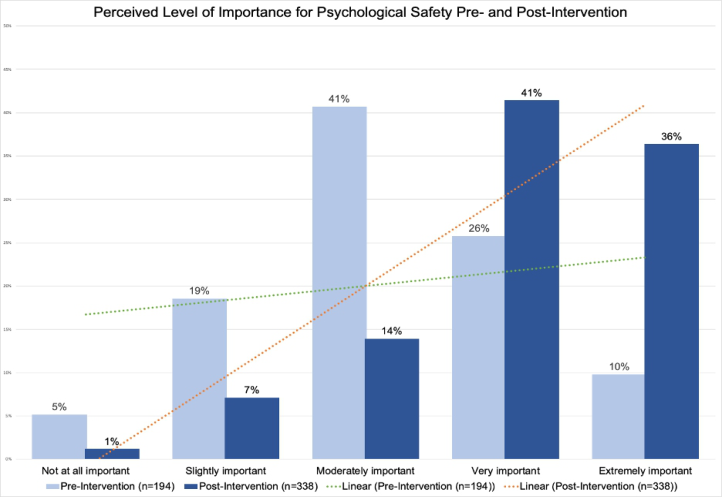
An inquiry was conducted among pilot safety leaders to assess the significance they attribute to the concept of psychological safety in the context of enhancing flight safety. Pre-intervention data displayed a relatively balanced range of responses across the importance scale, suggesting that before training, PSLs had diverse views on the significance of psychological safety. The green linear trend line, representing pre-intervention responses, indicates an even distribution, with no strong consensus on the criticality of psychological safety. This dispersion may reflect a lack of comprehensive understanding or awareness of how psychological safety directly impacts team dynamics, communication, and overall safety performance.
In stark contrast, the post-intervention data, represented by the orange trend line, demonstrates a clear and significant shift toward recognizing psychological safety as a paramount factor. The notable escalation in perceived importance post-training signifies that the intervention was successful in conveying the vital role psychological safety plays in effective Crew Resource Management (CRM) and Threat and Error Management (TEM).
The substantial increase in endorsements for the concept of “psychological safety” among Pilot Safety Leaders (PSLs) post-training, as indicated by the 58% rise in those selecting “very important” and the remarkable 260% increase in those selecting “extremely important,” is statistically significant (V = 886, p<.001, n = 192). This finding illustrates a profound shift in the understanding and prioritization of psychological safety within the aviation context. Figure 1 visually represents all Likert-scaled responses before and after the intervention, including sample sizes and trends.
1972 Perkins
Figure 1: Perceived level of importance for psychological safety pre- and post- intervention (Perkins, 2024).
The implications of this finding are multifaceted. The marked increase in the perceived importance of psychological safety among PSLs post-training highlights a critical gap in current training programs and emphasizes the need for a more integrated approach to safety training. It also demonstrates strong support for the concept from experienced pilots. By prioritizing psychological safety, aviation organizations can enhance the socio-processing capacity of their teams, leading to more effective risk management. Additionally, this finding advocates for a paradigm shift in training practices, where psychological safety is not merely an implicit expectation but a fundamental component of aviation safety strategy.
Optimizing Risk Mitigation
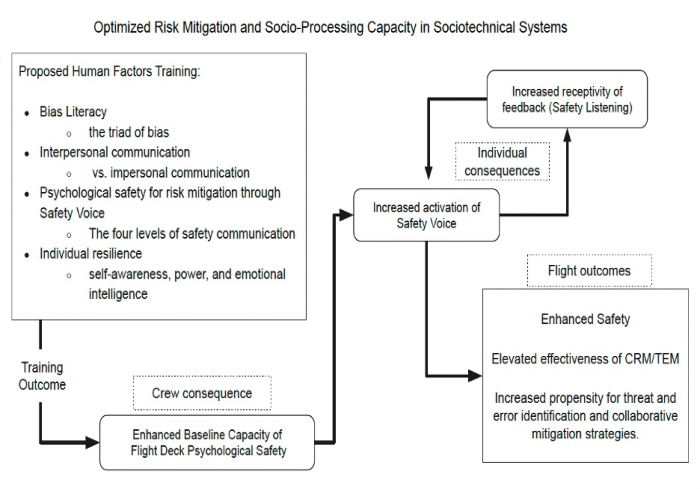
Figure 2 presents a model for optimizing risk mitigation strategies by making the socio-subsystem more resilient through advanced human performance pilot training. The model emanates from the theoretical framework established above and from Perkins’ (2024) dissertation. Training individual pilots on both the advanced interpersonal skills competencies, such as emotional intelligence and psychological safety, acknowledges and amplifies the foundational capability for fostering psychological safety in the flight deck. In this light, it enhances the socio-processing capacity of the flight deck subsystem. Such an enhanced foundational state facilitates members within the sociotechnical system to engage in safety voice more effectively and to be more receptive to feedback. This enables a dynamic voice-feedback loop through which pilots can continuously learn from each other. It leads
Enhancing Flight Deck Resilience and Optimizing Risk Mitigation 1973
to enhanced CRM/TEM practices, which in turn translates to a higher likelihood of identifying and collaboratively mitigating potential threats and errors.
Figure 2: The optimized risk mitigation model for sociotechnical systems (Perkins, 2024).
Mandating Emotional Intelligence and Psychological Safety in Pilot Training: A Systems-Frame Intervention Strategy Interventions focusing on modifying an individual’s thoughts, feelings, and behaviors are categorized as individual-frame (i-frame) interventions; in contrast, systems-frame (s-frame) interventions emphasize policy and institutional societal norms (Chater and Loewenstein, 2022). This paper advocates for adopting an s-frame intervention strategy, recommending that aviation regulators mandate the incorporation of emotional intelligence concepts and methods for building psychological safety in future human performance training programs.
Research indicates that pilots generally score lower on emotional intelligence traits compared to the general public (Dugger, et al., 2022), yet these traits are critically linked to safety outcomes (Srivastava, 2013; Bates, 2023). The aviation industry cannot rely on individual pilots to independently reach a self-motivated, enlightened state and altruistically integrate emotional intelligence into their safety repertoire. Instead, it is imperative that these concepts and the observable behaviors demonstrating competency be systematically mandated into pilot training programs. This approach ensures a standardized and effective enhancement of psychological safety and emotional intelligence training across the industry globally.
1974 Perkins
CONCLUSION
Psychological safety is indispensable in the aviation industry, profoundly influencing the activation of safety voice—a critical element for the effective implementation of Crew Resource Management (CRM) and Threat and Error Management (TEM). Despite its significance, this concept remains conspicuously absent from current professional aviation training curricula. The prevailing safety models within the industry anticipate pilots to vocalize safety concerns; however, empirical research reveals that without the foundation of psychological safety, pilots are prone to self-silencing, thereby compromising the efficacy of these established frameworks.
To truly optimize risk management, it is imperative to augment these models by integrating comprehensive training on the diverse components of emotional intelligence to arm pilots with the essential tools to cultivate psychological safety within the microculture of the flight deck. Enhancing the socio-processing capacity of the socio-subsystem fortifies the entire sociotechnical system, endowing it with the resilience to not only withstand potential conflicts or adversities but to transcend and evolve into a state of greater strength.
This transformative process is pivotal for enhancing flight deck resilience and refining risk mitigation strategies. Through targeted micro- improvements within the socio-subsystem, we can establish a robust safety culture and attain higher levels of safety. These endeavors lay the foundation for a future where aviation safety is progressively improved through refined team dynamics, optimizing human performance.
ACKNOWLEDGEMENT
The author acknowledges that this research was funded as part of a larger grant to the University of Washington, supporting a doctoral program focused on aviation safety. This funding was made possible by the generous support of three U.S.-based airlines and an aircraft manufacturer.
REFERENCES
Bates, S. G. (2023) Emotional Intelligence and Safety Culture in Business Aviation.
ProQuest Dissertations & Theses. Bienefeld, N. and Grote, G. (2014) ‘Speaking up in ad hoc multiteam systems: Individual-level effects of psychological safety, status, and leadership within and across teams’, European Journal of Work and Organizational Psychology, 23(6), pp. 930–945. Bowker, G., Star, S. L., Gasser, L. and Turner, W. (1997) Social science, technical
systems, and cooperative work: Beyond the great divide. Psychology Press. Carayon, P. (2006) ‘Human factors of complex sociotechnical systems’, Applied Ergonomics, 37(4), pp. 525–535. Carayon, P., Hancock, P., Leveson, N., Noy, I., Sznelwar, L. and van Hootegem,
G. (2015) ‘Advancing a sociotechnical systems approach to workplace safety - developing the conceptual framework’, Ergonomics, 58(4), pp. 548–564.
Enhancing Flight Deck Resilience and Optimizing Risk Mitigation 1975
Carmeli, A. and Gittell, J. H. (2009) ‘High-quality relationships, psychological safety, and learning from failures in work organizations’, Journal of Organizational Behavior, 30(6), pp. 709–729. Dugger, Z., Petrides, K. V., Carnegie, N. and McCrory, B. (2022) ‘Trait emotional
intelligence in American pilots’, Scientific Reports. Edmondson, A. (1999) ‘Psychological Safety and Learning Behavior in Work Teams’, Administrative Science Quarterly, 44(2), pp. 350–383. Edmondson, A. (2019) ‘The Role of Psychological Safety’, Leader to Leader, 92,
pp. 13–19. Federal Aviation Administration. (2004) Crew Resource Management Training.
Advisory Circular 120-51E, AFS-210. Federal Aviation Administration. (2006) Line Operations Safety Audits. Advisory Circular 120–90. Helmreich, R. L. and Foushee, H. C. (1993) ‘Why crew resource management?
Empirical and theoretical bases of human factors training in aviation’, in Weiner, E., Kanki, B. and Helmreich, R. (eds.) Cockpit Resource Management. San Diego, CA: Academic Press, pp. 3–45. International Civil Aviation Organization (2021) Manual on Human Performance (HP) for Regulators. Retrieved June 2023, from OPS-Section/Documents: https://www.icao.int/safety/OPS/OPS-Section/Documents/Advance- unedited. Doc.10151.alltext.en.pdf International Civil Aviation Organization (2012) Safety Management Manual
(SMM). Leroy, H., Dierynck, B., Anseel, F., Simons, T., Halbesleben, J. R., McCaughey, D.
and Sels, L. (2012) ‘Behavioral integrity for safety, priority of safety, psychological safety, and patient safety: A team-level study’, Journal of Applied Psychology, 97(6), pp. 1273–1281. Noort, M. C., Reader, T. W. and Gillespie, A. (2019) ‘Speaking up to prevent harm: A systemic review of the safety voice literature’, Safety Science, 117, pp. 375–387. Noort, M. C., Reader, T. W. and Gillespie, A. (2021) ‘Safety voice and safety listening during aviation accidents: Cockpit voice recordings reveal that speaking-up to power is not enough’, Safety Science, 139. https://doi.org/10.1016/j.ssci.2021.105260 O’Connor, P., Campbell, J., Newon, J., Melton, J., Salas, E. and Wilson, K. A.
(2008) ‘Crew resource management training effectiveness: A meta-analysis and some critical needs’, The International Journal of Aviation Psychology, 18(4), pp. 353–368. DOI: 10.1080/10508410802347044. Perkins, K. (2024) Optimizing Risk Mitigation with Advanced Interpersonal Skills Training. PhD. University of Washington. Available at: ProQuest https://www.proquest.com/dissertations-theses/optimizing-risk-mitigation- with-advanced/docview/3081566656/se-2?accountid=14784 Perkins, K., Ghosh, S. and Hall, C. (2024) ‘Interpersonal skills in a sociotechnical
system: A training gap in flight decks’, Journal of Aviation/Aerospace Education & Research, 33(2). https://doi.org/10.58940/2329-258X.2022. Perkins, K., Ghosh, S., Vera, J., Aragon, C. and Hyland, A. (2022) ‘The persistence of safety silence: How flight deck microcultures influence the efficacy of crew resource management’, International Journal of Aviation, Aeronautics, and Aerospace, 9(3). https://doi.org/10.15394/ijaaa.2022.1728 Rosenbaum, L. (2019) ‘Cursed by Knowledge — Building a Culture of Psychological
Safety’, The New England Journal of Medicine, 390(8), pp. 786–790.
1976 Perkins
Ruth, M. and Goessling-Reisemann, S. (2019) Handbook on resilience of sociotechnical systems. Salas, E., Wilson, K. A., Burke, C. S. and Wightman, D. C. (2006) ‘Does crew resource
management training work? An update, an extension, and some critical needs’, Human Factors, 48(2), pp. 392–412. DOI: 10.1518/001872006777724444. Skybrary (n.d.) ‘Threat and Error Management’. Retrieved from https://www.skybrary.aero/articles/threat-and-error-management-tem Srivastava, K. (2013) ‘Emotional intelligence and organizational effectiveness’, Industrial Psychiatry Journal, 22(2), pp. 97–99. https://doi.org/10.4103/0972- 6748.132912 Woods, D. (2015) ‘Four concepts for resilience and the implications for the future of
resilience engineering’, Reliability Engineering and System Safety, 141, pp. 5–9.
LISTED IN THE AHFE DIGITAL BOOKSTORE CATALOGUE
Explore the complete digital volume
Human Factors in Design, Engineering, and Computing
Read this individual research paper free through the original publisher, or explore the full digital proceedings book.
ISBN 978-1-964867-35-9
Explore this ISBN in the AHFE Bookstore ↗Listed in the July 2026 bookstore catalogue; search by ISBN to confirm current availability · Digital book purchase optional