Kimberly Perkins, Rachael Merola, Tasnim Hasan (2025). From Awareness to Action: Mapping Emotional Intelligence to Pilot Performance and Policy Reform in Aviation Mental Health. In: Human Factors in Design, Engineering, and Computing. AHFE Open Access, vol. 199, pp. 1798–1808. https://doi.org/10.54941/ahfe1006991
This study investigates two guiding questions: (1) Is there a gap between pilots’ mental health needs and their engagement with available institutional resources? (2) How can a focus on emotional intelligence inform educational and policy interventions in aviation?Researchers conducted a global survey of commercial pilots and air traffic controllers, which revealed minimal engagement with available support systems due to stigma and fear of career repercussions. Using Goleman’s five-component EI model, we examined international pilot competency frameworks and mapped observable pilot behaviors (OBs) to self-awareness, self-regulation, motivation, empathy, and social skills, identifying specific emotional competencies essential for adaptive performance in aviation. Results highlight the need for a systems-level redesign of aviation training and regulation that embeds emotional intelligence and resilience into human performance metrics and organizational culture.
Mental health within the aviation industry has been increasingly recognized as a critical concern, evident by the recent focus on academia (Bor, Field & Scragg, 2002; Wu et al., 2016; Pasha & Stokes, 2018; Cahill et al., 2021; Venus & Grosse Holtforth, 2022) and industry (ICAO, 2016; FAA, 2021). Despite this growing awareness, there remains a need to quantify the extent to which aviation professionals—particularly pilots and air traffic controllers, whose licensure is contingent upon stringent aeromedical certification— perceive mental health as a salient issue. While the FAA’s 2021 findings highlighted distrust and stigma as key barriers to seeking support, the first phase of our study aimed to capture a more diverse and global sample of both pilots and air traffic controllers.
In the second phase of our study, we focused on identifying strategies to support aviation professionals in light of the persistent barriers to help-seeking. Prior research indicates that individuals with higher levels
From Awareness to Action: Mapping Emotional Intelligence to Pilot Performance 1799
of Emotional Intelligence (EI) are more likely to be classified as resilient (Armstrong, Galligan, & Critchley, 2011; Zeidner et al., 2012); and, that EI serves as a protective factor against depression and anxiety (Moeller, Seehuus, Peisch, 2020; Zhang et al., 2023). A study (Persich et al., 2021) conducted during the COVID-19 pandemic found that participants who completed an EI training program scored lower on depression and suicidal ideation compared to those who received a non-EI placebo training. These findings highlight the potential of EI training as an effective intervention for addressing mental health challenges.
To ground our analysis in an established framework, we adopted Goleman’s (1995) five core dimensions of emotional intelligence: self- awareness, self-regulation, motivation, empathy, and social skills. While EI remains a topic of debate (Landy, 2005), particularly due to the conceptual overlap some dimensions may have with cognitive abilities and personality traits (Zeidner, Roberts, & Matthews, 2004); these debates fall outside the scope of this study.
We operationalized the five core dimensions of emotional intelligence by aligning them with a well-established international framework for pilot competencies, systematically mapping each dimension onto observable behaviors (OBs) as defined by the International Civil Aviation Organization (ICAO) and the International Air Transport Association (IATA) (2024). We selected pilot competencies as the initial site of analysis due to the existence of a well-established international framework, which provided a structured and codified basis for deductive coding. Moreover, the first author’s professional experience as an airline pilot enabled deep domain expertise in interpreting and contextualizing observable pilot behaviors within a competency-based framework. This focus not only ensured analytical rigor but also enhanced the ecological validity of our findings. However, the emotional intelligence framework developed here offers utility beyond the flight deck and can inform broader resilience-building strategies across high-reliability, high- stakes environments where human performance under stress is critical to system safety and effectiveness.
METHODOLOGY
This research was carried out using a convergent parallel mixed-methods approach (Creswell & Clark, 2011) which combined quantitative data from a global survey with qualitative analysis of existing literature. Using this methodology allowed the researchers to assess resource utilization and perceived barriers to mental health support among pilots and air traffic controllers, as well as to investigate the role of emotional intelligence (EI) as a potential approach to training content. Combining the survey data with relevant literature allowed an analysis of the potential of EI training to function as an upstream intervention aimed to address mental health challenges and systemic and psychological barriers to help-seeking in aviation and other safety-critical environments.
Survey Instrument and Distribution The researchers created a structured survey using Qualtrics, which was then distributed to commercial pilots and air traffic controllers worldwide between November 2024 to March 2025. The survey included validated scales and original items measuring:
Psychological distress levels (Likert 5-scale)
Utilization of mental health resources
Perceived structural and personal psychological barriers to support.
Demographic variables captured included region, role (pilot/ATCO), experience level, and gender. See Table one for sample characteristics.
Category Subcategory N % Role Pilot 253 16.0% Air Traffic Controller 1,167 74.0%
Gender Male 1,094 69.4% Female 453 28.7% Other/Prefer not to say 29 1.9% Age 18–34 241 15.3% 35–49 532 33.7% 50–64 645 40.9% 65+ 159 10.1%
Region North America 532 33.7% Europe 85 5.4% Asia 128 8.1% Oceania 170 10.8% South America 203 12.9% Africa 459 29.1% Note: Percentages are calculated from N = 1,577 and rounded to the nearest tenth. Some totals (e.g., “Role”) may not sum to 100% due to missing/blank responses. Blanks were excluded when a pivot table explicitly removed them, but otherwise counted in the total denominator.
Sampling Strategy The survey was disseminated using industry-based snowball sampling techniques. The initial participants were recruited through aviation unions, professional associations (e.g., Air Traffic and Navigation Services), and social media platforms (e.g., LinkedIn pilot groups). Following completion of the survey, the survey participants received an invitation to share the survey with their colleagues who were also pilots or ATC, enabling organic expansion of the sample pool. This snowball sampling technique facilitated access to a hard-to-reach and globally distributed population and resulted in a high number of responses (1,577) in a four-month period.
From Awareness to Action: Mapping Emotional Intelligence to Pilot Performance 1801
Data Analysis Survey data was analyzed using Excel and R in order to explore the sample characteristics and research question of whether mental health was a concern for pilots and their perceptions and experiences of usage of available resources.
Literature-Based Inductive Coding In addition to the survey data analysis, researchers undertook a qualitative analysis of eight seminal scholarly articles focused on pilot and ATCO mental health. Articles were selected based on their comprehensive investigation of one or more of the following themes: prevalence of psychological distress; structural and cultural stigma; institutional resource access, and regulatory influences.
A thematic analysis method described by Braun and Clarke (2006) guided the coding process in two distinct stages. Initially, the research team used open coding to extract repeated concepts and essential language and concerns without any pre-defined categories. Following this, the researchers consolidated their initial codes into three major thematic categories, termed organizational silence, fitness-to-fly anxiety; and regulatory fragmentation. The thematic analysis provided deeper understanding of patterns within pilot responses by situating the survey results within influential academic literature.
Deductive Typological Mapping Following the thematic analysis, the researchers used Goleman’s Emotional Intelligence (EI) model (Goleman, 1995) as a conceptual framework to perform a deductive mapping analysis. The researchers created a classification system which connected Emotional Intelligence components to specific behavioral competencies measured in aviation operations– specifically the Pilot Core Competencies developed by the International Civil Aviation Association (ICAO). The resulting framework consists of five categories: self-awareness, self-regulation, motivation, empathy, social skills, within which observable competencies used to evaluate pilots are situated.
RESULTS
The survey data provide evidence that mental health is a concern amongst pilots and and ATC: 88% report that mental health is a moderate, significant or major concern in the aviation industry; only 2% said it wasn’t a concern at all with the remaining 10% stating it was only a slight concern. And, 66% report they avoid using mental health tools or seeking assistance because they worry it could negatively impact their job or career.
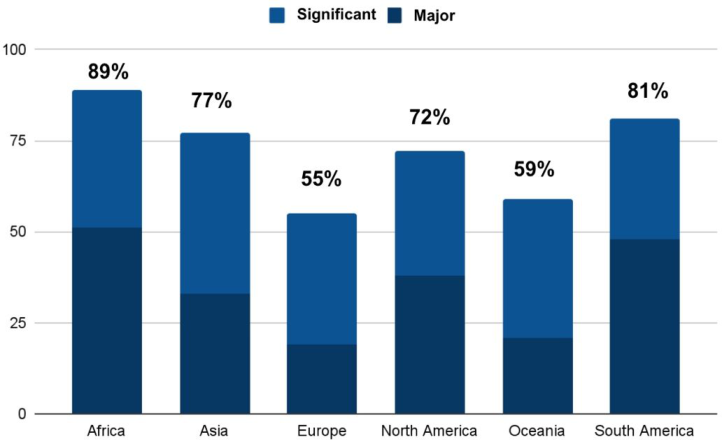
Notably, there are differences in how aviation professionals report their mental health behaviors based on their occupation, gender, and geographic location. Mental health stands as a major and significant concern for 89% of African respondents, yet only 55% of European respondents share this view (Figure 1). This points to a need to better understand what regulations
or systems are in place that may influence the level of concern based on the region of the world.
Figure 1: Pilot/ATC mental health concern by region (N = 1,577).
Looking at differences by profession, pilots exhibited greater risk- associated behaviors than Air Traffic Controllers; for example, pilots were significantly more likely to obtain unauthorized medical advice (72% vs. 28%) and were more likely to conceal or misrepresent their health information on a written healthcare questionnaire to protect their medical certification status (63% vs. 31%). Nearly half of respondents indicated that they had performed duties while experiencing a physical or psychological symptom that, in their view, warranted medical evaluation prior to duty. This pattern was observed across professional groups, with pilots reporting a marginally higher prevalence (48%) compared to ATC professionals (46%).
The results of the survey demonstrate a need for mental health interventions that pilots and ATC can utilize without fear of repercussions, as well as a need for trusted support systems that take into consideration differences within the aviation sector.
Qualitative Findings Using the inductive coding and Goleman’s EI framework, a framework was developed that matched the existing pilot competency standards (ICAO’s Pilot Core Competencies) which allowed the operationalization of emotional intelligence in safety-critical contexts. ICAO was founded in 1944 to promote cooperation between its 193 member countries, and its guidelines are widely followed by the regulatory agencies of member countries and the airlines that serve them. The framework establishes a relationship between observable pilot behaviors (OBs) and Goleman’s five emotional intelligence components
From Awareness to Action: Mapping Emotional Intelligence to Pilot Performance 1803
(self-awareness, self-regulation, motivation, empathy, and social skills). A list of the OBs and their associated EI dimensions is available upon request.
Table 2: Framework of EI and pilot competencies.
Table available in the original PDF paper.
Self- Awareness
Self Regulation
Motivation Empathy Social Skills OB 0.6
Application of knowledge Communication OB 2.2 OB 2.7 OB 2.6 OB 2.1 OB 2.1 OB 2.8 OB 2.4 OB 2.2 OB 2.5 OB 2.3 OB 2.8 OB 2.4 OB 2.6 OB 2.7
Leadership and Teamwork
OB 5.2 OB 5.6 OB 5.2 OB 5.1 OB 5.1 OB 5.5 OB 5.8 OB 5.7 OB 5.3 OB 5.3 OB 5.7 OB 5.9 OB 5.9 OB 5.4 OB 5.4 OB 5.8 OB 5.6 OB 5.5 OB 5.10 OB 5.11 OB 5.6 OB 5.10 OB 5.11
Problem Solving and Decision Making
OB 6.1 OB 6.3 OB 6.1 OB 6.2 OB 6.3 OB 6.7 OB 6.2 OB 6.7 OB 6.8 OB 6.8 OB 6.9 OB 6.9 OB 7.3 OB 7.7 OB 7.6 OB 7.5 OB 7.3 OB 7.6 OB 7.5 OB 7.7
Situation awareness and management of information Workload Management
OB 8.1 OB 8.1 OB 8.2 OB 8.4 OB 8.4 OB 8.2 OB 8.7 OB 8.8 OB 8.5 OB 8.5 OB 8.8 OB 8.6 OB 8.6 OB 8.9 OB 8.9
The table shown in Table 2 maps the relevant OBs from ICAO international pilot competency instrument onto the relevant EI dimension. The vertical axis displays key competency domains from the ICAO instrument (such as communication, leadership, decision-making, workload management and situational awareness) to show their operational contexts, while the horizontal axis contains the five components of emotional intelligence. The OBs were coded deductively for their EI matches before being introduced into the framework.
The framework demonstrates how emotional intelligence plays a role in pilots’ successful navigation of safety-critical aviation situations. For example, five observable behaviours (OBs) related to the EI components
of self-regulation and motivation appear in problem-solving and workload management domains because internal emotional control can help ensure operational effectiveness. Likewise, the OBs under empathy and social skills (EI components) and leadership and teamwork, communication, and situational awareness can be essential elements for safe and effective crew performance.
The framework presented reveals the prevalence of emotional competencies embedded within sociotechnical behaviors and also highlights that they are not currently explicitly recognized in pilot training and policy. It provides a model that can be replicated in other safety-critical industries for integrating socio-emotional learning into safety paradigms.
Results provide evidence that emotional intelligence is a necessity for technical and operational safety, which suggests that socio-emotional competencies should be integrated into Crew Resource Management (CRM) programs and Standard Operating Procedures (SOPs). Linking to the survey results, the framework supports developing mental health interventions that establish connections between psychological well-being and essential performance behaviors. This may help decrease stigma and promote early help-seeking among pilots.
DISCUSSION
This study investigated the connection between mental health, emotional intelligence and pilot performance through two main research questions: (1) Is there a demonstrable gap between ATC’s and pilots’ mental health needs and their engagement with available institutional resources? (2) How can a focus on emotional intelligence inform educational and policy interventions in aviation?
The study confirmed an extensive and concerning difference between ATCs’ and pilots’ knowledge of mental health issues and their actual utilization of existing support resources. The surveyed pilots and air traffic controllers showed mental health as a concern, yet most participants chose to stay away from official help resources. This hesitation to engage with support systems aligns with earlier evidence that pilots avoid reporting mental health issues due to stigma, fear of career repercussions, and low trust in institutional confidentiality (Cross et al., 2024). The psychological barriers consisting of stigma and fear of licensure consequences and lack of institutional trust were mentioned more often than structural barriers including cost or access. Such findings mirror prior qualitative research showing that many airline pilots conceal mental health issues for fear of professional consequences and because they distrust current reporting systems (Cross et al., 2024). The study demonstrates that aviation professionals maintain a silent attitude toward mental health issues despite rising understanding of its effects on operational performance and safety.
Our second phase implemented a new method to create a framework which connected observable pilot behaviors (OBs) to Goleman’s five- component model of emotional intelligence. The research aimed to identify how socio-emotional competencies exist within performance expectations
From Awareness to Action: Mapping Emotional Intelligence to Pilot Performance 1805
despite their absence from formal training and policy frameworks. The deductive mapping process showed that fundamental EI abilities including impulse control and accurate self-assessment and empathy for colleagues and conflict management skills form the basis for numerous competencies specified in international pilot standards (e.g., ICAO/IATA frameworks).
Emotional Intelligence as a Performance Tool The framework confirms that emotional intelligence serves as a core component of sociotechnical performance instead of being an additional element. As an example, self-regulation and motivation appear frequently in problem-solving and workload management domains because pilots need to stay composed under pressure while maintaining their commitment to performance excellence. The study showed that empathy together with social skills play a role in successful crew coordination and communication particularly during complex or high-stakes situations. These observations reinforce prior research indicating that individuals with higher emotional intelligence (e.g., strong self-regulation skills) cope more effectively with high- pressure demands and maintain performance under stress (Zeidner et al., 2012). By explicitly naming and categorizing these emotional capacities, the framework provides a practical guide for enhancing both training and assessment. It also offers an opportunity to de-stigmatize emotional regulation and help-seeking by re-framing them as core professional competencies.
The framework provides a useful way to train and assess through its explicit identification and classification of emotional capacities. It also creates space to eliminate stigma from emotional regulation and help-seeking by transforming these qualities into fundamental professional competencies.
Bridging the Gap Through Training and Culture The framework has substantial practical applications, for example:
The design of training programs using scenario-based simulations which focus on particular EI competencies such as conflict resolution, self- monitoring during cognitive overload situations, etc;
The integration of EI into CRM and SOPs to allow socio-emotional learning to become an operational standard that teams use in their protocols;
Mental health interventions that use emotional well-being as a performance asset and organizational priority instead of personal vulnerability.
The research shows that aviation training must move past its current focus on cognitive and technical skills to develop resilience-building methods which include cognitive-behavioral techniques and mindfulness practices and peer support models. This recommendation is supported by recent evidence that resilience-focused interventions (including CBT-based and mindfulness
Policy Gaps and Systems-Level Implications The demonstrated importance of EI for pilot performance has no corresponding systematic regulation of emotional competence or psychological resilience. The lack of policy attention to emotional competence and psychological resilience creates an institutional inability to support proactive mental health care for pilots while simultaneously enforcing disclosure penalties instead of support systems.
The research indicates that a systems-level transformation is necessary to support emerging “Safety-II” aviation safety paradigms which combine error prevention with successful adaptation understanding. The integration of EI into human performance metrics would enhance both individual coping capacity and system-wide collective safety outcomes.
Nonetheless, there remain important gaps to address in future research. For instance, pilots as a group have been found to exhibit lower average emotional intelligence on certain dimensions compared to non- pilots (Dugger et al., 2022), pointing to a need for deeper investigation into how aviation culture and selection processes impact socio-emotional skills. Future studies should employ longitudinal designs and subgroup analyses (e.g., comparing experience levels or cultural contexts) to examine how emotional intelligence and mental health evolve over time and across different ATC/pilot populations. Moreover, experimental research can test targeted emotional intelligence training interventions in aviation settings, building on evidence that such training improves mental health outcomes to determine their effectiveness in enhancing resilience, well-being, and operational performance.
CONCLUSION
This research reveals an essential mismatch between what aviation personnel need psychologically and the support systems they actually use. The fear of stigma together with career consequences prevents many pilots and air traffic controllers from accessing mental health support despite general knowledge about these challenges. The research demonstrates the necessity to move beyond awareness programs toward systematic psychological interventions.
Our development of a framework mapping observable pilot behaviors to Goleman’s emotional intelligence (EI) framework provides a practical method to incorporate socio-emotional competencies into aviation training and policy. The framework connects emotional intelligence capacities, including self-regulation, empathy and social skills to current performance standards, effectively uniting technical and emotional aspects of pilot performance. The model provides a framework to create specific training programs and evaluate interpersonal skills while promoting emotional competence as a fundamental requirement for operational safety.
The findings have implications which reach further than aviation. The same framework could benefit high-stakes professions including
From Awareness to Action: Mapping Emotional Intelligence to Pilot Performance 1807
healthcare, emergency response and transportation. Future research could explore how EI integration affects mental health, safety performance and organizational culture over time to further establish psychological resilience as a fundamental safety-critical work component.
ACKNOWLEDGMENT
The researchers would like to express their sincere gratitude to the International Federation of Air Traffic Controllers’ Associations (IFATCA) for their support in disseminating the survey, which was essential in obtaining the data from Air Traffic Controllers.
REFERENCES
Armstrong, A. R., Galligan, R. F., & Critchley, C. R. (2011). Emotional intelligence and psychological resilience to negative life events. Personality and Individual Differences, 51(3), 331–336. https://doi.org/10.1016/j.paid.2011.03.025 Bor, R., Field, G., & Scragg, P. (2002). The mental health of pilots: An overview.
Counselling Psychology Quarterly, 15(3), 239–256. https://doi.org/10.1080/ 09515070210143471 Cahill, J., Cullen, P., Anwer, S., Wilson, S., & Gaynor, K. (2021). Pilots’ mental health and wellbeing: A systematic review of qualitative research. Occupational Medicine, 71(2), 76–85. https://doi.org/10.1093/occmed/kqaa220 Chang, M., & Nuralieva, N. (2024). Mindfulness and mental resilience training for
pilots: Enhancing cognitive performance and stress management. ASEAN Journal of Psychiatry, 25(2). https://doi.org/10.54615/2231-7805.47343 Cross, D. S., Wallace, R., Cross, J., & Coimbra Mendonca, F. (2024). Understanding pilots’ perceptions of mental health issues: A qualitative phenomenological investigation among airline pilots in the United States. Cureus, 16(8), e66277. https://doi.org/10.7759/cureus.66277 Dugger, Z., Petrides, K. V., Carnegie, N., & Cormier, D. (2022). Trait emotional
intelligence in American pilots. Scientific Reports, 12, 15033. https://doi.org/ 10.1038/s41598-022-18868-4 Federal Aviation Administration. (2024, April 1). Mental health and aviation medical clearances: Aviation Rulemaking Committee final report [PDF]. U.S. Department of Transportation. https://www.faa.gov/sites/faa.gov/files/ Mental_Health_ARC_Final_Report_RELEASED.pdf Goleman, D. (1995). Emotional intelligence: Why it can matter more than IQ.
Bantam Books. Hicks, M. D., & Backus, D. (2020). Developing emotional intelligence in highstress professions: A meta-analytic review. Journal of Applied Psychology, 105(7), 719–738. https://doi.org/10.1037/apl0000468 International Air Transport Association. (2024). Competency assessment and evaluation for pilots, instructors, and evaluators: Guidance material (3rd ed.) [PDF]. https://www.iata.org/contentassets/ c0f61fc821dc4f62bb6441d7abedb076/competency-assessment-and-evaluation- for-pilots-instructors-and-evaluators-gm.pdf International Civil Aviation Organization. (2016). Manual on mental health in
aviation (Doc 10120). https://www.icao.int
Landy, F. J. (2005). Some historical and scientific issues related to research on emotional intelligence. Journal of Organizational Behavior, 26(4), 411–424. https://doi.org/10.1002/job.317 Moeller, R. W., Seehuus, M., & Peisch, V. (2020). Emotional intelligence,
belongingness, and mental health in college students. Frontiers in Psychology, 11, 93. https://doi.org/10.3389/fpsyg.2020.00093 Pasha, M. A., & Stokes, P. (2018). Pilot mental health: A review of relevant concepts and assessment strategies. Aerospace Medicine and Human Performance, 89(5), 452–456. https://doi.org/10.3357/AMHP.4972.2018 Persich, M. R., Smith, R., Cloonan, S. A., Woods-Lubbert, R., Strong, M., &
Killgore, W. D. S. (2021). Emotional intelligence training as a protective factor for mental health during the COVID-19 pandemic. Depression and Anxiety, 38(10), 1018–1025. https://doi.org/10.1002/da.23202 Schneider, T. R., Lyons, J. B., & Khazon, S. (2013). Emotional intelligence and resilience. Personality and Individual Differences, 55(8), 909–914. https://doi.org/ 10.1016/j.paid.2013.07.460 Sexton, J. B., Thomas, E. J., & Helmreich, R. L. (2000). Error, stress, and teamwork
in medicine and aviation: Cross-sectional surveys. BMJ, 320(7237), 745–749. https://doi.org/10.1136/bmj.320.7237.745 Venus, M., & Grosse Holtforth, M. (2022). Interactions of international pilots’ stress, fatigue, symptoms of depression, anxiety, common mental disorders and wellbeing. International Journal of Aviation, Aeronautics, and Aerospace, 9(1). https://doi.org/10.15394/ijaaa.2022.1667 Wu, A. C., Donnelly-McLay, D., Weisskopf, M. G., McNeely, E., Betancourt, T.
S., & Allen, J. G. (2016). Airplane pilot mental health and suicidal thoughts: A cross-sectional descriptive study via anonymous web-based survey. Environmental Health, 15(1), 121. https://doi.org/10.1186/s12940-016-0200-6 Zeidner, M., Matthews, G., & Roberts, R. D. (2012). The emotional intelligence, health, and well-being nexus: What have we learned and what have we missed? Applied Psychology: Health and Well-Being, 4(1), 1–30. https://doi.org/10.1111/ j.1758–0854.2011.01062.x Zeidner, M., Roberts, R. D., & Matthews, G. (2004). The emotional intelligence
bandwagon: Too fast to live, too young to die? Psychological Inquiry, 15(3), 239–248. https://doi.org/10.1207/s15327965pli1503_04 Zhang, X., Cheng, B., Yang, X., Suo, X., Pan, N., Chen, T., Wang, S., & Gong, Q.
(2023). Emotional intelligence mediates the protective role of orbitofrontal cortex spontaneous activity against depressive and anxious symptoms in late adolescence. European Child & Adolescent Psychiatry, 32(10), 1957–1967. https://doi.org/ 10.1007/s00787-022-02020-8
LISTED IN THE AHFE DIGITAL BOOKSTORE CATALOGUE
Explore the complete digital volume
Human Factors in Design, Engineering, and Computing
Read this individual research paper free through the original publisher, or explore the full digital proceedings book.
ISBN 978-1-964867-75-5
Explore this ISBN in the AHFE Bookstore ↗Listed in the July 2026 bookstore catalogue; search by ISBN to confirm current availability · Digital book purchase optional