Abiodun Kilani, Bolanle Ikotun, Rasheed Abdulwahab (2024). Enhancing the Structural Properties of Mortar with Treated Rubber Crumb. In: Human Factors in Design, Engineering, and Computing. AHFE Open Access, vol. 159, pp. 1730–1739. https://doi.org/10.54941/ahfe1005740
Department of Civil & Environmental Engineering and Building Science, College of Science, Engineering and Technology, University of South Africa, Florida Science, Campus, Roodepoort, Johannesburg, South Africa ↗
The applications of mortar in infrastructural developments cannot be overemphasized owing to its significances which are evident in the formation of composite structures. More importantly, mortar is one of the best construction materials required for the construction of building blocks, filling the gaps between blocks. It is a universally acceptable construction material because of its good structural and compatibility properties such as good flexibility and transformative capacity, and good binding property. As a flexible construction material, mortar is used as binder in masonry and walling units. The applications of mortar for construction purposes have highly contributed to the development of the built environment. However, ,mortar may deteriorate by deforming into powdery after used for construction, and turning into crumbling material. Thus, this research investigates on enhancing the fresh and hardened properties of mortar using rubber crumb treated with sodium hydroxide (NaOH). The strength properties of the rubber – mortar produced were evaluated through the physical and chemical properties of rubber; the consistency, workability, setting times of rubber - cement paste; compressive and flexural strengths of rubber – cement - mortar. The chemical composition and physical characterization of rubber crumb were evaluated by determining its fineness modulus, water absorption, bulk density, ash content, metal content and fibre content according to SANS 3001-AG1 and SANS 3001-AG20. Also, the workability, consistency and setting times, compressive and flexural strengths of mortar were determined according to ASTM C 1437, SANS 50196-3 and SANS 50196-1. The results of the experiment show that, the rubber treated with NaOH has good physical and chemical properties for enhancement of mortar’s fresh and hardened properties. The rubber – cement paste’s workability increases with increase in the percentage of rubber included. Also, the consistency of the mortar paste increased by 0.5 – 2.0% with increase in the value of rubber included. In addition, the application of rubber in mortar reduced its initial setting time while its final setting increases with increase in rubber content. The addition of 1.5% of rubber crumb increased the compressive strength of mortar by 3.32%, 9.13%, and 0.21% at 7, 14 and 28 days of curing respectively. Also, 1.5% rubber crumb increased the flexural strength of mortar by 5.94% at 28 days. In conclusion, the incorporation of 1.5% rubber crumb in mortar enhanced its mechanical properties.
Enhancing the Structural Properties of Mortar With Treated Rubber Crumb 1731
INTRODUCTION
Mortar is a construction material in the form of paste produced from the mixing of cement, sand, water, and lime occasionally which when hardened can be used to bridge the interface between the blocks of masonry’s building (Benny, 2021). The hardened paste holds together components in concrete, walling units and masonry (Beaulieu, 2024). The applications of mortar are significant to the global construction industries. The most important aspect of it is that, mortar can be used to make a finishing touch on stones’ and bricks’ walls materials such as rendering and plastering of walls, walls infilling rubble mortars, and flooring of foundations (Elsen, 2006). It can be used to make different decorative patterns on stones or bricks (Civil Engineering, 2024). Also, mortar can be used for the replacement and repairing of existing structures. One of the advantages of mortar to the construction industries is its flexibility and good transformative capacity into new structures (Easy Mix Concrete, 2024). Rubber crumb is the rubber produced from trucks’ and cars’ scrap tires which comprises of 20% black carbon, some metals, 50% rubber and other additives (Presti, 2013).
Despite the good properties of mortar that made it suitable as a universal construction material, yet, mortar comprises of some weak structural and physical properties such as poor workability, freezing in cold weather and cracking. In accordance with the findings of Giovanni (2018), it was discovered that almost all the mortar used for the construction of new buildings nowadays are deforming into powdery form and crumbed subsequently. This is very evident in buildings constructed with mortars thus, forming of large cracks at the exterior and interior parts of the walls thereby predisposing the structures to untimely deteriorations (Aoyama, 2022).
Numerous works have been done on addressing the weak properties of mortar which are now review. As investigated by Wang et al. (2022), stabilized reduced slag of stainless steel (SRSSS) and blast – furnace slag of ground – granulated (BFSGG) were incorporated into mortar to replace some certain percentages of cement for the production of mortar. The result showed that, the application of SRSSS and BRSGG in mortar increased the workability and qualities of mortar’s hardened properties up to 10% and 20% replacement with SRSSS and BFSGG respectively. The increase in SRSSS content of the mortar beyond 10% at 28 days of curing causing the formation of micro and macro pores, and develops into poor engineering properties’ formation in mortar, thus 10% was the acceptable percentage. In addition, the replacement of mortar’s cement with metakaolin (MK) and silica – fume (SF) together with coconut fibre (CF) showed that mortar’s physical and mechanical properties increased up to 6%, 10% and 10% replacement of cement with CT, MK and SF responsively. Also, the microstructure values of fibre – mortar are dense (Mian et al., 2023). In accordance with Ayesha et al. (2019) result, the rubberized mortar has high porosity, exhibit ductile failure and high resistance deformation. Its flexural and compressive strengths increase by 96% and 86% respectively.
As investigated by previous researchers, the application of rubber in mortar requires further enhancement to improve its performance as construction
material, and its weak properties. Thus, this study works on enhancing the structural properties of mortar using rubber crumb treated with sodium hydroxide (NaOH). The treatment of rubber crumb with sodium hydroxide was carried out in order to improve its interface for adequate compatibility with other mortar’s materials in forming paste. The aim of this research is to improve the structural performance of mortar with treated rubber. This aim was achieved through the following objectives (i) to characterize the properties of rubber (ii) to determine the physical and chemical properties of aggregates used (iii) to evaluate the fresh properties of mortar using cement, rubber and water to form paste (vi) to determine the hardened properties of mortar with rubber crumb.
MATERIALS AND METHODS
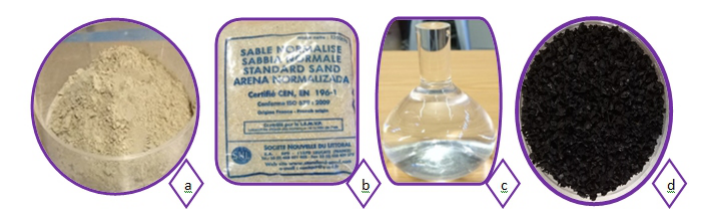
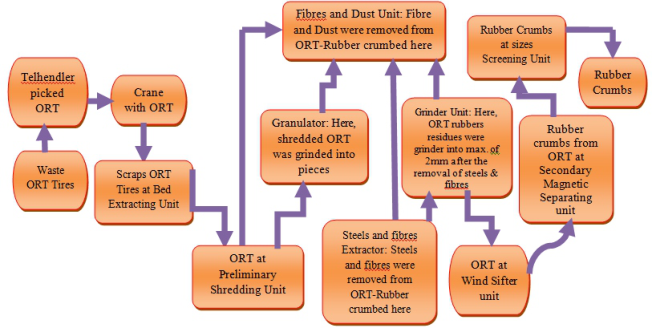
Materials’ Preparation The materials used for this experiment are 52.5N Ordinary Portland Cement, standard sand; portable water and rubber crumb treated with NaOH (see Figure 1). The cement used was supplied by Afrisam Cement Company’s branch at Main Reef road, Roodepoort, Johannesburg, South Africa. The sand used for this experiment was supplied by Arena Normalizada Company in France. The sand is called standard sand because; its method of production is in accordance to the certified EN 196–1 and conformed with ISO 679: 2009 standards. The tap water used for this experiment was from Civil Engineering Laboratory of University of South Africa (UNISA). Likewise, the rubber crumb used was extracted from scraps of resilient heavy trucks’ tyres normally referred to as off – road tyres (ORT). The extraction of rubbers from scrap tires were carried out following the efficient rubber separating method of Wangrooe (2019), O’Farrell (2019) and Zheng et al. (2022) at mechanical unit of Geodyn Solution Property Limited, at No. 1 Ivory Avenue, Klerksoord, Roslyn, Pretoria, South Africa in accordance with ASTM D 297 standard (see Figure 2). The extracted rubber crumb was treated with 7% of NaOH (by weight of rubber) for 24 hours at 60
C temperature and later oven dried for 48 hours at 110
C temperature to improve its surface area and interface for adequate compatibility with other mortar- materials following the method of Rida et al. (2022) and optimum treated percentage of Nuzaimah et al. (2020).
Figure 1: The materials used for the production of mortar (a) 52.5N ordinary portland cement (b) standard sand (c) portable water (d) rubber crumb treated with NaOH.
Enhancing the Structural Properties of Mortar With Treated Rubber Crumb 1733
Figure 2: Mechanical method of processing Off-Road Tyre (ORT) into rubber crumbs.
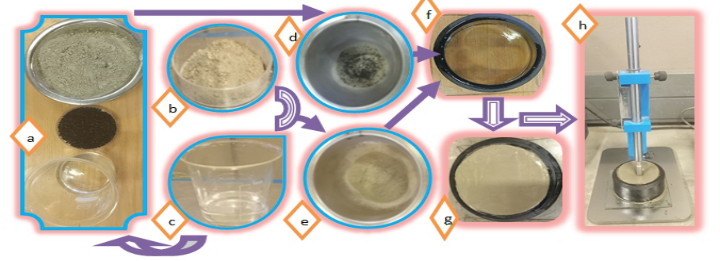
Characterization of Materials The rubber crumb was characterized according to SAN 3001 – AG1 standard. Likewise, the cement used was characterized through its paste’s early state properties (such as consistency and setting times) and its behavior with rubber in paste. This was carried out according to SANS 50196 -3:2006 Edition 2, and EN196 -3:2005 Edition 2 standards. The consistency and setting times of rubber – cement paste was determined using 500g of cement, 125g of water (by weight of cement) and 0%, 1.5%, 2.5%, 3.5% & 5.0% of treated rubber crumb. The method used to determine the consistency of rubber-cement paste is presented as shown in Figure 3. In addition, the characterization of sand was determined through the EN196-1 and confirmed ISO 679: 2009 standards.
Figure 3: Methods of determine the consistency of cement and cement – rubber pastes (a) Cement, rubber crumb and water batched for the tests (b-c) Batched cement and water were positioned for mixing (d) The cement, rubber and water were placed inside the mixing bowl for mixing (e) OPC cement and water from b-c were mixed together to form normal cement paste (f) Here, Vicat mould were oiled for easy de-moulding(g) The vicat mould filled with cement/cement-rubber pastes (h) The penetration of plunger into the paste inside the vicat mould.
COMPRESSIVE AND FLEXURAL STRENGTHS OF MORTAR The hardened properties of mortar were determined through its compressive and flexural strengths using 40 × 40 x 160 mm rubber – cement - mortar prisms in according to SANS 50196 - 3:2006 Edition 2 and EN196-3:2005. For the production of rubber – mortar; 450g of cement, 225g of water, 1350g of standard sand, and 0%, 1.5%, 2.5%, 3.5% & 5.0% of rubber crumbs were used.
RESULTS AND DISCUSSIONS The results of the experimental tests carried out on rubber-cement-mortar (RCM) are presented as follows
RESULTS OF RUBBER CRUMB CHARACTERIZATION Result of Rubber Crumb Sieve Analysis
The result of the sieve analysis of rubber crumb are presented as shown in Table 1
Table 1. Sieve analysis result of rubber crumb.
Table available in the original PDF paper.
Percentage Passing (%)
Percentage Retained (%)
Sieve Sizes (mm)
Cumulative Percentage Retained (%)
Mass of Rubber Retained (g)
Specified Limits According to IS 383 – 1970 and IS 2386 – 1963 & IRC, SP:107 – 2015
The sieve analysis’ result of rubber crumb obtained certified the specified limits of IS 383 – 1970 and IS 2386 – 1963 & IRC, SP: 107 – 2015 standards showed in Table 1. Also, the fineness modulus of the sand (4.96) is similar to the value obtained by Digvijay and Ashish (2023). This makes the rubber crumb suitable for the mortar production.
Result of Physical and Chemical Characterization of Rubber Crumb All the value of rubber’s properties obtained showed that rubber crumb is good for mortar production. With 1.0% rate of rubber crumb’s water absorption and its 0.6% moisture absorption capacity; it can be deduced that, production of mortar with rubber crumb should be with application of low – medium water - cement ratio. Also, the values of other parameters obtained (see Table 2) such as, fineness modulus, bulk density, metal and fibre content proved that rubber crumb is chemically and physically stable
Enhancing the Structural Properties of Mortar With Treated Rubber Crumb 1735
for mortar production. These results are in agreement with the result of Bello et al. (2022) experiment.
Table 2. Physical and chemical properties of rubber crumb.
Table available in the original PDF paper.
Physical Properties Value Chemical Properties Value (%) Length (mm) 0.15 - 2.0 Fibre Content 0.85 Fineness modulus 4.96 Ash Content 8.7 Water Absorption (%) 1.00 Moisture Content 0.6 Bulk Density (Kg/m3) 453.04 Metal Content 1.6
Physical and Chemical Properties of Cement The results of physical and chemical properties of Portland Pozzolana Cement (PPC): OPC 52.5N cement are presented as shown in Table 3. All the results obtained satisfied the SANS 50197 – 1 standard.
Table 3. Physical and chemical properties of PPC: Ordinary portland cement (OPC) grade 52.5N (PPC cement material safety data sheet, 2015).
Table available in the original PDF paper.
Chemical Properties
Physical Properties
Value SANS 50197 – 1 Requirement
Value SANS 50197 – 1 Requirement
2.0 5.0 Max.
Relative Density
± 3.14 - Insoluble residue (%)
< 0.01 0.1 Max.
Specific Area (m2/kg)
400 No Requirement
Chlorides (%) 2.5 5.0 Max.
1 10 maximum Loss of Ignition (%)
Le Chaterlier Expension (mm)
2.0 4.0 Max
Bulk Density (Kg/m3)
1100 - 1300 - Sulphur trioxides (%)
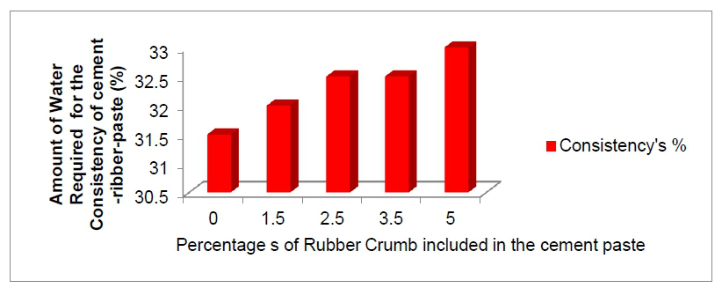
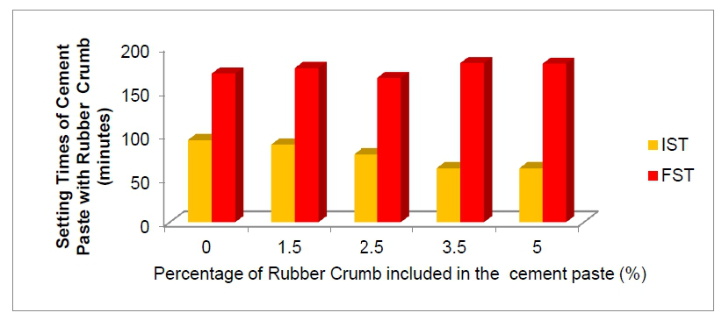
Results of Consistency, Setting Times and Workability of Mortar With Rubber Crumb The result of consistencies and setting times of cement pastes with rubber crumb are presented as shown in Figures 4 and 5. Compared with control, the consistency of the paste increased with increase in the percentage of rubber crumb. At the inclusion of 0.0%–2.5% of rubber, the paste consistencies increased by 0.5%. The consistencies of mortar were constant at the inclusion of 2.5%–3.5% of rubber crumb while its value increased by 0.5% at application of 5.0% of rubber crumb. All the result proof that rubber increase the consistency of the pastes by 0.5%. This result is in line with the value of rubber – cement - paste’s consistency obtained by Sulaiman et al. (2020) after plunger penetration record values of 6.8 mm which fell within the ranged of 4.0–8.0 mm according to SANS 50196 – 3.
Figure 4: Consistencies of cement pastes with rubber crumb.
The initial setting time of cement pastes decreases with increase in the percentages of its rubber content while the inclusion of rubber crumb in cement paste increased the setting time of the paste progressively. The application of rubber crumb in mortar control the early state setting of pastes’ final setting time which can result into cracks as times goes on. The result of this test is in agreement with that of Bello et al. (2022)’s findings who have the final setting time of rubber – cement paste beyond 169.17 minutes.
Where IST is Initial Setting Times and FST is Final Setting Times.
Figure 5: Setting times of cement pastes with rubber crumb
The workability of rubber – cement - mortar increased with increase in the percentage of rubber crumb included. This implies that, application of treated rubber resulted into the production of workable mortar.
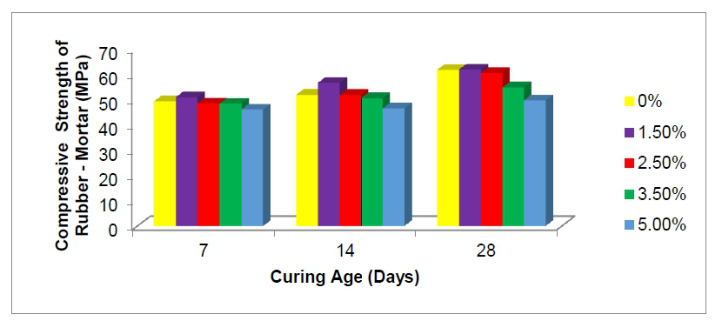
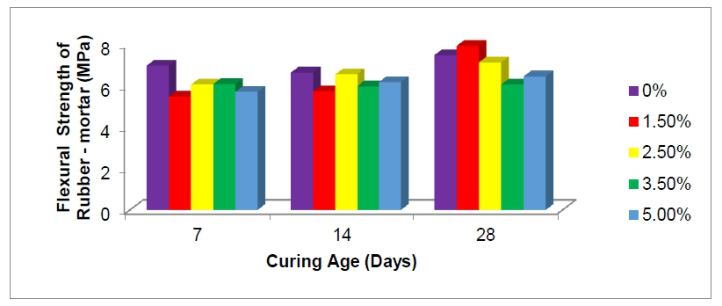
RESULTS OF COMPRESSIVE AND FLEXURAL STRENGTHS OF MORTAR The hardened state properties of rubber-mortar (RM) as determined through its compressive and flexural strengths are presented as shown in
Enhancing the Structural Properties of Mortar With Treated Rubber Crumb 1737
Figures 6 and 7. According to Figure 7, the compressive strength of mortars produced optimum strengths at 1.5% of rubber crumb inclusion. There was progression in strength increments in mortar as its curing days were increasing from 7 to 14 and 28 days. The percentage of strength increments were 3.32%, 9.13% and 0.21% respectively. This implied that rubber crumb is good for strength increment in mortar. The result is in agreement with Sulaiman et al. (2020)’s and Bello et al. (2022)’s findings which stated that rubber crumb increase the compressive strength of mortar up to 9.5%.
Figure 6: Compressive strength of rubber – cement mortar.
The flexural strength of rubber-mortar decreased with increasing rubber content at 7 day of curing. As at 14 days of curing, the rate of strength reduction decrease with increase in rubber content. This might be as a result of increase in the hydration process of rubber-mortar. On 28th day, the flexural strength of rubber –cement mortar increased by 5.94% than that of control (Figure 7). This implies that mortar with good strength, can be produced with extension of mortar’s curing ages beyond 28 days.
Figure 7: Flexural strength of rubber – cement mortar.
CONCLUSION
All the experimental results present in this study proved that mortar’s structural properties can be enhanced with treated rubber using accurate mix proportion. The inclusion of rubber in mortar has efficiently influenced its structural properties positively, especially for strength increment. It was concluded that, the incorporation of 1.5% rubber crumb in mortar enhanced its mechanical properties. In addition, the outcome of this investigation proofs that long curing age is required to achieve good flexural strength of rubber – mortar, possibly 28–90 days. With this percentage, mortar’s strength will be highly enhanced with the inclusion of rubber crumb as fibre not as aggregates’ replacement.
For excellent result, the inclusion of rubber crumb in mortar should not exceed 1.5% by weight of cement. Also, in order to achieve high rubber – cement – mortars’ strength, low - medium water – cement ratio should be used (suggested range: 0.35–0.5) for the production of rubber - cement - mortar. Because of low water absorption of the rubber crumb, the use of low – medium water/cement ratio will help in preventing the production of low strength mortar.
ACKNOWLEDGMENT
The Authors appreciate the effort of Miss Palesa Tshetlanyane and Department of Civil & Environmental Engineering and Building Science, UNISA for their contributions toward the success of this research.
REFERENCES
Aoyama (2022). What is “mortar”? Differences from concrete and points to note, Aoyama Art Inc., Japan. https://japanese-architects.com/articles/mortar#:~: text=Disadvantages%20of%20mortar%20finish,-3%2D1.~&text=Although% 20mortar%20replaces%20some%20of,walls%2C%20causing%20deteriorati on%20and%20leaks. ASTM D 2487: Aggregate and Soil Terminology. Retrieved from https: //pavementinteractive.org/reference-desk/materials/aggregate/astm-aggregate- and-soil-terminology/. Ayesha S., Mamun M., Rayed A., Mugahed A., Farhad A, and Hisham A. (2019).
Properties and utilizations of waste tire rubber in concrete: A review. Construction and Building materials, Page 711–731, https://doi.org/10.1016/j.conbuildmat. 2019.07.108Get rights and content. Beaulieu D. (2024). The Differences Between Cement, Concrete, and Mortar.
Retrieved from https://www.thespruce.com/difference-between-cement-concrete -and-mortar-2130884. Bello A., Abdullahi A. and Muhammad B. (2022). Use of Crumb Rubber as Partial Replacement of Fine Aggregate in Mortar. Sospoly Journal of Engineering, Entrepreneurship & Environmental Studies, Vol. 4 (2), ISSN: pp. 2536–7183, e2714-2720: Available at https://uaspolysok.edu.ng/sospolyjeee/. Benny K. (2021). Construction Mortar: Its Importance, Preparation, and Uses.
Retrieved from https://www.bennykuriakose.com/post/construction-mortar-its- importance-in-construction-preparation-and-uses#:~:text=Mortar%20is%20a %20combination%20of,concrete%20used%20in%20the%20construction.
Enhancing the Structural Properties of Mortar With Treated Rubber Crumb 1739
Civil Engineering. What is Mortar? Retrieved from https://civiltoday.com/civilengineering-materials/mortar/66-what-is-mortar-mix-definition#google_vignette. Digvijay S. and Ashish S. (2023). Mechanical Characteristics of Crumb Rubber
Concrete. International Journal of Creative Research Thoughts (IJCRT), Volume 11, Issue, Retrieved https://ijcrt.org/papers/IJCRT2308201.pdf. Easymix Concrete (2024). What is the different between concrete, cement and mortar. Retrieved from https://www.easymix-concrete.co.uk/news/what-is-the-di fference-between-concrete-cement-mortar/. Elsen J. (2006). Microscopy of historic mortars—a review. Cement and Concrete
Research Journal. 36, 1416–1424, doi: 10.1016/j.cemconres.2005.12.006. EN 196-1: (2016). Method of Testing Cement Part 1: Determination of Strength.
Retrieved from https://standards.iteh.ai/catalog/standards/cen/37b8816e- 4085-4dcc-a642-a383d9bddd6c/en-196-1-2016?srsltid=AfmBOopi5- fsAMUAmudvT4CV8FW-nytZfmwLzfcOJStNk1RKgEFaUcBv. Giovanni P. (2018). Feeling Undervalued. Retrieved from https://ww3.rics.org/uk/en /journals/built-environment-journal/weak-mortar.html. IS 383 (1970). “Specification for coarse and fine aggregates from natural sources for concrete”. Retrieved from https://law.resource.org/pub/in/bis/S03/is .383.1970.pdf. ISO 679: (2009) Cement – Test Methods – Determination of Strength. Publish
Edition 2: (2009). Retrieved from https://www.iso.org/standard/45568.html#:~: text=ISO%20679%3A2009%20specifies%20a,one%20half%20part%20of% 20water. Kevin N. (2024). Brick working and pointing. Mortar Repair : What causes mortar to deteriorate? Retrieved from https://www.brickworkandpointing.co.uk/brick work-repairs/mortar-repair/#:~:text=The%20primary%20factors%20that%20c ause,ageing%20process%20of%20the%20material. Mian S., Tariq A., Muhammad Z., Osama Z., Nabil B., Yao S., Nadeem A., and
Ali A. (2023). A study on improving the performance of cement-based mortar with silica fume, metakaolin, and coconut fibers. Case Studies in Construction Materials. 19, e02480, https://doi.org/10.1016/j.cscm.2023.e02480. O’Farrell, K. (2019). Tyre flows and recycling analysis. https://Tyre flows and recycling analysis - project report (environment.gov.au). Presti D. L. (2013), Recycled tyre rubber modified bitumens for road asphalt
mixtures: A literature review Construction and Building Materials 49 (6) 863–881. Sulaiman T. A., Ja’e I. A., Yau Y., and Hashim Y. M (2020). Investigation of Crumb Rubber Proportion on Compressive strength and Water Absorption of Crumb Rubber Mortar. Journal of Science Technology and Education 8(2), ISSN: 2277- 0011; Journal homepage: www.atbuftejoste.com. Wang H., Shen-Lun T., Chang-Chi H., and Ting-Yu J. (2022). Research on
engineering properties of cement mortar adding stainless steel reduction slag and pozzolanic materials. Case Studies in Construction Materials 16, e01144, https://doi.org/10.1016/j.cscm.2022.e01144. Wangrooe (2019). Waste Tyre Recycling Plant. Wangrooe Hightech. Retrieved 20/08/ 2021 from China Manufacturer Tire Recycling Plant, Tire Recycling Machine, Tire Shredder, TDF Shredder (wanrooe.com). Zheng X., Pramanik A., Basak A., Prakash C., Shankar S. (2022). Material
recovery and recycling of waste tyres-A review, Cleaner Materials, 5, 100115, www.journals.elsevier.com/cleaner-materials, https://doi.org/10.1016/j. clema.2022.100115.
LISTED IN THE AHFE DIGITAL BOOKSTORE CATALOGUE
Explore the complete digital volume
Human Factors in Design, Engineering, and Computing
Read this individual research paper free through the original publisher, or explore the full digital proceedings book.
ISBN 978-1-964867-35-9
Explore this ISBN in the AHFE Bookstore ↗Listed in the July 2026 bookstore catalogue; search by ISBN to confirm current availability · Digital book purchase optional