Reetta Oksa, Mia Laine, Edward White, Jussi Okkonen (2024). Basic psychological needs related to information ergonomics and loneliness. In: Human Factors in Design, Engineering, and Computing. AHFE Open Access, vol. 159, pp. 1275–1287. https://doi.org/10.54941/ahfe1005695
Remote working, particularly online teaching, in academia has significantly increased during and after COVID-19 pandemic. Simultaneously, loneliness at work has risen. Working in remote environments therefore requires employees to develop new types of working habits and psychological resilience. This study examines how basic psychological needs satisfaction related to online teaching has affected academics experiences of perceived usefulness of technology in their work, technostress and their sense of loneliness. The study is based on a survey dataset (n=201) collected of two Ghanaian universities during October 2023 to January 2024. The distributions of the item means were compared across the quantiles of autonomy, competence and relatedness. The results enhance the understanding to what level academics experience loneliness in collectivistic country like Ghana, and how basic psychological needs satisfaction in online teaching, perceived usefulness of technology and technostress interact in that relationship also from academic role perspective. The results provide useful information for academic working and curriculum planning as well as points for wellbeing at work considerations.
The aftermath of COVID-19 pandemics has accelerated the adoption of diverse modes of work, namely remote and hybrid work (Oksanen et al., 2021; Petani & Mengis, 2021). Remarkable technological advancements have facilitated seamless collaboration and efficient communication, even when working remotely (Fuchs & Reichel, 2023). However, remote work has also brough new kind of challenges for social interaction (Lal et al., 2023). Academia is no different, with many in the area increasing their adoption of remote and hybrid work and online teaching (Debrah et al., 2021; Naqshbandi, et al., 2024). While consequently, the role of technology mediated interaction has evolved (Tapani et al., 2022).
The study draws from Self-Determination Theory (SDT) which explains human motivation, engagement, and well-being (Ryan & Deci, 2017). It emphasizes three core psychological needs: autonomy (volition, self-regulation, and integrity), competence (mastery and effectiveness), and relatedness (belongingness and meaningful connections) (Baumeister & Leary, 1995; deCharms, 1968; Deci & Ryan, 2000; White, 1959).
The Motivation, Engagement and Thriving in User Experience (METUX) model, is based upon SDT, offering scales that are firmly rooted in psychological principles and enable researchers to gain valuable insights into how technology designs either enhance or compromise users’ psychological needs, ultimately contributing to their positive user experience outcomes and overall well-being (Hakami et al., 2022; Peters et al., 2018). Furthermore, the perceived usefulness of technology typically reflects the degree of how a certain technology increases employees’ work performance, productivity, effectiveness and how useful they perceive it (Davis, 1989; Venkatesh & Davis, 2000). The perceived usefulness of technology significantly influences teachers’ attitudes toward using it and may influence their intentions to use technology for work (Holden & Rada, 2011). Wang & Li (2019) study’s findings suggest that the demands placed upon teachers from organizational management culminate technostress in higher education and not technology use per se.
The recent adoption of digitalization, resulting in changes in working environments and habits have impacted academics wellbeing in varying degrees. Workplace technologies can induce stress, commonly referred to as technostress, consisting of techno-stressors (techno-invasion, techno-overload, techno-complexity, techno-insecurity and techno- uncertainty) and strain potentially leading to adverse outcomes (Ayyagari et al., 2011; Ragu-Nathan et al., 2008; Tarafdar et al., 2019). Increased technostress has been reported among faculty members during the COVID-19 pandemic (Boyer-Davis, 2020). Study by Li and Wang (2021) revealed that techno-complexity and techno-insecurity have been found to lower university teacher’s work performance. In contrast, literacy facilitation and involvement facilitation (i.e. organization fosters an environment where technology- related knowledge is documented, shared and supported) had positive effect on work performance (Li & Wang, 2021). Moreover, technology involvement facilitation and technical support provision have been found to alleviate techno-overload, techno-complexity and techno-insecurity (Li & Wang, 2021).
Studies have indicated that humans have innate need for social belonging and, consequently indicating a positive link between relatedness and well- being (Baumeister & Leary, 1995; Ryan & Deci, 2017). However, nearly one fourth of university employees reported experiences of loneliness when working remotely, which has been found to elevate stress and exhaustion but was moderated by personal resilience (Mäkiniemi et al., 2021). Remarkably, social belonging was not found to correlate with stress and exhaustion, nor did it act as a moderator in the relationship between loneliness, stress and exhaustion (Mäkiniemi et al., 2021). Nevertheless, remote workers job autonomy has been associated with less loneliness in early days of the pandemic (Wang et al., 2021). The current study assesses how basic psychological needs satisfaction related to online teaching has affected academics experiences of perceived usefulness of technology in their work and technostress and their sense of loneliness.
Basic Psychological Needs Related to Information Ergonomics and Loneliness 1277
METHODS
The data consists of an online survey that was collected from two Ghanaian universities during October 2023 to January 2024. The survey entails questions related to teaching online and offline, working habits and conventions, and questions about family relations and well-being. The respondents work as university lecturers or researchers.
In the current study, the extent to which online teaching meets users’ requirements for the basic psychological needs of competence, autonomy, and relatedness are examined. The effects of perceived usefulness of technology, technostress and perceived loneliness on the fulfilment of basic psychological needs related to online teaching were analyzed with a quantile regression approach.
RESULTS
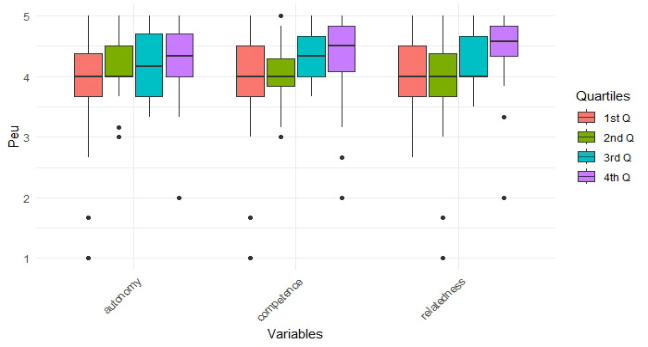
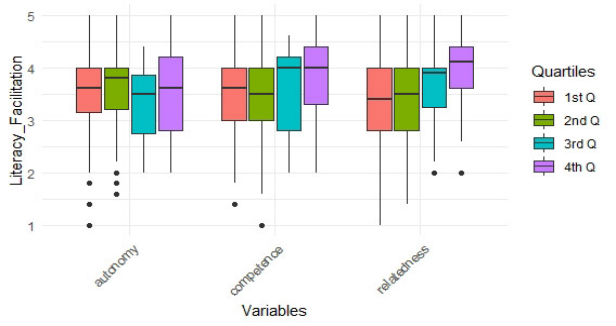
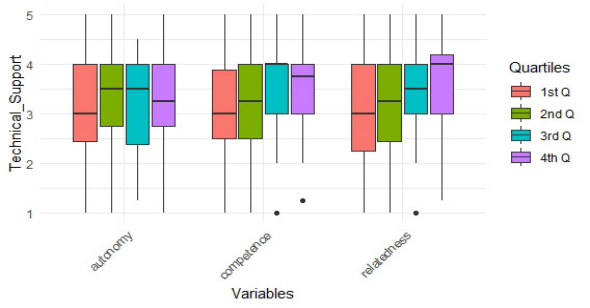
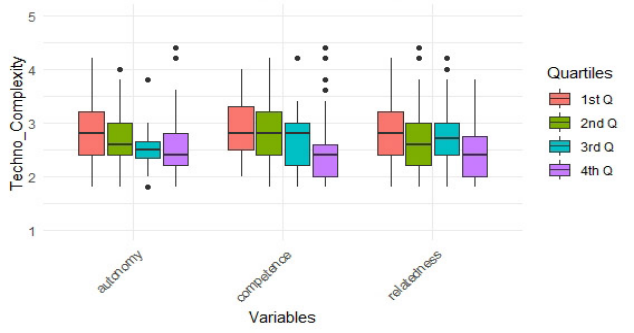
The associations between perceived loneliness, usefulness of technology, technostress creators and inhibitors were explored with quantiles of autonomy, competence, and relatedness. These associations are visualized with grouped boxplots, where the medians and interquartile ranges are shown as boxes. Any possible outliers are shown as dots.
The perceived usefulness of technology (PEU) was remarkably high, with the majority of responses between 3.5-5 shown in Figure 1. Furthermore, there seems to be a rising trend in PEU with consecutively higher quartiles of the satisfaction of psychological need, as the medians of PEU are higher in the fourth quartiles of autonomy, competence and relatedness than in the first.
Figure 1: Boxplot of perceived usefulness binned by quartiles of basic psychological needs.
Technostress inhibitor items i.e., literacy facilitation (organization fosters an environment where technology-related knowledge is documented, shared and supported) and technical support provision (perceived satisfaction of an
individual to the services rendered by the end-user help desk) tend to be higher in the highest quartiles of competence and relatedness. The levels literacy facilitation and technical support did not seem to be perceived differently in the quartiles of autonomy. These can be seen in the Figures 2 and 3. Overall, majority of the responses are between neutral to somewhat positive (2.5-4).
Figure 2: Boxplot of literacy facilitation binned by quartiles of basic psychological needs.Figure 3: Boxplot of technical support provision binned by quartiles of basic psychological needs.
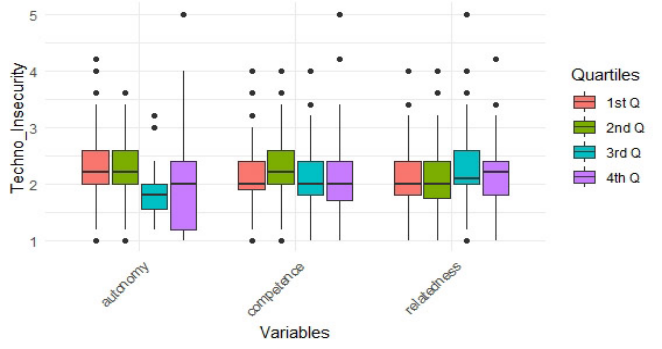
Techno-complexity appeared to be slightly lower in the consecutively higher quartiles of autonomy, relatedness and competence. Overall, the perceived levels of techno-complexity were around or below neutral, as displayed in Figure 4. Similarly in Figure 5, the respondents consistently reported quite low levels of techno-insecurity. The responses seemed to be similar across the quantiles, with little to no variance across quantiles, except the 3rd and 4th quantile of autonomy.
Basic Psychological Needs Related to Information Ergonomics and Loneliness 1279
Figure 4: Boxplot of techno-complexity binned by quartiles of basic psychological needs.Figure 5: Boxplot of techno-insecurity binned by quartiles of basic psychological needs.
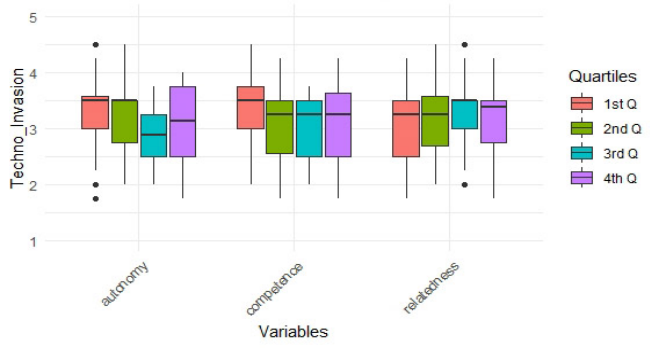
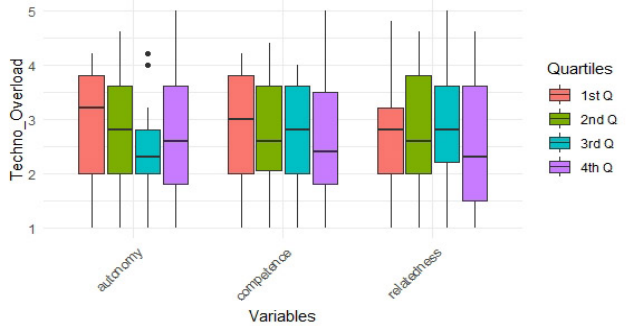
The responses the techno-invasion items in Figure 6 were consecrated around the neutral option. There was also no clear trend in the responses across the quartiles. Techno-overload in Figure 7 displays responses concentrating around the neutral, but there seemed to be a slightly decreasing trend in the location of the medians. That indicates higher levels of satisfaction of psychological needs were associated with lower levels of perceived techno-overload.
Figure 6: Boxplot of techno-invasion binned by quartiles of basic psychological needs.Figure 7: Boxplot of techno-overload binned by quartiles of basic psychological needs.
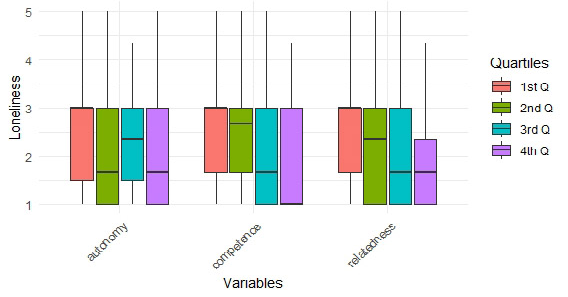
The analysis revealed that perceived loneliness decreased in each consecutive quartile of competence and relatedness, whereas autonomy’s relationship to loneliness might not be as straightforward, as shown in Figure 8. However, the perceived loneliness was higher in the lowest quartile of autonomy than in the highest. Hence, the satisfaction of basic psychological needs seems to buffer loneliness in online teaching context. Overall, only a fourth of respondents reported frequent perceived loneliness (>3).
Basic Psychological Needs Related to Information Ergonomics and Loneliness 1281
Figure 8: Boxplot of loneliness binned by quartiles of basic psychological needs..
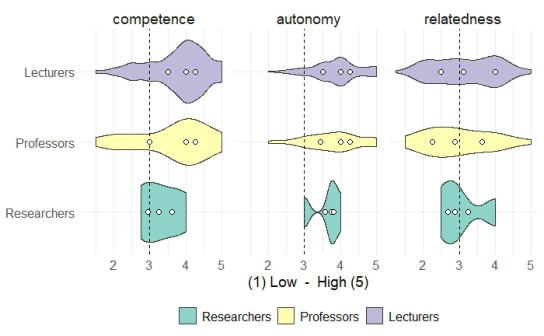
Lecturers’ and Professors’ responses, seen in Figure 9, resembled each other regarding competence, autonomy and relatedness. Contrary to Researches, these responses were more varied and include negative responses (IQRcomp for Lectures 0.75, Professors 1.25. and Researchers 0.69). Lecturers’ (Mcomp=4.00) (Maut=4.00) and Professors’ (Mcomp=4.00) (Maut=4.00) mean scores were higher for competence and autonomy, compared to Researchers (Mcomp=3.25) (Maut=3.75), who reported more neutral responses. Regarding relatedness, all mean scores were neural: Lecturers (Mrel=3.13), Professors (Mrel=2.88), and Researchers (Mrel=2.88). However, the responses to relatedness were more spread out around neutral than responses regarding competence and autonomy.
Figure 9: Basic psychological needs per academic role.
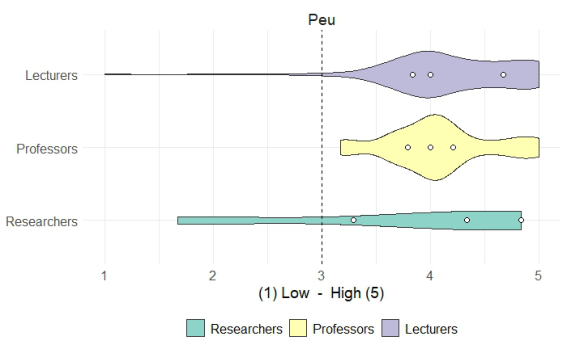
Researchers reported slightly higher (Mpeu=4.33) perceived usefulness of technology than Lecturers (Mpeu=4.00) and Professors (Mpeu=4.33), displayed in Figure 10. While the medians of Researchers and Professors were equal, a larger portion of Lecturer’s responses were ≥4.5. Professors reported only neutral to positive perceived usefulness of technology
(IQRpeu=0.42). However, Researchers (IQRpeu=1.54) and especially Lectures (IQRpeu=0.83) responses were more spread out including negative responses.
Figure 10: Perceived usefulness of technology per role.
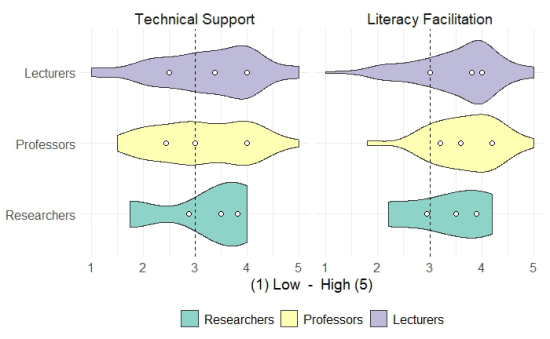
Academics perceptions of technostress inhibitors i.e., technical support provision and literacy facilitation resembled each other, but technical support had a wider range of responses and included more negative scores i.e. Researchers (Msupp=3.50, IQRsupp=0.94), Lecturers (Msupp =3.38, IQRsupp=1.50) and Professors (Msupp=3.00, IQRsupp=1.56), as shown in Figure 11. Regarding literacy facilitation, all academic roles reported mostly neutral to positive scores with Lecturers (Mlitf=3.80, IQRlitf=1.00) and Professors (Mlitf =3.60, IQRlitf =1.00) and Researchers (Mlitf =3.50, IQRlitf=0.95).
Figure 11: Technostress inhibitors per academic role.
Basic Psychological Needs Related to Information Ergonomics and Loneliness 1283
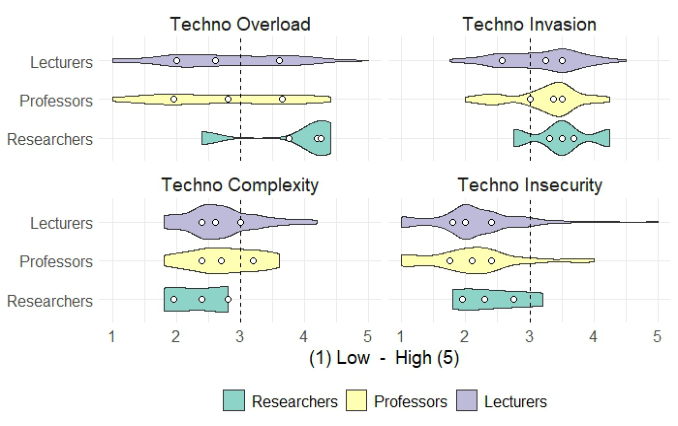
Researchers reported the highest median scores on techno-overload (Mtover=4.20, IQRtove=0.50). Nevertheless, Lecturers’ (Mtover=2.60, IQRtover=1.600) and Professors’ (Mtover=2.80, IQRtove=1.70) responses were more spread out than Researchers’. Similar pattern was observed with techno-invasion, although the median scores were quite even with Researchers (Mtinv=3.50, IQRtinv=0.38), Lecturers (Mtinv=3.25, IQRtinv=0.94) and Professors (Mtinv=3.38, IQRtinv=0.50). All academic roles reported fairly low techno-complexity scores: Researchers (Mtcoml=2.40, IQRtcoml=0.85), Lecturers (Mtcoml=2.60, IQRtcoml=0.60) and Professors (Mtcomlr=2.70, IQRtcoml=0.80). The same applied also to techno-insecurity: Researchers (Mtinsec=2.30, IQRtinsec=0.80, Lecturers (Mtinsec=2.00, IQRtinsec=0.60) and Professors (Mtinsec=2.10, IQRtinsec=0.65). The results can be seen in Figure 12.
Figure 12: Technostress creators per academic role.
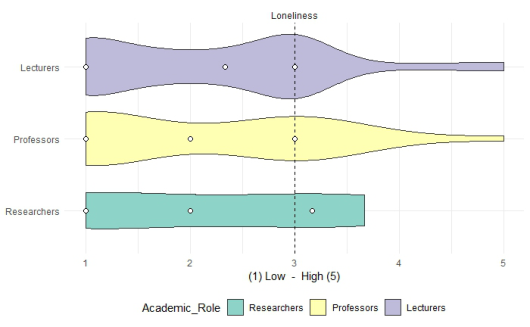
All academic roles reported lower levels of loneliness (Lecturers Mlone=2.33, Professors Mlone=2.00 Researchers Mlone=2.00) and 32% reported no loneliness at all. However, Lectures (IQRlone=2.00) and Professors (IQRlone=2.00) responses were more varied, and they reported also high levels of loneliness as displayed in Figure 13.
Figure 13: Perceived loneliness per academic role.
DISCUSSION
Based on the results, basic psychological needs of autonomy, competence and relatedness in online teaching context appear to be quite diverse in relation to perceived usefulness of technology, technostress and loneliness. Fulfilment of basic psychological needs is known to be the key driver of wellbeing, motivation and thrive at work (Ryan & Deci, 2017). Although the shift to online teaching has been tremendous, it is notable that academics reported quite mixed results regarding wellbeing. In addition, considering the Ghanaian context in which infrastructure for online teaching is still quite basic level (Adargwah, 2021; Sarpong et al., 2021), the results are rather encouraging.
Indeed, academics have indicated that the perceived usefulness of technology was considerably higher in the fourth quartiles of autonomy, competence and relatedness than in the first. This indicates that those 25% of the academics feel that their basic psychological needs are being met via online teaching and they also consider technology useful in their work supporting the prior findings that perceived usefulness of technology is influencing the attitudes and intentions to use technology (Holden & Rada, 2011). Technostress inhibitors i.e., literacy facilitation and technical support were higher in the highest quartiles of the academics whose autonomy, competence and relatedness were fulfilled in online teaching.
Furthermore, regarding technostress dimensions, it seems that those academics who felt competent and had a greater sense of autonomy and relatedness in online teaching context experienced lower techno-complexity. Overall, techno-insecurity was low among the academics, which is promising and indicates that they, for instance, do not feel that technology or colleagues with better technological skills threatens their work. Interestingly, academics did not report considerable techno-invasion, nor it appears to vary with quartiles of autonomy, competence and relatedness, although technology is usually regarded very invasive especially in remote work settings (Leung
Basic Psychological Needs Related to Information Ergonomics and Loneliness 1285
et al., 2017; Molino et al., 2020). Techno-overload was also quite neutral; however, these results could also indicate that higher levels of satisfaction of psychological needs could also alleviate possible perceived techno-overload.
Moreover, considering the increased loneliness reported among teachers (Mäkiniemi et al., 2021), our results are contradictory and suggest that when academics fulfil their needs of competence and relatedness in online teaching it can also decrease their perceived loneliness. Although the relationship between autonomy and loneliness is not entirely straightforward, it appears that perceived loneliness is more pronounced in individuals with lower autonomy compared to those with higher autonomy. This also aligns with the prior study by Wang and colleagues regarding positive role of autonomy in mitigating sense of loneliness (Wang et al., 2021).
Regarding the different academic positions, the results highlight that Researchers’ responses seem to differ from Lectures and Professors for most of the variables in question. For example, the results demonstrate that Lecturers and Professors experience more psychological needs satisfaction in online teaching context than Researchers. However, Researchers responses are more condensed without negative experiences. Researchers also reported less loneliness than other roles. Nevertheless, Researchers experienced more techno-overload and techno-invasion, but not so much techno-complexity and techno-insecurity. The findings between the academic roles could be plausibly explained by the varying nature of work between Researchers, with Professors and Lecturers doing more teaching and collaboration related tasks while Researchers may work more by themselves and feel less connected to their work community. Overall, it seems that Researchers in this sample are a group that regard their work very similarly to each other, as indicated by smaller IQRs. Notably, professors reported the highest perceived usefulness of technology in their work. The findings also highlight the positive results regarding technical support and literacy facilitation emphasizing their importance both for academic success and the overall wellbeing of the work community.
These current results are noteworthy especially as COVID-19 induced more technology utilization in teaching and swiftly pushed academics to teach online (Debrah et al., 2021; Naqshbandi, et al., 2024). Future studies could explore the longitudinal relations among these variables to better understand their trends over time. Nevertheless, these results emphasize the importance of providing technical support and facilitation, for instance knowledge sharing and training for academics. Keeping in mind that prioritizing effective organizational management can help sustaining wellbeing (Wang & Li, 2021). Furthermore, fostering social belonging is central in maintaining overall wellbeing and motivation at work.
ACKNOWLEDGEMENT
This study was conducted under European Comission Erasmus+ grant for Capacity Building in Higher Education project GOT, project number 101082794. The authors would like to acknowledge Dr Benjamim Ghansah,
Dr. Ephraim Kwaku Kwaa-Aidoo and Dr. Christopher Yarkwah for their contribution and support in planning and execution the survey.
REFERENCES
Adarkwah, M. A. (2021). “I’m not against online teaching, but what about us?”: ICT in Ghana post Covid-19. Education and information technologies, 26(2), 1665–1685. https://doi.org/10.1007/s10639-020-10331-z Boyer-Davis, S. (2020). Technostress in higher education: An examination of faculty
perceptions before and during the COVID-19 pandemic. Journal of Business and Accounting, 13(1), 42–58. Davis, F. (1989). Perceived usefulness, perceived ease of use, and user acceptance of information technology. MIS Quarterly, 13(3), 319–339. https://doi.org/10.2307/ 249008 Debrah, A., Yeyie, P., Gyimah, E., Halm, G. G., Sarfo, F. O., Mensah, T.,... &
Vlachopoulos, D. (2021). Online instructional experiences in an unchartered field- The challenges of student-teachers of a Ghanaian College of Education. Journal of Digital Learning in Teacher Education, 37(2), 99–110. https://doi.org/10.1080/ 21532974.2021.1892553 deCharms, R. 1968. Personal causation: The internal affective determinants of behaviour. Academic Press. Deci, E. L., & Ryan, R. M. (2000). The “what” and 2why” of goal pursuits:
Human needs and the self-determination of behavior. Psychological Inquiry, 11(4), 227–268. https://doi.org/10.1207/S15327965PLI1104_01 Fuchs, C. & Reichel, A. (2023). Effective communication for relational coordination in remote work: How job characteristics and HR practices shape user–technology interactions. Human Resource Management, 62(4), 511–528. https://doi.org/10. 1002/hrm.22161 Holden, H., & Rada, R. (2011). Understanding the influence of perceived usability
and technology self-efficacy on teachers’ technology acceptance. Journal of Research on Technology in Education, 43(4), 343–367. https://doi.org/10.1080/ 15391523.2011.10782576 Koenker, R. (2005). Quantile regression (Vol. 38). Cambridge University Press. Lal, B., Dwivedi, Y. K., & Haag, M. (2023). Working from home during Covid- 19: doing and managing technology-enabled social interaction with colleagues at a distance. Information Systems Frontiers, 25(4), 1333–1350. https://doi.org/10. 1007/s10796-021-10182-0 Leung, L.and Zhang, R. (2017). Mapping ICT use at home and telecommuting
practices: a perspective from work/family border theory. Telematics and Informatics, 34(1), 385–396. https://doi.org/10.1016/j.tele.2016.06.001 Li, L., & Wang, X. (2021). Technostress inhibitors and creators and their impacts on university teachers’ work performance in higher education. Cognition, Technology & Work, 23(2), 315–330. https://doi.org/10.1007/s10111-020-00625-0 Molino, M., Ingusci, E., Signore, F., Manuti, A., Giancaspro, M. L., Russo, V. &
Cortese, C. G. (2020). Wellbeing costs of technology use during Covid-19 remote working: an investigation using the Italian translation of the technostress creators scale. Sustainability, 12(15), 5911. https://doi.org/10.3390/su12155911 Mäkikangas, A., Juutinen, S., Mäkiniemi, J. P., Sjöblom, K., & Oksanen, A.
(2022). Work engagement and its antecedents in remote work: A person-centered view. Work & Stress, 36(4), 392–416. https://doi.org/10.1080/02678373.2022. 2080777
Basic Psychological Needs Related to Information Ergonomics and Loneliness 1287
Mäkiniemi, J.-P., Oksanen, A. & Mäkikangas, A. (2021). Loneliness and Well- Being during the COVID-19 Pandemic: The Moderating Roles of Personal, Social and Organizational Resources on Perceived Stress and Exhaustion among Finnish University Employees. International Journal of Environmental Research and Public Health, 18(13), 7146. https://doi.org/10.3390/ijerph18137146 Naqshbandi, M. M., Kabir, I., Ishak, N. A., & Islam, M. Z. (2024). The future
of work: work engagement and job performance in the hybrid workplace. The Learning Organization, 31(1), 526. https://doi.org/10.1108/TLO-08-2022-0097 Petani, F. J. & Mengis, J. (2021). Technology and the hybrid workplace: the affective living of IT-enabled space. The International Journal of Human Resource Management 1–24. https://doi.org/10.1080/09585192.2021.1998186 Ryan, R. M., & Deci, E. L. (2017). Self-Determination Theory: Basic Psychological
Needs in Motivation, Development and Wellness. The Guilford Press. Sarpong, S. A., Dwomoh, G., Boakye, E. K., & Ofosua-Adjei, I. (2021). Online teaching and learning under COVID-19 pandemic; perception of university students in Ghana. European Journal of Interactive Multimedia and Education, 3(1), e02203. https://doi.org/10.30935/ejimed/11438 Tapani, A., Sinkkonen, M., Sjöblom, K, Vangrieken, K. & Mäkikangas, A. (2022). Experiences of relatedness during enforced remote work among employees in higher education. Challenges, 13(2), 55. https://doi.org/10.3390/challe13020055 Venkatesh: V., & Davis, F. D. (2000). A theoretical extension of the Technology
Acceptance Model: Four longitudinal field studies. Management Science, 46(2), 186–204. https://doi.org/10.1287/mnsc.46.2.186.11926 Wang, X., & Li, B. (2019). Technostress among university teachers in higher education: A study using multidimensional person-environment misfit theory. Frontiers in Psychology, 10, 470614. https://doi.org/10.3389/fpsyg.2019. 01791 Wang, B., Liu, Y., Qian, J. & Parker, S. K. (2021). Achieving effective remote working during the COVID-19 pandemic: A work design perspective. Applied Psychology, 70(1), 16–59. https://doi.org/10.1111/apps.12290 White, R. 1959. Motivation reconsidered: The concept of competence. Psychological
Human Factors in Design, Engineering, and Computing
Read this individual research paper free through the original publisher, or explore the full digital proceedings book.
ISBN 978-1-964867-35-9
Explore this ISBN in the AHFE Bookstore ↗Listed in the July 2026 bookstore catalogue; search by ISBN to confirm current availability · Digital book purchase optional