Christian Andersson, Mia Laine, Jussi Okkonen (2025). Defining Autonomous Functionalities of Narrow Artificial Intelligences for a Defensive Unmanned Ground Vehicle to Enhance Human-UGV Teaming Performance for Defending Forces. In: Human Interaction and Emerging Technologies (IHIET-AI 2025): Artificial Intelligence and Future Applications. AHFE Open Access, vol. 161, pp. 232–242. https://doi.org/10.54941/ahfe1005914
Publisher statistics will load when you open Metrics.
AHFE OPEN ACCESS OPEN ACCESS CONFERENCE PROCEEDINGS PAPER
Defining Autonomous Functionalities of Narrow Artificial Intelligences for a Defensive Unmanned Ground Vehicle to Enhance Human-UGV Teaming Performance for Defending Forces
There is a growing need to integrate artificial intelligence (AI) into military systems, particularly unmanned vehicles (UxVs). In this paper, the application of AI in defensive combat scenarios involving UGVs is explored. The report is based on an extensive quasi-experiment (n= 458) in a simulation environment. The experiment employed the Wizard of Oz methodology to simulate autonomy in Laykka unmanned ground vehicles (UGVs) within the Virtual Battle Space 4 (VBS4) platform, conducted in collaboration with the Finnish Defense Forces (FDF). This paper explores the potential applications of AI in defensive combat operations. Participants included conscripts and enlisted staff officers, with five operators managing the UGVs. The simulation involved participants taking roles in a defending platoon supported by 16 autonomous UGVs, and in an attacking mechanized infantry company. A total of 48 scenarios were conducted, with data collected through questionnaires, mock graphical user interfaces, qualitative interviews, and scenario event analysis. This paper focuses particularly on the aspects of autonomy and its possible uses learned from the simulation, thus being an explorative study. Questionnaire and simulation data collected from users, operators, and observers is utilized to identify potential requirements and optimal locations for the integration of autonomy in UGVs. The findings highlight the necessity for highly structured command inputs when deploying AI in military contexts. Furthermore, the study suggests that AI is not always essential, and when utilized, it should be restricted to specific, well-defined tasks and functions.
The applications of artificial intelligence (AI) has grown in variety and usage. Due to this growth and spread of this technology, it is clear that the AI imbued machines are here to stay. Militaries across the globe recognizes the potential of AI and are more than interested in using and applying it to
Defining Autonomous Functionalities of Narrow Artificial Intelligences 233
different sectors of its forces, varying from decision making all the way to war machines on the battlefield. Zhang et al. identified seven distinguished application for AI in military application of which one was autonomous weapon platforms (Zhang et al., 2020). These platforms would include autonomous target recognition and targeting. The current Ukrainian war theatre has shown new capabilities used in full fledged war, including numerous types of unmanned vehicles (UxV). This theatre has shown a great need for autonomous unmanned ground vehicles (UGVs). Many countries are developing their own UGVs to be used in different applications and missions (Andersson, 2021). One of such devices in active research use is Laykka UGV. The Laykka UGV is a platform that can accommodate several modules in order to adapt its functionalities to several tasks. In a previous description, its main purpose and advantage are its disposability (Andersson et al., 2024). During this study, a new model of Laykka X.4 was introduced. In addition to functions of Laykka X.3, the new model could also carry out patient evacuation missions. The simulations were conducted in the Virtual battle space 4 (VBS4) environment (Bohemia Interactive, 2024).
Not only are the militaries interested in the UxVs but also in the artificial intelligence (AI) capable in operating these systems in more efficient manner than humans. Thus, wanting AI integrated into various military systems, but especially in the UxVs (Morgan et al., 2020). This integration sparks interesting questions, such as will the human-autonomy teaming (HAT) deepen, will this bonding bring forth increase in use efficiency, and how this relationship and interaction will affect the future uses of UxVs but especially UGVs. HAT is multifaceted phenomenon as discussed in O’Neill et al. (2020) in general or in this particular case in Okkonen et al. (2024). In Kolb (2012), it was found that soldiers did to some extent form bonds with UGVs and their relations deepened in stressful situations such as in combat.
It is important to take in to account the ethicality of the system especially when developing military grade systems especially with the AI (Royakkers & van Est, 2015). As such it is a topic of its own, thus this study does not take into consideration the ethical perspectives of use or operating procedures of this system.
METHOD
In the experiment participated totally of 470 people. Of 458 respondents to user experience were conscripts of which 92 had direct use contact with the Laykka commands. Other respondents were 5 operators and 7 observers. Of 458 users 26 were commissioned officers and personnel. The 5 operators were all commissioned officers. The 7 observers were either higher ranking officers or civilian specialists. The operators operated the Laykka’s in the simulator according to the user’s commands, and in the second stage, they simulated the AI. The observer’s task was to monitor the unfolding situations in the scenarios during the simulations and record the events. Three of the observers served also as commanding officers for the groups. The entire test group was divided in to 22 groups of approximately 17–20 persons each. The groups were divided into defending force (DEFFOR) and
opposing force (OPFOR) groups. In the simulation, OPFOR represented a full mechanized infantry company, as DEFFOR was a single platoon with the UGV reinforcements. These groups would switch roles after two fought scenarios. A single simulation session consisted of total four scenarios. 48 scenarios were fought in total, including four reference scenarios without UGVs. The reference scenarios demonstrated the power gap between OPFOR and DEFFOR without UGVs.
The operators and participants attended a brief training session before the experiment. The operators basic training was a three-hour intensive to core operation principals of the UGV and VBS commands. Conscripts attended a 30-minute introduction to essential VBS commands.
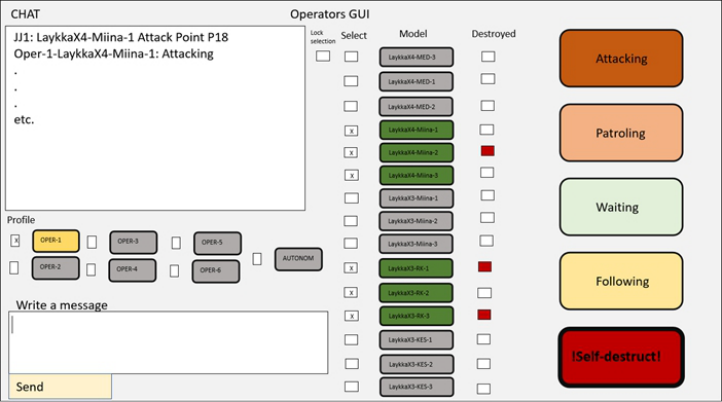
Figure 1: Mock graphical user interface of an operator with example commands for the UGV fleet. This minimal structure of a GUI was not regarded to be satisfactory by the operators.
In order to simulate an AI capable of understanding complex context in a similar manner to a human or a soldier, the Wizard of Oz (WoZ) method (Kelley, 1983) was used similar to the study conducted by (Johansson et al., 2020). In our study each group participated in four simulations scenarios. In scenarios 1 & 3 the users and operators could use a mock graphical user interface (mGUI) (see Figure 1) to communicate but still could shout to the operator if needed, as this was to simulate situation where operator was controlling the UGVs and there was no AI present. In scenarios 2 & 4 the operators were separated from the group and in accordance to the WoZ method simulated an AI to the defending platoon via the mGUI. Contrary to the study by Johansson et al., participants in this experiment could interact with the autonomous UGV only via the mGUI, and no voice commands were allowed.
The mGUI was developed solely for this experiment. The mock GUIs were similar for users and operators, the biggest difference being in the button’s
Defining Autonomous Functionalities of Narrow Artificial Intelligences 235
expressions. The aim of this mGUI was to guide users to give structured commands. The buttons filled automatically parts of the command seen in the message box. It was possible to write additions to the message in the message box, or write freely a completely new message. All messages send were seen in the chat box. The user could filter the messages by selecting if he wanted to see all the messages send during the mission in progress or just the ones from certain operator. All messages were saved on a separate server.
With the help of the Wizard of Oz method and the mGUI this study could find possibly new or unpredicted ways of use of the system, and in addition it eased data gathering. The mGUI aided in the immersion and creating the illusion of autonomy with a human like AI capable of understanding complex context in a similar manner to a human or a soldier in this case.
RESULTS
Following each simulation, all participants completed online questionnaires according to their roles. Additionally, after the conclusion of each session, users and operators were interviewed to clarify their responses and address notable events or occurrences observed during their session. This section presents the results of the questionnaires concerning the use of the mGUI, along with key findings and insights related to the autonomous Laykka system.
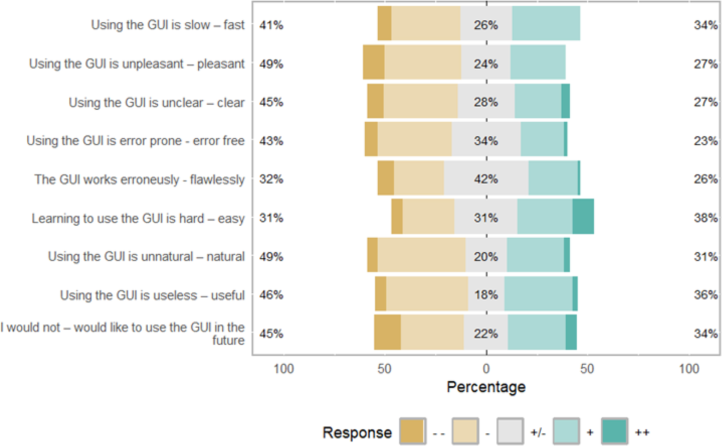
Figure 2: Operators response in using the mGui. The percentages refer to combined proportion of negative, neutral and positive responses.
The Operators’ (n = 5) repeatedly measured user experience with the mGUI is represented in Figure 2. What is notable in Figure 2 is the answers are close to being uniformly distributed, but they are weighted towards
the negative. The identified challenges included, but were not limited to, difficulties in switching between UGVs, challenges in monitoring multiple devices simultaneously, high sensitivity of controls, and the risk of initiating self-destruct mechanisms in close proximity to friendly infantry.
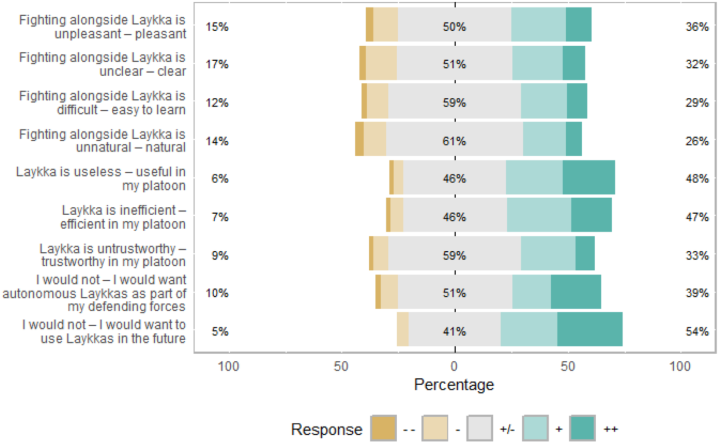
Figure 3: Conscripts user experience. The percentages refer to combined proportion of negative, neutral and positive responses.
Figure 3 represents the experiences of conscripts (n = 458) had with Laykka. The answer consists of users that directly interacted with Laykkas and mGui as well as those that did not. The answers are grouped together since the differences between these groups were insignificant. The autonomous Laykka was experienced neutrally (41–61%) positively (26–54%), with only a small proportion of responses being negative (5–17%). While Users and Operators alike found the mGui to be inadequate, autonomous Laykka was seen to be useful, effective and desired as part of the defensive forces. The conscripts expressed in open field of the questionnaires as well as in the interviews that the unmanned system increased sense of security. The presence of an unmanned system ahead of the human troops to absorb initial impacts with OPFOR increased situational awareness and facilitated readiness. The presence of UGVs were perceived to comforting during disengagement, as something was known to be slowing down the advance of OPFOR. Furthermore, the ability to deploy an UGV to retrieve a wounded individual from areas under fire was considered advantageous, as it reduced the need to expose additional troops to unnecessary danger.
During the autonomous phase of the experiment, operators noted that user-issued commands to the UGV were frequently flawed, incoherent, or poorly structured. While the experiment showcased a simulated AI capable of interpreting commands in a manner akin to human understanding, this
Defining Autonomous Functionalities of Narrow Artificial Intelligences 237
simulated capability proved to be insufficient to mitigate user error caused by the unstructured command format. The commands were often ambiguous, leading to misunderstandings even among human operators, which would typically necessitate additional clarifying questions, further delaying the execution of necessary actions.
Observer and operators brought up that even though there would be an AI capable of understanding contexts as well as human, in military applications the commands would still need to be fully structured and closed commands similar to “call for fire”. An example of this new type of command would be structured in a proposed manner: “Who to Whom (Call sign) – Location (Coordinates in MGRS or Point or Area, Direction, Distance) – Action (Attacking, Defending, Stalling, Autodestruct) – Target (Target type, Target activity, Degree of protection, Amount; coded) – Weapon type (MG, AT, etc.) – Fire mode (Number of rounds) – Specification – Autonomy level (Human or AI) – Engagement permission (If AI enabled) – Remarks (Notes or additional specifications open format).” Here an example of a fire order for a UGV: “Oper1 to Laykka11&Laykka14 – P20 100 15-00 300 – Attack – 26RL2 – Laykka11 MG 35 Full auto – Laykka14 Autodestruct – AI – Engage – Laykka11 Autodestruct after Full auto”. The call-for-fire procedure adheres to the Finnish Defence Forces (FDF) format, which is more rigid and prescriptive compared to NATO’s call-for-fire protocol, as outlined in Section II 308 of AArtyP-1(A)(NATO, 2004). This structure necessitates that human operators consistently issue commands to the machine in a highly organized and standardized manner. The modularity and openness of command comes in play how the GUI is laid out and how much an operator or a user can change it to fit individual needs.
Operators shared further insights about improving usability of the UGV during post-scenario interviews and open sections of operator questionnaires. A key requirement for enhancing the autonomy and control of UGVs is a system capable of providing simultaneous real-time information about the UGV’s status and operations. Operators brought up that this could be achieved through a multi-monitor setup or, at a minimum, a multi- window interface. Additionally, an essential feature requested was the integration of an advanced alert system within the UGVs. Such a system would enable the robots to notify operators of enemy presence, activities, and potentially predict the movement trajectories of enemy tanks or soldiers. Currently, the system was passive, lacking any alert or stimulus capabilities. Incorporating these features would enhance situational awareness and assist in re-engaging operators who may be fatigued, distracted, or disengaged. Operators also reported challenges in switching between UGVs and forming a comprehensive understanding of unfolding events. The integration of AI capabilities would enhance human responsiveness to the rapid dynamics of machine operations. A clear need was identified for the GUI to include functionality for quickly placing waypoints on the map, enabling more precise navigation and operational command execution. The ability to provide voice commands directly to the AI was deemed unnecessary, as noted by observers. During active combat scenarios, there is a significant
risk of misinterpretation of commands due to potential background noise or suboptimal phrasing.
In conclusion, the mGUI presented was not considered to be good enough, as shown in Figure 1, even though it was aimed to provide structured and a logical way of giving commands to the machines. The negative user experience presented in Figure 2 advocate for these results. The operators and observers noted in interviews, that AI is not required in every aspect or in every functionality of the UGV during combat, but autonomy is received well if the system is efficient and achieves desired results as seen in Figure 3.
DISCUSSION
Training of Operators All human-operated systems necessitate a certain degree of training or instruction to ensure their effective and accurate utilization. In the initial phase, it is crucial to provide foundational training focused on the platform’s core features, functionalities, and individual capabilities. The operator must first develop a comprehensive understanding of the machine’s functionality in its non-AI-assisted state. In the next stage of training, the focus shifts to familiarizing operators with the specific AI system, including its operation and integration with the machine. Operators must gain a comprehensive knowledge of all inputs, outputs, and the potential outcomes to ensure effective and informed interaction with the AI. For a soldier to effectively utilize their equipment, it is imperative to possess a detailed understanding of the system’s capabilities and limitations. This principle equally applies to AI systems. Consequently, AI employed in military applications must not operate as a “black box”; the soldier must comprehend the system’s constraints and underlying mechanisms to ensure informed and reliable use.
Basic training of the system was found to be essential by the operators, but they also expressed that the three-hour training was not experienced to be enough. Conversely, from the observers’ point of view the training seemed adequate to get the job done. Accelerated learning in action during the initial scenarios could be observed, and completely new and untrained skill emerged during the week.
AI Profiles Divisions in Military UGV During a previous similar smaller experiment, four different AI profiles were identified (Andersson et al., 2024). During the current experiment, these profiles were tested as to confirm the findings and make the AI capabilities requirements more precise. These four profiles were: “Master”-, “Tactical”-, “Recon”- and “Support”- profiles. The latest experiment helped to explore and define more specific AI functionalities for each profile and human computer interfaces for this kind of UGV.
Master profile would include AI capable managing the other three profiles narrow AIs. The Master AI would reside inside the main UGV platform, and the other ones inside adequate modules. This Master profile would be the main interface for the human operator and he would communicate thought it
Defining Autonomous Functionalities of Narrow Artificial Intelligences 239
to other profiles. This GUI would include the main commands for individual Laykka UGVs, that could be commanded individually or as a swarm.
The “Master” AI would include the swarm handling capabilities and autonomous navigations. During the experiment the swarm AI capabilities were not the main focus of the test, even though some of these features appeared in the experiment. The swarm capability was indeed needed for an efficient control of several fleets of UGV’s, this was stated by the operators and observers.
“Tactical” -profile would include AIs capable of recognising different military vehicles, personnel, provide target locking, target following, and predicting target trajectories using passive sensors. For a UGV with defensive capabilities and weaponry it was crucial that the AI would assist the operator for intercepting of the target and in aiming at the fast-moving target. In addition, it was desired that the robot and system would start alerting of targets into the map system or by a noise or video signal. What was desired to be shown was: targets (vehicle type, enemy or friendly, infantry presence), direction of movement and location. In addition to this the operators expressed a future improvement, that the system would give them recommendation based on information gathered and from the sensors of the UGVs in order to choose a Laykka for most efficient outcome. This applied especially when the operator had more than one UGV at his disposal.
In the “Recon” -profile, capabilities similar to those of the tactical profile were identified, but the Recon profile emphasized specialized use cases, such as advanced route selection, target recognition, and the ability to detect and counter enemy signals in real-time. The “Recon” -profile would require more sophisticated sensors than those used in the “Tactical” -profile, necessitating more specialized AI capable of leveraging these advanced sensors and additional capabilities.
Lastly the “Support” -profile would need to be able to provide supportive AI capabilities, in instances such as patient evacuation, managing drone swarms or tethered communication drones, and ammunition resupply routes. These systems would need to be as intuitive as possible and acting in a predictable manner.
Additional Identified AI Capabilities and Features for Enhancing Human-Machine Teaming in Military UGVs As in combat situation it is already difficult to give simple understandable commands to even humans. Thus, commands given to a machine need to be specific and be given according to strict command rules, they should be at this time of technological development given by a written format. To clarify, the command does not need to be fully written, buttons and pre-written messages and ready-made commands that transforms the order in a written format. The primary factor is the constrained and predefined format, which can be filled with elements such as buttons. The GUI role in formulating the message is to help to minimize the human error by guiding the human operator to precise and appropriate uses of the UGV and giving correct commands to the system. The AI could also help in selecting appropriate UGV according
to the target information from the call for fire command and following the situation of UGVs and their sensor. Leveraging data from the UGV network and historical actions, the AI can generate more informed recommendations and predict potential enemy behaviors, thereby suggesting corresponding countermeasures.
During the skirmishes it was noted that own casualties could arise from a self-destruct sequence when the UGV would engage an enemy tank close to friendly trenches or territory. To make the system more secure and avoid own unnecessary casualties there must be integrated a “non-fatal zone”-protocol where the AI is not automatically authorized to engage in lethal activity for example: shooting or exploding. The UGV would stop by the designed zone border and would not engage targets inside the “non-fatal” zone. This protocol could be overridden only by a human operator in a dire situation if needed, but then the possible risks and casualties would be known, and the responsibility would be carried by the operator that gave the permission to engage. Some additional levels to the suggested protocol could be a flexible allowance of AI actions. The operator could choose zones and give them different level of permissions for AI to engage, e.g in one zone AI is allowed to engage an identified target without the need for the operator separate permission, in the second zone the AI is required to ask for permission before engagement and in the third zone, the “non-fatal” the AI is not allowed to engage anyone or even enter the zone.
The observers and operators identified possibly a swarm AI capability to be useful for the UGVs. This hive would function based on a hierarchal or localized hierarchy system. This observation came forth from the difficulty to operate and observe several UGV’s at the same time. Multiple UGVs required the operator to make quick decisions on which one to choose for the assault task and where to gather intelligence on the enemy’s movements and forces. Several times operators chose incorrect Laykkas, that were either way behind the enemy lines or to far ahead of the enemy, and thus requiring operating them to closer positions. Simply said, it was more difficult to predict the enemy’s movements from a narrow visual system and with no alerts from the UGVs. The AI could assist operators by providing predictions of potential enemy movement trajectories, particularly during manual UGV operation, thereby enhancing the precision of system targeting.
This raises a question if there should be a binding between human and AI since early stages of the operators training, where AI is trained simultaneously from scratch and single AI is bound to each operator. As they train together and develop they become more efficient, and the AI starts to adapt to its human operator and is able to give required suggestions and guidance according to individual human quirks, but still the AI would understand the tactics and maneuvers required from each UGV device. This bonding would resemble the Tamagotchi effect (Frude & Jandri´c, 2015), as human would rely on the AI and taking care of it. This effect could go deeper into forming a bond as they are taking care of each other instead of human just taking care of the AI, and human care is needed for the AI development. (Kolb, 2012) stated in his dissertation that some amount of bonding and anthropomorphizing happened but this occurred mostly on teleoperated UGV. Incorporation of
Defining Autonomous Functionalities of Narrow Artificial Intelligences 241
AI could change these findings and how human operators see their UGVs in the future. The operators could be preselected and deemed suitable for operating UGVs based on certain capabilities as it is stated in the study by (Okkonen et al., 2024). One major issue could arise in a case if the human operator falls in combat, and someone else takes charge of this highly custom fleet of UGVs.
CONCLUSION
AI systems are not expected to be entirely flawless; rather, they must surpass human capabilities in speed and accuracy while remaining sufficiently predictable to ensure seamless and reliable operator interaction. The AI used in military context cannot be a black box system or unpredictable, but instead robust, explicable and transparent. The AI used needs to be made specifically for application in question, they should not be general all capable AIs, as they would complicate the whole system and its use unnecessarily. It can be said that AI is not needed in every aspect of combat or not even in all machines fighting the war. Sometimes simplicity is better. In an insecure and chaotic environment more insecurity is not desired, a soldier wants a machine or a system to be predictable, clear and secure to use for them, in order to achieve their mission targets. In high-risk environments, soldiers seek reassurance and a sense of security, which well-designed AI systems can potentially provide. However, an AI with unknown or poorly understood capabilities is unsuitable for combat applications. For deployment in UGVs, the AI must be both predictable and reliable, serving as a trustworthy and dependable operational partner.
ACKNOWLEDGMENT
The study for this paper was funded by the grant of PVTO program. Authors acknowledge the contribution of the FDFs Virtual Training Conscripts of Armoured Brigade, the FDF Chief of Virtual Training and participants, as well as the other people in Finnish Defence Forces.
REFERENCES
Andersson, C., 2021. The unmanned ground vehicles to be used in future military operations. 79 toim. Helsinki: Tiede ja ase. Andersson, C. A. ym., 2024. Effectiveness of an Expendable Unmanned Ground
Vehicle Stalling a Mechanized Infantry Company’s Primary Combat Units—A Virtual Simulation Experiment. Journal of Field Robotics, pp. 1556–4959. Bohemia Interactive, 2024. Bohemia. [Online] Available at: https://bisimulations.com/products/vbs4 [Accessed 07.11.2024]. Frude, N. & Jandri´c, P., 2015. The Intimate Machine – 30 years on. E-Learning and Digital Media, 3(12), pp. 410–424. Johansson, B. J. E. ym., 2020. Ledning av autonoma och sammansatta system för
mekaniserad strid, s.l.: FOI. Kelley, J., 1983. An empirical methodology for writing user-friendly natural language computer applications. CHI ‘83: Proceedings of the SIGCHI Conference on Human Factors in Computing Systems, 12 December. pp. 193–196.
Kolb, M., 2012. Soldier And Robot Interaction In Combat Environments, Ann Arbor: ProQuest LLC. Morgan, F. ym., 2020. Military Applications of Artificial Intelligence: Ethical
Concerns in an Uncertain World. NATO, N. A. T. O., 2004. AArtyP-1(A) Artillery Procedures. s.l.: NATO. Okkonen, J., Laine, M. & Andersson, C., 2024. Technology relationship, algorithmic thinking and task performance with UxV. Human Factors in Design, Engineering, and Computing AHFE, Issue 159, pp. 1–7. O’Neill, T., McNeese, N., Barron, A., & Schelble, B. (2022). Human–Autonomy
Teaming: A Review and Analysis of the Empirical Literature. Human Factors, 64(5), 904–938. https://doi.org/10.1177/0018720820960865 Royakkers, L. & van Est, R., 2015. A Literature Review on New Robotics: Automation from Love. Int J of Soc Robotics, Issue 7, pp. 549–570. Zhang, Y. ym., 2020. Application of Artificial Intelligence in Military: From Projects
View. s.l., IEEE, pp. 113–116.
LISTED IN THE AHFE DIGITAL BOOKSTORE CATALOGUE
Explore the complete digital volume
Human Interaction and Emerging Technologies (IHIET-AI 2025): Artificial Intelligence and Future Applications
Read this individual research paper free through the original publisher, or explore the full digital proceedings book.
ISBN 978-1-964867-37-3
Explore this ISBN in the AHFE Bookstore ↗Listed in the July 2026 bookstore catalogue; search by ISBN to confirm current availability · Digital book purchase optional