Laura Salmela, Sirra Toivonen, Jari Laarni, Jaana Keränen, Antti Väätänen (2024). Participatory approach for specifying user requirements for maritime border surveillance system. In: Human Systems Engineering and Design (IHSED2024): Future Trends and Applications. AHFE Open Access, vol. 158, pp. 354–362. https://doi.org/10.54941/ahfe1005558
Maritime safety and security in European waters constitute of organizationally multi-layered activities, also including cooperation, coordination and information exchange between numerous civilian and military authorities and European agencies. Risks and threats at sea are multifaceted with increasing complexity over time and managing them requires increased collaboration at various levels for achieving comprehensive situational awareness and operational efficiency. A multitasking platform integrating new sensing capabilities from coastal, low-altitude and high-altitude platforms with different external data sources and exploiting novel AI supported risk assessment and visualization capabilities may support national authorities in reaching these objectives. This paper reports a user requirements development process for such a system implementing participatory, iterative design approach. Security-critical development context may severely constrain requirements process in a multi-stakeholder environment. However, in-depth interaction between users and developers does ensure consistent, holistic, and unambiguous requirements process, thus increasing technology acceptance and project success.
Maritime safety and security constitute of activities and operations that are organisationally multi-layered and involve cooperation, coordination, and information exchange among over 400 civilian and military authorities across EU member states as well as European agencies, including the European Border and Coast Guard Agency, the European Fisheries Control Agency, and the European Maritime Safety Agency (European Border and Coast Guard Agency, 2024). Collectively, the organizations perform multiple tasks on the open sea and at coastal areas, such as border control, search and rescue, fisheries control, customs activities, law enforcement and environmental protection. Safety and security challenges, managed by the multitude of authorities, are intricate and interconnected, exemplified by incidents where migrants and refugees are rescued from vessels operated by transnational smuggling networks (UNHCR, IMO and ICS, 2015).
Participatory Approach for Specifying User Requirements 355
Maritime monitoring and surveillance systems integrate data from multiple sensing systems and background data sources into shared platforms, aiming to provide comprehensive situational awareness (Salmela, Umer and Toivonen, 2022) with wide area coverage and accuracy. This empowers authorities to make informed decisions, manage safety and security of lawful maritime activities, and act promptly upon emerging situations or irregularities (Roy, 2008; Riveiro, Pallotta and Vespe, 2018; Conceicäo et al., 2022; Sengül, Yil-man and U˘gurlu, 2023). As the maritime risk landscape constantly evolves, there is a pressing need for new capabilities to assign effective and efficient response measures.
Designing innovative systems for this complex domain underlines the importance of facilitating dialogue between different maritime stakeholders - including authorities, industry, and research parties – to ensure that future systems meet dedicated needs and demands of a diverse set of users (Hiemstra, 2008; Vespe and Mazzarella, 2016). In-depth exchange of views between various stakeholders enhances their understanding of the technical capabilities, needed operational features and potential implementation challenges (Chatzikokolakis and Zissis, 2021), would they be organizational, technical or of other kind.
This paper reports a user requirements development process for a maritime border surveillance system that aims at enhancing border guard situational awareness and the performance of surveillance tasks at external maritime borders of the European Union. The system also intends to support multi-stakeholder management of various incidents, to enhance data-driven decision-making processes, to strengthen collaboration between different stakeholders, to improve data management, and to efficiently exploit information extracted from various data sources. Traditional participatory, iterative design techniques were implemented to holistic development of user requirements which in our case study refer to requirements extracted from users and stakeholders, such as border guards, coast guards, and maritime safety and security authorities.
SOME INSIGHTS FROM RESEARCH LITERATURE Participatory design denotes a collaborative perspective to the design of various artefacts in which a range of stakeholders are harnessed to contribute to the design process (Greenbaum, 1993). Traditionally, participatory design has perceived users as “the foremost experts for their work, their involvement in the development process yields better requirements specifications, and result in better system design and more usable software” (Obendorf, Janneck and Finck, 2009, p. 52). Moreover, to obtain new creative ideas about a particular topic, it is important to foster dialogue between stakeholders. Several methods have been developed to promote negotiations between stakeholders with different intentions such as future workshops, scenario planning, prompted reflections and contextual inquiry (Laarni and Aaltonen, 2013). Eliciting domain-specific knowledge particularly in complex development settings can be supported by storytelling that reveals how experts think when
solving work-related problems. Cognitive task analysis methods, such as Critical Decision Method (CDM), represent a special class of participatory methods dedicated in promoting experts to tell relevant stories (Crandall, Klein and Hoffman, 2006). CDM has been applied in several studies in various safety-critical domains (ibid.), and for example Väätäinen, Laarni and Höyhtyä, 2020 found it suitable for identifying challenges associated with the operation of autonomous robotic swarms and providing other useful information for the requirements development of the technical solutions designed for European border authorities.
As noted by Karasti 2014, referred in (Roland, Sanner and Sæbø, 2017), large-scale technical projects involving multiple stakeholders may significantly challenge participatory design efforts. Zahlsen, Parmiggiani and Dahl (2022) identify seven categories of constraints when implementing participatory design in major IT projects: (1) involving users, (2) ensuring continuous user engagement, (3) handling user heterogeneity, (4) capturing and utilizing insights, (5) applying participatory methods, (6) acquiring appropriate project conditions for PD, and (7) maintaining democratic control. Complex projects often introduce logistical questions on developer possibilities to “engage intimately with situated practices spread out across a large number of sites” (Roland, Sanner and Sæbø, 2017, p. 5).
Spatiality may also contest the application of domain-specific knowledge into the projects’ requirements development process. As policies, practices, and technical solutions tend to be localized, the knowledge obtained from experts coming from different countries and organizations differs. Harmonization of the generated knowledge base and the requirements founded upon it, can constitute a major challenge. Formal methods, such as Domain Science, have been developed to better co-ordinate, plan and manage requirements in systems engineering (Bjørner, 2021).
THE PROCESS FOR DEVELOPING USER REQUIREMENTS Overview
The setting of our work is a multi-annual project called EURMARS1 - An advanced surveillance platform to improve the EURopean Multi Authority BordeR Security efficiency and cooperation funded in the context of EU civil security research under the Horizon Europe – the Framework Programme for Research and Innovation (i.e., Cluster 3 – Civil Security for Society). The final output of the project constitutes of a system-of-systems, including several systems, such as coastal ground sensing system, high-altitude sensing system and satellite-based systems integrated into a platform and operated by border guards for example at a maritime command-and-control unit. At the end of the project, the technology readiness level (TRL) of the solution is estimated to reach TRL 7 or 8 – system prototype demonstration in operational environment (7) or system complete and qualified (8). Different Pilot Use Cases (PUCs) have been defined to validate the solution, covering real-world operations: maritime border surveillance, land border control, 1https://cordis.europa.eu/project/id/101073985
Participatory Approach for Specifying User Requirements 357
maritime search and rescue, and the monitoring of maritime structures and oil spills.
The research consortium consists of close to 20 partners from EU Member States and third countries, including companies, law enforcement authorities, maritime authorities, an EU agency, research institutes and a university. All consortium partners with one or more persons from each organization participated in the user requirements development process with the current authors having a leading role in tailoring a suitable methodological approach for the requirements work and in collecting, analysing, and converting partner inputs received in different forms into exact requirements specifications described in a requirements template. We also facilitated the prioritization process and generated a dedicated repository for requirements management and their distribution inside the consortium.
Our methodology for participatory requirement development merges standard requirements engineering approaches (ISO/IEC/IEEE, 2011), guidelines from requirements literature (Wiegers, 2013; Robertson and Robertson, no date) and insights gained from prior jointly funded research projects having similar thematic focus, objectives, stakeholders, process timeframes and approaches to iterative systems development.
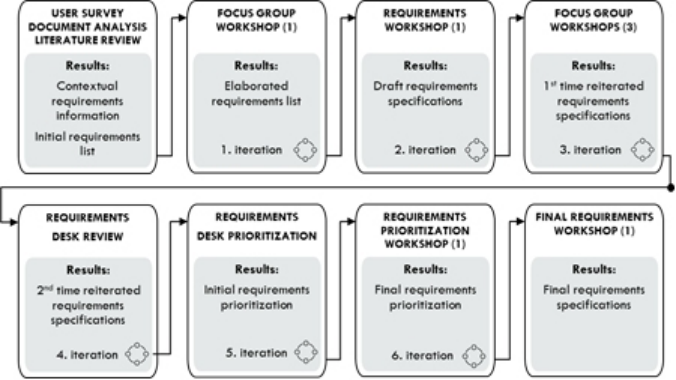
Process Phases The requirements development process consisted of four phases: requirements elicitation; requirements analysis; requirements specification; and requirements validation. The phases were conducted partially in parallel as individual requirements specifications reached maturity at different paces. Figure 1 shows the process depicting also implemented user research methods and results of intermediate phases.
Figure 1: User research methods and process for user requirements development.
User Survey Surveys form a cost-efficient method to gather user information, for example when users are remotely located from requirements analysts and developers (Wiegers and Beatty, 2013). Surveys can be used to extract user needs and provide important contextual information about capability gaps, stakeholders, use environments, or processes that enhance developer understanding also about user expectations for future border surveillance systems. Survey data also complements and informs other elicitation techniques, such as focus group workshops.
Together with insights extracted from requirements literature, our survey design relied on adapting similar requirements elicitation techniques implemented in previous EU border surveillance projects and projects focusing on maritime information sharing e.g., (Lavene, 2019; Zissis et al., 2020). In the user survey, we collected organizational data and information about relevant stakeholders, scope of work, data model, preferred system features and quality attributes for future systems. The survey included over 70 open- ended and closed questions gathering comprehensive information for our project’s needs. A part of planned survey recipients (e.g., representatives of law enforcement authorities) and project work package leaders were engaged in the survey design, and they reviewed the survey before distribution. The survey data was analysed qualitatively, as the number of responses received was too low for a statistical analysis. Five organisations participated in the survey.
Document Analysis and Literature Review Document analysis can be used to generate information about the state-of- the-art in existing systems or a new domain (Wiegers and Beatty, 2013). European projects, such as the current project, build upon previous research efforts and development work in the same or associated domains. Therefore, to supplement the requirements work, we performed document analysis and literature review. Firstly, we examined available requirements specifications of relevant European research projects and analysed the potential of reusing requirements in our development work. Secondly, we investigated research literature and other open-source material complementing various aspects of requirements identification, analysis, and specification. We used EBSCO databases and Google Scholar for our literature searches.
Focus Group Workshops and Consortium-Wide Workshops Together with the user survey, our participatory approach included a series of workshops organized within smaller focus groups or as consortium- wide workshops. From ten to thirty persons participated in the individual events. Both virtual and physical workshops were organized to facilitate in-depth interaction between intended users, other stakeholders, and technology developers of the consortium. Both individual opinions and those based on group discussions were presented in the workshops. Altogether, seven participatory workshops were organized during the requirements development process. The workshops were facilitated by two to four
Participatory Approach for Specifying User Requirements 359
human factors experts. Their roles included leading, guiding, observing, and documenting workshop discussions. The length of the workshops varied from two hours to a full working day.
The workshops had varied objectives serving the needs of each iteration round. For instance, the first focus group workshop aimed at presenting and discussing the key findings of the user survey and the initial requirements identified from the survey responses. The workshop also focused at discussing the generalizability of the initial requirements across various user groups (e.g., applicability of identified requirements for national authorities and local circumstances in different countries) and addressing potential missing information or incomplete survey responses. To promote requirements elicitation and analysis, the consortium members were also engaged in the process by requesting them to review intermediate requirements results at different iterative rounds as desk work.
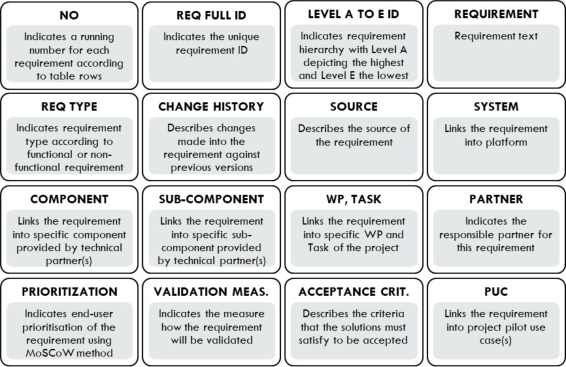
Documenting Requirements Into a Repository To document the requirements, we created a requirements template and later implemented this structure into an Excel-based requirements repository (Figure 2). Besides documentation, the repository facilitated participatory design by providing a means to systematically collect detailed user and developer feedback on the intermediate results at various iteration rounds. Information provided about single requirements is versatile and depending on the goals and resources of the development work and complexity of the developed system, the template could be modified and utilized in an appropriate manner. The template essentially provides a tool to recognize and classify main requirements, to identify and indicate their possible sub- requirements, to clearly illustrate a requirements hierarchy, and to structure the presentation and collection other requirement-specific information. In our project, the information fields and requirements data were included in the Excel workbook.
Figure 2: Abstracted user requirements template information fields and their descriptions.
DISCUSSION
Defining requirements is an important part of systems development, and the quality and understanding of the user requirements among different partners can be critically improved with iterative, participatory design. The participatory methods enable diverse perspectives to be considered and aid in identifying possible deficiencies or inconsistencies in the requirements. Ideally, participatory design fosters a common understanding of the requirements among all participants, although it heavily relies on the availability and readiness of stakeholders to engage. Through iteration, evolving or divergent demands of different stakeholders can be better accommodated. Yet, several rounds of iteration are time-consuming and presume repeated stakeholder involvement. Therefore, the objectives and the benefits of the requirements development implemented as a participatory process need to be well-understood and shared for the process to be successful.
In our project, the requirements development resulted in the specification of 143 requirements. It was completed in approximately six months, including the reporting of the results into a project deliverable submitted to the funding authority. The process included multiple phases, covering comprehensive and complementary data collection efforts and several iteration rounds, as reaching an active consensus in a multinational and multiorganizational setting engaging dozens of individuals was more laborious than initially expected.
Nonetheless, it was critical to avoid hastily drafting and specifying requirements based on limited interaction between intended users, other stakeholders, and technology developers. Moreover, methods encouraging close interaction notably increased developers’ understanding of a heterogenous set of intended users, their operational practices, and processes associated with maritime situational awareness and other safety and security related activities as well as the environments where the future system would be deployed. Reciprocally, the requirements process increased users’ understanding about the possibilities and constraints of the various sub- systems to be integrated in the platform. Additionally, workshop discussions were found to contextualize and enrich initial requirements derived from documentary analysis and literature review, making requirements elicitation a learning experience for all stakeholders.
As inputs to the requirements development process were captured in different formats from numerous individuals (e.g., feedback written in free text, opinions raised during workshops), particularly, the utilization of these insights needed much interpretive work from the process facilitators. Often, the collected feedback did not directly translate into a well- specified requirements definition(s) but needed extensive post-processing, further consideration, and cross-comparison between defined PUCs, research literature or previous work in this area. More stringent feedback methods might reduce additional analysis work effort in future projects. However, allowing flexibility is likely to better support feedback collection and engagement in general in multinational design settings.
Participatory Approach for Specifying User Requirements 361
CONCLUSION AND FUTURE WORK In this paper, we described a user requirements development process implemented for a maritime border surveillance system in the context of EU funded civil security research. We iteratively implemented participatory design techniques to elicit, analyze, specify, and validate user requirements from future users and other stakeholders. Our work can be used to inform and guide similar research efforts, helping to ensure transparent, collaborative, and effective development of varied security solutions. As a future research direction, it would be important to study how the recently published Capability Roadmap of the European Border and Coast Guard2
(2024) could streamline user requirements development in European border management R&I projects, mitigate plausible challenges of participatory design approaches in these settings, and support transfer learning across consecutive or parallel research efforts.
ACKNOWLEDGMENT
This work has received funding from the European Union’s Horizon Europe Research and innovation programme under grant agreement No. 101073985.
REFERENCES
Bereta, K., Chatzikokolakis, K., Zissis, D. (2021). Maritime Reporting Systems.
In: Artikis, A., Zissis, D. (eds) Guide to Maritime Informatics. Springer, Cham. Bjørner, D. (2021). Domain Science and Engineering. A Foundation for Software Development. Springer, Cham, Switzerland. Conceição. V., Tsigopoulos A., Galanis G., Toivonen S. (2022). ARESIBO –
Augmented Reality Enriched Situation Awareness for Border Security. Evaluation Framework and Results of Large-Scale Trials. 4. Ciências Militares, Portugal. Crandall, B., Klein, G., & Hoffman, R. R. (2006). Working Minds: A Practitioner’s Guide to Cognitive Task Analysis, MIT Press, Cambridge, MA. European Border and Coast Guard Agency. (2024). Operations. EU’s coast guard
cooperation. Available at https://www.frontex.europa.eu/what-we-do/operations/ eu-s-coast-guard-cooperation/. Greenbaum, J. (1993). A Design of One’s Own: Towards Participatory Design in the United States. In: Schuler, D., Namioka, A. (eds.) Participatory Design: Principles and Practices, Lawrence Erlbaum, Hillsdale, NJ. Hiemstra, H. (2008). Defining a Balanced Maritime Safety and Security System.
INCOSE International Symposium, 18: 2088–2101. ISO/IEC/IEEE. (2011). 29148–2011 standard on Systems and software engineering - Life cycle processes - Requirements engineering. Laarni, J., Aaltonen, I. (2013). Anticipation Dialogue Method in Participatory
Design. In: K. Blashki, P. Isaias (eds.), Emerging Research and Trends in Interactivity and the Human-Computer Interface, IGI Global. Lavene, G. (2019). D2.9 MARISA User requirements (Final). European Commission.
Obendorf, H., Janneck, M., Finck, M. (2009). Inter-Contextual Distributed Participatory Design. Scandinavian Journal of Information Systems, 21(1). Riveiro M., Pallotta, G., Vespe, M. (2018). Maritime anomaly detection: A review.
Participatory Design. Scandinavian Journal of Information Systems, 29(2). Roy, J. (2008). Anomaly detection in the maritime domain. Proceedings Volume 6945, Optics and Photonics in Global Homeland Security IV, SPIE Defense and Security Symposium. Salmela, L., Amer, U., Toivonen S. (2022). High-level architectures of multilateral
information-sharing within the maritime domain in Europe. Border Security Report. ¸Sengül, B.; Yılmaz, F.; U˘gurlu, Ö. (2023). Safety–Security Analysis of Maritime Surveillance Systems in Critical Marine Areas. Sustainability, 15(23). UNHCR, IMO, ICS. (2015). Rescue at Sea. A Guide to Principles and Practice as
Applied to Refugees and Migrants. [online] Available: https://www.unhcr.org/me dia/rescue-sea-guide-principles-and-practice-applied-migrants-and-refugees Vespe M. & Mazzarella F. (ed.). (2016). Maritime Knowledge Discovery and Anomaly Detection Workshop Proceedings. JRC Conference and Workshop reports. Ispra. Väätäinen, A., Laarni, J., & Höyhtyä, M. (2020). Development of a Concept of
Operations for Autonomous Systems. In: J. Chen (ed.), Advances in Human Factors in Robots and Unmanned Systems, 208–216, Springer. Wiegers, K., Beatty, J. (2013). Software Requirements (3rd ed.). Microsoft Press, Redmont. Zahlsen, Ø. K., Parmiggiani, E., Dahl, Y. (2022). Challenges of Scaling Participatory
Design: A Systematic Literature Review. OzCHI ‘22: Proceedings of the 34th Australian Conference on Human-Computer Interaction, 143–159. Zissis, D., Bereta, K., Chatzikokolakis, K., et al. (2020). Maritime Use Case: Requirements, Scenario Definition and Initial Evaluation Report. D3.2. European Commission.
LISTED IN THE AHFE DIGITAL BOOKSTORE CATALOGUE
Explore the complete digital volume
Human Systems Engineering and Design (IHSED2024): Future Trends and Applications
Read this individual research paper free through the original publisher, or explore the full digital proceedings book.
ISBN 978-1-964867-34-2
Explore this ISBN in the AHFE Bookstore ↗Listed in the July 2026 bookstore catalogue; search by ISBN to confirm current availability · Digital book purchase optional