Jari Laarni, Antti Väätänen (2023). Development of a Concept of Operations for an autonomous tram system. In: Intelligent Human Systems Integration (IHSI 2023): Integrating People and Intelligent Systems. AHFE Open Access, vol. 69, pp. 541–549. https://doi.org/10.54941/ahfe1002875
Public transportation is becoming smart and autonomous. Also trams and their operation environments are becoming autonomous, and it has been envisioned that in the near future trams could drive among other traffic in all conditions and circumstances. On the other hand, there are several challenges in the development of autonomous tram systems, since trams are operating in urban environments where high demands are set for sensors and sensor networks aiming at reliable detection of pedestrians and other vehicles. We are developing ‘The SmartRail ecosystem’ setting, which promotes transition from traditional engineering and manufacturing towards more advanced service and business ecosystem enabling a smart autonomous tram and integrated digital services for its whole life-cycle. The paper will present the development of a Concept of Operations (ConOps) for autonomous smart trams to demonstrate how they can be applied and utilized in public transportation in the future. The proposed ConOps can be considered as a boundary object in the design, validation or procurement of autonomous trams. We also propose that the ConOps should be maintained throughout the system life-cycle as an overview description and definition of overall goals and policies.A ConOps is a high-level description of how the elements of a system and entities in its environment interact in order to achieve their stated goals. The ConOps for an autonomous tram system will include, among others, the following information: overall goals and constraints of the SmartRail system, overall environmental characteristics, other stakeholders, main system elements and functions, operational states and scenarios, high-level performance requirements, system advantages and disadvantages, and human-autonomy teaming concept. Four different operational states will be considered: 1) starting a morning shift at the tram garage; 2) approaching a pedestrian crossing; 3) approaching and passing a tram stop; and 4) crossing other vehicles. The effect of seasonal conditions and weather events are also considered. A ConOps diagram has been drawn to illustrate how different stakeholders and the operating environment interact, and what kind of information is shared between different stakeholders.A special attention will be paid on the development of human-autonomy teaming concept for smart autonomous tram systems. A typical autonomous framework is based on a cross-tabulation of a scale of level of automation with stages of human information processing for a set of operational situations. We propose flexible automation solution in which the control function can be flexibly allocated to the automation or to the human operator at different phases of a tram route.Various knowledge elicitation techniques were used to gather relevant information for the ConOps: The development of the ConOps is based on a literature review, semi-structured interviews of tram drivers and trainers, and group interviews of experts working on research and development of autonomous road vehicles.
Public transportation is becoming smart and autonomous. Also trams and their operation environments are becoming autonomous, and it has been envisioned that in the near future autonomous trams could drive among other traffic in all conditions and circumstances. On the other hand, there are seve- ral challenges in the development of autonomous tram systems, since trams are operating in urban environments where high demands are set for sen- sors, sensor networks, and data interpretations aiming at reliable detection of pedestrians and other vehicles.
We are developing ‘The SmartRail ecosystem’ setting, which promotes a transition from traditional engineering and transportation systems towards more advanced service and business ecosystem enabling a smart autonomous tram and integrated digital services for its whole lifecycle.
The paper will present the development of a Concept of Operations (ConOps) for autonomous smart tram systems to demonstrate how they can be applied and utilized in public transportation in the future. The proposed
ConOps can be considered as a boundary object in the design, validation or procurement of autonomous tram systems. We also propose that the ConOps should be useful throughout the system life-cycle as an overview description and definition of overall goals and policies.
The ConOps for an autonomous tram system consists of, e.g., human- autonomy teaming definition, identification of main operational states and of characteristics of user interfaces for supervising the tram fleet and occasi- onally controlling individual trams.
CONCEPT OF OPERATIONS BACKGROUND A ConOps is a high-level description of how the elements of a system and enti- ties in its environment interact in order to achieve their stated goals (Fairley and Thayer, 1997). Typically, a ConOps is considered beneficial in the requi- rements specification work during the early stages of the design process, but as a knowledge sharing object the ConOps can support communication and collaboration between stakeholders throughout the design process (Laarni et al., submitted).
The ConOps for an autonomous tram system will include, among oth- ers, the following information: overall goals and constraints of the Smar- tRail system, overall environmental characteristics, other stakeholders, main system elements and functions, operational states and scenarios, high- level performance requirements, system advantages and disadvantages, and human-autonomy teaming concept. Four different operational states are con- sidered: 1) starting a morning shift at the tram garage; 2) approaching a pedestrian crossing; 3) approaching and passing a tram stop; and 4) crossing other vehicles. The effect of seasonal conditions and weather events are also considered. ConOps diagrams are used to illustrate how different stakehol- ders and the operating environment interact, and what kind of information is shared between different stakeholders at different phases of an operati- onal scenario. In addition, possible management modes are presented in a table format, and depictions of control concepts are used to demonstrate how autonomous/semiautonomous trams can be operated.
CONOPS DEVELOPMENT Data Collection
Various knowledge elicitation techniques were used to gather relevant infor- mation for the ConOps: The development of the ConOps is based on a literature review, semi-structured interviews of tram drivers and trainers, and a workshop with experts working on research and development of auto- nomous road vehicles. In the beginning of the workshop, we presented a scenario of an autonomous tram ride focusing on some key events such as approaching a street corner and approaching and leaving a station.
Based on the collected data, we first conducted a hierarchical task analy- sis to understand the state-of-the-art of the functioning of an urban tram system from the perspective of different stakeholders (i.e., passengers, tram
Development of a Concept of Operations for an Autonomous Tram System 543
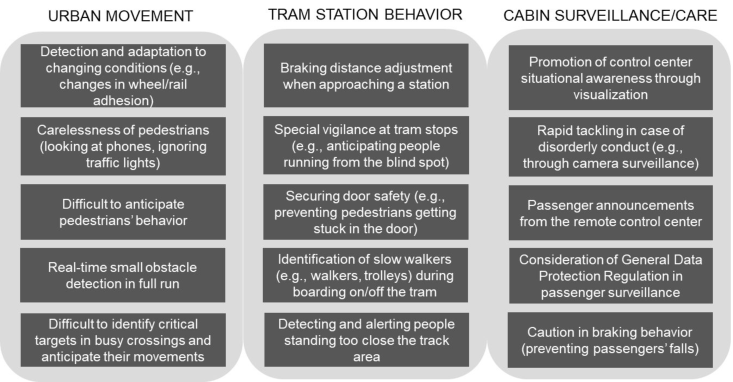
Figure 1: Challenges and requirements for smart autonomous tram system.
drivers and control-center operators). A special attention was paid to the identification of risky and challenging tasks in tram driving.
Towards Smart Autonomous Tram Systems Trams drive in a mixed urban environment where their tracks are typically only partially segregated from road traffic and pedestrians. Tram stations are easily accessible, and passengers can cross tracks when switching from one platform to another. According to our interviews, some of the key challenges in tram driving are:
Traffic schedules and time management (e.g., keeping up with the timeta- ble);
smooth braking, stopping and start-up in various conditions (e.g., tree leaves under the wheels in autumn);
unpredictable traffic environment (e.g., unfamiliarity with traffic regula- tions and inattentive passengers);
multitasking requirements (e.g., simultaneously monitoring traffic and serving passengers).
An autonomous tram must continuously monitor its environment to be able to react rapidly to changing traffic conditions. There is a need for advanced sensor systems (e.g., radars, lidars and cameras) and on-board intel- ligence in order to detect, orient, identify, analyze, decide and act without human intervention and control (e.g., SYSTRA, 2018). The autonomous tram has to anticipate changing traffic situations, passenger flows and weather conditions.
Experts identified several challenges, risks and requirements associated with a smart autonomous tram system, of which the most important are listed in Figure 1. Regarding urban movement, many of the challenges are caused
544 Laarni and Väätänen
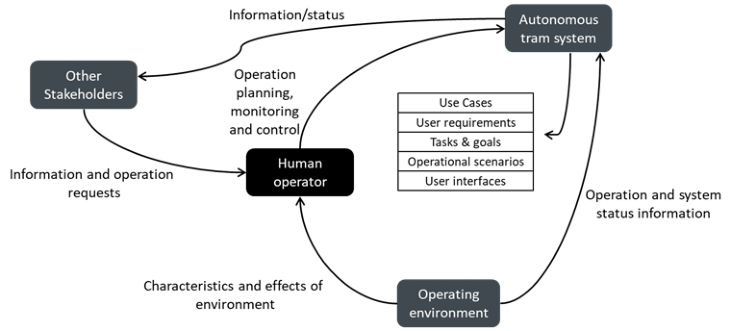
Figure 2: High-level ConOps diagram for an autonomous tram system.
by the fact that trams are not typically segregated from cars and pedestri- ans. There is no silver bullet to resolve the challenges, but wide field-of-view environmental perception was considered as a critical requirement for auto- nomous tram solutions. Regarding tram station behavior, the tram agent is confronted with several trade-offs between fluent and rapid functioning and maintaining passenger safety in all conditions. The tram driver’s gut decisions in these trade-off situations are based on extensive previous experiences. A key question is how to train the tram agent to make good enough decisions without compromising system transparency and common ground. In order to maintain situational awareness of what is happening in the tram cabin and to share this information with control center operators constant camera- based surveillance and delivery of surveillance information is required. A key challenge is how to do that without violating data protection and privacy regulations.
ConOps Diagrams A ConOps diagram is a high-level description of the main stakeholders, their tasks and responsibilities and interactions with other stakeholders (e.g., Väätänen et al., 2020). The ConOps diagram for smart autonomous tram operations is composed of four main entities: autonomous tram system, control center operators, other stakeholders and the operating environment (Figure 2). Control center operators who have a key role in the control of the smart tram system co-operate with other actors such as other stakeholders and the smart tram system itself. The autonomous tram system consists of a fleet of semi-autonomous/autonomous trams and the technical tram manage- ment system. Other stakeholders are officials and traffic company personnel that are involved in the establishment and maintenance of the smart tran- sportation system infrastructure. The operating environment consists of, e.g., lightness, weather and traffic conditions and legislation and regulation issues. The diagram also describes the interaction between different stakeholders
Development of a Concept of Operations for an Autonomous Tram System 545
and the operating environment and demonstrates what kind of information is required and shared.
Human-Autonomy Teaming A special attention will be paid on the development of human-autonomy tea- ming concept for smart autonomous tram systems. A typical autonomous framework is based on a cross-tabulation of a scale of level of automation with stages of human information processing for a set of operational situ- ations. We propose flexible and adaptive automation solution in which the control function can be flexibly allocated to the automation or to the human operator at different phases of a tram route.
According to our experts, there is a long road to an autonomous tram system through several steps from increased semi-autonomous driver assi- stance towards full autonomy. In full autonomy, the tram drives itself and circulates its route without the presence of a tram driver (Vagia and Rødseth, 2019). However, even fully autonomous trams need human supervision and periodic assistance. Control center operators have to monitor and supervise the progress of the circulation of the tram fleet in order to be able to react to nuisances and accidents and remotely operate individual trams if needed. Sometimes, degraded conditions may require long-time continuous operator interventions, and active collaboration and coordinated activities with other control center operators.
Human-automation teaming can be characterized by analyzing and addressing the following attributes of teaming: team relationship, predi- ctability, common ground, directability, observability, directing attention, adaptability, shared awareness and calibrated trust (Dubey et al., 2020; McDermott et al., 2018):
Team relationship: One option is that the tram system is fully autonomous, but the operator is able to intervene when asked to do so by the tram agent. At lower levels of autonomy, there is a more balanced relationship between the operator and the tram agent.
Observability: In principle, the operator is able to continuously monitor in detail how the tram agent is processing traffic and passenger informa- tion. In practice, this is not feasible and possible in full autonomy. A more relevant alternative is to provide a high-level visual depiction of the tram agent’s decision making behavior capitalizing on, e.g., interfaces that are designed according to the principles of ecological display design (Burns and Hadjukiewicz, 2004).
Predictability: The operator is able to anticipate the future intentions of the tram agent and understand what might happen next. The critical infor- mation must be presented in an intuitive fashion so that the operator can easily detect and comprehend it and react accordingly if needed.
Common ground: An operator and the tram agent have a shared under- standing of the overall traffic and passenger situation. To achieve this, cri- tical information must be delivered to the operator in an intuitive fashion. Common ground is a prerequisite for predictability and directability.
546 Laarni and Väätänen
Directability: The operator has an ability to make rapid adjustments and, for example, drive the tram on the fly. He/she is not able to ‘step in’, if the other human-autonomy attributes have not been taken into account to a sufficient degree. It is a practical issue to determine what is ‘sufficient’ in each operational situation.
Directing attention: Both the operator and the tram agent is able to direct each other’s attention to critical traffic and passenger information. Alarms and alerts are a typical way to do that in a control center context. An open question is how the operator could do that in full automation without disturbing the agent’s flow of information processing.
Adaptability: The joint cognitive system composed of an operator and a tram agent is able to react rapidly to the changes in the operational environment. Constant adaptability is a key requirement in tram driving in a hectic urban environment. It is still an open question how to augment adaptability in autonomous driving by teaming of human and artificial agents.
Shared awareness: The operator and the autonomous agent must have a common understanding of the traffic situation, and both partners must have an accurate understanding of their own state and the state of the other partner.
Calibrated trust: The operator is able to understand how much to trust the tram agent at different operational conditions. Trust is promoted by reliable and predictable performance of the tram agent at different phases of the ride.
Management of Autonomous Tram System Autonomous public transport system management modes A management mode demonstrates how the interplay between the control center and the entire autonomous public transport system is configured. Six different management modes were identified according to the complexity of tram fleet operation (Table 1). In the first and simplest level, one operator assigns a task to a single tram and monitors its journey when it circulates on a tramway line. In higher levels, a single operator monitors the journey of several trams or a fleet of trams, or a team of operators monitors the journey of several fleets of trams travelling on more than one tramway line. In the most complicated level, several operators manage fleets of autonomous vehicles belonging to different urban transport systems (e.g., autonomous trams, metro trains and shuttle busses).
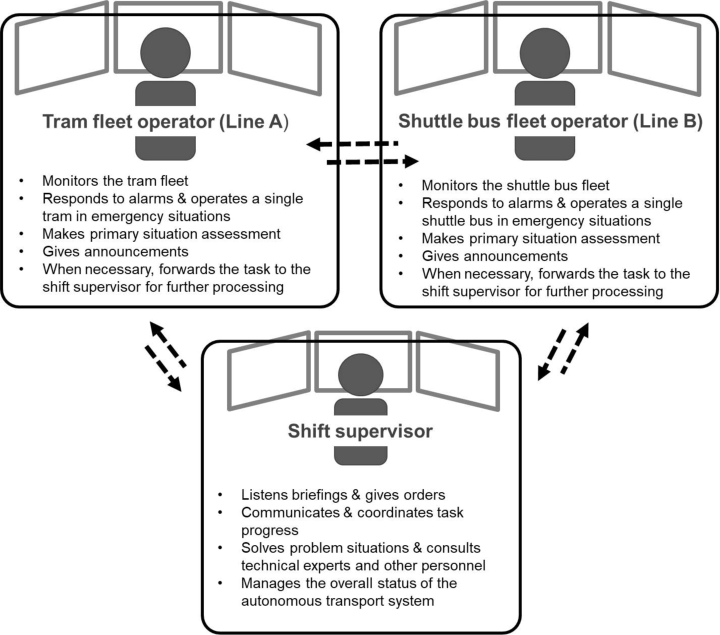
Control concept for the management of a fleet of autonomous trams A ConOps shall also consist of a control concept for the supervision of the autonomous tram system (see Figure 3). The control concept characterizes operator tasks and duties, their interactions with the tram system and colla- boration and coordination of activities with other control center operators (Laarni et al., 2017). Control concepts can, for example, promote a better understanding of potential multitasking challenges in monitoring of a fleet of trams and bottlenecks of situational awareness.
Development of a Concept of Operations for an Autonomous Tram System 547
Table 1. Autonomous public transportation system management modes.
Table available in the original PDF paper.
Level Management Mode 1 Operator monitors one particular tram on a tramway line. 2 Operator monitors several trams on a particular tramway line. 3 Operator monitors more than one fleet of trams circulating on more than one tramway line. 4 Several operators monitor more than one fleet of trams circulating on more than one tramway line. 5 Operator monitors several vehicles belonging to more than one urban transport systems (e.g. trams, trains and shuttles). 6 Several operators monitor several fleets of vehicles belonging to more than one urban transport systems (e.g. trams, trains and shuttles).
Figure 3: Example of a control concept for the operation of an autonomous tram system (e.g., Laarni et al., 2017).
The Figure 3 illustrates an example where one operator monitors a fleet of autonomous trams operating on a single tramway, and another operator monitors a fleet of autonomous shuttle buses driving on a single bus route. Both of them respond to alarms and alerts and operate a single tram or a shuttle bus in an emergency situation. In case of increased workload, they
548 Laarni and Väätänen
can forward some of their tasks to the shift supervisor for further processing. A shift supervisor monitors and manages the performance of fleet opera- tors, provides backup for them, communicates and consults technical and other experts, and manages the overall status of the entire autonomous public transportation system or some part of it.
CONCLUSION
Since we are still in the beginning phase of the development of smart auto- nomous public transport, only the construction of a high-level ConOps is possible and feasible. Next versions should address in detail the technical, security, regulatory, ethical and human factors challenges faced in the deve- lopment of autonomous transport systems. One of the main questions in the advancement of autonomous public transport is who has the main respon- sibility for the passengers’ and other road users’ safety. This is one of the main challenges in the development of future legislation and regulation for the autonomous transportation systems. The SmartRail ecosystem we advo- cate will rise and fall depending on how this key challenge is addressed and resolved.
Promises of safety, efficiency and cost savings in the future is one of the main drivers to promote autonomous urban public transport. A ConOps as a high-level description of the interaction of system elements can be a use- ful tool for pointing out possible targets for autonomous tram systems. For example, how should the remote monitoring of autonomous fleet of trams be organized to ensure both safe and economical operation of a fleet of autonomous transport system?
ACKNOWLEDGMENT
The research was funded by Business Finland under the SmartRail 2 project. We want to thank all interviewees and workshop participants for their valuable contribution.
REFERENCES
Burns, C.M., Hadjukiewicz, J.R. (2004). Ecological Interface Design. Boca Raton: CRC Press. Dubey, A., Abhinav, K., Jain, S., Arora, V., Puttaveerana, A. (2020). “HACO: A
Framework for Developing Human-AI Teaming”, in: Proceedings of the 13th Innovations in Software Engineering Conference (ISEC), Jabalpur, India, 27–29 February 2020. pp. 1–9. Fairley, R.E., Thayer, R.H. (1997). The concept of operations: The bridge from operational requirements to technical specifications, Annual Software Engineering, Volume 3 p. 417–432. Laarni, J., Koskinen, H., Väätänen, A. (2017). “Concept of Operations development
for autonomous and semi-autonomous swarm of robotic vehicles”, in: Proce- edings of the Companion of the 2017 ACM/IEEE International Conference on Human-Robot Interaction, Mutru, B. and Tscheligi (Eds.). pp 179–180. Laarni, J., Koskinen, H., Väätänen, A. (submitted). Concept of Operations as a boundary object for knowledge sharing in the design of robotic swarms.
Development of a Concept of Operations for an Autonomous Tram System 549
McDermott, P., Dominquez, C., Kasdaglis, N., Ryan, M., Trahan, I., Nelson, A. (2018). Human-machine teaming systems engineering guide. The MITRE Corporation. SYSTRA (2018). Automated and autonomous public transportation. Possibilities,
challenges and technologies. SYSTRA Website: https://www.systra.com/wp-co ntent/uploads/2020/09/systra-automated_and_autonomous_public_transport _2018-1.pdf Vagia, M., Rødseth, Ø.J. (2019). “A taxonomy for autonomous vehicles for different transportation modes”, Journal of Physics: Conference Series, Volume 1357, International Maritime and Port Technology and Development Confere- nce and International Conference on Maritime Autonomous Surface Ships 13–14 November 2019, Trondheim, Norway. Väätänen, A., Laarni, J., Höyhtyä, M. (2020). “Development of a Concept of Ope-
rations for autonomous systems”, in: Advances in Human Factors in Robots and Unmanned Systems, Chen J. (Ed.). pp. 208–216.
LISTED IN THE AHFE DIGITAL BOOKSTORE CATALOGUE
Explore the complete digital volume
Intelligent Human Systems Integration (IHSI 2023): Integrating People and Intelligent Systems
Read this individual research paper free through the original publisher, or explore the full digital proceedings book.
ISBN 978-1-958651-45-2
Explore this ISBN in the AHFE Bookstore ↗Listed in the July 2026 bookstore catalogue; search by ISBN to confirm current availability · Digital book purchase optional