Hanna Koskinen, Jari Laarni, Marja Liinasuo, Antti Hynninen, Douglas Owen, Victor Bolbot, Meriam Chaal (2024). Towards a Vision of Bridge Zero – Participatory Design of Automated Maritime Solutions. In: Advances in Human Factors of Transportation. AHFE Open Access, vol. 148, pp. 707–717. https://doi.org/10.54941/ahfe1005263
In recent years, Maritime Autonomous Surface Ships (MASS), i.e., ships which can operate, to a varying degree, independently of human involvement, have raised special interest in the maritime industry. Despite this, the development of MASS is still much under way, due to various challenges in all levels of maritime activity, including, e.g., equipment failure, human error, and defective interaction with the physical environment (Chang, Kontovas, Yu, Yang, 2021). We have explored autonomous ship technologies and developed concepts for MASS in a nationally funded research project (Business Finland, Enablers and Concepts for Automated Maritime Solutions - ECAMARIS). A central operational concept investigated in the project is the so-called Bridge Zero (B0), defined as a conditionally and periodically uncrewed bridge. According to the starting point in ECAMARIS for a B0 concept, the bridge can be left completely unmanned and unattended for a defined period in open sea conditions, thus freeing the bridge crew, e.g., for other duties or rest. A B0 workshop was organized among ECAMARIS project participants to collect perspectives and conceptions about possibilities and challenges for B0. The workshop participants consisted of a multidisciplinary group, including representatives both from maritime industry and academic organizations. The total number of participants was 11. The workshop comprised four main exercises: 1) warm-up (generating the worst possible solution for B0), 2) B0 ideation (specifying the endpoint goal “operating an uncrewed bridge under defined conditions” and identifying functions that must be performed to satisfy the goal), 3) barrier identification, and 4) closing discussion.Participants were divided into three heterogeneous groups that worked through the exercises. Each group documented their conceptions on a large sheet of paper. The sheets and the audio-recorded wrap-up discussion constitutes the output of the B0 workshop. Workshop results were analyzed by categorizing responses and identifying main themes and sub-themes. Overall, there was general agreement that improved safety is the key driver for the development of B0. The minimum requirement is that the autonomous system is capable of executing the voyage plan of the ship and achieve and maintain a safe navigational watch at the same level of safety as a human Officer of the Watch (OOW). To that aim, it is important that the system has, in a sense, an understanding of its capabilities and limitations with relation to task requirements (McDermott et al., 2018) to be able in good time to alert the bridge personnel to take control in demanding conditions. Several sociotechnical, economic, and regulatory barriers and constraints delaying the fast implementation of B0 were identified in the workshop. Some strategies for how to overcome them were also proposed and explored.REFERENCESChang, C. H., Kontovas, C., Yu, Q., & Yang, Z. (2021). Risk assessment of the operations of maritime autonomous surface ships. Reliability Engineering & System Safety, 207, 107324.McDermott, P., Dominguez, C., Kasdaglis, N., Ryan, M., Trahan, I., & Nelson, A. (2018). Human-machine teaming systems engineering guide. MITRE CORP BEDFORD MA BEDFORD United States.
In recent years, Maritime Autonomous Surface Ships (MASS), that is, ships which can operate, to a varying degree, independently of human involvement, have raised special interest in the maritime industry. There are currently many small and medium-sized uncrewed ships referred also as Uncrewed Surface Vessels (USV), used for routine tasks (Barrera et al., 2021). As regards larger vessels, for example, merchant ships (commercial ships carrying goods) have also been suggested to benefit from being uncrewed or operated with less crew; advantages are in economy, society, and safety (Wang et al., 2020). To mention some, such benefits may be lower risk of human errors resulting in accidents; lower fuel consumption and pollution emissions due to slower
sailing and more cargo capacity due to less crew facilities (Wang et al., 2020; Rødseth, Burmeister, 2015a; Rødseth, Burmeister, 2015b). Despite this, the development of MASS is still much under way, due to various challenges in all levels of maritime activity (Chang et al., 2021).
We have explored autonomous ship technologies and developed concepts for MASS in a nationally (Business Finland) funded research project called ECAMARIS (Enablers and Concepts for Automated Maritime Solutions). ECAMARIS focuses on three use cases, with selected technology applications, estimated to provide significant business and safety benefits to shipowners. The use cases are (i) relocated bridge, meaning a bridge without conventional visibility requirements so that more efficient spatial arrangements could be made; (ii) conditionally and periodically less-crewed bridge, changing the configuration and tasks of the crew while maintaining safety; and (iii) condi- tionally and periodically uncrewed bridge according to which the bridge is left completely uncrewed and unattended for a defined period. In ECAMARIS, a special focus has been on the development of a concept and requirements for an electronic lookout, a system possibly replacing a subset of human lookout functions (Owen et al., 2023).
The electronic lookout may be one solution that is needed to implement the so-called Bridge Zero (B0) which is also a central operational con- cept investigated in the project. In ECAMARIS, B0 has been defined as a conditionally and periodically uncrewed bridge. There are several ongoing European projects addressing similar issues. For example, a research consor- tium led by Fraunhofer–Center für Maritime Logistik und Dienstleistungen (CML) is developing in the B ZERO project, a ‘watch-free’ ship with an unmanned bridge (Zero, 2024). The uncrewed bridge is enabled by a suitable set of sensors, decision support systems and a documentation system.
According to the starting point in ECAMARIS for a B0 concept, the bridge can be left completely uncrewed and unattended for periods in open sea con- ditions as appropriate given technical capabilities of the system, thus freeing the bridge crew, for example, for other duties or rest.
RELATED LITERATURE Autonomous systems are attracting more attention in various transport sec- tors including the maritime transportation in which autonomous or smart shipping has recently gathered momentum. It is expected, the maritime domain may undergo significant transformations as a result of autonomy, which could affect the roles and responsibilities of both human and tech- nical agents (Bolbot et al., 2022). Thus, discussions related to autonomous ships range from developing technological capability (e.g., automated sen- sor integration) to human skills and actions expected in various operational situations (Lutzhoft & Earthy, 2024). Between these extremities are other main topics related to legal, training, economical, safety, (cyber)security, and maintenance aspects (Lutzhoft & Earthy, 2024). For example, there are many concerns related to the transition from crewed to uncrewed ships as well as the safety of autonomous ships in general (Jalonen et al., 2017). Such safety-related issues are connected to the capabilities of autonomy in different
Towards a Vision of Bridge Zero – Participatory Design of Automated Maritime Solutions 709
operational situations (i.e., normal and emergencies), the extent maintenance is to be carried out, problems in software and in data communication con- nections, and undue trust on information and communication technology (ICT) systems (Bolbot et al., 2019). In terms of human-machine teaming (e.g., McDermott et al., 2018), the autonomous system can be seen as a partner to a human expert with an ability to compensate human capabilities.
There are multiple descriptions for the levels of automation (LoA) (IMO 2024; Lehtovaara, 2022). The LoA of ships may also vary, that is, the sys- tems are not necessarily either fully autonomous or manually operated by the crew, but often the operational concept falls somewhere in between. More- over, the ships’ autonomous level can also change states from one to another depending on the situation. As an example of LoA categorization in the ship- ping context is the one provided in a white paper by Lehtovaara (2022). In this categorization, in the lowest level (Level 0), human controls the vessel. In Level 1 automation may assists operations and in Level 2, during partial automation when automation performs some tasks independently of human, human does not perform all tasks but is still needed for taking the respon- sibility on the ship at any time. During conditional automation (Level 3), again, operation or some part of it is automated. Human may have periodi- cal oversight but is still responsible for the ship. High automation (Level 4) is the highest level of automation with human oversight; the system alerts the human when needed and many tasks are performed automatically without human attendance. Some ship systems are on this level already, but functions requiring human attendance and combining observations and information are directed by regulations and constrained by minimum requirements. In the autonomous level (Level 5), human is not involved in the ship operation at all. This means that the ship systems must be capable of coping also with unforeseen situations without human oversight.
The categorization by Lehtovaara (2022) does not explicitly encompass remote operations although the expression of ‘human oversight’ also includes the possibility of having human in a remote-operation center (ROC). Conse- quently, one research direction has been concentrating on the communication between the ship and the human operators in the ROC and the design and implementation of this digital interface and the associated operational pro- cesses that are crucial for the safety and efficiency of the autonomous ships (e.g., Jalonen et al., 2017; Salonen et al., 2020).
There are many challenges and threats that an uncrewed ship can, pose for other sea users and even to the ship itself, including the cargo and equip- ment on board (Zelski & Wolak, 2020). The problems may originate from system failure as well as the lack of resilience to a cuber attack against the sys- tem; for instance, safety pertaining to navigational issues is not self-evident (ibid.). So far, it is not clear how autonomous navigation would be real- ized safely (Coito, 2021; Johnsen et al., 2022). Problems can arise between human-controlled and autonomous ships, complicating collision risk estima- tion and collision avoidance actions as autonomous systems may choose the action according to a predetermined decision criteria whereas human oper- ator can improvise (Kim et al., 2022). As regards artificial intelligence (AI), there are limitations in its functioning as the performance depends on the
training material provided; thus, the ability to identify own limitations and to alert humans when the situation becomes too demanding for the AI are highly important for safety (Murray et al., 2022).
From a more general perspective, the potential benefits that the autonomous vessel technology brings about – superior global regime for mar- itime search and rescue operations, enhanced detection of maritime drug traffickers, and greater navigational safety by reducing human errors, these same benefits also present formidable challenges (Coito, 2021). Moreover, there is a lot to define and decide, also as regards law, policies, and regula- tions, as the present navigational instruments such as COLREGS and SOLAS Convention presuppose the availability of human crew and human judgement (Coito, 2021).
METHOD AND MATERIALS A B0 workshop was organised in autumn 2023 among ECAMARIS project participants to collect perspectives and conceptions about possibilities and challenges for B0, specifically:
Generate ideas for the system purpose, goal and exclusions for the B0 Operational Concept.
Investigate possible B0 configurations and identify associated challenges.
Provide input to research roadmap for further research.
Specify what could be a minimum viable product.
The workshop represented a design sprint in which the aim was to explore complex design problems in a limited time frame. As such, it was intended to generate initial input towards the definition of a high-level system pur- pose, goals, and exclusions sections in the ECAMARIS Operational Concept template (Owen et al., 2023).
Participants The workshop participants consisted of a multidisciplinary group, including three representatives from maritime industry (development engineer, product specialist and master marine as their job titles), four senior researchers from a research organization and four researchers from an academic organisation. The total number of participants was 11.
Workshop Procedure Participants were divided into three heterogeneous groups that worked through the exercises to maximise diversity of that group members by area of expertise. The workshop comprised four main exercises (see Table 1) to gen- erate and explore ideas related to a periodically and conditionally uncrewed bridge. First, a warm-up ideation exercise was organized in which the partic- ipants were asked to generate and list the worst possible solution and ideas for B0 and list the properties that made the ideas so bad. The idea behind the warm-up was that when participants were asked to search for the opposite of the worst imagined attribute it may help think about functions that would actually be needed. Second, the participants were involved in the concept
Towards a Vision of Bridge Zero – Participatory Design of Automated Maritime Solutions 711
design exercise in which the aim was first to specify the endpoint, that is, the B0 goal in terms of the problem it is intended to solve and then identify the functions that must be performed to satisfy the goal. Third, after the B0 con- cepts were drafted they were placed under critical review of the participants with the idea of identifying possible barriers and challenges related to them. The final exercise was a closing discussion in which the main learnings from the workshop were summarized.
Table 1. Workshop exercises.
Table available in the original PDF paper.
Exercise Description
1. Warm-up (group work)
Come up with and list the worst possible ideas for B0. Mix and match those ideas and generate the worst possible B0 solution. 2. B0 ideation (group work)
Picture of envisioned intelligent B0 concept. Write a short statement in your group describing the B0 goal (e.g., what industry problem is B0 intended to solve and what are the needed functionalities) 3. Critical review – barriers & challenges (group work)
Contemplate safety, sustainability, regulator/assurance, ethical, and business-related hurdles as well as Human / Technical / Organizational (HTO) challenges for the B0. Review and update your B0 concept based on what you discuss. 4. Closing discussion (all)
Present and discuss with all the B0 workshop participants about the results of the group work. Can you see commonalities between the concepts / any required future research needs on B0?
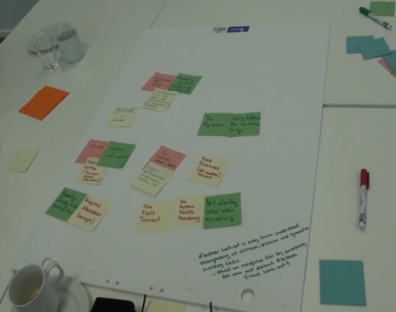
Each group documented their work-in-progress and conceptions on a large sheet of paper with the help of markers and sticky notes (Figure 1).
Figure 1: One group’s sticky notes on a table.
The paper sheets (documented via photographing) and the audio-recorded closing wrap-up discussion constitute the output of the B0 workshop.
Data Analysis Workshop results were analysed by categorizing responses and identifying main themes and sub-themes.
RESULTS
The main objective of the workshop was to generate ideas for the system purpose, goal, and possible barriers for the B0 Operational Concept (Owen et al., 2023). The aim was also to generate a statement on possible B0 con- figurations and associated challenges. In general, the workshop was fruitful, providing many suggestions and ideas to support further development of the B0 concept. Because the time was limited, the discussions focused only on big issues and did not dig deeper into the specifics of B0 design.
Vision Statement We asked the groups to crystallize their thoughts onto a vision statement. Two of the three statements were concise stating that they autonomous system must follow rules and maintain a safe state when it takes control of the ship, while the third statement describes the same idea in a more detailed manner (Table 2).
Table 2. Vision statements of the groups in the workshop.
Table available in the original PDF paper.
Group Vision Statement 1 “The system should navigate by itself by following COLREG rules.” 2 “The system shall be capable of executing the duties in relation to keeping a safe navigational watch to at least the same level of safety as a human Officer of the Watch (OOW).” 3 “The system shall execute the voyage plan of the ship (at open sea) while continuously maintaining a safe state by utilizing electronic lookout and other navigational data to assess whether a safe state can be maintained by course and/or speed alterations and/or asking input from the crew. The system shall also execute deviations automatically and analyze the operational envelope.”
Key Drivers for Bridge Zero Several driving forces from seafarers’, ship operators’ and maritime industry’s perspective were identified. From the seafarers’ point of view, implementation of B0 promises to lead to improved well-being and more meaningful work. From the ship operators’ perspective, the aim is to provide more value for money. The maritime sector is striving for improved safety and solutions for possible crew shortage.
Overall, there was general agreement that an aspiration for improved safety is the key driver for the development of B0. The minimum require- ment is that the autonomous system can execute the voyage plan of the ship and achieve and maintain a safe navigational watch at the same level of safety
Towards a Vision of Bridge Zero – Participatory Design of Automated Maritime Solutions 713
as a human Officer of the Watch (OOW). To that aim, it was identified impor- tant that the system has, in a sense, an understanding of its capabilities and limitations with relation to task requirements to be able in good time to alert the bridge crew to take control in demanding conditions.
It has been forecasted that the lack of seafarers is a prominent problem in the future, and therefore there is an urgent need to replace human bridge personnel by automation. On the other hand, since there are skilful seafarers in other parts of the world where labour costs are much lower, there is no urgent need to replace the bridge personnel by autonomous ship systems.
Critical Capabilities and Functions The main idea behind the B0 concept is that the autonomous system has periodically complete control over the navigation of the ship. According to the workshop discussions, this means at least five different defining factors:
1) Human functions such as path planning, operation envelope monitoring and projection are delegated to the system. 2) The system performs risk and situation assessment by calculating route and collision avoidance, informing the crew about the navigational risk, and predicting the development of the situation. 3) In addition to operational status, the autonomous system is aware of the ship’s technical status. 4) The system performs automatic operations, e.g., automatic course and ship adjustment. 5) The system delivers summary information to the crew, e.g., about ship motion, navigational status and risks and presents alerts and requests human intervention in complex situations.
The groups identified the features listed above as defining issues for imple- menting higher automation level systems such as B0 in maritime industry. B0 full control is an operation mode where the ship system periodically takes over the human functions related to bridge operation. This means that the B0 system should be able to carry out path planning, operation envelope monitoring, and take actions based on that. Moreover, the B0 system should be able to define or restrict the operational envelope of the ship based on the current and predicted operational situation. As one critical capability, the groups recognized, the B0 system ability to have ship system awareness, which means it can monitor the state of the ship’s subsystems and sensors.
Barriers Several sociotechnical, economic, and regulatory barriers and constraints delaying the implementation of B0 were identified in the workshop. Some strategies about overcoming them were also proposed and explored.
The groups discussed what they saw as the main barriers in implement- ing autonomous ships and B0 concept that the maritime industry should overcome. These barriers identified by the groups include, for example, 1) regulation barriers, guidelines and legislation which have not been updated
and that do not take into account the current possibilities and state of tech- nology; 2) safety barriers, which require more profound understanding and analysis about how advanced ship development may ensure reliability and security; 3) economic barriers, which delay the return on investment and profitability of autonomous ships and implementation of B0; and 4) ethical barriers, which raise questions about the impact of high level of automa- tion on human crew, such as their role in the B0 operation and form of employment and the maintenance and development of the human operators’ maritime skills and knowledge (e.g., human skill deterioration). One impor- tant ethical question is the availability and quality of the training data used for the B0 systems, for example, how to ensure the quality and adequacy of training material, if it is impossible to record video camera-based material (due to GDPR) for training. In general, carefully considerations should be also done regarding the privacy of people which are in one way or the other in interaction with the ship systems.
Design Challenges There was some discussion about what the B0 looks like. Participants seemed to have somewhat different views about the layout of B0. If the development of ship autonomy is led only by technology, we may end up with a worst-case solution such as a ‘black box’ without doors and windows. Another related question is whether the ship is remotely controlled from onshore ROC or whether there is still a crew on board. A consensus seemed to be that both options should be possible.
In general, there is a fear that the B0 system is designed in a way that the autonomous systems make judgments automatically and do not provide any useful information to the crew. As a consequence, the distrust prevails and the crew does not know who is in control of the ship.
All in all, it was thought that the design of B0 is quite easily a too technology-oriented enterprise, and ergonomic factors are not considered to a sufficient degree. As a result, the final system does not, for example, miti- gate the crew’s workload at all. To prevent this kind of unwanted scenario, one group pointed out that a structured human factors and safety engineer- ing process has to be followed in the design of B0 in order to prevent design faults, possibly leading to system failures and operator mistakes.
DISCUSSION
Even though the time was limited, the workshop was able to discuss exten- sively about the topic. Different points of views were presented: Participants raised not only technological issues, but also economic, ethical, and regula- tory concerns as well as the difficulties related to the training of AI-based systems were mentioned. From a wider perspective, only the topics related to cybersecurity and maintenance (Lutzhoft & Earthy, 2024) as well as the ones related to maritime search and rescue operations and the specific issue of dealing with drug traffickers (Coito, 2021) were not touched. The main lesson learned was that maintaining safety is to be emphasized. Even if the
Towards a Vision of Bridge Zero – Participatory Design of Automated Maritime Solutions 715
usage of advanced technology and autonomous systems removes the possi- bility of human errors, these new systems bring along other types of safety risks.
The LoA in the B0, as discussed in the workshop, seems to be closest to the Level 3 of Lehtovaara’s (2022) scale. In B0, humans are periodically (only for some specific time) and conditionally (only in open sea) absent in the bridge, without controlling the ship or supervising its performance. However, ship system is supposed to alert human operators whenever something deviant is taking place and thereafter, human takes over the control again and as a whole, human has responsibility over the ship. Handover from system to human in a challenging situation is critical because human should be provided with information to have appropriate situation awareness and if in a hurry, the information transfer should be both rapid and extensive enough. The conditional automation describes the situation in B0, and it is also beyond the current maritime regulation.
It seems that the participants had a quite broad vision of the opportunities and challenges in the design of B0, and their comments implied that we are still in the beginning stage in the development of such systems. Even if B0 would be technically possible, it does not mean that it could be realized in the near future. Since many of the challenges seem insurmountable at present, it is more feasible to approach the target, an autonomous ship, only gradually. For example, the full control should be only possible in open sea conditions, and the autonomous system would assist users and provide decision support for navigational tasks in other conditions. This kind of incremental development approach seems to be in accordance with the conceptions published in recent literature (see Related Literature section above), even if the appearance of autonomous vessels has been pronounced in the media for a long time.
There are difficult technological barriers to overcome. For example, teach- ing neural networks is challenging, and we do not know all safety implica- tions related to deep learning AI. And it is unclear how to implement the maritime rules on the program in such a way that the system acts in an eth- ically appropriate manner. Moreover, as was mentioned above, yet we have many options, but we have no clear idea how B0 should look like - and how the ship would look like if the bridge is removed. It is also unclear what role remote operation of the ship would play. The workshop discussions did not provide a clear answer to this. Even though remote operation was con- sidered as a viable option, the majority seemed to think that a periodically uncrewed bridge does not indicate that the ship must also be periodically remotely operated.
The workshop was well-structured, and it produced a plethora of enrich- ing ideas and raised important issues. However, the documentation of group discussions could have been better planned, and a more detailed recording of discussions would have been useful.
All in all, the workshop was successful in identifying several important viewpoints and discussing about them. The workshop proved useful for find- ing relevant perspectives for further conceptual design pertaining to B0. The successfulness of the workshop depended on the expertise of its participants; not only the maritime professionals but also the researchers were highly
familiar with the subject. Thus, similar results can be expected only when participants are experts from various areas.
CONCLUSION
In ECAMARIS project, we have explored autonomous ship technologies and developed concepts for MASS. One central operational concept investigated in the project is the B0 that in ECAMARIS was defined as a conditionally and periodically uncrewed bridge. A B0 workshop was organized among ECA- MARIS project participants to collect perspectives and conceptions about possibilities and challenges for B0. The aim of the B0 workshop was to gen- erate a statement on possible B0 configurations and associated challenges and created a solid ground for taking the next steps in the B0 development (i.e., description of B0 concept of operations). In general, the workshop was fruit- ful, providing many suggestions and ideas to support further development of the B0 concept.
ACKNOWLEDGMENT
The authors would like to acknowledge all the B0 workshop partici- pants about sharing their knowledge and insights on maritime operations. The study was funded by Business Finland, ECAMARIS project, number 3706/31/2021.
REFERENCES
Barrera, C. Pardon, I. Luis, F. S., Llinas, O. Marichal, G. M. (2021) Trends and Challenges in Unmanned Surface Vehicles (USV): From Survey to Shipping. The international Journal of Marine Navigation and Safety of Sea Transportation, 1(15). Bolbot, V., Methlouthi, O., Chaal, M., Valdez, O., BahooToroody, A., Tsetkova,
A., Hellström, M., Saarni, J., Virtanen, S., Owen, D., Lei, D., Basnet, S. (2022) Identification and analysis of educational needs for naval architects and marine engineers in relation to the foreseen context of Maritime Autonomous Surface Ships (MASS). Aalto University publication series Science + Technology, 2/2022. Bolbot, V., Theotokatos, G., Bujorianu, L., Boulougouris, E., Vassalos, D. (2019) Vulnerabilities and safety assurance methods in Cyber-Physical Systems: A com- prehensive review, Reliability Engineering & System Safety, 182, pp. 179–193. B Zero, (2024). Website: https://www.cml.fraunhofer.de/en/research-projects/B-Z
ERO.html, accessed 14 February, 2024. Chang, C. H., Kontovas, C. Yu, Q. and Yang, Z. (2021). Risk assessment of the operations of maritime autonomous surface ships. Reliability Engineering & System Safety, 207, 107324, pp. 1–11. Coito, J. (2021). Maritime autonomous surface ships: New possibilities— and challenges—in ocean law and policy. International Law Studies, 97(1), pp. 258–306. Felski, A., Zwolak, K. (2020). The ocean-going autonomous ship—Challenges and
threats. Journal of Marine Science and Engineering, 8(1), 41, pp. 1–16. IMO (2024). Autonomous shipping. Website: https://www.imo.org/en/MediaCentre /HotTopics/Pages/Autonomous-shipping.aspx, accessed 15 February, 2024.
Towards a Vision of Bridge Zero – Participatory Design of Automated Maritime Solutions 717
Jalonen, R., Tuominen, R. and Wahlström, M. (2017). Safety of unmanned ships— safe shipping with autonomous and remote controlled ships. Aalto university publication series Science + Technology 5/2017, pp. 1–84. Johnsen S., Thieme, C., Myklebust, T., Holte, E., Fjørtoft, K., Rødseth, Ø. (2022).
Hazads and Risks of Automated Passenger Ferry Operations in Norway. In: Tareq Ahram and Waldemar Karwowski (eds) Human Factors in Robots, Drones and Unmanned Systems. AHFE (2022) International Conference. AHFE Open Access, vol. 57. AHFE International, USA, http://doi.org/10.54941/ahfe1002312. Kim, T. E., Perera, L. P., Sollid, M. P., Batalden, B. M. and Sydnes, A. K. (2022). Safety challenges related to autonomous ships in mixed navigational environments. WMU Journal of Maritime Affairs, 21(2), pp. 141–159. Lützhöft, M., Earthy, J. (2024). “Chapter 1 Introduction”, in: Human-Centred
Autonomous Shipping, Lützhöft, M., & Earthy, J. (Eds.). pp 1–4. McDermott, P., Dominguez, C., Kasdaglis, N., Ryan, M. and Trahan, I. (2018).
Human-Machine Teaming Systems Engineering Guide. MITRE Corp Bedford MA Bedford United States, pp. 1–63. Murray, B., Rødseth, O. J., Nordahl, H., Wennersberg, L. A. L., Pobitzer, A., & Foss, H. (2022). Approvable AI for autonomous ships: Challenges and possible solutions. In Proceedings of the 32nd European Safety and Reliability Conference (ESREL 2022), pp. 1975–1982. Owen, D., Laarni, J., Liinasuo, M., & Koskinen, H. (2023). ECAMARIS Operational
Concept Template for Autonomous and Automated Maritime Systems. Espoo: Aalto University. Rødseth, Ø. J., Burmeister, H.-C. (2015b). Risk assessment for an unmanned merchant ship. TransNav: International Journal on Marine Navigation and Safety of Sea Transportation 9 (3), 357–364. Salonen, T.-T., Wahlström, M., & Karvonen, H. (2020). Designing a remote-
pilotage system: work styles to be considered. In T. Lusikka (Ed.), Proceedings of TRA2020, the 8th Transport Research Arena: Rethinking transport – towards clean and inclusive mobility (pp. 235–236). Finnish Transport Agency. Wang, J., Xiao, Y., Li, T., & Chen, C. P. (2020). A survey of technologies for unmanned merchant ships. IEEE Access, 8, pp. 224461–224486.
LISTED IN THE AHFE DIGITAL BOOKSTORE CATALOGUE
Explore the complete digital volume
Advances in Human Factors of Transportation
Read this individual research paper free through the original publisher, or explore the full digital proceedings book.
ISBN 978-1-964867-24-3
Explore this ISBN in the AHFE Bookstore ↗Listed in the July 2026 bookstore catalogue; search by ISBN to confirm current availability · Digital book purchase optional