Hui Zhang, Wanyi Wei, Yingping Cao (2024). The effect of congruity between background music language and brand culture on consumer behavior. In: Usability and User Experience. AHFE Open Access, vol. 156, pp. 382–391. https://doi.org/10.54941/ahfe1005449
Numerous research have explored how musical elements affect consumer behavior in the retail scenario. But this claim has not been fully proven in the online shopping scenario, which has become one of the current mainstream consumption methods. Some researchers have stressed the value of musical congruity, the majority of their discussions have focused on the structural characteristics (rhythm, volume, genre, etc.) or affective characteristics (style, familiarity, valence, etc.), and the cultural characteristics (nation, territory, language, etc.) of music seem to be less discussed. This study focuses on the different music languages to explore the influence of the context effect brought by the cultural characteristics of music on consumer behavior. Language variations in music are primarily represented in the lyrics. The study aims to explore how music enhances the online shopping experience by influencing users' cognitive and emotional responses. It also provides guidance on music selection for e-commerce brands to use music strategically to promote goods consumption.In this study, we simulated the current mainstream e-commerce shopping websites to make online shopping pages of sneakers and selected the music (music with Chinese lyrics, music with English lyrics) on the mainstream music platform charts as experimental materials. The experiment recruited 30 participants (15 females; all of them have online shopping experience); they were divided into three groups (no music, music with Chinese lyric, music with English lyric) and asked to choose a pair of sneakers for themselves from randomly given goods (Chinese brands *8, European and American brands *8) under different background music. We captured the participants' browsing duration, trajectory, and focus position with the eye tracker. Participants' cognitive responses (product purchase intention ranking, product evaluation, music experience), emotional response (PAD emotion), and final behavioral response (direct purchase, shopping cart addition, sharing, collection) were collected through questionnaires.According to the experimental data's T-test, from the perspective of brand, when the music language and brand culture are consistent, the sharing rate of goods will increase. From the perspective of music, goods that have the same nation with background music will get a higher share rate. Compared with the environment without music, the user's pleasure and arousal are significantly improved under both Chinese songs and European and American songs.Our research shows that congruity between music language and brand culture leads to higher levels of pleasure and significantly affects online consumer behavior. When the music culture is consistent with the brand, the rate at which consumers share the goods increases. The pleasant user experience brought by musical congruity increases consumers' evaluation of the cognitive response of the product, thus positively affecting consumers' purchase intention. The experimental results provide new insights into music selection in the online shopping scene in the field of auditory marketing. It enriches the existing literature on musical congruity and cultural characteristics.
The atmosphere of a service environment is increasingly seen as an important marketing strategy by corporate brands. Many companies build their cor- porate image by creating a unique emotional environment using a specially tailored atmosphere. Of all the research on the atmosphere of the service envi- ronment, music is probably the most studied atmosphere element because it can be easily modified and is inexpensive. Many studies have explored the impact of background music on consumer behavior in retail settings. As one of the mainstream consumption methods of online shopping, the role of background music in the user experience seems to have not been fully proven.
Music can influence consumer behavior in certain situations. Considering the influence of the context effect, some scholars have emphasized the impor- tance of musical consistency. Musical congruence is defined as the extent to which consumers perceive background music as important or appropriate for the central message conveyed (Kellaris, Cox & Cox, 1993). Mattila et al.
The Effect of Congruity Between Background Music Language 383
(2001) studied the effect of matching music to smell. Their results show that when the music and smell are consistent, consumers rate the store’s environ- ment and experience more highly. In addition, many corporate brands use music as a way or means to express their personality and image to the pub- lic. A song that aligns with the brand can create a connection between the individual and the brand while also helping to maintain and strengthen those connections (Beverland et al., 2006).
Many studies have explored how musical features, such as rhythm, style, genre, familiarity, and emotional valence, affect consumers’ cognitive and emotional responses. But most of them are about the structural and emotional characteristics of music, and the cultural characteristics of music (ethnic, regional, and linguistic) seem to be discussed less. Language is the medium of communication between people, and different languages represent different cultures and ideologies, which can influence people’s way of thinking and values. In music, language differences are mainly reflected in the lyrics. The same type of music in different languages will give people completely different feelings, and these different feelings may affect people’s behavior.
This study focuses on the context effects of musical cultural character- istics brought about by different musical languages on consumer behavior. Explore how music enhances the online shopping user experience by influ- encing users’ cognitive and emotional responses. It also provides guidance on music selection for e-commerce brands to use music strategically to promote product consumption.
BACKGROUND
Background Music and Language Herrington and Capella (1994) classify musical variables as structural fea- tures and emotional features. Overall, background music has positive effects on emotions, attitudes, and behavioral responses (Garlin and Owen, 2006). Current research will combine the two to explore how music specifi- cally influences user behavior. Zoghaib, Luffarelli, and Feiereisen (2023) found that music pieces with an irregular contour or unstable tonality induce increased perceptions of brand innovativeness. Fast-tempo back- ground music increases consumers’ variety-seeking behavior by enhancing their arousal (Sun et al., 2023).
However, the cultural characteristics of music (ethnic, regional, linguis- tic) seem to be less discussed in these studies. Some works have explored the symbolic use of language in popular music. Chen (2009) claim that national languages (such as Asian languages) can convey “orientality”, “collectivism”, “our nature”, etc., while English or other foreign languages convey “West- ernness”, “globality”, “modernity”, “individuality”, etc. It seems that the language of music is closely related to its cultural characteristics. Different languages represent different cultures and ideologies, which can affect peo- ple’s ways of thinking and values, and this feeling of difference is likely to also affect people’s consumption behavior. Therefore, we propose the following hypothesis: H1: Different music languages will affect consumer behavior.
Music Congruity An important proposition in cue exploitation theory is called cue consistency (Slovic, 1966). Mitchell, Kahn, and Knasko (1995) argue that inconsistent cues can cause cognitive dissonance. In terms of background music, previous studies have found that when the music played matches the store or product background, the influence of music on customer behavior will be enhanced (Vida, Obadia, & Kunz, 2007). For example, when wine stores play typically French music, consumers buy more French wine than German wine (North et al., 1999). Therefore, we hypothesize the following:
H2: When the music language is consistent with the product brand, it has a positive effect on consumption behavior.
Effect of Music Congruity on Emotional State and Consumer Behavior According to their Stimulus-Organism Response (SOR) model, customers’ interaction with cues or stimuli leads to an emotional state of pleasure, arousal, and dominance (PAD). This leads to approach or avoidance behav- ior (Mehrabian and Russell, 1974). All studies on the effects of background music confirm that it affects the consumer experience, with varying degrees of focus on dependent variables. In terms of music congruity, Oakes (2007) states that music congruity enhances emotional responses to advertisements. Increased musical timbre congruity enhanced desired affective responses to the advertisement (Oakes and North, 2006). Therefore, we expect that music congruity will produce a positive emotional response and hypothesize that the following:
H3: When the music language is consistent with the brand, positive emotional responses are generated, thus influencing consumer behavior.
METHOD
Experimental Material Selection In this study, we simulated the current mainstream e-commerce shopping websites to make an online shopping page for sports shoes, including the interface of 16 sports shoes. We used a random number generator to randomly select 8 Chinese brands and 8 European and American brands.
Through the investigation of the current popularity charts of mainstream music platforms in China, 10 songs with Chinese lyrics1 and 10 songs with English lyrics2 are selected as background music materials.
Participant A total of 30 participants aged 19–25 years from China (mean age ± SD = 20.53 ± 2.15 years; 50% females) took part in this study. The participants gave their informed consent and reported no ophthalmic disorder or hearing impairments. All participants fulfilled the screening cri- teria and had normal musical perception and expression skills, were able to understand the researchers’ instructions, and expressed their thoughts. The
The Effect of Congruity Between Background Music Language 385
participants were university students in Hangzhou, China, recruited through social media (WeChat and QQ). All participants received compensation for their participation.
Procedure Before the start of the study, the experimenter will explain the whole exper- iment process, and the participants can adjust the equipment or the volume according to their own needs, without noise and human interference.
Eye tracker calibration was completed before starting the experiment, and participants were asked to minimize head movements during eye-tracking recording. We randomly divided the participants into three groups: no back- ground music (NM), music with Chinese lyrics(CM), and music with English lyrics(EM). The experimenter will play the corresponding music according to the groups.
Throughout the experiment, participants were asked to browse the inter- face of 16 pairs of sneakers, and eye-tracking data was collected to record the participants’ operational behavior, including the participants’ browsing time and focus position. After each visit to the interface, a questionnaire was given to record the participants’ cognitive responses, i.e. purchase intention and behavioral response, including adding to the shopping cart, buying, shar- ing, and collecting. The participants’ emotional responses, including pleasure, arousal, and control, were recorded before and after the music was played.
RESULTS
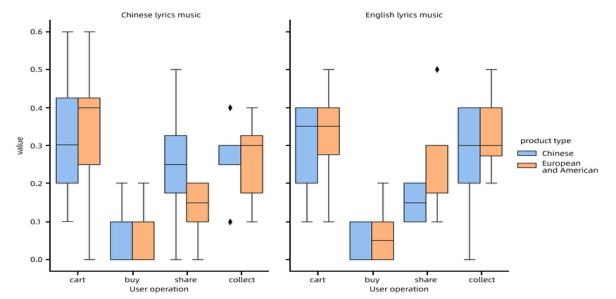
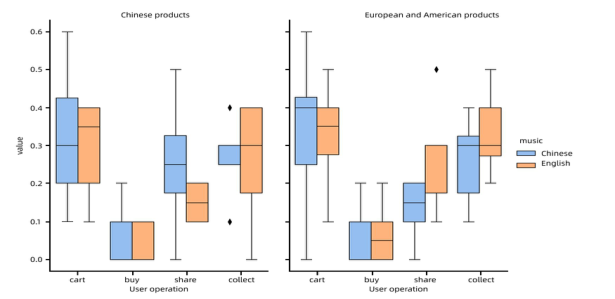
User Operation We analyzed the behavioral responses of the subjects through four operations in browsing the product interface, recorded the distribution of user opera- tion data under different groups (see Figure 1, 2), and conducted a T-test to observe the differences among different experimental groups (see Table 1, 2).
Figure 1: The operation data distribution of users browsing Chinese products/European and American products under the condition of Chinese lyrics music/English lyrics music.Figure 2: The operation data distribution of users listening Chinese lyrics music/English lyrics music under the condition of browsing Chinese products/European and American products.
Under the condition that the music language is the same but the products are different, there is no significant difference in the ratio of adding to the shopping cart, buying ratio, and collection ratio of Chinese products com- pared with European and American products. Under the condition of Chinese music, the sharing rate of Chinese products was significantly higher than that of European and American products (t = 1.938, p = 0.047). Similarly, under the conditions of European and American music, the sharing rate of European and American products is significantly higher than that of Chinese products (t = −2.553, p = 0.019).
Table 1. In the same music language conditions, the user operation ratio.
Table available in the original PDF paper.
User operation Chinese lyrics music English lyrics music
Chinese products - European and American products
Chinese products - European and American products Rate of adding cart t=−0.105, p = 0.46 t=−0.386, p = 0.356 Rate of immediate purchase t = 0.386, p = 0.353 t = 0.344, p = 0.368 Rate of adding to favorites t=-0.0, p = 0.5 t=−0.798, p = 0.226 Rate of products shared t = 1.938, p = 0.047 t=−2.553, p = 0.019
Under the condition that the products are the same but the music language is different, there is no significant difference in the ratio of adding to the shopping cart, buying ratio, and collection ratio of Chinese music compared with European and American music. The weak significance of the sharing rate of Chinese products when playing Chinese music was higher than that when playing European and American music (t = 1.673, p = 0.058); The sharing rate of European and American products when playing European and American music is significantly higher than that when playing Chinese music (t = −2.357, p = 0.017). In general, it can be seen that when the music language is consistent with the product, it has a positive impact on the share rate of the product.
The Effect of Congruity Between Background Music Language 387
Table 2. In the same product conditions, the user operation ratio.
Table available in the original PDF paper.
User operation Chinese products European products
Chinese lyrics music - English lyrics music
Chinese lyrics music - English lyrics music Rate of adding cart t = 0.333, p = 0.372 t = 0.149, p = 0.442 Rate of immediate purchase t = 0.386, p = 0.353 t = 0.344, p = 0.368 Rate of adding to favorites t=-0.202, p = 0.421 t=−1.122, p = 0.14 Rate of products shared t = 1.673, p = 0.058 t=−2.357, p = 0.017
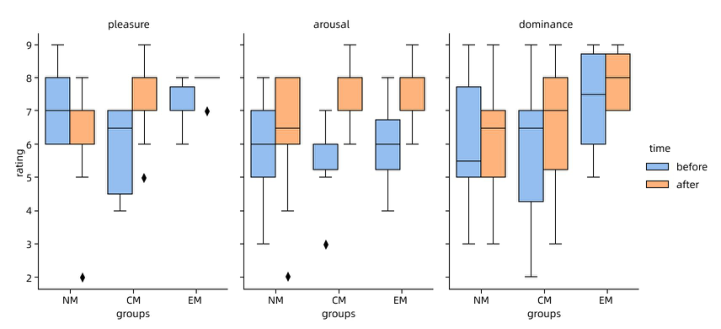
User Emotion We used a 9-level Likert-based scale to record the emotional states of the subjects before and after the experiment: pleasure, arousal, and dominance (see Figure 3). We conducted a T-test analysis of the data. The results showed that, on the whole, Chinese music had a significant effect on pleasure (t = −2.31, p = 0.016), and a strong significant effect on arousal (t = −3.151, p = 0.003). European and American music had a significant effect on pleasure (t = −3.165, p = 0.003) and arousal (t = −3.75, p = 0.001). Neither music had a significant effect on the degree of control (see Table 3).
Table 3. Overall comparison of user emotions before and after.
Table available in the original PDF paper.
User emotion No background music Music with Chinese lyrics Music with English lyrics pleasure t = 1.543, p = 0.07 t=−2.31, p = 0.016 t=−3.151, p = 0.003 arousal t=−0.486, p = 0.171 t=−3.75, p = 0.001 t=−3.165, p = 0.003 dominance t=−0.227, p = 0.411 t=−0.742, p = 0.234 t=−1.202, p = 0.122
Figure 3: Emotional score data distribution of participants in 3 groups under different music environments.
For different brands of products (see Table 4), Chinese music significantly improved the pleasure of users browsing Chinese products (t = −1.769, p = 0.055), while European and American music did not; European and
American music significantly improved the pleasure of users browsing Euro- pean and American products (t = −2.753, p = 0.011), while Chinese music did not; Both kinds of music significantly improved the arousal of users browsing different products; European and American music significantly improved the control degree of users browsing Chinese products (t = −1.627, p = 0.069). In general, it can be seen that user pleasure and arousal are significantly improved in both Chinese songs and European and American songs.
Table 4. Overall comparison before and after the user’s mood under the condition of observing the music congruity.
Table available in the original PDF paper.
User emotion Product type No background music
Music with Chinese lyrics
Music with English lyrics
Equations and mathematical formulas are available in the original paper PDF.
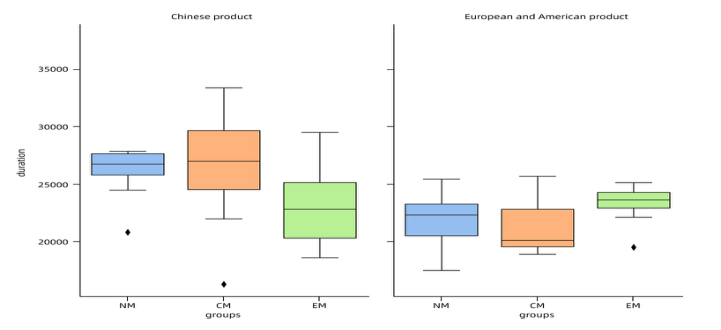
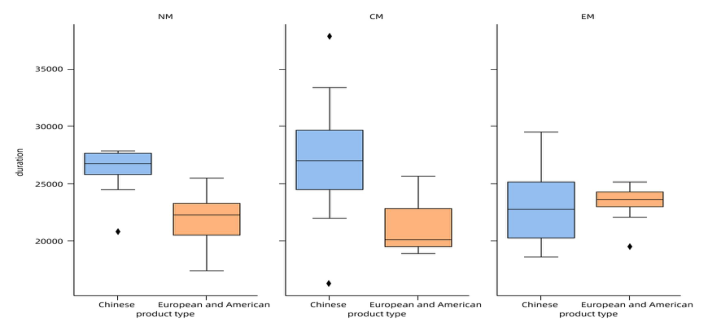
Length of Stay By recording the browsing time of the participants in shopping on differ- ent interfaces through the eye tracker (see Figure 4, 5), we can obviously observe that Chinese music significantly increases the residence time of the participants in browsing the interface of Chinese products (t = 2.378, p = 0.016), while for European and American products, European and American music significantly increased the retention time of participants (t = −1.859, p = 0.042).
DISCUSSION
In hypothesis 1, we propose that different music languages will affect con- sumer behavior. The results show that music in different languages has no significant impact on shopping cart adding, purchasing, and collecting behav- iors, etc., but when the music language and brand are consistent, music has a significant impact on sharing behavior, which also validates hypothesis 2. As to why music only has a significant impact on sharing behavior, further experimental studies are needed. We preliminarily conclude that music affects
The Effect of Congruity Between Background Music Language 389
consumer behavior mainly through the intermediary role of emotions. Music stimulates positive emotions or emotional connections, thus making people more willing to share their experiences or preferences.
Figure 4: User residence time distribution of Chinese products/European and American products under the condition of no music/Chinese lyrics music/English lyrics music.Figure 5: User residence time distribution of no music/Chinese lyrics music/English lyrics music under the condition of browsing Chinese products/European and American products.
This is exactly what we mentioned in hypothesis 3: When the music lan- guage is consistent with the brand, it produces a positive emotional response, which affects the consumption behavior. The results showed that partici- pants’ pleasure and arousal were significantly improved under both Chinese and European music. Consistent music resulted in higher pleasure and lower arousal. We believe that the lower arousal caused by the music congruity can make the user relax and calm and thus produce a higher sense of pleasure, but this still needs more abundant data to support it. In summary, music con- gruity influences the cognitive response of users through the mediating effect of pleasurable degree and arousal degree.
CONCLUSION
Our research shows that congruity between music language and brand culture leads to higher levels of pleasure and significantly affects online consumer behavior. When the music culture is consistence with the brand, the rate at which consumers share the products increases. The pleasant user experience brought by musical congruity increases consumers’ eval- uation of the cognitive response to the product, thus positively affecting consumers’ purchase intention. The experimental results provide new insights into music selection in the online shopping scene in the field of auditory mar- keting. It enriches the existing literature on musical congruity and cultural characteristics.
ACKNOWLEDGMENT
The authors would like to thank the Fundamental Research Funds for the Central Universities (531118010836) for the support of this research work.
REFERENCES
Beverland, M., Lim, E. A. C., Morrison, M., & Terziovski, M. (2006). In-store music and consumer–brand relationships: Relational transformation following experiences of (mis) fit. Journal of Business Research, 59(9), 982–989. Chan, B. H. S. (2009). English in Hong Kong Cantopop: Language choice, code-
switching and genre. World Englishes, 28(1), 107–129. Duncan Herrington, J., & Capella, L. M. (1994). Practical applications of music in service settings. Journal of Services Marketing, 8(3), 50–65. Garlin, F. V., & Owen, K. (2006). Setting the tone with the tune: A meta-analytic
review of the effects of background music in retail settings. Journal of business research, 59(6), 755–764. Kellaris, J. J., Cox, A. D., & Cox, D. (1993). The effect of background music on ad processing: A contingency explanation. Journal of Marketing, 57(4), 114–125. Mattila, A. S., & Wirtz, J. (2001). Congruency of scent and music as a driver of
in-store evaluations and behavior. Journal of retailing, 77(2), 273–289. Mehrabian, A., & Russell, J. A. (1974). An approach to environmental psychology.
the MIT Press. Mitchell, D. J., Kahn, B. E., & Knasko, S. C. (1995). There’s something in the air: Effects of congruent or incongruent ambient odor on consumer decision making. Journal of Consumer Research, 22(2), 229–238. North, A. C., Hargreaves, D. J., & McKendrick, J. (1999). The influence of in-store
music on wine selections. Journal of Applied psychology, 84(2), 271. Oakes, S. (2007). Evaluating empirical research into music in advertising: A congruity perspective. Journal of Advertising Research, 47(1), 38–50. Oakes, S., & North, A. C. (2006). The impact of background musical tempo and
timbre congruity upon ad content recall and affective response. Applied Cognitive Psychology: The Official Journal of the Society for Applied Research in Memory and Cognition, 20(4), 505–520. Slovic, P. (1966). Cue-consistency and cue-utilization in judgment. The American Journal of Psychology, 79(3), 427–434. Sun, W., Chang, E. C., & Xu, Y. (2023). The effects of background music tempo
on consumer variety-seeking behavior: The mediating role of arousal. Frontiers in Psychology, 14.
The Effect of Congruity Between Background Music Language 391
Vida, I., Obadia, C., & Kunz, M. (2007). The effects of background music on consumer responses in a high-end supermarket. International Review of Retail, Distribution and Consumer Research, 17(5), 469–482. Zoghaib, A., Luffarelli, J., & Feiereisen, S. (2023). Branding with music: How can
music contour and tonality enhance perceived brand innovativeness and brand evaluations?. Psychology & Marketing, 40(10), 1965–1985.
LISTED IN THE AHFE DIGITAL BOOKSTORE CATALOGUE
Explore the complete digital volume
Usability and User Experience
Read this individual research paper free through the original publisher, or explore the full digital proceedings book.
ISBN 978-1-964867-32-8
Explore this ISBN in the AHFE Bookstore ↗Listed in the July 2026 bookstore catalogue; search by ISBN to confirm current availability · Digital book purchase optional