Hui Zhang, Xinjie Liang, Yingping Cao (2024). The Influence of Background Music Popularity on Consumer Online Shopping Behavior: A Model Analysis. In: Usability and User Experience. AHFE Open Access, vol. 156, pp. 48–57. https://doi.org/10.54941/ahfe1005414
With the popularity of online shopping, online e-commerce is paying more attention to the impact of sensory marketing on consumer behavior. Previous studies suggest that music plays a significant role in enhancing the online shopping experience for consumers. However, the specific patterns of consumer impulse that music induces are yet to be fully discovered. Therefore, the study aims to explore the influence of music popularity on online shopping behavior in reference to the familiarity on emotion regulation. The results can create a better auditory environment for users' shopping experience and give a guidance for merchants to choose music that fits their brand positioning.MethodThirty participants (15 females) between the ages of 19 and 33 (M = 23.8, SD = 3.2) were recruited and all had years of online shopping experience. Participants were evenly assigned to three groups(no-music group, non-pop music group, and pop music group). The task scenario of participants is to buy a pair of sports shoes, so we simulated the current mainstream e-commerce shopping website to make online shopping pages of sports shoes. We first got 50 popular and 50 non-popular songs based on popularity on the charts of various music platforms. Then 10 of each the most popular and the least popular songs were selected from each of the two groups based on user feedback. Participants were asked to browse eight goods while listening to music in a quiet indoor environment. In terms of objective data collection, eye tracker was used to record participants' browsing time, browsing track and focusing position. After that, we used a questionnaire to collect the subjective evaluation. The questionnaire mainly includes three parts: recording emotions before shopping, recording behaviors during shopping (direct purchase, add shopping cart, share and collection), and recording experiences after shopping (ranking of purchase intention, emotions and music feelings). Finally, we conducted a qualitative analysis of semi-structured interviews to improve the experimental design.ResultsA t-test of the experimental data revealed that the duration of participant browsing markedly increased when shopping with music, in comparison to shopping without music (p<0.05). Compared with non-pop music, the subjects were more familiar with pop music and listened to it for a longer time. During the experience with popular music, the emotional arousal of the participants significantly increased in the shopping context (p<0.05). More precisely, the heightened shopping excitement contributed to an elevated rate of adding items to the cart and sharing these selections.ConclusionOur research shows that music popularity significantly influences online consumer behavior. Specifically, in terms of the connection between music types and shopping experience, pop music first increases users' attention to goods. In addition, familiar music enhanced the arousal dimension of mood, thus promoting the arousal of desire to buy. These insights enhance our comprehension of the strategic use of background music in e-commerce shopping contexts. Based on the conclusions of the research, a better auditory experience can be created for users in the shopping scene in the future. In terms of business application and marketing strategy, it can also guide merchants to strategically use music to influence mood changes and promote product consumption.
With the popularity of online shopping, online e-commerce pays more and more attention to the influence of sensory marketing on consumer behavior. Consumer attitudes are also different than they used to be. What consumers buy is no longer the product itself, but also the various sensory stimuli and experiences in the consumption process (Li et al., 2023). Among the human senses, hearing is the second most important source of information acquisi- tion after vision. Previous research has shown that music plays an important role in enhancing consumers’ online shopping experience. More recently there has been increased commercial interest in sonic branding, a move from the ‘visual turn’ to the ‘sonic turn’ (Khamis & Keogh, 2023). However, the specific patterns of music-induced consumer impulses have not been fully discovered. Therefore, this study aims to explore the influence of music pop- ularity on online shopping behavior. The results of the study can create a better auditory environment for users’ shopping experience, and can also guide merchants to choose music that suits their brand positioning.
The Influence of Background Music Popularity on Consumer Online Shopping Behavior 49
RELATED LITERATURE The purpose of this study is to explore the influence of music popularity on online shopping behavior, which requires in-depth research and understand- ing of the mechanism and practice of music to promote consumption. This part mainly starts with the theory and development of music to promote consumption, and explores and analyzes the relevant literature. Through understanding the practical application of music in the online shopping scene, the subsequent experimental design and development will be guided.
The Mechanism of Music Promoting Consumption The shopping atmosphere is established by a variety of sensory elements. Such as visual layout, auditory music, olfactory odor and so on. And the above features can be explained by Mehrabian and Russell’s Stimulus-Organism- Response (SOR) model.The SOR model is a commonly used model in the field of psychology and consumer behavior. This model has been used to study the influence of store environment factors on Chinese consumers’ senti- ment and intention to purchase luxury brands. The results show that listening to music can make customers feel excited and happy while shopping for luxury goods (Yang et al., 2022).
Other studies show that many Organism regions are found to be involved in regulating emotion. For example, music can independently influence fla- vor evaluation and gustatory experience by eliciting emotions (Lin et al., 2024). And fast music is more effective than slow music for evoking pos- itive taste expectations and purchase intentions (Pantoja & Borges, 2021). Emotional value also played a mediating role in the relationship Between attitudes toward store music and customer loyalty (Meng & Yang, 2022). This is a trend of contemporary brand owners in sensory marketing, that is, from a single behavioral induction transition to produce an image bind- ing with the product itself. Just as music increasing the salience of valued product attributes (Flynn et al., 2022). This building of loyalty and trust is conducive to the expression of the brand through sound, namely sonic brand- ing. Beyond that, the mere presence of music decreases consumers’ liking of complex visuals (Klein et al., 2021). This serves as a guide for the subsequent construction of the audition combination for shopping scenes.
Music Material Selection For the selection of audio material, many previous studies have represented different emotional pointers through macro music genres. The experiment of taste preference by jazz, classical, rock and hip hop music genres proves that different genres of music lead to different taste preferences (Motoki et al., 2022). Alternatively, existing songs were selected based on different beats. Another study looked at consumers’ memory retention in advertisements using four electronic dance songs played to different beats (Johnson et al., 2021). However, with the development of time, the selection of music is not homogenized. Many studies have begun to self-adjust the parameters of the audio itself to control the independent variable. They may have acquired material from existing music platforms and later altered emotional pleasure by controlling the variables to ensure that arousal and tempo were the same
(Chang & Kim, 2022). In addition to this, there are many researchers who create their own audio via MIDI to meet the requirements of their experi- ments. However, a better way to study the popularity of music is to categorize and define existing music through pre-experimentation. For example, the user’s subjective rating of music as “enjoyable, appropriate, or annoying” (Xu & Yang, 2023). This composed soundtracks approach with strategically chosen soundscapes reduces the definitional bias caused by the researcher’s subjectivity (Peng-Li et al., 2021).
Application Scenario of Music in Online Shopping Previous research has focused more on the role of music as a marketing aid in brick-and-mortar stores. However, a growing body of research sug- gests that brands favor music to achieve longer-lasting impression-enhancing effects. There has been research around how brands can leverage the char- acteristics of music pieces to convey an innovative image and boost brand evaluations among consumers (Zoghaib et al., 2023). Thus the online shop- ping consumption scenario would be more compatible with this trend, as it is less exposed to other environmental distractions. The musical experience of online shopping also varies according to the consumer’s purposeful orien- tation. Crossmodally incongruent background music (vs. no music) leads to more positive consumer reactions for experiential browsers and more neg- ative consumer reactions for goal-directed searchers (Doucé et al., 2022). In addition to this, studies in the advertising category are more frequent. Resolving mild musical incongruity may enhance consumers’ attitude toward advertising, perception of brand image and quality, as well as their purchase intent (Abolhasani & Golrokhi, 2021). Typically, there is a video pilot on the product display page. This part of the advertising content has been widely used in online shopping scenarios. In addition, the interaction between music and consumers also enhances the online shopping experience. Interactive music enhances the experiential value of e-commerce for low-involvement consumers (Hwang et al., 2020). This is harder to realize in offline shopping scenarios. Therefore, it can also be seen that the scene of music consumption is gradually shifting from offline to online.
METHOD
Music Scoring Experiment In order to make the music materials selected for the experiment more in line with the subjective perception of the participants in terms of popularity, we conducted a music scoring experiment before the main experiment. In this experiment, we first selected 50 popular songs and 50 non-pop songs based on the chart ranking of each music platform. Then 10 participants were invited in each of the two groups to conduct the rating experiment. During the experiment, the participants were asked to open the playback page of the 50 songs and listen to the songs in turn. After listening to the songs, they were asked to think about the appropriateness of using the music for the purchase of the product on the side of the display. The process took about 50 minutes in total. Based on the experimental results, we came up with the top 10 songs in the popular group versus the bottom 10 songs in the non-pop group. The results will be used in subsequent experiments.
The Influence of Background Music Popularity on Consumer Online Shopping Behavior 51
Participant We recruited 30 users with many years of online shopping experience. Among them, there was an equal gender ratio of men and women, as this allowed the influence of the gender factor to be ignored. Participants ranged in age from 19 to 33 years (M = 23.8, SD = 3.2), which is the largest age group in the online shopping population. All participants had no medical conditions affecting their eyes or hearing, had normal music perception and expression, and were able to understand the researcher’s instructions and express them- selves. Participants were randomly and equally divided into three groups to participate in the online shopping operation of the no music group, the no pop music group and the pop music group respectively.
Procedure First, the whole experimental process was explained by the experimenter, and then the participants were asked to fill in the personal information and informed consent form. Second, the researcher adjusted the equipment according to the different participants’ own conditions. The experiment was conducted indoors, and the participants chose to sit in a natural and com- fortable position without the use of clamps, and the seat was soft and stable. There was no noise or human interference throughout the experiment. In our experimental scenario, the subject needs to put their head on the head rest, and the experimenter will adjust the eye movement system. After the adjustment, there will be a test interface similar to the experimental content to ensure that the participants understand the purpose of the experiment.
We simulated the current mainstream e-commerce shopping website to create an online shopping page for sneakers. At the beginning of the experi- ment, participants will browse the interfaces of a total of 8 pairs of couples’ sneakers. Eye-focusing was performed before browsing each interface to ensure accurate eye-movement information acquisition. A questionnaire was administered after each interface was browsed. The participants were mainly questioned about their willingness to collect, willingness to add to the shop- ping cart, pleasure and control. During the experiment, the experimenter will play the corresponding music according to the type of participants. We considered that the playing order of the songs might have an effect on the participants’ emotions. Therefore the song playing within the group was not randomized, but each experimental group was randomized. The experiment was set up with two experimental groups and one control group. The control group did it without music. The experimental group completed the inter- face browsing under the background of popular music and unpopular music respectively.
At the end of the experiment, the participants need to conduct an inter- view, the interview content is mainly to understand the subject’s recall degree of the product, and synthesize the results of the questionnaire to determine the subject’s willingness to buy. At the same time, the experimenter needs to record the results of the experiment data, mainly eye movement heat map, eye movement trajectory map and page dwell time, through these data can determine the subject’s point of interest, compared with the questionnaire interview is more objective.
RESULTS
In order to balance the subjectivity and objectivity of the experimental results, this section describes the results from the following three perspec- tives: (1) participants’ purchase intention and emotion assessment; (2) eye movement data; and (3) interview findings.
Purchase Intention and Emotion Assessment of Participants In terms of participants’ willingness to buy, we recorded the ratio of four behaviors (CART, BUY, SHARE, COLLECT) of the participants in different music environments. In addition, the participants’ emotional states before and after the experiment were counted based on a 9-point Likert scale. The main dimensions of emotional assessment were pleasure, arousal and dominance.
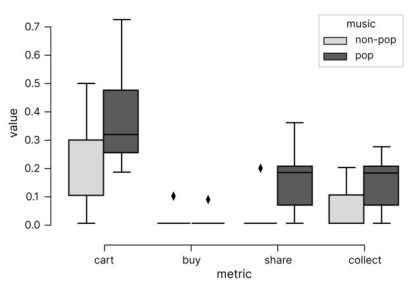
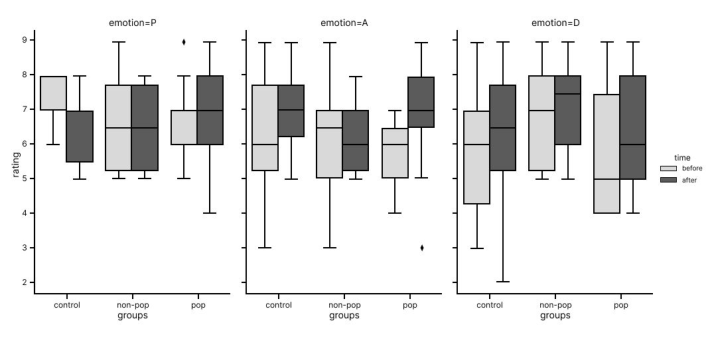
Based on the experimental results, we conducted a t-test to observe the differences between the different experimental groups (see Table 1). We observed that in the experimental group no music-with music (non-popular), there was no significant change in both purchase behavior and mood. In contrast, compared to non-pop music, the participants’ CART (t=−2.106, p = 0.027) versus SHARE (t=−2.621, p = 0.01) ratio in the shopping sit- uation of listening to pop music) ratios are significantly increased. In the non-pop music shopping scenario, the mean value of the ratio of participants’ CART for the item was about 0.1875, while it increased to 0.375 in the pop music scenario. The effect on SHARE behavior was even more pronounced. Only one subject performed this behavior in the non-pop music scenario. In contrast, the commodity sharing ratio increased to 0.159 under pop music (see Figure 1). In addition, pop music showed a significant increase in arousal in mood. It can be seen that pop music has a certain effect on the pleasure, arousal and dominance of emotions (see Figure 2). Among them, the effect of arousal is the most significant.
Table 1. T-test results of experimental data.
Table available in the original PDF paper.
Data content No music-with music Non pop-pop Add shopping cart ratio t=−0.742, p = 0.235 t=−2.106, p = 0.027
Immediate purchase ratio t = 1.368, p = 0.096 t = 0.067, p = 0.474 Add to favorites ratio t = 1.336, p = 0.102 t=−1.594, p = 0.067
Commodity sharing ratio t=−0.449, p = 0.33 t=−2.621, p = 0.01 User emotional pleasure t = 1.655, p = 0.058
Equations and mathematical formulas are available in the original paper PDF.
The Influence of Background Music Popularity on Consumer Online Shopping Behavior 53
Figure 1: Non-pop - pop music shopping behavior results data distribution.Figure 2: The data distribution of emotional scores of participants in three groups of music environment.
However, it is undeniable that the presence of non-pop music still has a certain effect on the pleasantness and arousal of shopping mood. We specu- late that the presence of music, regardless of its popularity, creates a pleasant atmosphere for shopping. The decrease in arousal may be due to the fact that non-pop music does not create a sense of familiarity in the participants, and therefore the participants are not excited, but rather their attention is somewhat distracted.
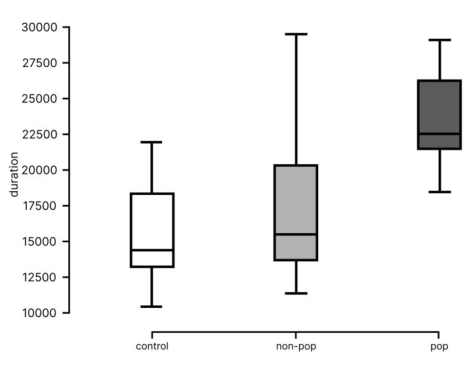
Eye-Tracking Data By recording the participants’ shopping browsing duration, it can be clearly observed that the intervention of music prolonged the participants’ page dwell time (t=−2.280, p = 0.019). And the effect of pop music is more signif- icant compared to non-pop music (t=−2.345, p = 0.017). The shorter page dwell time of the participants with pop music was also higher than the longer time without music intervention (see Figure 3).
Figure 3: Shopping browsing time of participants in three groups of music environment.
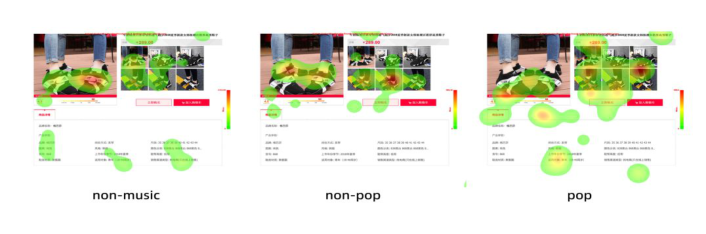
In addition, we conducted eye movement thermogram collection. Through eye movement thermograms, we observed that the intervention of music did not directly increase the frequency of gaze in the original gaze area. Rather, there were certain regional changes in non-popular music scenes. The result of one of the participants’ gaze on the same item is taken as an example (see Figure 4). As can be seen, the distribution of the thermogram of attention for non-pop music is shifted to the image part compared to the condition without music intervention. In contrast, the thermogram for the pop music intervention showed an overall increase in the whole page. It can be seen that the music intervention made the participants pay more attention to the infor- mation content of the web page with strong visual expression. The neglect of textual information is also related to the distraction of non-pop music. This conjecture is consistent with the results of the previous subjective assessment. The intervention of popular music, on the other hand, had a multifaceted effect on the emotional dimensions of the participants, so that they had a tendency to be more interested in all forms of information about the product.
Figure 4: Eye movement thermogram distribution in three musical environments.
The Influence of Background Music Popularity on Consumer Online Shopping Behavior 55
Interview After the main experiment was completed, we interviewed the participants to find out how they felt during the experiment and what they recalled in detail. Among all the products, we found that the styles that impressed the partic- ipants were more likely to have vivid colors. In addition, the design of the product is also known as the reason for attracting the participants. The ten- dency to buy depends on the evaluation of the product. They believed that the real evaluation of the product would greatly influence their judgment. Therefore the virtual webpage constructed in this study makes the partici- pants’ trust in the goods not particularly high. However, with the addition of music, it made them have enjoyment during the whole experiment. Most thought the whole experience of the experiment was good. The introduction of some stories would have made the scene more immersive.
DISCUSSION
In summary, emotion is an important bridging factor for music to influence consumption. When customers feel pleasure, excitement, or dominance due to popular music, they are more likely to have a positive impression of the shopping experience. This positive experience will make them more willing to adopt many behaviors that promote consumption, such as up-selling. In the process, the establishment of an emotional connection between the cus- tomer and the brand will also indirectly contribute to their loyalty and trust in the product. On the contrary, non-popular music does not have a sense of familiarity and may lead to hesitation or avoidance of purchase. And one of the most significant increases in emotional arousal will make customers more willing to take risks and thus make purchase decisions. participants’ shopping experience in a non-pop music environment may be more oriented towards calmness and indifference. It cannot elicit strong emotional fluctu- ations similar to pop music. Therefore, the comprehensive experience effect of pop music is stronger in trendy sports brands. More extensive research is needed in the future in the online shopping environment of other types of goods.
What’s more, participants were willing to spend more time browsing prod- ucts and web content in the company of pop music. This suggests that the familiar auditory environment gives users the tendency to explore further on product information. In the same way, familiarity led to an increase in the participants’ listening time for music. This enhanced the depth of the shopping experience. The higher attention to visual images, on the other hand, is related to the associative effect of vision and hearing. Therefore, merchants should first consider the image-audio fit relationship when subse- quently selecting background music. We also found that customers in a happy mood tend to be more willing to share their shopping experiences and spread positive emotional experiences through word-of-mouth. This can arouse the interest of other potential customers and increase brand awareness and appeal.
CONCLUSION
This study aims to explore the effect of music popularity on online shop- ping behavior. We selected popular and non-pop songs by selecting them on music platform charts and combining them with participants’ subjective reviews. Through the construction of a virtual online shopping platform, we allowed the participants to complete the browsing of several trendy sports goods in different music environments. The results were analyzed from sub- jective and objective perspectives through eye-tracking, questionnaires and interviews. Our study shows that music popularity significantly influences online shopping consumer behavior. Specifically, in terms of the link between music genres and shopping experience, popular music significantly increased users’ attention to products. In addition, familiar music enhances the emo- tional arousal dimension, which promotes the desire to buy and the desire to share. Our findings contribute to the strategic use of background music in e-commerce shopping environments. Based on the findings, better listen- ing experiences can be created for users in shopping scenarios in the future. In terms of business applications and marketing strategies, merchants can also be guided to utilize music to influence mood changes and thus promote product consumption.
ACKNOWLEDGMENT
We are grateful to the 30 participants for their participation and assistance in the experimental study. We also thank for the research supported by the Fundamental Research Funds for the Central Universities (531118010836).
REFERENCES
Abolhasani, M., & Golrokhi, Z. (2022). Eat to the beat: musical incongruity resolution in restaurant advertising. Journal of International Consumer Marketing, 34(5), 567–591. Chang, D. R., & Kim, Q. (2022). A study on the effects of background film
music valence on para-social interaction and consumer attitudes toward social enterprises. Journal of Business Research, 142, 165–175. Doucé, L., Adams, C., Petit, O., & Nijholt, A. (2022). Crossmodal congruency between background music and the online store environment: The moderating role of shopping goals. Frontiers in psychology, 13, 883920. Flynn, E., Whyte, L., Krause, A. E., North, A. C., Areni, C., & Sheridan, L. (2022).
Attribute accessibility, normative influence, and the effect of classical and country music on willingness to pay for social identity and utilitarian products. Psychology of Music, 50(1), 3–16. Hwang, A. H. C., Oh, J., & Scheinbaum, A. C. (2020). Interactive music for multisensory e-commerce: The moderating role of online consumer involvement in experiential value, cognitive value, and purchase intention. Psychology & Marketing, 37(8), 1031–1056. Johnson, V., Zhu, Z., Anguera, R., Bollinger, J., Eccles, J., Hardtke, D.,... &
Zanto, T. P. (2021). Increasing brand awareness: Memory for short audio ads. Psychology & Marketing, 38(11), 1960–1972. Khamis, S., & Keogh, B. (2021). Sonic branding and the aesthetic infrastructure of everyday consumption. Popular Music, 40(2), 281–296.
The Influence of Background Music Popularity on Consumer Online Shopping Behavior 57
Klein, K., Melnyk, V., & Voelckner, F. (2021). Effects of background music on evaluations of visual images. Psychology & Marketing, 38(12), 2240–2246. Li, H., Xu, J., Fang, M., Tang, L., & Pan, Y. (2023). A study and analysis of the
relationship between visual—auditory logos and consumer behavior. Behavioral Sciences, 13(7), 613. Lin, X., Liu, Y., & Huang, J. (2024). Reducing sweetness expectation in milk tea by crossmodal visuo-auditory interaction. Appetite, 192, 107107. Meng, Y., & Yang, H. (2022). Attitudes toward store music and customer loy-
alty: The mediating role of emotional value. Social Behavior and Personality: An international journal, 51(6), 1–7. Motoki, K., Takahashi, N., Velasco, C., & Spence, C. (2022). Is classical music sweeter than jazz? Crossmodal influences of background music and taste/flavour on healthy and indulgent food preferences. Food Quality and Preference, 96, 104380. Pantoja, F., & Borges, A. (2021). Background music tempo effects on food evalu-
ations and purchase intentions. Journal of Retailing and Consumer Services, 63, 102730. Peng-Li, D., Mathiesen, S. L., Chan, R. C., Byrne, D. V., & Wang, Q. J. (2021).
Sounds Healthy: Modelling sound-evoked consumer food choice through visual attention. Appetite, 164, 105264. Xu, J., & Yang, H. (2023). Store music and customer loyalty to the store: Negative emotion as a mediator. Social Behavior and Personality: An international journal, 51(4), 1–7. Yang, S., Isa, S. M., Wu, H., Thurasamy, R., Fang, X., Fan, Y., & Liu, D. (2022).
Effects of stores’ environmental components on Chinese consumers’ emotions and intentions to purchase luxury brands: Integrating partial least squares-structural equation modeling and fuzzy-set qualitative comparative analysis approaches. Frontiers in Psychology, 13, 840413. Zoghaib, A., Luffarelli, J., & Feiereisen, S. (2023). Branding with music: How can music contour and tonality enhance perceived brand innovativeness and brand evaluations?. Psychology & Marketing, 40(10), 1965–1985.
LISTED IN THE AHFE DIGITAL BOOKSTORE CATALOGUE
Explore the complete digital volume
Usability and User Experience
Read this individual research paper free through the original publisher, or explore the full digital proceedings book.
ISBN 978-1-964867-32-8
Explore this ISBN in the AHFE Bookstore ↗Listed in the July 2026 bookstore catalogue; search by ISBN to confirm current availability · Digital book purchase optional