Marleen Vanhauer, Stephan Raimer (2024). Challenges and Opportunities of Low-Code Figma and Modul-F for Use within the Public Sector. In: Usability and User Experience. AHFE Open Access, vol. 156, pp. 324–330. https://doi.org/10.54941/ahfe1005443
Low-code/no-code applications becoming more and more popular would especially within the public sector foster faster digitalization of public services. Working with these applications requires no programming skills and therefore, professionals within their domain can easily implement digital prototypes independent of designers and software developers. Respectively, public administrative employees and executives often have a deep understanding of the actual digital public services to be implemented. Low-code development tools have been evaluated within the healthcare sector (Ness et al., 2019), educational sector (Khosrojerdi et al., 2021), whereas Gottschick et al. (2023) applied a software development approach using low-code/no-code for implementation of a public sector cloud service. Lethbridge (2021) stated a need to first provide proper low-code platforms, to have an impact on faster development of digital services. This led us to the question: Which low-code prototyping tools exist and what their opportunities and challenges are when used by public sector employees? By expert evaluation (Harley, 2019), we compared Figma (Figma, 2016) and the Figma-Low-Code plugin (Figma Community, 2020) with the customized low-code platform Modul-F (Senatskanzlei Hamburg, 2023) for the public sector. We found an advanced maturity in structure, layout and functions of both low-code platforms. According to Nielsen’s (2023) usability quality criteria, learnability of Modul-F was fast (high), and learnability of Figma with Low-Code plugin was rated neutral (medium). The efficiency of the Modul-F Editor was high, it was low for Figma with the low-code plugin. However, memorability was low for both platforms. Running the Figma-Low-Code plugin did require programming skills. Building a prototype with the Modul-F Editor did not allow to design individual user flows. In the future, usability studies should be conducted to assess flaws and satisfaction during actual use by public administrative employees, executives, and designers having no programming skills. Moreover, we anticipate that a nation-wide public service design system with component library, e.g. KERN UX-Standard (Senatskanzlei Hamburg, 2024), would fully leverage the potential of any low-code/no-code platform. To conclude, using low-code/no-code platforms requires interdisciplinary teams of administrative staff and designers working together on digital concepts on a professional daily basis.
Low-code/no-code applications becoming more and more popular would especially within the public sector foster faster digitalization of public ser- vices. Working with these applications implies to require no programming skills and therefore, professionals within their domain can easily implement digital prototypes independent of designers and software developers. Respec- tively, public administrative employees and executives often have a deep understanding of the actual digital public services to be implemented.
Challenges and Opportunities of Low-Code Figma 325
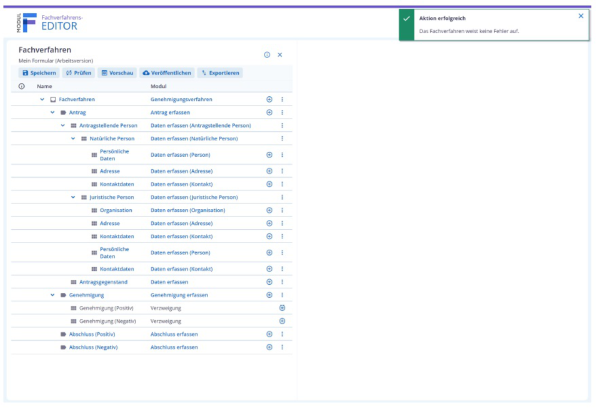
Since 2017, the German Onlinezugangsgesetz (OZG) had triggered a major development in Germany. By the end of 2022, the defined goals were not achieved, but fundamental change is still being pursued on all federal levels. In 2023, a particular focus was placed on the consistent end-to- end digitalisation of administrative services. This means, that not only the application by citizens, but also the entire processing procedure up to the final decision takes place in the digital space without media discontinuity. A primary goal is to also make the administration entirely free of digital media discontinuity and thus, significantly more efficient. In this context, the project to create a target image for a holistic OZG framework architecture with binding standards, uniform interfaces and centralised basic components was launched in 2023 with a successful consultation process. Modul-F as a low-code development platform is one of these basic components (BMI, 2023). Modul-F (see Figure 1) was created as part of the OZG implementation, when analysing existing administrative services and procedures in the state of Hamburg. Here, it was found, that a large number of smaller administrative applications exist – which, despite their differences, are similar: too small for the development of their own complex and cost-intensive IT specialist soft- ware, too important and frequent to be ignored in the digitisation process, e.g. permits for animal experiments, cutting down a tree, or launching a drone. A dedicated solution is needed to enable the digitalisation of such applications simply and cost-effectively (Fraunhofer FOKUS, 2022). As a solution for this, Modul-F offers a modular approach to simplify and accelerate the develop- ment and provision of software applications and specialised procedures for public administration. In the future, Modul-F will provide certain functions that are needed in every public administration as pre-programmed modules.
Figure 1: Designing by modules with modul-F for the public sector (adapted from Senatskanzlei Hamburg, 2023).
326 Vanhauer and Raimer
As part of this study, we wanted to examine the low-code prototyping plat- forms Modul-F and Figma, and analyse their opportunities and challenges for use within the public sector.
LITERATURE REVIEW
Low-code development tools have been evaluated within the healthcare sec- tor (Ness et al., 2019), educational sector (Khosrojerdi et al., 2021), whereas Gottschick et al. (2023) applied a software development approach using low- code/no-code for implementation of a public sector cloud service. Lethbridge (2021) stated a need to provide first proper low-code platforms in order to have an impact on faster development of digital services.
METHOD AND PROCEDURE By expert evaluation (Harley, 2019), we compared the Figma prototyping- platform (Figma, 2016) and its Low-Code plugin (Figma Community, 2020) with the customized low-code platform Modul-F for the public sector by Senatskanzlei Hamburg (2023).
The experts, i.e. authors had several years of practical usability research experience or had been conducting user and stakeholder interviews within the public sector for at least 2 years.
Modul-F consists of 2 applications, the Modul-F Editor and the Portal. The Modul-F Editor has been created for designers (Fachverfahrens-Designer) to design digital public applications and processes by the help of prefixed mod- ules. The Modul-F Portal has been designed for general clerks filling and processing a published application with data. Our review focused on the Modul-F Editor.
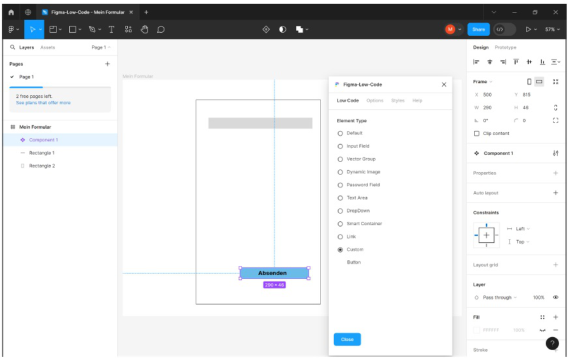
Figma (see Figure 2) is a popular prototyping tool for designers, researchers, and developers working collaboratively on digital prototypes regardless of their domain. Through the Figma Community, users have access to templates, plugins and other content published by the community.
Figure 2: Prototyping with Figma and low-code plugin (adapted from Figma, 2024).
Challenges and Opportunities of Low-Code Figma 327
We compared both platforms in relation to Nielsen’s (2023) usability qual- ity criteria learnability, memorability and efficiency, which were rated high, medium, or low. We also collected usability strengths (opportunities) and usability problems (challenges) (Harley, 2019) of which the latter were rated by severity grades of high, medium, or low severity.
As a sample task to complete, we chose to create a prototype of a standard input form.
RESULTS
In the following, we summarized our assessment in respect to the learnabil- ity, memorability, and efficiency (see Table 1). Furthermore, we highlighted opportunities and challenges of each platform.
Learnability, Efficiency and Memorability The learnability of the Modul-F Editor was fast (high), except a short on- boarding document, no further help was required. The learnability of Figma with the Low-Code plugin was rated neutral (medium), since fully run- ning the plugin required basic programming knowledge. Support was made available through helping hints and video tutorials on YouTube (Figma-Low- Code, 2020).
Creating a functional prototype with the Modul-F Editor was easy, effi- ciency was high. At the same time, we experienced a low efficiency of Figma with the Low-Code plugin – at first glance, using the Figma-Low-Code plugin did not appear more advantageous than using Figma alone.
However, memorability was low for both platforms, if not having used these platforms on a daily basis to reach a professional level.
Usability quality criteria Modul-F Editor Figma with Low-Code plugin Learnability High Medium Efficiency High Low Memorability Low Low
Opportunities Our overall impression about Figma with installed Low-Code plugin and the Modul-F Editor was, that we found an advanced maturity in structure, layout, design, and provided functions of both platforms. Both of them allowed to drag & drop reusable components (modules) in respect to com- bining them into a functional prototype, or application. Both worked stable and, if necessary supported comprehensive user feedback, e.g. through error messages.
Using the low-code Modul-F Editor did not require any programming skills. Our created prototype application (standard input form) was per se linked to a real database.
328 Vanhauer and Raimer
The platform was available for download to public bodies and institutions via the portal mp.govdigital.de (Senatskanzlei Hamburg, 2023). Working with the Modul-F Editor allowed to apply administrative-specific, interactive templates and modify single elements or documents.
The platform was tailored to public service process designers (Fachverfahrens- Designer). We recognized a high level of public-sector-specific terms, e.g. procedure (Fachverfahren, FV, and Genehmigungsverfahren), applications (Anträge), and process (Genehmigungsprozess, Vorgang).
The Editor also offers additional functionalities like calendar, e-mail, and a PDF-export, e.g. into e-file applications.
As stand-alone prototyping application, Figma did not require any pro- gramming skills. It allowed to create a low-fidelity prototype (standard input form) with individual user flows, but without a connection to a real database, nor high-fidelity functionality.
Via the web, the platform is accessible for anyone, private persons and non- public institutions. The Figma-Low-Code plugin can be downloaded through the Figma Community (2020). Figma allows to apply and modify ready- made design templates to one’s own needs. “The [Low-Code] plugin allows to define advanced widgets (input, lists and more) […]” (Figma Community, 2020).
Challenges Running and taking full leverage of the Figma-Low-Code plugin did – in con- trast to using the low-code Modul-F platform – require programming skills. In order to create a high-fidelity prototype with connection to dynamic data, as a user, we were required to transform standard element types, e.g. rectan- gles, to application elements, e.g. input fields. Therefore, specific knowledge about how to define classes, functions (methods) and data was needed. Some the basic interactive components of the plugin were still in Beta stage (High severity).
Building a prototype with the Modul-F Editor – in contrast to Figma with Figma-Low-Code plugin – did not allow to design individual user flows, since it is based on predefined, linear process modules, e.g. application, approval and completion. For optional modules, a minimal modification of the user flow was possible, e.g. by adding an address to the personal data module (High severity).
The Modul-F Editor did also not automatically save changes made to a document. Whenever changing to another program space, we were prompted to save changes manually (High severity).
Multiple public sector-specific terms were used throughout the Modul- F user interface and documentation, e.g. procedure (Fachverfahren, and Genehmigungsverfahren), applications (Anträge), and process (Genehmigungsprozess, Vorgang) (Medium severity).
Despite a real database connection, the user documentation stated that the data had to be entered manually into the application prototype by the clerks, when filing a new application. Applicants could not enter and send data themselves (Low severity).
Challenges and Opportunities of Low-Code Figma 329
CONCLUSION
Modul-F is an application for prototyping digital public services tailored to the public sector. Foremost, it serves professionals (Fachverfahrens-Designer), creating digital forms. It did not require any programming skills, but offers lit- tle to no freedom in the design of user flows. Modul-F is a good step towards standardized design for digital public services.
Figma is primarily for professional designers creating public services. It provided more creative freedom for prototyping user flows. However, to cre- ate a high-fidelity prototype with dynamic data, basic programming skills were required for using the Low-Code plugin. Figma (without Low-Code plugin) fostered to be at least an equivalent alternative – with more freedom in the design of user flows, to create prototypes for a wider range of digital public services.
We conclude, that Modul-F and Figma are both suitable for creating a standard input form - with Modul-F being more than just a prototyping tool, but a real application for forms processing.
However, we anticipate that not only low-code/no-code implementations are necessary, but also a public design system compatible with low-code pro- totyping, e.g. the KERN UX-Standard (Senatskanzlei Hamburg, 2024), to ensure standardized visual design across nation-wide digital services.
Professionals working within the public sector should choose Figma as prototyping platform for digital services, necessarily in combination with a design system. If working with a low-code plugin is not an option, using components of a design system’s component library could speed up the workflow.
Modul-F should be designed with more freedom for digital public service designers by maximizing optional modules and keeping mandatory input fields to a minimum.
We consider automatically saving files to be essential. Technical terms specific to the public sector should be simplified and used consistently throughout the application interface and documentation.
We further suggest to consider the process before and after using a pub- lic digital service (Fachverfahren). How is data for a new application being entered? Who is allowed to enter and send data? For seamless communica- tion between the applicant and the clerk, and to minimize media disruptions, all target groups need to be taken into account.
For further studies, we recommend to conduct usability interviews with public service professionals and designers without programming skills, to assess flaws and satisfaction during the actual use of these platforms.
To conclude, we state that using low-code/no-code platforms requires interdisciplinary teams of public administrative professionals and designers collaboratively working together on digital prototypes on a daily-basis.
ACKNOWLEDGMENT
The authors would like to thank Zhera Öztürk and Claas Trede (Senatskanzlei Hamburg) for providing a demo access to the Modul-F application.
330 Vanhauer and Raimer
REFERENCES
BMI [Bundesministerium des Innern und für Heimat] (2023) ‘Jahresrück- blick der “Digitalen Verwaltung” 2023,’ Onlinezugangsgesetz, 20 Decem- ber. https://www.digitale-verwaltung.de/SharedDocs/kurzmeldungen/Webs/DV/ DE/2023/12_jahresrueckblick.html (Accessed: February 1, 2024). Figma (2016) Erstelle interaktive Prototypen mit Figma. https://www.figma.com/de /prototyping/ (Accessed: January 29, 2024). Figma Community (2020) Figma-Low-Code Plugin. https://www.figma.com/comm
unity/plugin/858477504263032980 (Accessed: January 26, 2024). Figma-Low-Code (2020) Figma-Low-Code YouTube Channel. https://www.youtub e.com/@figma-low-code9378 (Accessed: January 29, 2024). Fraunhofer FOKUS (2022) MODUL-F: Low-Code-Baukasten zur Verwaltungs-
digitalisierung. https://www.fokus.fraunhofer.de/de/dps/projekte/MODUL-F (Accessed: February 1, 2024). Gottschick, J. et al. (2023) ‘Code generation for Cloud-Based implementation of public sector processes using a Pattern-Based approach,’ in Communications in computer and information science, pp. 250–262. https://doi.org/10.1007/978-3- 031-40213-5_18. Harley, A. (2019) UX Expert Reviews. https://www.nngroup.com/articles/ux-expert
-reviews/. Khosrojerdi, F., Motaghi, H., & Yusof, M. (2021) The Application of No-Code/Low- Code Platforms in the Sector of Education. An Approach to Develop an Engi- neering Employability Skill Framework: A Methodological Proposal Based on Quantitative Study Employee Job Performance in Multinational Environment, pp. 72–78. Lethbridge, T. C. (2021) ‘Low-Code is often High-Code, so we must design Low-
Code platforms to enable proper software engineering,’ in Lecture Notes in Computer Science, pp. 202–212. https://doi.org/10.1007/978-3-030-89159-6_14 Ness, C. (2019) Potential of low-code in the healthcare sector: An exploratory study of the potential of low-code development in the healthcare sector in Nor- way. https://openaccess.nhh.no/nhh-xmlui/bitstream/handle/11250/2644695/ma sterthesis.pdf. Nielsen, J. (2023) Usability 101: Introduction to Usability. https://www.nngroup.
com/articles/usability-101-introduction-to-usability/#:~:text=Learnability%3A %20How%20easy%20is%20it,easily%20can%20they%20reestablish%20pro ficiency%3F (Accessed: January 26, 2024). Senatskanzlei Hamburg (2023) MODUL-F: Plattform zur einfachen und schnellen Erstellung von Fachverfahren nach dem Baukastenprinzip (EFA-202306-00073). https://mp.govdigital.de (Accessed: January 26, 2024). Senatskanzlei Hamburg (2024) KERN – UX Standard. https://www.kern-ux.de/
(Accessed: February 27, 2024).
LISTED IN THE AHFE DIGITAL BOOKSTORE CATALOGUE
Explore the complete digital volume
Usability and User Experience
Read this individual research paper free through the original publisher, or explore the full digital proceedings book.
ISBN 978-1-964867-32-8
Explore this ISBN in the AHFE Bookstore ↗Listed in the July 2026 bookstore catalogue; search by ISBN to confirm current availability · Digital book purchase optional