Peiyue Lin (2025). Between Indoor and Outdoor: Design for Three User Types of Outdoor Kitchens. In: Usability and User Experience. AHFE Open Access, vol. 194, pp. 235–243. https://doi.org/10.54941/ahfe1006686
There is a growing trend towards enhancing outdoor living spaces as extensions of the home. According to the ICFA Outdoor Trending Report (2021), 49% of Americans barbecue in outdoor living spaces, underscoring the demand for outdoor kitchens. However, there is a notable lack of user research of outdoor kitchens, including insights into users’ workflows and the identification of distinct user types. To address this gap, this study analysed five years of user-generated posts on Reddit, focusing on indoor-outdoor workflows and product combinations. The analysis identified three user types: Minimalists, who prioritize simplicity; Tinkerers, who seek flexibility; and Architects, who create fixed and customizable setups. Based on these insights, a modular outdoor kitchen design system was developed to accommodate diverse user preferences. This research aims to bridge the gap between mass-market solutions and personalized needs by integrating modular design principles with user-driven insights, providing a framework for future outdoor kitchen innovations.
Enjoying fresh air and being surrounded by plants while staying within the comfort of home, Outdoor living spaces have been an increasingly popular extension of modern lifestyles, with the value of global market reaching USD 2.9 billion in 2023, and it is continuing to grow (GMI, Outdoor Living Structure Market Size, 2024). North America currently dominates the market, holding a market share of over 48.5% (IMARC, Outdoor Living Structure Market Size, 2024). A survey conducted by the International Casual Furnishings Association in January 2023 found that 49% of Americans use outdoor living spaces for grilling, driving the demand for outdoor kitchen products.
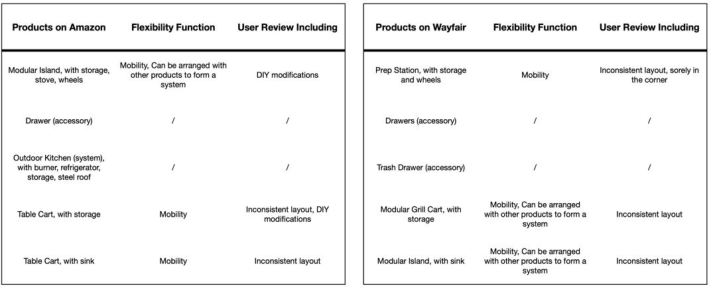
Unlike indoor kitchen products, outdoor kitchen products often need to transition between indoor and outdoor environments, adapt to seasonal changes, and are primarily used for leisure and social gatherings rather than routine cooking, requiring greater flexibility in design. But existing products fail to meet the flexibility requirements of users, as evidenced by user reviews of American top-selling items on two popular e-commerce platforms. User reviews often include inconsistent combinations and mention
DIY modifications, indicating these products cannot support diverse user workflows and preference.
Figure 1: Top-selling products on two popular e-commerce platforms and user reviews.
To address these challenges, it is critical to identify different user groups, selecting representative users, and determining their specific needs in user- centered design (Kujala and Kauppinen, 2004). To date, kitchen-related user research primarily focused on indoor kitchens, including universal design principles in conventional kitchens (Afacan and Demirkan, 2010) and user experience support in smart kitchens (Hashimoto et al., 2008). Users were categorized based on varying ergonomic needs, levels of expertise (Kerr, Tan and Chua, 2014), collaboration styles (Paay, Kjeldskov and Skov, 2015) and even specific workflows within each stage of cooking.
Although outdoor kitchens have been analyzed as cultural phenomena (Grindstaff, 2009), there is a lack of user research of outdoor kitchens. Even studies on outdoor spaces tend to focus on public spaces within urban or residential contexts (Chen and Ng, 2012; Huang, Lin and Lien, 2015; Gatti, Brownlee and Bricker, 2022), outdoor recreational activities like sports and tourism like sports and tourism (Rice et al., 2020; Winter et al., 2020), or the dependent user groups in outdoor environments (Merewether, 2015; Othman and Fadzil, 2015).
To fill this gap and gain a general understanding of the user types in outdoor kitchens, as well as how to better meet their needs, this paper analyzed nearly five years of user-generated posts related to outdoor kitchens on Reddit. This research aimed to gain insights of different user’s workflows and their own setups, then develop a more flexible and integrated design tailored to different user groups.
METHODOLOGY
Numerous studies have demonstrated the feasibility of using retrospective data from social media platforms as powerful data sources (Li et al., 2015; Saravanan, 2017). These platforms provide data in large quantities (Ohme et al., 2024), and can be accessed efficiently via open APIs or web scraping. To efficiently and broadly understand the needs of American outdoor kitchen users, this research also used Reddit as the primary data source. The majority
Between Indoor and Outdoor: Design for Three User Types of Outdoor Kitchens 237
users of Reddit are based in American (Statista, 2024), making it an ideal platform for studying American user preferences. Another key advantage of Reddit lies in its structure. Every Reddit post is categorized within a “subreddit,” a community centered around a specific topic (Anderson, 2015). This feature makes it easier to extract highly relevant data by narrowing the focus to targeted communities.
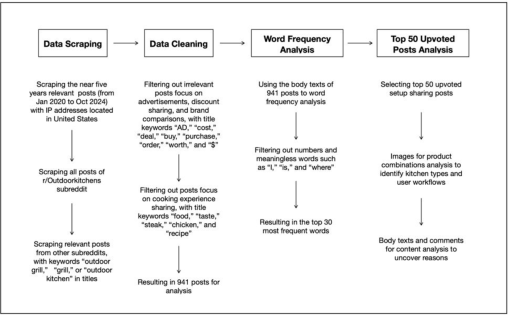
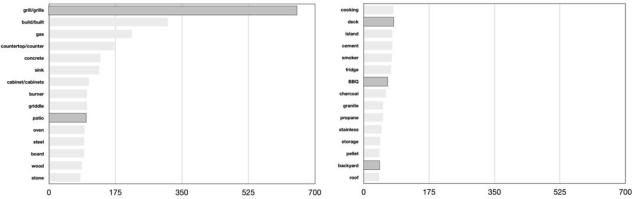
To collect data, this study used a Reddit scraper to access Reddit’s APIs, extracting posts from the r/Oudoorkitchens subreddit over the past five years (from January 2020 to October 2024). Additionally, keywords “outdoor kitchen,” “grill” and “outdoor grill” were used to scrape the posts that were not categorized under the subreddit but also relevant posts from broader communities. To focus on American users, only posts from IP addresses located in the United States were included. A data cleaning process was then conducted to remove two types of irrelevant posts. First, advertisements and posts related to discount sharing or brand comparisons were filtered out using keywords such as “cost,” “deal,” “buy,” “purchase,” “order,” “worth,” “discount,” and “$.” Second, cooking experience sharing posts were also excluded based on keywords such as “food,” “taste,” “steak,” “chicken,”and “recipe.”After filtering, a total of 941 relevant posts remained for analysis. The bodies of these posts were conducted to word frequency analysis, excluding meaningless or stop words such as “I” “is,” etc. The top thirty most frequently used terms are shown in the Figure 3.
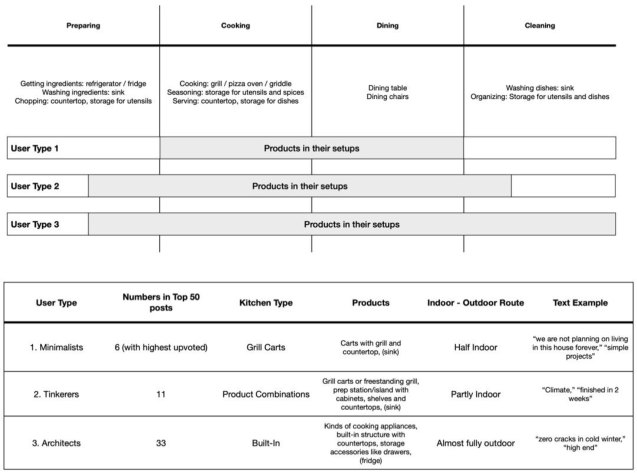
The top fifty upvoted posts showcasing user outdoor kitchen setups from the filtered dataset were selected for in-depth analysis. Based on the cooking workflow, outdoor cooking tasks were classified into four stages— preparation, cooking, dining, and cleaning, with each stage corresponding to specific products. Images from the fifty posts were used for product combination analysis to identify kitchen types and map user workflows, while the body texts and popular comments were used for content analysis to validate workflow mapping and extract reasons behind setup choices and workflow preferences.
Figure 2: Data collection and analysis process.
238 Lin
RESULTS
The word frequency analysis identified three primary categories of high- frequency words: activities, products or materials, and locations. Barbecuing remains the primary purpose of outdoor kitchen usage, with “grill” emerging as the most frequently mentioned term, representing both an essential product and a core activity. Additionally, the data suggests that outdoor kitchens are most located on patios or decks in backyards.
Figure 3: Top 30 results of word frequency analysis.
Analysis of the highest upvoted posts revealed three distinct outdoor kitchen typologies: grill cart kitchens, product combination kitchens, and built-in kitchens. Each of these types corresponds to a specific user group, characterized by distinct workflow patterns and product preferences.
Figure 4: Three user types.
Between Indoor and Outdoor: Design for Three User Types of Outdoor Kitchens 239
1. Minimalists – Grill Carts Kitchen This user group demonstrates how to build the most minimal form of an outdoor kitchen: a grill cart that doubles as a countertop, typically paired with a charcoal grill. A sink may occasionally be added as an optional component.
Their workflow begins with preparation completed entirely indoors. Ingredients, utensils, and seasonings are arranged on the cart, which is then moved outdoors. Grilling and dining take place outside, and outdoor dining tables often served as additional countertop space. After use, all items are returned indoors for cleaning and storage.
For some minimalists, a limited budget motivates this pared-down approach. Others integrate outdoor grilling into their routine but prefer minimal setups for reasons of cleanliness and simplicity. They believe handling preparation and cleanup indoors is the most effective way to maintain a tidy exterior space. By storing items inside, they avoid pest- related issues and eliminate the need for secure or weatherproof storage. This approach also allows them to leverage existing indoor infrastructure such as sinks, refrigerators, and expansive countertops, making the minimalist setup both convenient and resource efficient.
2. Tinkerers – Product Combinations Kitchen Tinkerers are the primary adopters of mass-produced outdoor kitchen products. They assemble customized setups by combining standalone elements—grills, carts, sinks, and storage cabinets—into flexible, modular systems. Some pursue professional-grade equipment, often naming specific brands, while deliberately avoiding high-maintenance appliances like refrigerators.
Their workflow blends indoor and outdoor steps. Ingredients are prepared inside and transported outdoors, where cooking and partial cleaning occur. Indoor sinks are commonly used, and refrigeration remains indoors. These combinations typically remain outdoors during warmer months and are stored or covered during winter.
Tinkerers tend to reside in regions with mild climates and fewer pest concerns. Their posts often reflect larger families or higher cooking demands, prompting the need for expanded workspace and storage. While this setup is more affordable and quicker to implement than built-in kitchens, it frequently sacrifices coherence in aesthetics and functionality. Nonetheless, Tinkerers value the convenience, cost-efficiency, and creative freedom of this hybrid approach.
3. Architects – Built-in Kitchen Architects construct permanent outdoor kitchens using custom- built frameworks—wood, metal, or masonry—integrated with durable countertops made of stainless steel or granite. These setups typically include fixed sinks, drawers, and other built-in features. While the infrastructure is largely bespoke, mass-produced accessories like carts are occasionally incorporated for serving or transporting items during gatherings.
240 Lin
Their cooking workflow is almost entirely outdoor based. These users can be considered “professional level” due to their investment in high- performance appliances: gas grills, burners, smokers, refrigerators, and more. Many of the frequently mentioned products in the word frequency analysis are associated with this group. They typically have generous budgets and dedicate substantial space to create robust, all-season environments. Portability is not a priority—words like “concrete,” “steel countertop,” and “granite” dominate their language. Their kitchens often include roofing, integrated dining or lounge areas, and bar elements, forming multifunctional zones that serve not just for cooking, but for social relaxation and extended use throughout the year.
DISCUSSION
This study identifies three distinct user types—Minimalists, Tinkerers, and Architects—each reflecting different expectations, constraints, and practices in outdoor kitchen use. These differences extend beyond product preferences, encompassing spatial arrangements, cooking workflows, and levels of customization. Minimalists prioritize simplicity and mobility, often reusing existing indoor infrastructure. Tinkerers assemble personalized systems by combining standalone products, valuing flexibility. Architects, by contrast, invest in permanent outdoor environments with integrated, professional- grade setups. This classification shifts the design perspective from product types to user behaviors, enabling more targeted decisions about which configurations best suit which users.
Despite clear distinctions among user types, several functional requirements—such as portable carts, storage, and sinks—consistently appear across different groups. These shared needs highlight opportunities for designing common components that serve a wide range of users.
Importantly, user identity is not fixed. Life transitions—such as aging, changes in household size, or relocation—may lead users to shift from one category to another. A Minimalist may evolve into a Tinkerer by gradually adding functions, or eventually become an Architect when committing to a permanent setup. This user trajectory suggests that outdoor kitchen systems should not only serve present needs but also accommodate growth and change. Providing expandable options and an upgrade-friendly framework may be a more sustainable design strategy in the long term.
DESIGN In response to these user insights, the design adopts a modular approach informed by product family theory. Instead of prescribing fixed configurations, it offers a system of interoperable components—grills, sinks, storage, and countertops—that can be combined and adapted across different user types and life stages.
Modularity is a fundamental principle in many techniques supporting product family design (Gauss, Lacerda and Cauchick Miguel, 2021). By using shared sets of common modules among a product family (Hölttä-Otto,
Between Indoor and Outdoor: Design for Three User Types of Outdoor Kitchens 241
2005), modular product platforms can provide substantial cost and time savings while offering a range of products. As a result, a multitude of product platform methods have been developed over the last decade within the design research community (Otto et al., 2016).
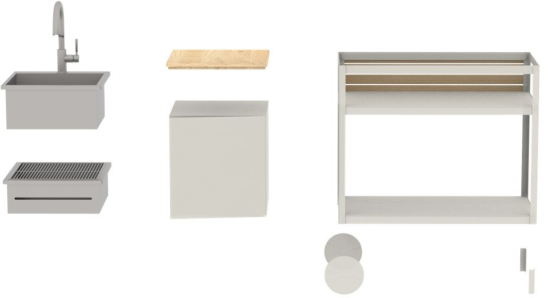
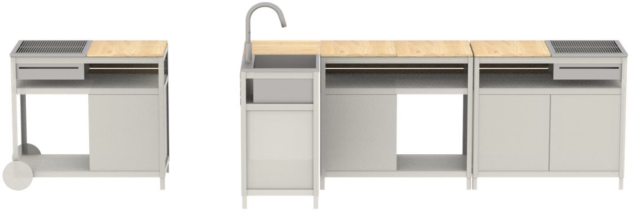
To develop the modular product family for outdoor kitchens, four shared modules and one family frame are defined based on previous analysis. The shared functional modules include a grill, sink, countertop, and cabinet. Each module can be securely fixed to the frame using a simple slot design. By rearranging the modules, users can create different products such as a grill cart, mobile prepare station, or freestanding sink, effectively addressing the diverse needs of different user groups. Additionally, these modules can serve as complementary accessories for built-in kitchens.
The structure frame is adaptable, allowing users to switch between fixed stands and mobile options by replacing part of the legs with wheels. This flexibility allows users to arrange them in various layouts.
Figure 5: Modules and the family frame.Figure 6: Module and frame combinations.
CONCLUSION AND NEXT STEPS This research proposes a modular design framework for outdoor kitchens, grounded in user-generated content from social media. By identifying three distinct user types—Minimalists, Tinkerers, and Architects—it offers insights
242 Lin
that inform a flexible system architecture, balancing the scalability of mass- market products with the adaptability required for personalized setups. However, as the study relies on retrospective online data, it lacks direct user validation. This limitation raises important questions about the practical implementation and usability of the proposed system in real-world contexts. To strengthen the applicability of the findings, future work will involve focus group interviews, prototype development, and usability testing with representative users. These efforts will help evaluate how well the modular configurations align with actual user behaviors, preferences, and spatial constraints—ultimately refining the system for real-life adoption.
REFERENCES
Afacan, Y. and Demirkan, H. (2010) ‘A priority-based approach for satisfying the diverse users’ needs, capabilities and expectations: A universal kitchen design case’, Journal of Engineering Design, 21(2–3), pp. 315–343. Available at: https:// doi.org/10.1080/09544820903303423. Anderson, K. E. (2015) ‘Ask me anything: What is Reddit?’, Library Hi Tech News,
32(5), pp. 8–11. Available at: https://doi.org/10.1108/LHTN-03-2015-0018. Chen, L. and Ng, E. (2012) ‘Outdoor thermal comfort and outdoor activities: A review of research in the past decade’, Cities, 29(2), pp. 118–125. Available at: https://doi.org/10.1016/j.cities.2011.08.006. Gatti, E. T. J., Brownlee, M. T. J. and Bricker, K. S. (2022) ‘Winter recreationists’
perspectives on seasonal differences in the outdoor recreation setting’, Journal of Outdoor Recreation and Tourism, 37, p. 100366. Available at: https://doi.org/ 10.1016/j.jort.2021.100366. Gauss, L., Lacerda, D. P. and Cauchick Miguel, P. A. (2021) ‘Module-based product family design: Systematic literature review and meta-synthesis’, Journal of Intelligent Manufacturing, 32(1), pp. 265–312. Available at: https://doi.org/ 10.1007/s10845-020-01572-3. Glenski, M., Pennycuff, C. and Weninger, T. (2017) ‘Consumers and Curators:
Browsing and Voting Patterns on Reddit’, IEEE Transactions on Computational Social Systems, 4(4), pp. 196–206. Available at: https://doi.org/10.1109/ TCSS.2017.2742242. Grindstaff, B. (2009) ‘Making the Great Outdoors Better: The outdoor kitchen and the changing design of American luxury’, Idea Journal, 9(1), pp. 122–133. Available at: https://doi.org/10.37113/ideaj.vi0.148. Hashimoto, A. et al. (2008) ‘Smart Kitchen: A User Centric Cooking Support System’, in. Available at: https://www.semanticscholar.org/paper/ Smart-Kitchen%3A-A-User-Centric-Cooking-Support-Hashimoto-Mori/ 1745ba30f8ff3f4a0480147592cf7a4e73199ce5 (Accessed: 26 January 2025). Hölttä-Otto, K. (2005) Modular product platform design. Helsinki University
of Technology. Available at: https://aaltodoc.aalto.fi/handle/123456789/2596 (Accessed: 26 January 2025). Huang, K.-T., Lin, T.-P. and Lien, H.-C. (2015) ‘Investigating Thermal Comfort and User Behaviors in Outdoor Spaces: A Seasonal and Spatial Perspective’, Advances in Meteorology, 2015(1), p. 423508. Available at: https://doi.org/10.1155/2015/ 423508. Kerr, S. J., Tan, O. and Chua, J. C. (2014) ‘Cooking personas: Goal-directed design
requirements in the kitchen’, International Journal of Human-Computer Studies, 72(2), pp. 255–274. Available at: https://doi.org/10.1016/j.ijhcs.2013.10.002.
Between Indoor and Outdoor: Design for Three User Types of Outdoor Kitchens 243
Kujala, S. and Kauppinen, M. (2004) ‘Identifying and selecting users for usercentered design’, in Proceedings of the third Nordic conference on Human- computer interaction. New York, NY, USA: Association for Computing Machinery (NordiCHI ‘04), pp. 297–303. Available at: https://doi.org/10.1145/ 1028014.1028060. Li, X. et al. (2015) ‘Where you Instagram? Associating Your Instagram Photos with
Points of Interest’, in Proceedings of the 24th ACM International on Conference on Information and Knowledge Management. New York, NY, USA: Association for Computing Machinery (CIKM ‘15), pp. 1231–1240. Available at: https:// doi.org/10.1145/2806416.2806463. Medvedev, A. N., Lambiotte, R. and Delvenne, J.-C. (2019) ‘The Anatomy of Reddit: An Overview of Academic Research’, in F. Ghanbarnejad et al. (eds) Dynamics on and of Complex Networks III. Cham: Springer International Publishing, pp. 183–204. Available at: https://doi.org/10.1007/978-3-030-14683-2_9. Merewether, J. (2015) ‘Young Children’s Perspectives of Outdoor Learning Spaces:
What Matters?’, Australasian Journal of Early Childhood, 40(1), pp. 99–108. Available at: https://doi.org/10.1177/183693911504000113. Ohme, J. et al. (2024) ‘Digital Trace Data Collection for Social Media Effects Research: APIs, Data Donation, and (Screen) Tracking’, Communication Methods and Measures, 18(2), pp. 124–141. Available at: https://doi.org/ 10.1080/19312458.2023.2181319. Othman, A. R. and Fadzil, F. (2015) ‘Influence of Outdoor Space to the Elderly
Wellbeing in a Typical Care Centre’, Procedia-Social and Behavioral Sciences, 170, pp. 320–329. Available at: https://doi.org/10.1016/j.sbspro.2015.01.042. Otto, K. et al. (2016) ‘Global Views on Modular Design Research: Linking Alternative Methods to Support Modular Product Family Concept Development’, Journal of Mechanical Design, 138(7), p. 071101. Available at: https://doi.org/ 10.1115/1.4033654. Paay, J., Kjeldskov, J. and Skov, M. B. (2015) ‘Connecting in the Kitchen: An
Empirical Study of Physical Interactions while Cooking Together at Home’, in Proceedings of the 18th ACM Conference on Computer Supported Cooperative Work & Social Computing. CSCW ‘15: Computer Supported Cooperative Work and Social Computing, Vancouver BC Canada: ACM, pp. 276–287. Available at: https://doi.org/10.1145/2675133.2675194. Rice, W. L. et al. (2020) ‘Changes in recreational behaviors of outdoor enthusiasts during the COVID-19 pandemic: Analysis across urban and rural communities’, Journal of Urban Ecology, 6(1), p. juaa020. Available at: https://doi.org/10.1093/ jue/juaa020. Saravanan, M. (2017) ‘Determining Ethnicity of Immigrants using Twitter Data’,
in Proceedings of the 4th Multidisciplinary International Social Networks Conference. New York, NY, USA: Association for Computing Machinery (MISNC ‘17), pp. 1–10. Available at: https://doi.org/10.1145/3092090.3092100. Winter, P. L. et al. (2020) ‘Outdoor Recreation, Nature-Based Tourism, and Sustainability’, Sustainability, 12(1), p. 81. Available at: https://doi.org/10.3390/ su12010081.
LISTED IN THE AHFE DIGITAL BOOKSTORE CATALOGUE
Explore the complete digital volume
Usability and User Experience
Read this individual research paper free through the original publisher, or explore the full digital proceedings book.
ISBN 978-1-964867-70-0
Explore this ISBN in the AHFE Bookstore ↗Listed in the July 2026 bookstore catalogue; search by ISBN to confirm current availability · Digital book purchase optional