Zhixin Cai (2025). RescueFlex: A Modular Intelligent Rescue Robot System for Complex Disaster Scenarios. In: Human-Computer Interaction & Emerging Technologies. AHFE Open Access, vol. 195, pp. 296–304. https://doi.org/10.54941/ahfe1006248
This study presents RescueFlex, a modular intelligent rescue and transport robot system designed to address key challenges in complex disaster rescue scenarios. Based on a quadruped robot platform, the system integrates multi-robot collaboration, modular design, and autonomous navigation technologies, incorporating thermal imaging, search and rescue, material transport, and medical evacuation functional modules. The research context stems from rescue needs in disaster-prone regions, particularly in countries severely affected by disasters like China, where approximately 90% of disaster deaths in remote areas are caused by delayed rescue operations, with a critical rescue window of only 72 hours. Traditional rescue methods show significant limitations when facing complex environments: first, time inefficiency leads to limited coverage within the rescue window; second, poor environmental adaptability results in high equipment failure rates in extreme conditions; third, information processing delays are closely related to rescue failures and insufficient information sharing. The RescueFlex system addresses these challenges through user-centered design methods and human-computer interaction innovations. The system adopts a "user-centered" design philosophy, combining contextual design and systematic innovation approaches through in-depth user research, scenario analysis, and iterative design to create a highly modular and adaptive rescue system. The system architecture includes hardware systems (core navigation unit, functional modules, sensing systems), software systems (autonomous navigation, multi-robot collaboration, task planning), and interaction systems (intuitive interfaces, multimodal interaction). This research provides innovative solutions and design paradigms for the disaster rescue field from human-computer interaction and design perspectives, with significant implications for improving rescue efficiency and ensuring personnel safety.
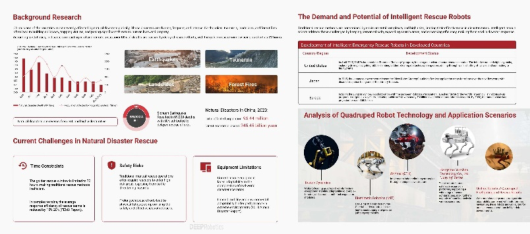
Natural disasters occur with alarming frequency worldwide, causing devastating impacts on human lives and property. China ranks among the countries most severely affected by natural disasters, experiencing earthquakes, tsunamis, landslides, and forest fires that continually threaten human safety and property. According to recent statistics, approximately 90% of disaster-related deaths in remote areas result from delayed rescue operations, with a critical rescue window of only 72 hours (Murphy, 2014). In 2023 alone, natural disasters in China affected 95.44 million people and caused direct economic losses of 345.45 billion yuan, highlighting the urgent need for more effective disaster rescue approaches.
RescueFlex: A Modular Intelligent Rescue Robot System for Complex Disaster Scenarios 297
Traditional rescue methods demonstrate significant limitations when confronting complex environments and high-risk situations. Human search and rescue operations in earthquake rubble environments experience efficiency decreases of approximately 40%, while rescuer safety risks increase by 60% (Zhang et al., 2012). These challenges have driven growing demand for intelligent rescue systems. The international community has recognized this need, with the U.S. DARPA launching the “Robotics Challenge”program in 2012, Japan releasing the “New Robot Strategy” in 2015, and the European Union initiating the SPARC project in 2014 with investments exceeding 12 billion euros in rescue robotics research. China’s rescue robot market has experienced rapid growth, expanding from 40 million yuan in 2016 to 220 million yuan in 2022, demonstrating the field’s significant development potential and market value.
This research aims to develop a highly adaptive, modular, and intelligent rescue robot system capable of addressing the key challenges in complex rescue environments. Unlike traditional rescue equipment and single- function robots, the RescueFlex system integrates multiple innovative technologies centered around a “user-centered” design philosophy. The system focuses on four primary aspects: human-computer interaction optimization, modular architecture design, environmental adaptability, and multi-robot collaboration. The main innovations include: (1) developing a modular functional reconfiguration strategy on a quadruped robot platform; (2) designing an interaction system aligned with rescuers’ cognitive characteristics to reduce operational burden in high-pressure environments; (3) constructing an intelligent perception and navigation system suitable for complex environments such as rubble, wildfires, and extreme weather; and (4) establishing an efficient multi-robot collaboration mechanism to improve overall rescue efficiency and coverage.
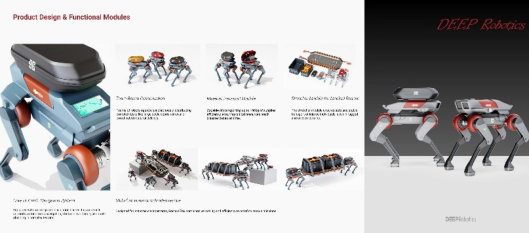
Figure 1: RescueFlex modular intelligent rescue and transport robot system overview.
DESIGN CHALLENGES IN DISASTER RESCUE The golden window for natural disaster rescue typically spans only 72 hours, after which survival rates decline dramatically. In complex terrain, rescue teams’ response efficiency decreases by 15–20%, wasting precious rescue time (FEMA, 2021). Traditional rescue methods show significant deficiencies
298 Cai
in time efficiency. Equipment deployment processes are cumbersome, with professional rescue teams requiring 45–60 minutes from arrival to complete equipment setup. Furthermore, path planning in complex environments relies heavily on manual decision-making, resulting in inefficient searches and limited coverage. Analysis of major earthquake rescue operations reveals traditional rescue methods cover only 3–5% of disaster areas per hour, mostly concentrated in relatively safe peripheral zones.
Figure 2: Major challenges in natural disaster rescue operations.
Disaster environments present diverse and unpredictable conditions that severely challenge rescue equipment adaptability. Existing rescue equipment faces three primary adaptability issues: limited mobility in navigating rugged terrain and obstacles; reduced sensing system performance in smoke, dust, and low-light conditions; and single-function capabilities unable to meet changing rescue requirements. Adaptability tests on various rescue equipment types indicate less than 20% can simultaneously adapt to more than three disaster environment types, with most designed for specific scenarios only.
In disaster rescue operations, information acquisition and decision support are crucial factors. Studies indicate approximately 50% of rescue failures relate to insufficient information sharing or decision-making errors (Casper & Murphy, 2003). Rescue personnel need to process complex information and make rapid decisions under extreme pressure, placing stringent requirements on information presentation methods and decision support systems.
Traditional rescue information systems exhibit three major deficiencies: information fragmentation with ineffective integration of multi-source data; non-intuitive visualization that fails to support quick understanding and decision-making; and delayed information updates that inadequately reflect real-time situation changes. Analysis of domestic earthquake rescue operations shows information processing delays averaging 8–15 minutes, unacceptable in life-critical rescue environments.
RESCUEFLEX SYSTEM DESIGN RescueFlex system design follows a core “user-centered” philosophy aimed at addressing key disaster rescue challenges while meeting actual rescue personnel needs. The design process incorporates Contextual Design and
RescueFlex: A Modular Intelligent Rescue Robot System for Complex Disaster Scenarios 299
Systematic Innovation (TRIZ) theories, employing rigorous methodology to ensure practical utility and innovation. The design team conducted extensive user research through interviews and observation of personnel from fire departments, earthquake rescue teams, and Red Cross organizations to identify core task flows and operational pain points.
Figure 3: Major natural disaster types in China and their impacts.
In the contextual analysis phase, the team constructed multiple representative rescue scenarios including earthquake rubble search and rescue, forest fire monitoring, and extreme weather rescue operations. This scenario-based analysis approach enabled understanding of user behavior patterns and decision processes across different contexts. The team employed rapid prototyping methods for multiple design iterations, incorporating rescue expert evaluations at each stage to continuously refine system functionality and interaction experience.
RescueFlex is built on a quadruped robot platform with modular, distributed architecture that achieves high functional integration and adaptive flexibility. The system architecture comprises three major components—hardware, software, and interaction systems—working in concert to form a comprehensive rescue solution.
The hardware system centers around a core navigation unit integrating various functional modules and sensor systems. The navigation unit features high-precision sensors and computing platforms supporting autonomous navigation and decision-making in complex environments. Functional modules include search and rescue units, material transport modules, and medical stretcher modules that can be flexibly combined according to mission requirements. The perception system integrates thermal imaging, obstacle detection, and target recognition sensors, providing comprehensive environmental awareness.
The software system employs a layered architecture including low-level control systems, mid-level navigation planning, and high-level decision management. The interaction system emphasizes simplicity and intuitiveness with four primary interfaces: task allocation, navigation and monitoring, scenario switching, and task completion summary. These interfaces employ unified design language and interaction logic to reduce learning requirements and improve operational efficiency.
300 Cai
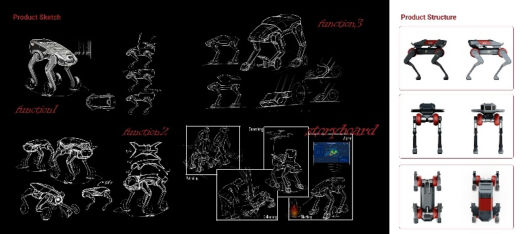
Figure 4: RescueFlex product concept sketches and functional planning.
RescueFlex’s interaction design is founded on the principle of “reducing cognitive burden while improving operational efficiency” to help rescue personnel perform effectively under high-pressure conditions. The interface design carefully considers rescue scenario requirements including environmental noise, visibility limitations, and time pressure.
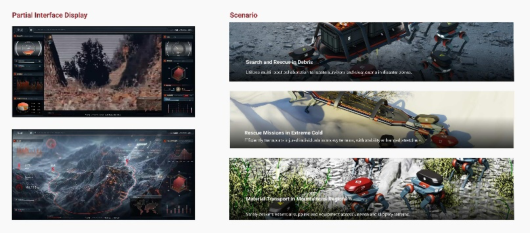
The system implements four specialized interfaces: (1) task allocation interface displaying mission types, priorities, and resource allocation; (2) navigation and monitoring interface providing real-time mapping and environmental data visualization; (3) scenario switching interface recommending optimal configuration adjustments based on environmental changes; and (4) task summary interface delivering completion rates and operational metrics visualization to support decision-making.
The interface employs a color coding system with red indicating high- priority tasks and warnings, orange showing medium-priority items, and blue representing informational content. The system supports touch, voice, and gesture multimodal interactions to accommodate different rescue environments, with each modality optimized for specific operational contexts.
Figure 5: RescueFlex system structure and module composition.
RescueFlex employs highly modular design principles enabling rapid functional reconfiguration for different rescue scenarios. The system features five core functional modules: (1) the core navigation unit with integrated navigation display and high-performance computing; (2) the
RescueFlex: A Modular Intelligent Rescue Robot System for Complex Disaster Scenarios 301
team collaboration module enabling synchronized operation of multiple robots; (3) the material transport module with 100kg load capacity; (4) the medical stretcher module utilizing active stabilization technology; and (5) the environmental sensing module integrating thermal imaging, acoustic detection, and gas detection capabilities.
Modules utilize standardized interface designs supporting plug-and-play functionality with rapid module replacement. This approach significantly simplifies module exchanges and enhances both functional flexibility and maintenance efficiency, with research indicating modular rescue equipment substantially reduces repair times compared to traditional integrated systems—a critical advantage in time-sensitive rescue environments.
APPLICATION SCENARIOS Building collapses from earthquakes and similar disasters represent common and complex rescue scenarios. RescueFlex implements a complete workflow for rubble rescue operations forming a closed-loop process from task initialization to data feedback. Command centers assign general missions that the system automatically decomposes into executable subtasks. Robots systematically explore rubble areas using autonomous navigation and obstacle avoidance, generating three-dimensional maps with potential life sign and hazard markers through multimodal environmental modeling techniques.
Figure 6: RescueFlex operation interface design and interaction processe.
Based on environmental analysis, the system automatically recommends optimal module configurations for mission adaptation. During execution, robots navigate optimized paths while collecting real-time data. Research demonstrates autonomous search robots can access narrow spaces inaccessible to human rescuers, substantially improving search capabilities. The human-machine interface emphasizes clear visualization of structural elements and life sign detection results, enabling rapid decision-making and enhancing rescue efficiency.
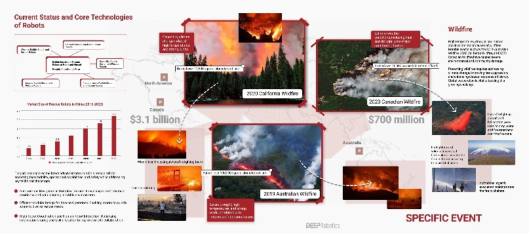
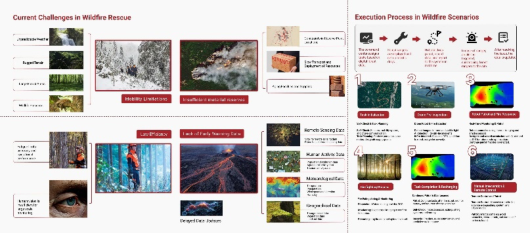
Forest fires present unique challenges with rapid spread, extensive coverage, and high danger levels. RescueFlex’s wildfire workflow begins with command centers assigning initial tasks based on digital forest data. The system coordinates with drones for preliminary inspection, using aerial patrol and thermal imaging to establish fire boundaries and spread directions.
302 Cai
During patrol operations, robots deploy thermal imaging and gas detection modules to monitor fire development while identifying potential safety corridors. The system implements fire spread prediction algorithms based on environmental data to provide critical decision support. During firefighting support, RescueFlex assists human firefighters by transporting equipment, monitoring air quality, and providing real-time thermal imaging data.
The wildfire scenario interface emphasizes intuitive fire situation awareness using heat map and terrain map visualization with prominent decision point indicators, prioritizing fire spread direction, intensity, and safety corridor displays while providing critical environmental data.
Extreme weather conditions present severe challenges where traditional rescue methods often prove inefficient. RescueFlex leverages quadruped platform stability and adaptability for specialized extreme weather rescue workflows. The system establishes optimal material transport or personnel rescue routes through terrain and meteorological data analysis, then activates specialized environment adaptation modules to enhance stability and mobility in extreme environments.
During operation, the system continuously monitors environmental changes and dynamically adjusts travel routes and movement parameters using extreme environment adaptation algorithms. The interface focuses on temperature and terrain risk factor visualization plus energy management optimization, implementing temperature grading displays and terrain risk indicators while providing energy consumption predictions and endurance optimization recommendations.
DISCUSSION AND FUTURE DIRECTIONS Despite RescueFlex’s innovative solutions, several limitations warrant attention. Primary challenges include energy constraints, as current battery technology cannot support extended operation under full-load conditions; adaptability limitations in extreme environments, particularly high-temperature, high-radiation, and high-humidity conditions; complex scheduling algorithms for large-scale multi-robot collaboration requiring further optimization; and human-machine trust development needing additional field validation.
Figure 7: Workflow diagram for rubble rescue scenarios.
RescueFlex: A Modular Intelligent Rescue Robot System for Complex Disaster Scenarios 303
Future human-computer interaction optimization will focus on: (1) developing context-aware interfaces that automatically adjust information presentation methods according to task stages, environmental conditions, and user behavior; (2) enhancing multimodal interaction system robustness, particularly in noisy, variable lighting, and vibration environments; (3) improving system decision process transparency through decision path visualization and risk assessment; and (4) developing personalized interface adaptation mechanisms based on user behavior analysis.
The development roadmap centers on: (1) enhancing system autonomy through reinforcement learning technologies enabling robots to autonomously learn and adapt in complex environments; (2) exploring additional biologically-inspired designs to improve environmental adaptability and energy efficiency; (3) developing more efficient swarm intelligence collaboration algorithms; and (4) exploring deep collaboration modes between human rescue personnel and robot systems forming human-machine fusion rescue architectures.
CONCLUSION
The RescueFlex modular intelligent rescue robot system addresses complex disaster rescue challenges through innovative human-computer interaction design, modular functional architecture, and autonomous navigation technology. The system design comprehensively considers special rescue scenario requirements and challenges, conducting in-depth exploration in time efficiency, environmental adaptability, and decision support.
From design science and human-computer interaction perspectives, RescueFlex’s design methodology and interaction strategies provide valuable reference paradigms for intelligent transformation in the disaster rescue field. The “user-centered” design concept, contextualized interaction design, and modular functional architecture collectively form a system framework adapted to complex rescue environments.
As natural disaster frequency and intensity increase, intelligent rescue technology assumes greater importance. While RescueFlex still faces challenges, its innovative design concepts and technological approaches establish direction for future rescue robot development. Advances in artificial intelligence, materials science, and energy technology will enable intelligent rescue systems like RescueFlex to play increasingly critical roles in future disaster response, ultimately achieving the goals of reducing casualties and improving rescue efficiency while contributing to building safer and more resilient societies.
REFERENCES
Casper, J., & Murphy, R. R. (2003). Human-robot interactions during the robotassisted urban search and rescue response at the World Trade Center. IEEE Transactions on Systems, Man, and Cybernetics, Part B (Cybernetics), 33(3), 367–385.
304 Cai
DARPA. (2012). DARPA Robotics Challenge. Defense Advanced Research Projects Agency. Retrieved from https://www.darpa.mil/program/darpa-robotics- challenge. Federal Emergency Management Agency (FEMA). (2021). Urban search and rescue response system. FEMA Publications. Murphy, R. R. (2014). Disaster robotics. MIT Press. Zhang, L., Liu, X., Li, Y., Liu, Y., Liu, Z., Lin, J.,... & Liang, W. (2012). Emergency
medical rescue efforts after a major earthquake: Lessons from the 2008 Wenchuan earthquake. The Lancet, 379(9818), 853–861.
Read this individual research paper free through the original publisher, or explore the full digital proceedings book.
ISBN 978-1-964867-71-7
Explore this ISBN in the AHFE Bookstore ↗Listed in the July 2026 bookstore catalogue; search by ISBN to confirm current availability · Digital book purchase optional