David Smith, Gorham Bird (2024). History Lives On: Interdisciplinary Design to Uplift Rural Communities. In: Interdisciplinary Practice in Industrial Design. AHFE Open Access, vol. 144, pp. 30–37. https://doi.org/10.54941/ahfe1005115
Starting as a partnership between Booker T. Washington and Julius Rosenwald in 1914, a grassroots movement to educate black children grew into over 5000 school buildings throughout the segregated deep south of the United States by 1932. Today, less than 600 of these “Rosenwald School” structures remain nationally, and most are in a state of great decay. These schools represent the education of a new generation of African American thinkers and are considered by economists to have created the African American middle class. This paper will explore the methodologies used to curate, design, and fabricate an exhibit, “History Lives On—Preserving Alabama’s Rosenwald Schools,” aimed at increasing public engagement and awareness of the history of the school building program. The exhibition project serves to educate the public and bring history to life by illustrating the inequities that existed in the educational system of the Jim Crow South.
Booker T. Washington (1856–1915), a well-respected educator, conceived the idea of building a network of schools for African American children to better prepare them for advanced education. He proposed this idea to Julius Rosen- wald (1862–1932), President of the Sears company based in Chicago. The two men agreed to start with six schools funded by Rosenwald and match- ing funds from the specific local governments and communities served by the schools. The concept of the Rosenwald Schools grew into over 5000 schools built in 883 counties in 15 states, educating one-third of African American children across the deep South (Kelly, 2022). The Rosenwald Schools laid the groundwork for the Civil Rights movement, including alumni such as poet Maya Angelou and Civil Rights Leader and US Congressman John Lewis, among other notable figures. As these schools fall into disrepair and col- lapse, the cultural artifacts of the architecture are lost. Given the impact of the Rosenwald School program on advancing the education of generations of African American children, very little is public knowledge. These stories remain within the communities but have not yet been shared with a more public audience or other generations.
History Lives On: Interdisciplinary Design to Uplift Rural Communities 31
Significance of the Rosenwald Schools impact can be seen through the stories of those who actually attended a Rosenwald School. As mentioned above, the congressman John Lewis attended a Rosenwald School and wrote about the experience in his memoir. Among other significant events he writes about how all the money for school supplies was raised by community events such as fish fries and picnics that might include a mini- carnival or handmade games (Lewis, 1998). Marian Coleman, 74, who attended a Rosenwald School in Bartow County, Georgia from 1951 to 1955 recalls how the sense of community around the school made the greatest impression upon her as a child. “My parents would always plan special things for us,” says Coleman, “There were fundraising dinners for the development of the school and folks made quilts that were raf- fled off. We knew they were interested in us having a better education” (Solender, 2021).
The architecture of the Rosenwald Schools serves as an artifact, embody- ing the motivations and desires of African Americans to attain equality in education. By documenting the architecture, the stories of communities, and the legacy of the Rosenwald School program, the architecture is preserved for posterity. An interdisciplinary team is engaging the public by shining light on the extant Rosenwald schools in Alabama with the purpose of doc- umentation and preservation. Using archived plans, photos, objects, digital technologies, and immersive environments, collaborators in graphic design, architecture, and building science are bringing this documentation to the public as an exhibit designed and fabricated with the staff of the Alabama Department of Archives and History. While acknowledging benefactors and leadership of the Rosenwald School movement is important, the process of collecting artifacts and content into a coherent narrative for the exhibit revealed the true legacy belongs to the individual rural communities that built, sustained, and benefited from generations of children educated in these schools.
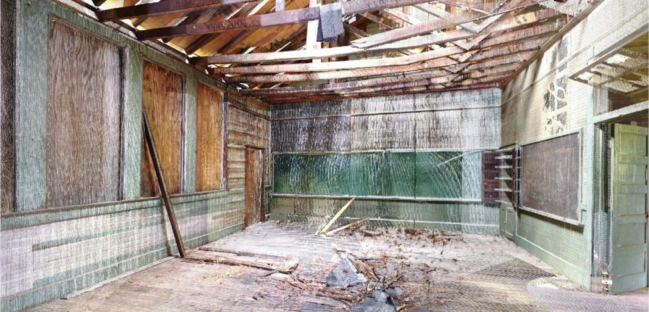
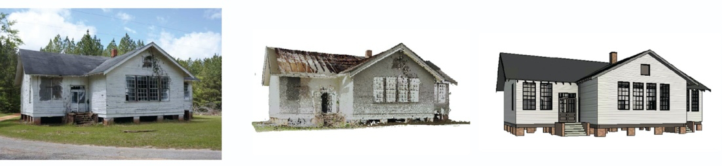
EXTANT SCHOOL DOCUMENTATION The original research inspiring the exhibition focuses on the identification and documentation of four Rosenwald Schools in Alabama. The New Hope School in Chambers County, the Mount Sinai School in Autauga County, the Tankersley School in Montgomery County, and the Oak Grove School in Hale County. These schools were found in various states of decay. For instance, the roof of the Tankersley School is failing and crumbling into the building’s interior. Documentation of these schools in the field utilized vari- ous techniques, but of particular note is the use of LiDAR (Light Detection and Ranging) scanning and drone photography. These digital tools made it possible to create accurate detailed specification drawings of the school buildings including BIM (Building Information Modeling) models as seen in Figures 1 and 2 (Bird, 2024).
32 Smith and Bird
Figure 1: LiDAR image of Tankersley school revealing construction details and extent of decay (image provided by author).Figure 2: Progression of creating precision specification of Tankersley school using standard photography (left) and LiDAR point cloud technology (center) to create a precision BIM model (right) (image provided by author).
CONTENT COLLABORATORS Beyond the basic display of the documentation itself, the purpose of the exhibit is to put the present-day condition of the Rosenwald Schools in a greater context. The exhibit became a narrative presentation of the schools’ origin, the political climate of the time, current school conditions, and efforts to preserve what is left as artifacts of history for future generations. This greater context was made possible by the multiple collaborators who contributed to the project.
The primary content creators and designers of the exhibit are educators who come from three different disciplines—architecture, building science, and graphic design. This team found a willing exhibit collaborator in the historians at the Alabama Department of Archives and History. In addition to supplemental artifacts, content, and consulting; the Alabama Department of Archives and History provided space and manpower for the installation of the inaugural ‘History Lives On’ Rosenwald School exhibition in their building in Montgomery, Alabama.
The exhibit narrative was also enriched with the help of three other con- tributors. The Franklin Library of Fisk University provided rare photographs
History Lives On: Interdisciplinary Design to Uplift Rural Communities 33
of Alabama Rosenwald schools, as shown in Figure 3. The Mt. Sinai Com- munity Center loaned original artifacts from the Mt. Sinai school to be used in the exhibit. And finally, Dr. Kwesi Daniels, Professor of Architec- ture at Tuskegee University provided images and consultation concerning the Alabama Rosenwald Schools.
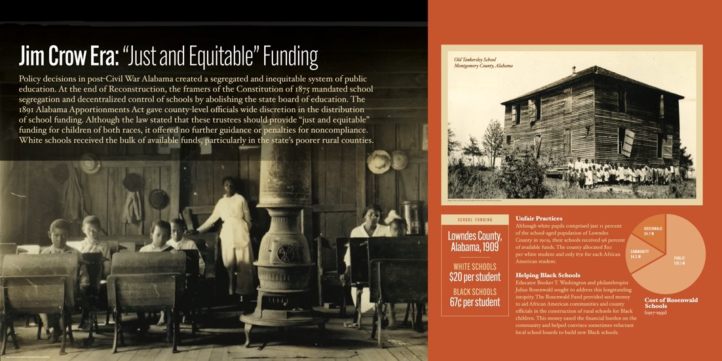
Figure 3: 4 × 8-foot board from exhibit showing an example of fisk library image in the upper right (image provided by author).
EXHIBIT DESIGN AND FABRICATION The design and fabrication of the exhibit is not a permanent installation, but one that can travel from venue to venue. With that in mind, the consis- tent traveling elements of the exhibit can be divided into three parts; the 2D components, 3D components, and a video animation. Other elements of the current exhibit, such as the original large schoolroom divider and student desk, are on loan and may not follow the traveling exhibit.
The 2D components are made up of two 4x8 foot posters, nine 4x4 foot posters, and a single poster measuring 4x6 feet—all printed on vinyl and mounted to durable PVC boards. The posters can be hung from the ceiling or mounted to walls, creating flexibility for each venue. Across the top of each poster is a 1x4 inch board painted with a whitewash formula similar to the original Rosenwald school interior walls.
The text and images on the posters constitute the structure of the exhibit’s narrative. The posters span across all parts of the exhibit and walk the viewer through the story of the Rosenwald Schools. The first poster starts with how schools for black children were unequally funded during the Jim Crow Era. The second poster is a timeline from post-US Civil War up to the present marking general worldwide events, events affecting African Americans, and events specifically affecting African American education. The following phase of posters continues to describe a new kind of school for black children focus- ing on the Rosenwald Schools and featuring design schemes, architects, and
34 Smith and Bird
community efforts that brought them into reality. From there the posters’ content turns to the current condition of the extant Rosenwald Schools in Alabama featuring documentation from the field. The final posters reveal efforts to preserve the remaining schools and the important legacy they represent.
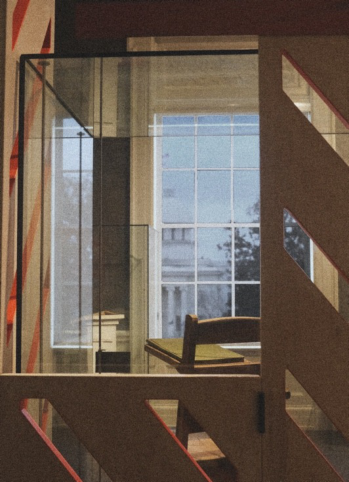
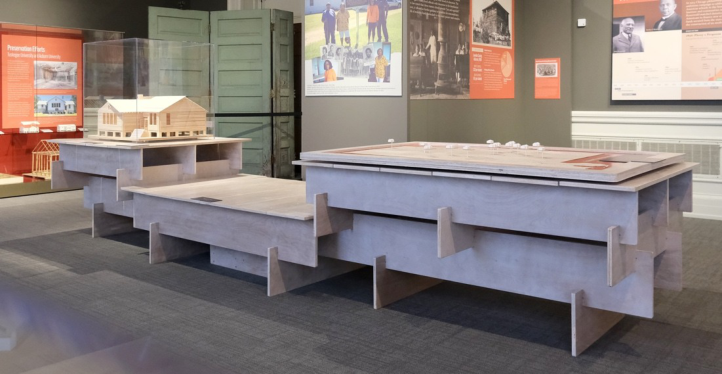
The 3D components built for the exhibit can be divided into two parts, 1) multi-purpose furniture pieces and 2) models of some of the Rosenwald Schools. The first of the two furniture pieces is an entryway room divider painted with the same whitewash as the boards across the top of the posters. In this venue, a few blocks away from the Alabama Capitol Building, the entryway divider just so happens to be positioned in front of a window that frames the dome of the Capitol Building. A thoughtful visitor to the exhibit may notice this and realize that the historic laws that once governed education for African Americans in Alabama were legislated in that very building as shown in Figure 4. The second piece of furniture serves as a rest bench with platforms on either side. The platform on the left displays a hand-built model of the Tankersley School, while the platform on the right displays a map of Alabama that shows where all the Alabama Rosenwald Schools were located by county as well as the locations of the remaining Rosenwald extant schools. The bench piece measures 4x16 feet and is also painted with whitewash as shown in Figure 5. The bench is designed to be assembled and broken down into single boards with simple tools. Additional smaller-scale school models are also on display created using 3D printing.
Figure 4: Close-up of divider framing alabama capitol building seen through the window (image provided by author).
History Lives On: Interdisciplinary Design to Uplift Rural Communities 35
Figure 5: Bench with model on left platform and map on the right platform (image provided by author).
The last element of the traveling exhibit is the video. The looping video hits high points of the exhibit narrative and takes the viewer into an immersive walk through the Tankersley Rosenwald School.
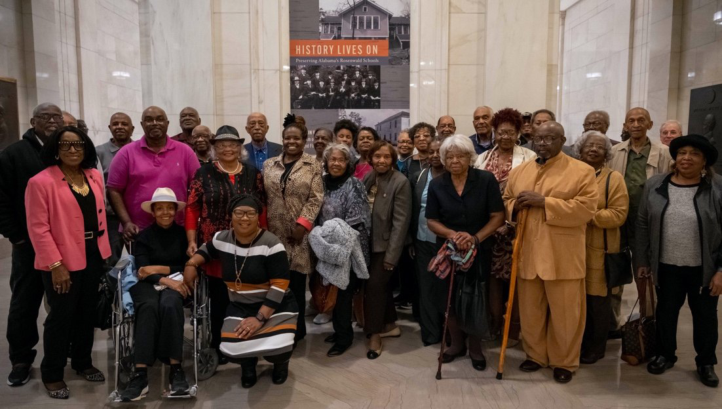
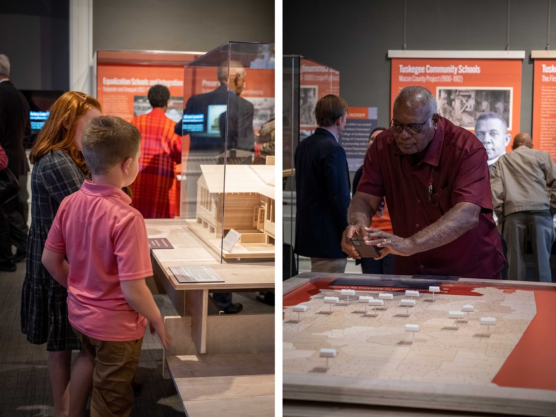
PUBLIC ENGAGEMENT The exhibit is free to the public and is scheduled to be on display until Septem- ber 30, 2024. An opening event for the exhibit was hosted by the Alabama Department of Archives and History on October 17, 2023, followed by a panel discussion about Rosenwald Schools (Hudson, 2023). The panel dis- cussion was facilitated by Sam Christensen, Exhibits Curator at the Alabama Department of Archives and History; Gorham Bird, Assistant Professor of Architecture at Auburn University; Dorothy Walker, a community leader researching Alabama’s Rosenwald Schools; and Thomas Boyd, an alumni and community leader representing the Tankersley Rosenwald School. The open- ing was well attended and visited by many alumni and members of alumni families that still feel the positive impact of the Alabama Rosenwald Schools as shown in Figure 6. Additionally, the opening was attended by a diverse group including young people as seen in Figure 7.
CONCLUSION
This collaboration of an interdisciplinary team comprised of educators in architecture, building science, and graphic design using specialized skills and digital technology created a unique exhibit about the Alabama Rosenwald Schools. This exhibition was designed to be able to travel to other communi- ties with Rosenwald Schools, as well as other venues across the country. The narrative of the exhibit shares the history of those striving to expand edu- cational opportunities for their African American communities, and those
36 Smith and Bird
today working to keep alive the legacies of these vital community institu- tions (Hudson, 2023). Andrew Feiler, author of the Book, A Better Life for Their Children, asserts that the actions of Booker T. Washington and Julius Rosenwald changed the nation. The fact that they crossed the divides of race, religion and region is a lesson to us that we can make America a better place for all (USA Today, 2022).
Figure 6: Alumni and alumni families attending the exhibit opening (image provided by Alabama department of archives and history).Figure 7: The exhibit opening was attended by a diverse group including young people (images provided by Alabama department of archives and history).
History Lives On: Interdisciplinary Design to Uplift Rural Communities 37
REFERENCES
Bird, G. (2024) Architectural Agency in Digital Documentation: Realizing Alabama’s Rosenwald Schools, Association of Collegiate Schools of Architecture. Avail- able at: https://www.acsa-arch.org/chapter/architectural-agency-in-digital-docu mentation-realizing-alabamas-rosenwald-schools/ (Accessed: 30 January 2024). Hudson, G. A. (2023) Alabama Department of Archives and History. Available
at: https://archives.alabama.gov/about/press-releases/news-detail.aspx?ID=16235 (Accessed: 04 February 2024). Kelly, K. (2022) The Rosenwald schools: Schools for African-Americans in the rural South, America Comes Alive. Available at: https://americacomesalive.com/rosenw ald-schools/ (Accessed: 30 January 2024). Lewis, J. and D’Orso, M. (1998) ‘Pilot Light’, in Walking with the Wind: A Memoir
of the Movement. New York, NY: Simon & Schuster, p. 45. Solender, M. (2021) How the Rosenwald schools shaped a generation of black leaders, Smithsonian.com. Available at: https://www.smithsonianmag.com/histo ry/how-rosenwald-schools-shaped-legacy-generation-black-leaders-180977340/ (Accessed: 14 April 2024). USA Today Magazine (2022) ‘A Better Life for Their Children’, September,
pp. 48–53.
LISTED IN THE AHFE DIGITAL BOOKSTORE CATALOGUE
Explore the complete digital volume
Interdisciplinary Practice in Industrial Design
Read this individual research paper free through the original publisher, or explore the full digital proceedings book.
ISBN 978-1-964867-20-5
Explore this ISBN in the AHFE Bookstore ↗Listed in the July 2026 bookstore catalogue; search by ISBN to confirm current availability · Digital book purchase optional