Sanna Nieminen, Satu Jumisko-Pyykko, Kirsi Kemell, Mikko Seppälä, Satu Honkanen (2026). Industrial SMEs’ Experiences of Network Agency. In: Human Factors, Business Management and Society. AHFE Open Access, vol. 215, pp. 361–371. https://doi.org/10.54941/ahfe1007617
To foster innovation and business development, SMEs must act as active agents within their networks. The aim of this study is to investigate industrial SMEs’ experiences of network agency. We conducted 12 semi-structured group interviews with key personnel and core team members of industrial SMEs. The data were analyzed using thematic analysis. The findings are presented as a model of SMEs’ network agency, comprising six interconnected components. At its core are (1) the network of actors, (2) the characteristics of the collaboration among these actors, (3) the perceived benefits of network agency, and (4) building and managing networks. These core elements are further shaped by (5) enabling factors and (6) limiting factors. For academics, the study offers new insights into the characteristics of network agency in the context of SMEs. For practitioners, it provides practical guidance for strengthening network agency in industrial SMEs.
Industrial SMEs are essential as specialized suppliers to large enterprises within complex global supply chains (Bilali, 2022; Gereffi et al., 2005; Kano et al., 2020). They provide vital components, technologies, solutions, process expertise, and skills. However, they often operate under conditions of unequal power, dependency, and high cost and performance pressures. In this environment, the ability of SMEs to exercise network agency becomes vital. Active network agency involves intentional network building and relationship development. SMEs increasingly rely on inter-organizational networks (Lin & Lin, 2016).
An SME is defined by the European Commission (2026) based on the headcount (< 250) and then either the turnover (< 50 million EUR) or balance sheet total (< 43 million EUR). A business network can be described as a dynamic structure of interconnected business units linked by long- term, resource-intensive relationships, in which actions in one relationship influence others and firms and relationships evolve (Håkansson & Ford, 2002). Additionally, network agency is a concept that concerns the origins of action in social networks and how it arises from the interaction between individuals and network structures (Tasselli & Kilduff, 2021).
For decades, studies have shown that networks are crucial to a company’s success and greatly influence its performance (Holm et al., 1996; Bengtsson & Kock, 1999; Eisingerich & Bell, 2008; Aarikka-Stenroos & Ritala, 2017). Examining SME networks and network agency is important because SMEs operate in a structurally dependent way. Their growth, innovation, and internationalization largely depend on how effectively they can actively build, utilize, and shape their network relationships and actions under resource constraints (Zeng et al., 2010; Audretsch & Guenther, 2023).
Previous network research has mainly concentrated on complex global supply chains and the experiences of large international actors (Gadde et al., 2003; Gereffi & Lee, 2012; Wiedmer & Griffis, 2021). SMEs often function in asymmetrical, dynamic, and partly uncontrollable relationships that are not addressed in this focus (Singh, 2011; Tsai et al., 2022). We recognize that networks are significant for SMEs, but there is less understanding of how to operate within them (Jørgensen & Ulhøi, 2010; Lin & Lin, 2016). The experiences of individual SMEs regarding network activity have received little attention.
The goal of this study is to examine industrial SMEs’ experiences with network agency. We conducted a group interview study involving 12 industrial SMEs. The novelty of this research lies in analyzing how SMEs function in networks as active and influential players in everyday interactions and strategic decisions, a topic that has received limited attention in previous studies. This paper offers new insights into the characteristics of network agency for scholars and practical advice for enhancing network agency in industrial SMEs.
RESEARCH METHOD Semi-structured group interviews were conducted with 12 Finnish industrial SMEs during March-April 2025. The interview themes were innovations and networks, functioning and benefits of networks, and network agency. Key personnel participated in the interviews in each company (a total of 47 individuals, with roles such as top management, CEO, production, sales, R&D and procurement manager). Prior to the interviews, written consent was filled and the interviews were audio recorded. The interviews were conducted by two researchers. The mean duration of the interviews was 79 (sd: 12) minutes.
Analysis. The data was analyzed using a bottom-up thematic analysis (Braun & Clarke, 2006). The procedure had five steps; 1) To familiarize the researchers with the data, the interviews were transcribed and read through. 2) Initial codes were created for all pieces of meaningful text in relation to the research question. The size of one unit of analysis (a piece of text containing one coherent thought) varied from one word to eight sentences. 3) A total of 1,661 interview codes were categorized based on their similarity to identify the initial themes. 4) The initial themes were revised two times to determine the final themes. 5) Definitions and names were given to the themes. The categorization and identification of the themes were carried out by three researchers simultaneously.
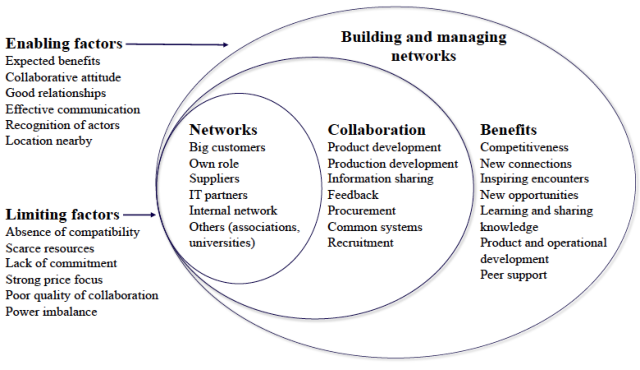
FINDINGS Our findings show that industrial SMEs’ experiences of network agency are composed of six main clusters. At its core are (1) the SMEs’ networks, (2) the characteristics of collaboration between these actors, (3) the perceived benefits of network agency, and (4) building and managing networks. These core elements are further influenced by (5) enabling factors and (6) limiting factors. Figure 1 shows an overview of the six main clusters and their categories.
Figure 1: Industrial SMEs’ experiences of network agency.
SMEs’ Networks Big customers. The customers of SMEs are mainly large enterprises, often regional leaders and/or international players, with whom they engage in close and long-term cooperation. However, SMEs are intentionally diversifying their customer base to reduce dependence on a single big customer, keeping risks manageable. SME’s actions are strongly influenced by the needs of big customers, global supply chains, and the potential relocation of procurement to different locations or countries.
Own role. SMEs view their role in the network mainly as subcontractors and component manufacturers, often playing a small but essential part in a global supply chain. They adjust their operations to meet the requirements of big customer companies and their projects. Delivery reliability must be high, and it still depends on many other players in the network. This emphasizes the importance of strong collaborative relationships in multi-stage production chains.
Suppliers. SMEs maintain extensive supplier networks, including both domestic and international partners. Domestic suppliers do exist, but they are often geographically dispersed and concentrated in industrial areas outside central Finland. Local supplier networks vary between companies: some have deep, long-standing local relationships, while others have very limited ones. The supplier’s location is usually not a decisive factor; even delivery times and transportation costs influence supplier choices.
IT partners. IT partners are crucial collaborators for SMEs, and local operators are often employed to provide better support for developing and implementing new features in IT systems, such as AI.
Internal network. For some SMEs, an internal network involves collaboration between the group companies, where expertise, products, and resources are shared in areas such as product development, maintenance, and operational growth. Sometimes, an internal network can also assist in entering new markets.
Other networks. Other networks include sector-specific SME networks, regional collaborations, education-related collaborations, and managers’ personal networks, all of which support skills development, recruitment, and stakeholder cooperation to varying degrees.
Collaboration in SME Networks Product development. Collaboration in product development involves SMEs, big customer companies, educational institutions, and authorities sharing expertise, testing solutions, and exchanging feedback, helping products develop more efficiently and quickly. It is a practical, step-by-step, and trust- based process.
Production development. For SMEs, developing production means practical co-development with customers and partners to ensure that solutions are manufacturable, usable, and reliable. Collaboration can include sharing capacity, flexible subcontracting, and the cross-use of production equipment.
Information sharing. Information sharing occurs through practical actions within the network: participants exchange experiences, technical solutions, and best practices via visits, joint projects, documents, and daily dialogue. This sharing is rooted in trust and a willingness to help others, even in challenging situations and among competitors.
Feedback. Feedback is collected from customers and end users based on their experiences with use, maintenance, and troubleshooting. Challenging customers provide valuable insights that help improve processes and products. The amount and frequency of feedback vary.
Procurement. There is little visible collaboration in procurement. However, local SMEs appear interested in cooperative efforts, such as sharing subcontractors, making joint purchases, and coordinating investments to improve cost efficiency and delivery reliability.
Common systems. SMEs have some system integrations with their customers and within their groups to support ordering, delivery, and service. Common systems and tools, such as ERP, AI solutions, and real-time data transfer, are developed and implemented collaboratively with suppliers and customers.
Recruitment. Professional collaboration among SMEs facilitates the transfer of expertise and supports recruitment. Educational institutions provide trainees and future employees through collaboration.
Collaboration at interfaces is highly customer-centered and practical, focusing on joint development, direct contact, and long-term partnerships. Although often close, the nature of collaboration varies in structure and systematic approach depending on the interface and involved actors.
Industrial SMEs’ Experiences of Network Agency 365 The Perceived Benefits of Network Agency
Competitiveness. The network offers the possibility to improve competitiveness, share knowledge to support it, and provide added value for other actors in the network to improve their competitiveness.
New connections. The network is important for establishing new connections, and for giving and receiving recommendations to extend contacts.
Inspiring encounters. Discussions evoke inspiration, learning, open new thinking and acting possibilities, and help in being updated in topical issues. Discussions can be with peers, or representants from different domains, or they may take place during company visits or when acting in a network.
New opportunities. The network is seen as a potential source for new opportunities, such as larger collaboration projects, new innovations, or active problem solving.
Learning and sharing knowledge. The network can serve as a platform to learn to know about other companies’ knowledge, products, capabilities, and ways of solving the daily challenges, and sharing own knowledge in these. It supports finding the shared interests in a larger group. One of the interviews illustrated this aspect by saying: “– when someone recognizes that there is a topic that would be interesting for others too. That network is about sharing, not only that you ask, but rather it gives you ideas and information.—It is about sharing and pointing out good things. And if there are some problems, you can call for support from others such as asking how this has been solved in your company. Or whether you have been faced with similar things? Where could we find support?” (Interview 11) Product and operational development. Networks provide support for product development through incremental improvements (e.g. enhancing quality or cost-effectiveness) as well as facilitating the development of new products. It provides support in operational development (e.g. co-sharing of personnel resources, solving daily challenges, improving production).
Peer support. The benefit of networks lies in the ability to give and receive a wide-spectrum of peer support for daily challenges business and company development.
Building and Managing Networks Networks are viewed positively within the SME context, their usefulness is well recognized, and the importance of networking continues to grow. Generally there is a shared belief that deepening network collaboration is both beneficial and worthwhile. However, attitudes toward networking vary among SMEs. While some view networks as essential for their very existence, others see them as just another task in an evergrowing todo list, that is repeatedly postponed due to limited resources. The mindset and commitment of the management play a crucial role in the network agency, and their attitude largely determines how actively and effectively the company engages in networking with others.
At one end of the spectrum are SMEs that only turn to networks when a problem arises or when they encounter a situation they cannot handle alone. For these SMEs, network development is not an active or routine
part of their everyday work. There might be interest in collaboration and curiosity about areas where networking could add value, but they do not, however, consider or discuss networks in a longterm, strategic, or systematic way. One of the participating interviewees explains this by saying: “We really haven’t known how to think about such things (becoming more active in network cooperation). I’ve always talked a bit about what I’ve done in terms of collaboration and such, but as a group, we haven’t really known how to approach such matters.” (Interview 6). Additionally, internal collaboration should be more effective as particularly RDI activities require close and active cooperation. A lack of internal collaboration is an expression of a more conventional organizational culture. A low tendency toward network agency can also be a matter of personality, and it may be easier and more natural for some than for others. Some SMEs expressed a wish that larger companies could act as facilitators for collaboration, given that they have more resources to support and coordinate networking efforts.
At the other end of the network agency spectrum are SMEs that have recognized the strategic value of a wellfunctioning network and have incorporated networkrelated objectives into their strategies. These companies engage in deliberate, longterm discussions about what should remain inhouse, where collaboration interfaces lie, and what activities could be carried out together with partners. Networks are assessed regularly, and longterm partnerships are actively developed. Key people take responsibility for cultivating networks within their own areas, and networking is also shaped by client needs as new client projects may require entirely new technologies, materials, or handling methods. Collaboration within the network can be driven by emerging ideas or opportunities, encouraging companies to examine whether someone has already done similar work or to identify potential partners for collaboration. Codevelopment is viewed as an investment, and collaborating with the network is a natural part of everyday operations. The success of the network is seen as mutually reinforcing, advancing the performance and goals of every organization involved.
Enabling Factors Expected benefits. Networking is built on the expectation of shared value. The assumption is that the time spent is useful and everyone taking part gains something meaningful. Expected benefits can include more revenue, better profitability, new competence or future possibilities to increase competitiveness.
Collaborative attitude. Good cooperation requires a collaborative attitude. This begins with mutual interest to pursue common interests instead of competing. Understanding each other’s needs, reciprocity, and willingness to combine competencies along with a curious mindset toward new opportunities can strengthen trust and deepen cooperation.
Good relationships. Personal relationships and networks are valuable in network collaboration. In these relationships, face-to-face communication is important for building a humane atmosphere, collaboration and trust,
Industrial SMEs’ Experiences of Network Agency 367 and it cannot be replaced by remote communication. Openness is seen as a reciprocal value in the network. This is visible in terms of honesty and sharing of knowledge, also including the willingness to share failures. Trust characterizes relationship between the actors where both needs and strengths are understood, and it is built in active interaction. It requires taking care of the relationship, sticking to what was agreed, and not misusing the trust. It is a requirement for collaboration.
Effective communication. Communication is expected to be transparent, friendly, appropriate, explicit and upbeat. Availability, open dialogue and discussion about development ideas as well as reciprocal feedback are essential for forming connections.
Recognition of actors. Knowing people and companies makes it easier to recognize cooperation possibilities. Personal network contacts are important— when others know you and your company, it can increase demand and it is easier to receive help when required. As one of the participants explained: “It just comes to mind that we get help very easily, if we need something for a specific problem ourselves, from customers and others. We certainly have a good reputation in that sense. We provide high-quality service. Then it is easy for us to get help, too.” (Interview 3) Location nearby. Proximity brings logistic advantages, increases the security of delivery and enables quicker responses. Location nearby is experienced as a factor that makes collaboration easier and impacts the choices of networking partners.
Limiting Factors Absence of compatibility. Lack of compatibility can stem from several sources. If there are no shared activities or aligned interests, collaboration becomes difficult. The mismatch may arise from differences in production processes, machine incompatibility, or the absence of specific expertise. This is especially critical in innovationdriven collaboration, which relies on partners whose capabilities and approaches complement one another.
Scarce resources. Uncertain times lead SMEs to adopt a more cautious approach. When every day is busy and the time is limited, networking and expanding networks is easily cut off. For example joint product development is viewed positively, but it is also seen as requiring significant resources.
Lack of commitment. Lack of commitment can significantly hinder collaboration. It may appear as limited interest in longterm collaboration, an inability to recognize new opportunities or engage in joint projects. Constructive dialogue, especially about feedback or development needs, is often missing. Lack of commitment may also appear as interest in collaboration only during difficult times, when alternatives are limited.
Strong price focus. Many interviewees noted that, despite a genuine willingness to collaborate, price ultimately becomes the deciding factor. High material and labor costs place significant pressure on SMEs, undermining both their cost efficiency and competitiveness.
Poor quality of collaboration. Lack of interest, negative attitudes, or direct competition between partners often leads to weak collaboration. Even highquality products cannot compensate for partners who are perceived as difficult or unpleasant to work with. If previous cooperation has resulted in poor experiences or broken trust, it is understandable that a solid foundation for future collaboration is missing. This element was highlighted for instance by one of the participants, who noted: “And that’s one of the things, of course, that I’ve noticed here, that if a supplier has problems, very little information is provided. It’s bad for us, when we wait and are prepared for it, and then they don’t give the information, that we have a workshop here sick and we are closed, we can’t deliver – that the delivery of the products will be delayed by a week or two. There is no such information, we must pry it out from them.” (Interview 2) Power imbalance. SMEs often operate as subcontractors for large companies. Globally operating clients may require demanding quality systems and extensive documentation related to production processes. Even preparing offers can become overly complex and timeconsuming. When SMEs feel that major clients are trying to compete them “to death”, tensions increase, and such a strained dynamic is far from an ideal foundation for collaboration.
DISCUSSION AND CONCLUSION The aim of this study was to investigate industrial SMEs’ experiences with network agency. The interview study findings confirm previous research on the key role of SMEs in global supply chains (Bilali, 2022; Gereffi et al., 2005; Kano et al., 2020) by showing that industrial SMEs’ networks are built on a multi-level structure consisting of large enterprises as customers, domestic and international supplier networks, IT partners, intra-group cooperation partners, and regional, educational, and sector-specific networks.
The innovation and supply chain capabilities of SMEs are built on early- established, trusting network relationships and clear coordination throughout the entire network (Jørgensen & Ulhøi, 2010; Singh, 2011). This study supports and expands on these findings by demonstrating the specific types of collaboration that occur at the interfaces. The practical, customer-focused collaboration within SMEs’ networks is multi-layered and includes product and production development information exchange, feedback, procurement, shared systems, and recruitment.
Network relationships are crucial to SME performance because they facilitate access to resources, build trust, and enable information sharing (Lin & Lin, 2016). Therefore, networks are especially important when a company lacks internal resources and relies on external connections to enhance its competitiveness. This study found that SMEs believed that networks and collaboration offered a competitive advantage, helped establish new connections, and generated new business opportunities. Additionally, networking encouraged learning, knowledge exchange, and peer support, reinforcing Lin & Lin’s (2016) assertion about the role of networks in fostering knowledge sharing. Our results suggest that networks support not only
Industrial SMEs’ Experiences of Network Agency 369 economic success but also innovation, growth, and inspiration, broadening the previous understanding of the benefits of network relationships for SMEs.
SMEs in our study value collaboration but, in many cases, do not consciously build or analyze their networks, leaving significant strategic potential untapped. Research shows that intentional network development can help SMEs overcome outsidership (Schweizer, 2013), improve governance and collaboration structures (Cisi & Sansalvadore, 2022), and support upgrading in global value chains through strategic, multi partner ties (Kang & Kim, 2023).
Collaboration and network relationships arise from both structural factors and the active involvement of the actors. Holm, Eriksson, and Johanson (1996) show that commitment and network connections strengthen trust and the profitability of collaboration, while weak commitment and structural deficiencies in networks hinder the development of relationships. Tasselli & Kilduff (2021) complements this perspective by pointing out that networks develop not only through structures but also through actors’ choices, motives, and their ability to shape network relationships.
The results of this study support the idea that successful collaboration requires both favorable network structures and active, intentional efforts by actors to build relationships. The enabling factors experienced by SMEs, such as expected benefits, a cooperative attitude, strong relationships, effective communication, recognition of actors, and proximity, can be seen as expressions of active network agency, where the company both leverages and deliberately develops its relationships. Conversely, limiting factors such as a lack of compatibility, limited resources, lack of commitment, price focus, poor collaboration quality, and power imbalances restrict both structural cooperation and the actors’ ability to shape their networks.
Future research is needed to validate the model of SMEs’ network agency. Further work needs to examine how SMEs can transition from merely operating within networks to intentionally developing and managing them. Longitudinal studies, particularly those tracking changes in network agency over time, would provide valuable insights into opportunities for growth. Broader research across various fields and regions could help identify how contextual factors influence SMEs’ ability to collaborate. Methodologically, combining interviews with network mapping or social network analysis may reveal differences between perceived and actual network behaviors. A comparative study of SMEs with strong versus weak network engagement could identify which practices most effectively promote innovation, competitiveness, and growth.
To conclude, this study highlighted that networks are vital strategic assets for industrial SMEs. Trust-based, long-term relationships with customers, suppliers, and regional partners foster innovation, learning, and competitiveness. However, SMEs often rely on networks intuitively rather than intentionally managing them. Actively analyzing and developing key relationships through clearer coordination, regular communication, and deliberate partner selection, can yield greater benefits and reduce vulnerabilities, such as power imbalances or resource limitations. By adopting a more intentional approach to network development, SMEs can strengthen
their supply chain position, discover new business opportunities, and support more sustainable growth.
ACKNOWLEDGMENTS
The authors would like to thank the personnel of the 12 SMEs for sharing their valuable insights on their network agency. The data was collected as part of the “Sustainable Growth in the Network with Systems Intelligence” project funded by the European Regional Development Fund (ERDF).
REFERENCES
Aarikka-Stenroos, L., & Ritala, P. (2017). Network management in the era of ecosystems: Systematic review and management framework. Industrial marketing management, 67, 23–36. Audretsch, D. B., & Guenther, C. (2023). SME research: SMEs’ internationalization
and collaborative innovation as two central topics in the field. Journal of Business Economics, 93(6), 1213–1229. Bengtsson, M., & Kock, S. (1999). Cooperation and competition in relationships between competitors in business networks. Journal of business & industrial marketing, 14(3), 178–194. Bilali, J. B. (2022). Small/medium sized enterprises (SMEs) competitiveness: A global
perspective competitiveness of small and medium-sized enterprises. Journal of Enterprise and Business Intelligence, 2(2), 109–119. Braun, V. and Clarke, V (2006). Using thematic analysis in psychology. Qual. Res.
Psychol., 3(2), 77–101. Cisi, M., & Sansalvadore, F. (2022). Formalized business networks in SMEs and structural relations for their governance. Journal of Small Business & Entrepreneurship, 34(3), 295–312. Eisingerich, A. B., & Bell, S. J. (2008). Managing networks of interorganizational
linkages and sustainable firm performance in business-to-business service contexts. Journal of Services Marketing, 22(7), 494–504. European Commission. 2026, January. SME definition. Directorate-General for Internal Market, Industry, Entrepreneurship and SMEs, European Commission. https://single-market-economy.ec.europa.eu/smes/sme-fundamentals/sme- definition_en Gadde, L. E., Huemer, L., & Håkansson, H. (2003). Strategizing in industrial
networks. Industrial marketing management, 32(5), 357–364. Gereffi, G., Humphrey, J., & Sturgeon, T. (2005). The governance of global value chains. Review of international political economy, 12(1), 78–104. Gereffi, G., & Lee, J. (2012). Why the world suddenly cares about global supply
chains. Journal of supply chain management, 48(3), 24–32. Holm, D. B., Eriksson, K., & Johanson, J. (1996). Business networks and cooperation in international business relationships. Journal of international business studies, 27(5), 1033–1053. Håkansson, H., & Ford, D. (2002). How should companies interact in business
networks?. Journal of business research, 55(2), 133–139. Jørgensen, F., & Ulhøi, J. P. (2010). Enhancing innovation capacity in SMEs through early network relationships. Creativity and innovation management, 19(4), 397–404.
Industrial SMEs’ Experiences of Network Agency 371 Kang, S., & Kim, C. (2023). How do strategic networks help SMEs upgrade in global
value chains? A cross-national analysis. Cogent Business & Management, 10(1), 2202833. Kano, L., Tsang, E. W., & Yeung, H. W. C. (2020). Global value chains: A review of the multi-disciplinary literature. Journal of international business studies, 51(4), 577–622. Lin, F. J., & Lin, Y. H. (2016). The effect of network relationship on the performance
of SMEs. Journal of Business Research, 69(5), 1780–1784. Singh, R. K. (2011). Developing the framework for coordination in supply chain of SMEs. Business Process Management Journal, 17(4), 619–638. Schweizer, R. (2013). SMEs and networks: Overcoming the liability of outsidership.
Journal of International Entrepreneurship, 11(1), 80–103. Tasselli, S., & Kilduff, M. (2021). Network agency. Academy of Management Annals, 15(1), 68–110. Tsai, F. S., Cabrilo, S., Chou, H. H., Hu, F., & Tang, A. D. (2022). Open innovation
and SME performance: The roles of reverse knowledge sharing and stakeholder relationships. Journal of Business Research, 148, 433–443. Wiedmer, R., & Griffis, S. E. (2021). Structural characteristics of complex supply chain networks. Journal of Business Logistics, 42(2), 264–290. Zeng, S. X., Xie, X. M., & Tam, C. M. (2010). Relationship between cooperation
networks and innovation performance of SMEs. Technovation, 30(3), 181–194.
LISTED IN THE AHFE DIGITAL BOOKSTORE CATALOGUE
Explore the complete digital volume
Human Factors, Business Management and Society
Read this individual research paper free through the original publisher, or explore the full digital proceedings book.
ISBN 978-1-964867-91-5
Explore this ISBN in the AHFE Bookstore ↗Listed in the July 2026 bookstore catalogue; search by ISBN to confirm current availability · Digital book purchase optional