Momoka Muto, Wonseok Yang (2024). The Influence of Microcopy on User Decision-Making. In: Interdisciplinary Practice in Industrial Design. AHFE Open Access, vol. 144, pp. 188–197. https://doi.org/10.54941/ahfe1005131
Microcopy is gaining attention in UI design for the purpose of improving user Conversion Rate (CVR). It is particularly used to help users make choices during processes such as membership registration and online purchases. A preliminary survey on the use of the service suggests that when users are given a choice of equivalent values, the reasons for their decision are vague and they have little awareness when making a choice. Therefore, we considered that the strengths of it could be used to help users make choices. In this research, we classified it expression patterns into four types: "Signal type" that conveys immediate benefits, "Benefit type" that conveys fundamental benefits, "Support type" that removes uncertainty, and "Unbenefit type" that dares to incite anxiety. CVRs for these same scenes and their impressions were investigated. The results of the experiment showed that the "Signal Type" and "Benefit Type" encouraged users to make a choice without making them feel uncomfortable, while the "Support Type" and "Unbenefit Type" gave users a sense of distrust and may induce a choice different from their original intention. We also investigated the semantic understanding of Microcopy when there is a relationship between the task the user wants to perform and the action the service side wants to prompt, and when there is no relationship. The results revealed that there were differences in semantic understanding depending on whether there was or was not a relationship between the user's task and the task. These results support the objective of this research, which is the psychological impact of Microcopy patterns on users' choice behavior.
The expansion of online services has made it important for users to have the skills to operate independently and for communication, including the trans- fer of meaning between services and users. However, choices are becoming more complex in an online environment built with vast amounts of infor- mation. Nielsen found that 16% of the time, users pay attention only to the words on the User Interface (UI) when viewing a site (Nielsen, 1997). As repetitive behavior is becoming habitual, and as a result, knowledge-based behavior more rule-based, decisions in similar situations are being based on past experience and knowledge, which may lead to choices without a clear basis for decision-making (Bargh et al., 1996) (Mikels et al., 2011). For that reason, in a digital society where various services are expected to become
The Influence of Microcopy on User Decision-Making 189
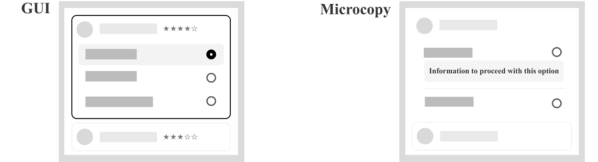
more complex in the future, it is important to provide users with appropriate information and guidance when making a decision. Therefore, psychology and behavioral economics are actively incorporated into conventional Graph- ical User Interface (GUI). Examples in Figure 1 include Von Restorff’s law, which emphasizes that one of the options guiding the user is the series posi- tion effect, bringing meaning to the order in which options are displayed (Wolfgang & Hedwig, 1933) (Hermann, 2013). The bandwagon effect pro- motes the assignment of value based on the number of collective opinions that are used in a variety of services at the time of choice (Leibenstein, 1950). In addition to the visual GUI, Microcopy has been attracting attention in recent online services as a means of improving Conversion Rate (CVR) and providing users with a better experience in freely making choices. According to Fogg’s behavioral model, people who are more motivated to perform a cer- tain action and have a higher capacity to perform it, are more likely to take action when prompted. Microcopy often incorporates this concept to guide highly motivated users (Fogg, 2009). In addition, linguistic expressions can provide clear information and encourage choices because they are composed of short sentences or words that can be read without causing stress to the user. Kobayashi et al.’s research has shown that the amount of text that is easiest to read in Japanese is approximately 20 to 30 characters (Kobayashi et al., 2016). Although several previous studies have clarified the behavioral inducement capability of different copy expressions, few have investigated the relationship between the psychological impact of expressions (Luguri, 2021) (Mogilner, 2009) (Goldstein, 2008). In addition, because the manner of expression differs from service to service and brand to brand, clarifying the changes in user psychology and thinking is bound to improve User Expe- rience (UX) and encourage choice. In conclusion, this research clarifies the usefulness and behavioral inducement of the psychological effects of differ- ent Microcopy representations as a decision-making factor when users make a choice.
Figure 1: Difference between GUI and microcopy.
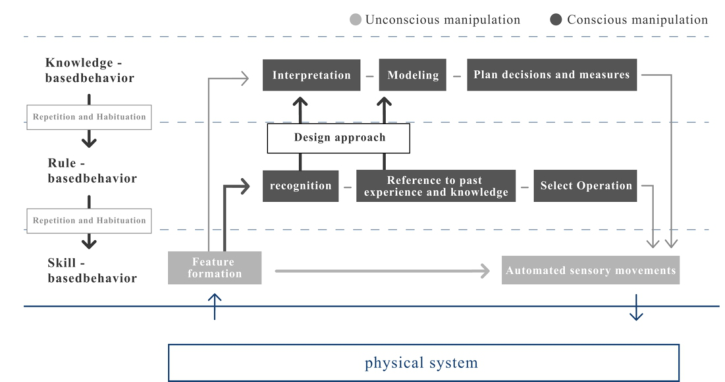
EFFECTS OF BEHAVIOR CHANGE The human behavioral process involves visual perception of information, recognizing the meaning or matter to which the information pertains, and then acting based on the content (Card et al., 1983) This process is classified into three categories according to degree: knowledge based behavior, rule based behavior, and skill based behavior (Rasmussen, 1983) (see Figure 2).
190 Muto and Yang
Knowledge-based behavior is the process of planning and executing deci- sions and measures to solve a problem, by modelling and interpreting the object or content when it is perceived to be complex (Yamaoka et al., 2015). In rule-based behavior, this process is conducted without awareness, such that upon perceiving the situation of the object, the method of manipulation or operation is selected based on past experience and knowledge (Yamaoka et al., 2015). These models proceed from a higher-level knowledge to a lower- level rule base as operations are facilitated through repetition and habituation (Inoue, 2016). Therefore, normal operations and actions that would baffle a novice can become routine for the more experienced, allowing instantaneous decisions in line with the behavior of the rule base. However, without a deep understanding of the current situation, an individual may perform an oper- ation that was not originally intended (Wendel et al., 2020). Therefore, to address the errors in rule-based behavior, the relationship between functions and their consequences should be clarified by providing explanations to indi- viduals or through other means (Gyoba & Iwasaki, 2007). In conclusion, this research clarifies the usefulness and behavioral inducement of the psychologi- cal effects of different Microcopy representations as a decision-making factor when users make a choice (Gyoba & Iwasaki, 2007).
Figure 2: Three-level hierarchical model of action.
METHODS OF CONVEYING THE MEANING OF INFORMATION Information Processing Process
In the field of UI design, there are various ways of expressing appropriate information to the user, depending on the information processing process. In Norman’s 7 stages of action, first, legibility is measured by “perception,” and then “interpretation”determines the clarity of meaning (Norman, 1990). In interface design, the association and coordination of morphological and sensory elements such as colour, brightness, shape, and position are used to
The Influence of Microcopy on User Decision-Making 191
promote legibility and eye guidance (Inoue, 2016). Elements used in “inter- pretation,” such as numbers, letters, and diagrams are aligned and grouped to contribute to clarity and understanding of operations (Inoue, 2016).
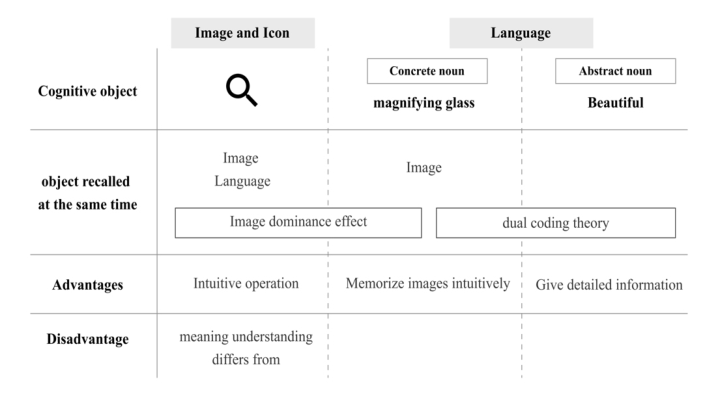
Image Representation in Semantic Elements In addition, semantic elements that impart meaning to the elements are used to express clarity. Semantic elements mainly comprise images, icons, and words (Inoue, 2016). Images and icons are effective in situations that require intuitive operations because they dominate the image (Nelson et al., 1974). However, icons used in UI design can only express words in general lan- guage, and thus cannot clearly convey detailed content and purpose (Sakano & Okada, 2021). Therefore, the icons in service-specific designs may be influenced by previous experience and knowledge.
Linguistic Representation in Semantic Elements Words can clearly convey the meaning given the time (Inoue, 2016). Accord- ing to the dual encoding theory, words can be divided into concrete and abstract nouns (Paivio, 1991). Figure 3 shows the difference between image and language representations. Concrete nouns can be intuitively memorized because images can be recalled simultaneously with letters. However, abstract nouns express states of affairs and convey detailed information although intu- itive imagery is difficult to achieve. Therefore, compared to images and icons, words are used more often as copies in the design field to accurately convey the meaning to individuals who lack knowledge and experience. Microcopy, which is the subject of this research, is utilized to induce actions through lan- guage elements (Yifran, 2022). As an example, it is often used in payment scenes, account registration, and error reporting.
Figure 3: Image and language representation.
192 Muto and Yang
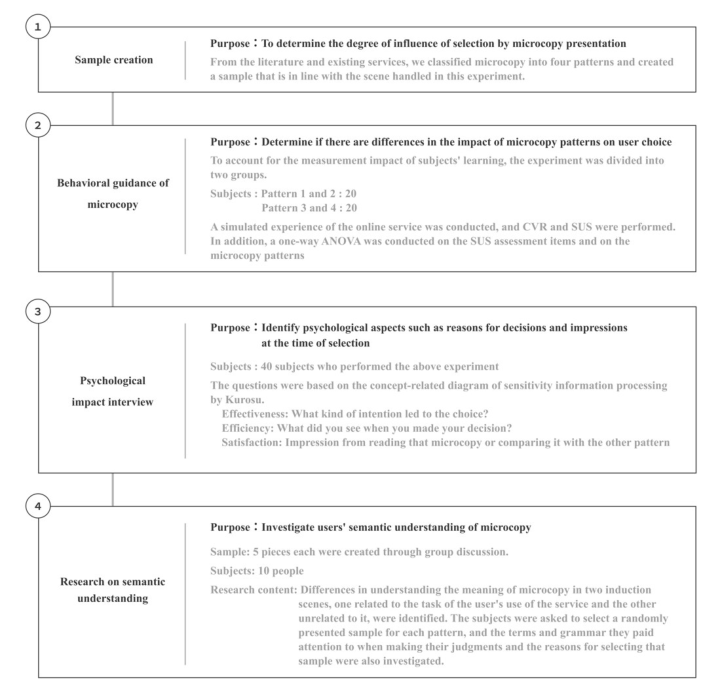
RESEARCH METHOD In this research, we conducted a survey and experiments using the follow- ing procedures to clarify how the presentation of microcopies affects users’ choices, thoughts, and judgments they make (see Figure 4).
Figure 4: Research flow.
Create Samples In order to clarify the influence of Microcopy UI patterns on user behavior and psychology, we classified the Microcopy and created UI samples to be used during the experiment. Below, we categorized the Microcopy into three patterns of Microcopy used in the literature and existing services, and one additional sample added in this research (Yifran, 2022) (Yamamoto et al., 2022). Figure 5 describes the organization of those patterns.
1. Signal type: presenting immediate benefits to the user 2. Benefit type: to provide future benefits to other users and to society 3. Support type: remove the concerns of users when they use the service 4. Unbenefit type: Dare to cause anxiety.
The Influence of Microcopy on User Decision-Making 193
Figure 5: Microcopy classification patterns.
Next, we determined the experimental scene that would utilize the above patterns. To avoid dark patterns, we focused on scenes that encourage better direction while respecting individual opinions in accordance with the concept of libertarian paternalism, thereby creating a sample that was adopted by an online shopping Consumer-To-Consumer (C2C) service (see Table 1).
Table 1. Representation of microcopy extracted from samples.
Table available in the original PDF paper.
Pattern Expression Signal type “Makes it easier to sell”, “Less hassle” Benefit type “Environmentally friendly”, “Increased satisfaction from the recipient” Support type “Prevent problems”, “Safety and security”, “Prevent forgetting to send” Unbenefit type “Causes waiting time”, “Makes it harder to sell”
Results on Behavioral Inducibility of Microcopy The selection rate and usability evaluation for each selection scene and the results of the analysis, organized by Microcopy pattern, are shown in Tables 2 and 3, respectively. Clearly, both System Usability Scale (SUS) evaluation and CVR are high for signal and benefit types. In contrast, for support and unben- efit types, the classifications based on SUS evaluation are “acceptable,” and CVR is found to decrease by up to 50% in some cases, depending on the scene of choice (Sauro, 2011). A one-way ANOVA conducted on SUS items and Microcopy patterns revealed significant differences among the three question items (see Table 2). The three items had in common that the questions were related to the content of the Microcopy.
Table 2. SUS and CVR results for each pattern.
Table available in the original PDF paper.
Pattern SUS CVR (↓Each Investigation Scene) Average Median 1 2 3
Signal type 70.8 C 72.5 C+ 95% 85% 85% Benefit type 77.3 B+ 80.0 A− 95% 85% 80% Support type 67.1 C 66.3 C 80% 55% 55% Unbenefit type 63.5 C− 65.0 C 95% 75% 40%
194 Muto and Yang
Table 3. One-way ANOVA on SUS questions.
Table available in the original PDF paper.
Question Items Ease of Understanding
Inappropriateness of Content
Offensiveness of the Content p-value 0.0200(p<0.05) 0.0009(p<0.05) <0.001(p<0.05)
Results on the Psychological Impact of Microcopy
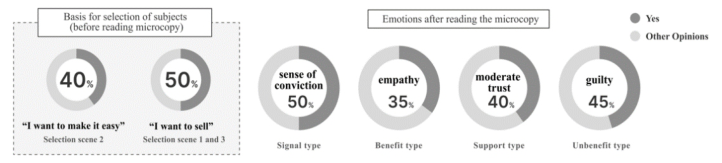
Figure 6 shows the results of the interviews about the emotions felt when reading the microcopy, organized by pattern, as well as the most common opinions about why they made the choices they did.
Signal type: The subjects acquired a “sense of conviction.” Many of the subjects who implemented other patterns also assumed “signal-type” content when selecting.
Benefit type: Subjects felt “sympathy” in expressing that they “want to contribute if they can”; however, some subjects said that it would be dif- ficult to understand the meaning in cases of a gap existing between the user’s expectation and Microcopy remark.
Support type: Some respondents judged the service to be safe because it was provided by a service provider, indicating that they had a “moderate sense of trust” in the service.
Unbenefit type: The content of the Microcopy made the respondents feel “compelled” to make a choice or “guilty” of making another choice.
The interview results showed a common pattern in that many subjects had immediate interests such as “I want to sell” or “I want to make it easy” as their intention when selecting the Microcopy. This experiment simulated the flow in a similar service. Thus, the subjects who had experience with the service were not aware of the Microcopy, or if they were aware, they were not influenced by it because they had clear intentions.
Figure 6: Psychological effects of microcopy.
Results on Semantic Understanding of Microcopy Tables 4 and 5 summarize the results of Scenarios 1 and 2, respectively. Overall, the participants focused more on adjectives and nouns than on grammatical expressions when making judgments. As for “signal types,” fewer were selected from the samples in Research Scene 1 than Scene 2. This means that “scenes not related to the user’s task” are more likely to comprise multiple content that the users may consider of immediate benefit.
The Influence of Microcopy on User Decision-Making 195
Regarding expressions that drew 80% or more attention, no significant dif- ferences between survey Scenes 1 and 2 were observed for “signal,” “benefit,” and “unbenefit” types; however “support” type focused on expressions with direct reassurance such as “safety and security” in Scene 1, whereas a causal relationship was observed in Scene 2, with no significant difference between the expressions. The “supportive” type in Scene 2 paid more attention to directly reassuring expressions, such as “safety and security,” whereas in Scene 1, “supportive” type paid more attention to expressions that described causal relationships and measures addressing specific concerns.
Table 4. Scene results related to the user’s task.
Table available in the original PDF paper.
Signal Type Benefit Type Support Type Unbenefit Type Variable (4–8) Agreement There is a sample selected by all There is a sample selected by all
Constraints. Necessary Burden
No subjects selected for other samples Word Effective use Instantaneous Waiting time
Relieve your anxiety Solid support Peace of mind
Sustainable future Reduction of CO2 emissions
Disadvantages
Expression Direct and easy Sustainability Direct reassurance
Table 5. Scene results unrelated to the user’s task.
Table available in the original PDF paper.
Signal Type Benefit Type Support Type Unbenefit Type Agreement Selected many other samples
put off Regret Decrease
No additional charge ∼without ∼.
SDGs Social Contribution
Variable (5–8) Variable (2–9) There is a sample selected by all Word Easy 60 yen Today’s shopping Disadvantages Expression Frequency/ specific values Direct Ease Sustainability Measures to address specific concerns
CONSIDERATION The following considerations can be made from the above results.
First, in the analyses CVR and SUS, as well as one-way ANOVA, revealed that there were differences among Microcopy patterns relating to user selec- tion behavior. However, the interviews confirmed that subjects who usually used similar services were not significantly affected by Microcopy. These find- ings suggest that the degree of influence of microcopying may vary depending on the user’s familiarity with the act of selection.
196 Muto and Yang
Second, focusing on CVR and SUS for each pattern, the signal and benefit types were higher, suggesting that users may be more likely to act on the presentation of benefits when making a choice.
Third, we investigated users’ semantic understanding and focus points in “scenes that are related” and “scenes that are not related” to the user’s task and the guided content. The results revealed that while users focus on similar words for both scenes in the non-supportive pattern, the supportive pattern focuses on expressions with direct reassurance in “relevant scenes” and on specific expressions with a causal relationship in “irrelevant scenes” with users indicating reasons such as “the content is abstract” and “I don’t under- stand the relevance for not selecting it for the sample.” These findings suggest that including concrete expressions is preferable for scenes that are difficult for users to imagine.
CONCLUSION
The purpose of this research was to clarify the effects of different microcopies on choice and the psychological effects based on these effects. Therefore, based on the literature and a preliminary survey, we classified Microcopy representations and conducted a survey and experiments to measure the effec- tiveness of each pattern. Based on the experiments, the patterns with the highest selection inducement rate among the subjects were “signal”and “ben- efit” types. The one-way ANOVA conducted on the interviews and SUS items for investigating the psychological effects, suggest that the selection rate may vary depending on the degree of understanding the meaning of the Micro- copy. Using the semantic comprehension survey, the relationship between user’s task and the content of the cue was compared for with and without a relationship. Based on the results of the survey, we believe that the “signal type” that presents immediate benefits improves semantic comprehension in scenes where a relationship exists between the user’s task and the guided content. As for the “benefit type,” the user’s understanding of the meaning differed in both situations. In addition, we believe that if Microcopy is to be used as a “support type,” it may be possible to match the user’s understand- ing by determining whether to use specific or direct reassuring expressions, depending on the existence of a relationship between the scene of use and content of inducement. In conclusion, clearly, the expression of Microcopy can have an impact on the perception and understanding of meaning and can impact the user’s decision-making and psychology when making a choice.
REFERENCES
Bargh, J. A., Mark, C., and Lara, B. (1996). Automaticity of Social Behavior: Direct Effects of Trait Construct and Stereotype Activation on Action. Journal of Personality and Social Psychology, 71(2), pp. 230–240. Card, K. S., Moran, P. T., and Newell, A. (1983). The Psychology of Human-
Computer Interaction. Lawrence Erlbaum Associates, pp. 24–44. Fogg, B. J. (2009). A Behavior Model for Persuasive Design, In Proceedings of the 4th International Conference on Persuasive Technology. ACM, (40), pp. 1–7.
The Influence of Microcopy on User Decision-Making 197
Goldstein, J. N., Cialdini, B. R., and Griskevicius, V. (2008) “TA Room with a Viewpoint: Using Social Norms to Motivate Environmental Conservation in Hotels”. Journal of Consumer Research, 35(3), pp. 472–482. Gyoba, E., and Iwasaki, M. (2007). Illustrative Explanations of the Cognitive
Behavior levels and Error types. Educational Informatics Research, (5), pp. 71–79. Hermann, E. (2013). A contribution to experimental psychology. NIH, 20(4), pp. 155–156. Inoue, K. (2016). Interface Design Textbook, Maruzen Publishing, JA. Kobayashi, J., Sekiguchi, T., Niibori, E., and Kawashima, T. (2016). Relation between
Reading Speed, Eye Movements, and Line Length in Japanese Electronic Text Reader. The Institute of Electronics, J99-D (1), pp. 23–34. Leibenstein, H. (1950). Bandwagon, Snob, and Veblen Effects in the Theory of Consumers’ Demand. The Quarterly Journal of Economics, 64(2), pp. 183–207. Luguri, J., and Strahilevitz, J. L. (2021) “Shining a Light on Dark Patterns”. Journal
of Legal Analysis, 13, pp. 43–109. Mikels, A. J., Maglio, J. S., Reed, E. A., and Kaplowitz, J. L. (2011). APA, PsycArticles, Emotion, 11(4), pp. 743–53. Mogilner, C., and Aaker, J. (2009) “The time versus money effect: Shifting prod-
uct attitudes and decisions through personal connection”. Journal of Consumer Research, 36, pp. 277–291. Nelson, T. O., Metzler, J., and Reed, D. A. (1974). “Role of Details in the Longterm Recognition of Pictures and Verbal Descriptions”, Journal of Experimental Psychology, 102(1), pp. 184–186. Nielsen, J. (September 30, 1997) How Users Read on the Web. Nielsen Norman
Group Website. Retrieved 5 January 2024 from: https://www.nngroup.com/articl es/how-users-read-on-the-web/. Norman, A. D. (1990), Design for whom?, Shinyo-sha, JA. Paivio, A. (1991). Canαdian J. Psychol., 45, pp. 255–287. Rasmussen, J. (1983). Skills, rules, knowledge; signals, signs, and symbols, and other distinctions in human performance models, IEEE Transactions on Systems, Man and Cybernetics, 13, pp. 257–266. Sakano, F., and Okada, A. (2021). “The Effects of “Meaningful” and “Meaningless”
Figures on Children’s Memory Strategies”. The Japanese Journal of Ergonomics, 57(1), p. 42. Sauro, J. (2011). A Practical Guide to the System Usability Scale. Measuring Usability LLC. Wendel, S., (2020). Designing for behavior change, translated by Takeyama, M.,
Aijima, M., Tannaka, N. and Matsumura, K. O’Reilly, JA. Wolfgang, K., and Hedwig, V. R. (1933). An Analysis of The Processes In The Trace Field. The Psychological Institute of the University of Berlin, pp. 299–342. Yamamoto, T., Nakano, Y., and Shimizu, R. (2022) “The Microcopy”, Hidewa
System. Yamaoka, T., Okada, A., Tanaka, K., Mori, R., and Yoshitake, R. (2015), Basics of Design Ergonomics, Musashino Art University Press. Yifran, K. (2022), Textbook of UX Writing, translated by Nakano, Y. and Goji, Y.,
Shoei Publishing Co., JA.
LISTED IN THE AHFE DIGITAL BOOKSTORE CATALOGUE
Explore the complete digital volume
Interdisciplinary Practice in Industrial Design
Read this individual research paper free through the original publisher, or explore the full digital proceedings book.
ISBN 978-1-964867-20-5
Explore this ISBN in the AHFE Bookstore ↗Listed in the July 2026 bookstore catalogue; search by ISBN to confirm current availability · Digital book purchase optional