Yuki Uwajima, Wonseok Yang (2024). Effect of freedom of customization on psychological ownership. In: Interdisciplinary Practice in Industrial Design. AHFE Open Access, vol. 144, pp. 179–187. https://doi.org/10.54941/ahfe1005130
The digitization of tangible assets, driven by advancements in Information and Communication Technology (ICT), not only fosters the emergence of new products, services, and markets but also significantly transforms consumer behavior from ownership-based to access-based consumption. This shift in consumption models can threaten or transfer consumers' psychological sense of ownership, presenting new opportunities for preservation. Particularly in streaming services such as Spotify, YouTube, and Apple Music, access-based content consumption may lead to a potential decrease in the psychological sense of ownership toward these services. Psychological ownership in access-based consumption refers to the psychological state in which consumers are conscious of ownership as an alternative to physical ownership. Given that perceived psychological ownership has been proposed to enhance loyalty and Willingness To Pay (WTP) for services, mitigating the decrease in psychological ownership is a crucial challenge, particularly in subscription-based streaming services, where retention is directly correlated with profits.Gary and Julie (2017) proposed that enhancing psychological ownership of music streaming services involves increasing consumers’ awareness that they can control the content created through shareable streaming profiles. Additionally, Inose (2023) emphasized the significance of enhancing the customization of music streaming services to amplify the desire for control, a factor contributing to the emergence of psychological ownership. Currently, existing streaming services offer features such as creating and sharing User-Generated Playlist(UGP) as playlists or favorites. Based on these prior studies and the current state of existing services, it is suggested that increasing the freedom of customization of the playlist features of streaming services can enhance psychological ownership. In design, there is limited research on freedom of customization during service usage.Therefore, this study investigates the impact of changes in freedom of customization in streaming service usage on consumer psychological ownership. To identify the factors that offer users a sense of psychological ownership of streaming services, a survey was conducted with 33 participants. Consequently, the elements related to playlist customization, such as changing playlist names and thumbnails, were identified. Moreover, elements related to sharing playlists with others were observed to have an impact on the psychological sense of ownership. Based on these results and prior research, the focus was narrowed to playlist customization.Subsequently, based on the identified elements, multiple UI samples with varying degrees of freedom for customization were created. A task was assigned to 20 students involving the creation of playlists with these UI samples, and then a survey was conducted to measure their sense of control and psychological ownership. The results revealed that an increase in the freedom of customization in playlists contributed to heightened psychological ownership of the service itself. However, an excessive increase in customization elements may lead to an operational burden during creation and excessive self-investment, potentially hindering the creation of playlists and the occurrence of psychological ownership.In conclusion, our study reveals that enhanced customization in streaming services boosts users' psychological ownership of these platforms. This insight can guide streaming service designers in identifying features and service requirements that elevate user loyalty and engagement.
The digitization of tangible objects associated with ICT development creates new products, services, and markets, while at the same time significantly changing consumer behavior from possession-based to access-based (Iseki, 2023). This change in behavior can threaten consumers’ sense of Psy- chological Ownership, relocate them to collective objects, and create new opportunities for retention (Morewedge et al., 2021). Access-based content consumption, especially in streaming services for online music, such as Spo- tify, YouTube, and Apple Music, can lead to a potential decline in the sense of Psychological Ownership of the service (Sinclair and Tinson, 2017). Psy- chological Ownership refers to the formation of a self-concept of an external object (Frinze et al., 2020), resulting in a psychological state in which con- sumers have a sense of ownership of the object as an alternative to Physical Ownership (Pierce et al., 2002). Since these perceptual characteristics have been suggested to increase reuse intentions, loyalty, and willingness to pay (WTP) for a service, users would benefit greatly from a sense of Psychologi- cal Ownership (Kwon, Kawamata and Suda 2023), (Atasoy and Morewedge,
2017) in subscription-based streaming services (Nakagawa, 2021), where persistence rates are directly related to profits.
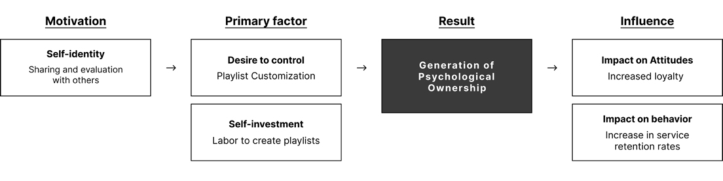
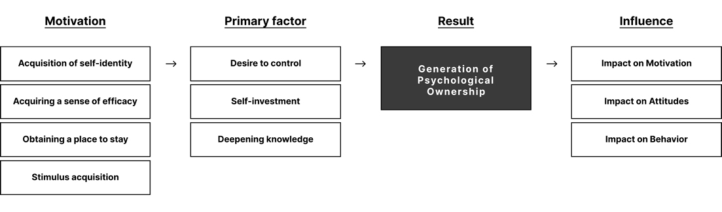
Figure 1: Adapted in part from psychological ownership theory (Jussila et al., 2015).Figure 2: Generation process of psychological ownership during playlist creation in streaming services.
Sinclair and Tinson (2017) suggests that to increase users’ sense of Psy- chological Ownership of music streaming services, it is important to increase their sense of control over the content they create in their streaming profiles, which can be shared among others. In his research on Music-Streaming Ser- vices, Iseki (2023) found that increasing the customizability of an application is important for increasing the desire for control, which is a factor in gener- ating a sense of Psychological Ownership. Existing streaming services share User-Generated Playlists (UGP) (Li et al., 2022). UGPs which are generated within a normative framework shared among users, are highly relevant for the recognition and expansion of C-to-C services (González-Rodríguez et al., 2021) and should be further promoted. However, research on the relationship between the degree of freedom of UI customization and Psychological Ownership when using services remains insufficient. Based on the above, this study examines how the degree of freedom to customize playlists in streaming services affects users’ sense of Psychological Ownership.
Psychological Ownership Theory and Conceptual Models Psychological Ownership (Jussila et al., 2015) theory presents a conceptual model that integrates the motivations and factors that cause Psychological Ownership, target attributes, moderating influences, and consequences of this psychological state (see Figure 1).
Effect of Freedom of Customization on Psychological Ownership 181
Motives that cause Psychological Ownership are divided into four main categories: “Acquiring a sense of efficacy,” “Acquisition of self-identity,” “Acquiring a place to stay,” and “Acquisition of stimuli,” while factors are divided into three categories: “Desire to control,” “Self-investment,” and “Deepening knowledge.” Generating normative frameworks such as playlists is important for acquiring self-identity (Lüders, Dinkelberg and Quayle 2022). In addition, users must invest in UI control and effort when cre- ating playlists. Based on the above, this study focused on “Acquisition of self-identity” as the motivation for Psychological Ownership, and “Desire to control”and “Self-investment”as the factors. Based on the conceptual model of Psychological Ownership, the process of generating a sense of Psycholog- ical Ownership during playlist creation in streaming services is illustrated in Figure 2.
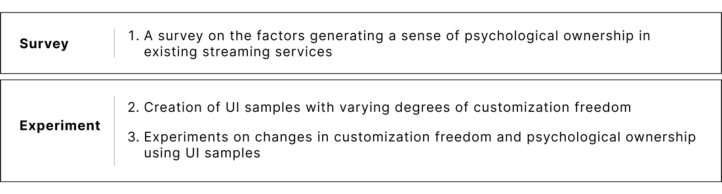
Figure 3: Research method.Table 1. List of extracted functions.
Table available in the original PDF paper.
List of Functions My Lists: Sort by My Lists: Change Thumbnail My Listings: Rename My Lists: Description My Lists: Share My Lists: Followers/Followers My Lists: Like Function My List: Co-Edit Content: Ranking Content: Recently Accessed Content: Highlight Access Content: Recommendations Content: Exclusives Content: Share Function Content: Like Function Profile: Icon Settings Profile: Description Profile: Name Function Profile: Viewing Time Record Profile: Notifications & Privacy Profile: Multiple Accounts Profile: Followers and Followers Profile: Access History Profile: Download Function
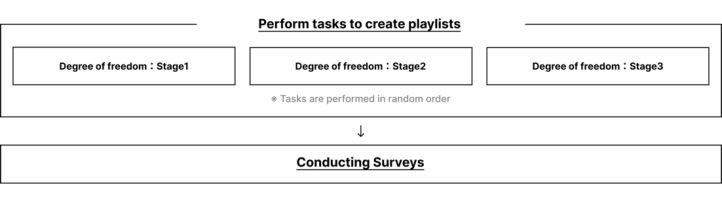
RESEARCH METHOD First, a survey was conducted on the factors that generate a sense of Psycho- logical Ownership in existing streaming services, followed by an experiment focusing on the relationship between the degree of freedom to customize playlists and the sense of Psychological Ownership. The main flow of the study is as follows (see Figure 3).
A Study on the Causes of Psychological Ownership in Streaming Services A survey of 33 people was conducted to identify the factors that cause users a sense of Psychological Ownership in the use of streaming services. The survey
182 Uwajima and Yang
identified 24 functions from five streaming services that use a subscription system (Amazon Music, Apple Music, Netflix, YouTube, and Spotify) and asked whether these functions were linked to the generation of a sense of Psychological Ownership (see Table 1).
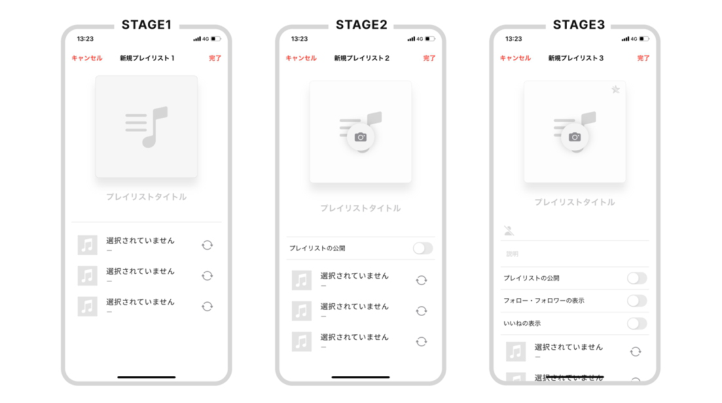
Figure 4: Three playlist creation UI samples with varying degrees of customization freedom.Figure 5: Detailed experimental procedures.
An Experiment on the Degree of Freedom of Customization and Psychological Ownership This experiment aimed to determine how the degree of freedom to customize playlists in streaming services affects users’ sense of Psychological Owner- ship. Using the seven features that affect Psychological Ownership obtained in the survey, we created three playlist creation UI samples (see Figure 4) with increasing and decreasing degrees of freedom of customization; the UI sam- ples were divided into three levels of freedom, with the first level consisting of two features, “song selection” and “title editing,” and the second level con- sisting of two features, “playlist sharing” and “ Edit Thumbnail” were added for four functions, and the third level consisted of seven functions, including
Effect of Freedom of Customization on Psychological Ownership 183
“Like,” “Follow/Follow”, and “Edit Description.” In addition, the sample was created using Xcode with a UI similar to that of Apple Music.Using these three UI samples, 20 subjects were given the task of creating a playlist, and questionnaires were administered to measure “sense of control,” “Psy- chological Ownership,” and “workload” after each task was completed (see Figure 5).
Table 2. Factor analysis results.
Table available in the original PDF paper.
Factor 1: Shared Functions Loadings Factor 2: Shared Functions Loadings My List : Like Function 0.849 My List : Thumbnail Editing 0.895 My List : Followers/followers 0.837 Profile : Icon Editing 0.678 Profile : Followers/followers 0.737 Profile : Name functions 0.585 Profile : Description 0.566 Content : Like Function 0.576 Content : Share function 0.475 My List : Name Editing 0.576 Profile : Name functions 0.422 Content : Evaluation Function 0.377 My List : Share function 0.355 My List : Share function 0.321 Profile : Description 0.318
The sense of control was measured by four items (Reinterpreted from Kwon, Kawamata and Suda, 2023 and Bagga, Bendle and Cotte, 2019) : “I was able to customize it as I wanted”, “I can customize it to my liking,” “I felt like I could customize it anytime I wanted,” and “I can customize it freely.”
Psychological Ownership was measured by four items (Reinterpreted from Shu and Peak, 2010) : “I feel like the playlist I created is truly mine,” “I feel like I own the playlist I created,” “I get a sense of making the playlist my own,” and “I feel like I am the personal owner of the playlist I created.”
Workload was measured from the NASA-TLX (Excerpted from Miyake, 1993) with four items : “How much psychological desire did it take to create the playlist?,” “How much time desire did it take to create the playlist?,” “How much stress did the creation cause?,” and “How would you rate the playlist you created?.”
Each measurement scale was answered using the 7-point Likert scale method. Finally, the subjects’ attributes and thoughts were investigated in an interview.
RESULTS AND DISCUSSION
Results of a Survey on the Generation of Psychological Ownership in Streaming Services A factor analysis was conducted on the survey results to clarify the patterns and interrelationships of the functions that affect the sense of Psychological Ownership. In the factor analysis, eight factors had eigenvalues exceeding 1.0. However, too many factors would make interpretation difficult and cre- ate the possibility of overfitting, so the number of factors with a minimum information criterion of three was adopted this time, referring to the value
184 Uwajima and Yang
of Akaike’s Information Criterion (AIC). In addition, because Psychologi- cal Ownership has psychological characteristics, and the factors are likely to interact with each other, an oblique rotation (Quartimin) was employed. Although the cumulative contribution rate of Factor 3 was low at 44%, we believe that this cumulative contribution rate is appropriate, considering that there are various factors that affect the sense of Psychological Ownership and that the streaming service itself, which was the subject of this study, may not evoke a sense of Psychological Ownership.
Figure 6: Average value of each item according to the level of customization freedomTable 3. Total contribution to function.
Table available in the original PDF paper.
Function Value Function Value Like Function 0.849 Share function 0.475 Description 0.837 Thumbnail Editing 0.422 followers/followers 0.737 Song Selection 0.355 Name functions 0.566
Factor 1 was mostly related to how others evaluated and viewed one’s account and MyList, while Factor 2 was mostly related to the customization and editing of MyList and the profile (see Table 2). Factor 3 did not show any trend in the functions listed. These results suggest that the sharing and edit- ing functions may generate a sense of Psychological Ownership of streaming services.
Next, we summarized similar functions among those listed in the sur- vey and applied the formula (factor 1 loadings × factor 1 contribution ratio) + (factor 2 loadings × factor 2 contribution ratio) + (factor 3 load- ings × factor 3 contribution ratio) to the summarized factors to calculate the values indicating their contribution to the overall variation. We identi- fied seven specific functions that could lead to the generation of a sense of Psychological Ownership (see Table 3).
Effect of Freedom of Customization on Psychological Ownership 185
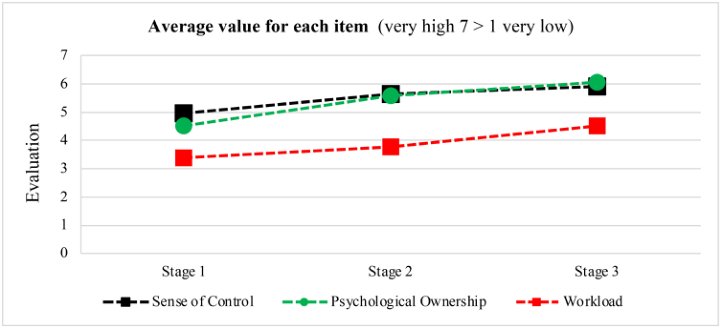
Results and Discussion on Freedom of Customization and Psychological Ownership We found that sense of control, Psychological Ownership, and workload increased with increasing degrees of customization freedom, indicating that increasing the degree of customization freedom in My List causes a sense of Psychological Ownership over the targeted service (see Figure 6). The results of the repeated two-way ANOVAs also showed significant differences between experiments. This indicates that there was a statistically significant change in the results from experiment to experiment. However, we found that user workload also increased when the degree of customization freedom increased. In particular, when customizing functions related to sharing with others, such as “Like” and “Follow/Follow,” the interview results revealed that the workload increases as users become aware of how they are viewed and considered by others.
Figure 7: Differences in sense of control based on presence or absence of shared desires.Figure 8: Differences in psychological ownership based on the presence or absence of a desire to share.
186 Uwajima and Yang
Figure 9: Difference in workload based on shared desires.
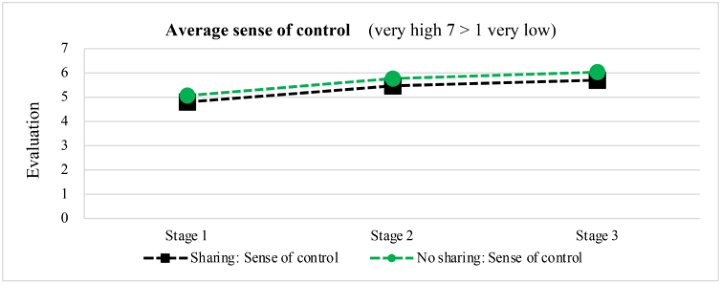
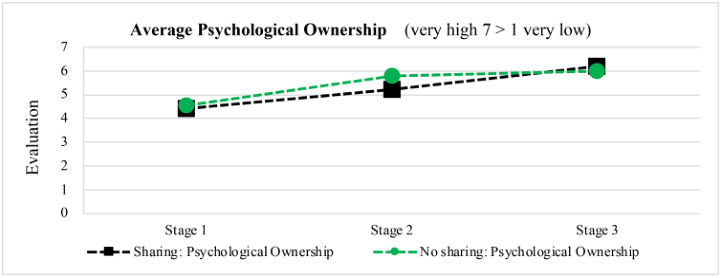
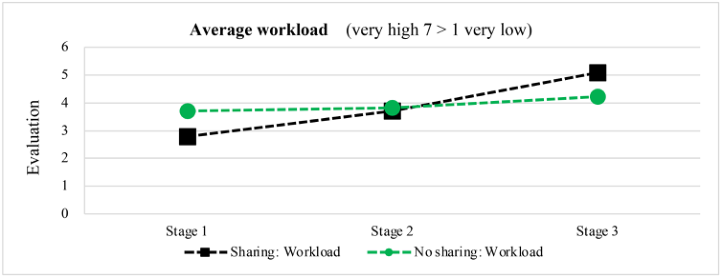
The respondents were divided into seven who desired to share playlists and 13 who did not. Figures 7–9 show the results for those who did and did not desire to share. The sense of control exhibited a similar increasing trend as the degree of freedom stage increased, regardless of whether the desire to share was present.
For Psychological Ownership and workload, the values were higher when there was no desire to share up to the second level of customization freedom; however, from the third level, the values were higher when there was a desire to share.
In the UI sample for the third level, sharing functions such as “Like” and “Follow/Follow” were added. These results suggest that people who desire to share are more likely to feel a sense of Psychological Ownership when they customize functions related to sharing. However, they are also more likely to increase their workload when they are aware of others. The results suggest that people without a desire to share do not customize sharing functions; therefore, the workload does not change much and sense of Psychologi- cal Ownership does not change much from the second to the third level of freedom to customize.
CONCLUSION
Through research and experimentation, it was found that increasing the degree of freedom to customize sharing and editing functions when designing UGPs, such as playlists and “My Lists” for streaming services, can increase users’ sense of control and Psychological Ownership. Based on the Psycho- logical Ownership theory, users can reflect on their playlists and gain a sense of identity through customization. This series of processes influences the generation of a sense of Psychological Ownership and motivation to create playlists. Because self-identity, which is a motivator, can also be acquired by sharing a normative framework such as a playlist with others, we believe that by distinguishing whether individuals have a desire to share and design the content of customization accordingly, we can expect more efficient motiva- tion for a sense of Psychological Ownership. On the other hand, an increase
Effect of Freedom of Customization on Psychological Ownership 187
in the degree of freedom of customization also leads to an increase in work- load, which may not lead to the creation of a My List itself and may not generate a sense of Psychological Ownership itself; therefore, careful design is necessary.
REFERENCES
Atasoy, O., Morewedge, C. K. (2017)”Digital Goods Are Valued Less Than Physical Goods”, Journal of Consumer Research Volume 44, Issue 6. Bagga, C. K., Bendle, N., Cotte, J. (2019)” Object valuation and non-ownership
possession: how renting and borrowing impact willingness-to-pay”, Journal of the Academy of Marketing Science Volume 47, pp. 97–117. Frinze, M. P., Marchand, A., Eisingerich, A. B., Benkenstein, M. (2020)”Access- Based Services as Substitutes for Material Possessions: The Role of Psychological Ownership”, Journal of Service Research Volume 23, Issue 3. González-Rodríguez, R. M., Díaz-Fernández, C. M., Bilgihan, A., Shi, F., Okumus,
F. (2021)” UGC involvement, motivation and personality: Comparison between China and Spain”, Journal of Destination Marketing & Management Volume 19. Iseki, S. (2023)”Desire for Control as an Underlying Motive of Psychological Ownership for. Music Streaming Services: Moderation Effect of Usage Frequency”, Japan Marketing Journal Volume 43, No. 1. Jussila, I., Tarkiainen, A., Sarstedt, M., Hair, J. F. (2015)” Individual Psychological
Ownership: Concepts, Evidence, and Implications for Research in Marketing”, Journal of Marketing Theory and Practice Volume 23, Issue 2. Kwon, S., Kawamata, H., Suda, T. (2023)” Effects of Screen Contact with Digital Media on Perceived Control and Psychological Ownership”, Japan Marketing Journal Vol. 42, No. 3. Li, Z., Song, M., Duan, S., Wang, Z. (2022)” Are users attracted by playlist titles and
covers? Understanding playlist selection behavior on a music streaming platform”, Journal of Innovation & Knowledge Volume 7, Issue 3. Lüders, A., Dinkelberg, A., Quayle, M. (2022)” Becoming “us” in digital spaces: How online users creatively and strategically exploit social media affordances to build up social identity”, Acta Psychologica Volume 228. Miyake, S., Kumashiro, M. (1993)”Subjective mental workload assessment technique-An introduction to NASATLX and SWAT and a proposal of simple scoring methods-”, Human Engineering Volume 29, No. 6. Morewedge, C. K., Monga, A., Palmatier, R. W., Shu, S. B., Small, D. A. (2021)”
Evolution of Consumption: A Psychological Ownership Framework”, Journal of Marketing Volume 85, Issue 1. Nakagawa, S. (2021)” The effects of perceived variety of video contents on consumers’ loyalty toward subscription-based video streaming service”, Japan Society of Marketing and Distribution Review Volume 5, No. 2. Pierce, J. L., Kostova, T., Dirks, K., Olin, J. M. (2002)”The State of Psychological
Ownership: Integrating and Extending a Century of Research”, Review of General Psychology Volume 7, No. 1. Shu, S. B., Peak, J. (2010)” Psychological Ownership and affective reaction: Emotional attachment process variables and the endowment effect”, Journal of Consumer Psychology Volume 21, pp. 439–452. Sinclair, G., Tinson, J. (2017)” Psychological Ownership and music streaming
consumption”, Journal of Business Research Volume 71, pp. 1–9.
LISTED IN THE AHFE DIGITAL BOOKSTORE CATALOGUE
Explore the complete digital volume
Interdisciplinary Practice in Industrial Design
Read this individual research paper free through the original publisher, or explore the full digital proceedings book.
ISBN 978-1-964867-20-5
Explore this ISBN in the AHFE Bookstore ↗Listed in the July 2026 bookstore catalogue; search by ISBN to confirm current availability · Digital book purchase optional