Yugo Furuhashi, Wonseok Yang (2024). Unraveling Factors of Decision Fatigue in Customization Services. In: Interdisciplinary Practice in Industrial Design. AHFE Open Access, vol. 144, pp. 168–178. https://doi.org/10.54941/ahfe1005129
In the context of product purchases, Customization Services refer to the ability of customers to modify specifications, such as appearance, performance, and configuration, according to their preferences and needs. The commerce sector has also undergone digitalization with the use of tools such as 3D models on websites and apps. This trend extends across various fields, from everyday items to the automotive industry, where Customization Services are gaining considerable attention. A distinctive feature of Customization Services is the capability of users to create a product tailored to their preferences using an extensive array of options. However, a multitude of choices can be a source of stress owing to information overload, leading to indecision during services usage. Therefore, this research aims to investigate whether the way information is presented to users during the customization process influences smooth decision-making and consequently affects Purchase Intention. Initially interviews were conducted to identify factors hindering user choices in the product creation process. These findings suggest that the current User Interface (UI) might contribute to user indecision by presenting only information about the product being created, without facilitating comparisons. Additionally, specific elements that users wished to present during the product creation process were identified. Subsequently, UI samples were created based on the obtained elements and measurements of Decision Fatigue and Purchase Intention were conducted. These results confirmed that providing users with information that enables product comparisons can alleviate decision-making obstacles. Furthermore, Individual Differences in personal experiences and interests related to sneaker purchases were closely associated with the effectiveness of information presentation. This research contributes as a pioneering research endeavour to the increasing landscape of product Customization Services. It aims to help users efficiently discover and make decisions regarding their preferences for more user-friendly services.
The digitalization of the commercial sector has further accelerated online sales by allowing customers to search for and purchase information from a variety of devices and media (Sometani et al., 2007). As consumers need to focus not only on appearance and functionality, but also on experience, Customization services that allow customers to create product according to their preferences from household goods to expensive items such as cars and
Unraveling Factors of Decision Fatigue in Customization Services 169
houses are becoming more widespread (Akai, 2021), (Shuai et al., 2023). Traditionally, customers would customize product in stores through conver- sations with salespeople, who would provide information about the product, while holding actual samples in their hands (Kikuchi et al., 2020). There- fore, the relationship between trust created through dialogue and the intuitive understanding gained from seeing and touching the actual product had a significant impact on the willingness to purchase and satisfaction with the product (Raymond, 2002). Today, however, with the availability of 3D and other tools on websites and apps, online sales have become commonplace, allowing consumers to customize product according to their own tastes and preferences from a vast selection of choices unrestricted by time or location (Jianxin et al., 2006). For example, the Nike By You website allows users to choose from around 10–20 colors for 12 different parts (Akitagawa et al., 2019). Thus, users can create more than 10 billion patterns. However, an overabundance of choices is a source of stress, and consumers can get lost in their choices (Cynthia et al., 1998). In addition, the difficulty of face-to-face interaction and seeing product in person has reduced opportunities to engage directly with product and salespeople. This has led to Decision Fatigue, as they feel handicapped in their decision-making process with respect to the overabundance of choices in online Customization Services. Consequently, consumers’ desire to create their own ideal product and difficulty in mak- ing the best decision due to repetitive decision-making may cause Fear of Better Options (FOBO) and decrease their willingness to purchase (Rohmad et al., 2023). Therefore, in this research, we focus on sneakers, clothes, and sunglasses, which are the most informative product in the customization pro- cess, to investigate the point at which Customization Services users become confused about their choices. We then clarified whether the method of pre- senting information to users in the process of using a Customization Services can be a factor in eliminating Decision Fatigue.
Decision Fatigue From an Excess of Choices Decision fatigue is a psychological state in which a person’s judgment decreases and they feel fatigued because of continuous decision-making (Grant et al., 2018). Although there is extensive research in the medical field on this topic, today’s world, where all types of information are easily accessible, has also expanded into the fields of psychology and behavioural economics (Emily et al., 2022). In decision-making with excessive choices, individuals are prone to experiencing “ego depletion”and “choice overload,” which can result in information processing overload, leading to a decrease in quality of decision-making and an increased likelihood of making incorrect judgments (Hyunjin et al., 2013). This also creates the problem of decision procrastination. Additionally, owing to the limitations of human decision making, it is necessary to understand Decision Fatigue when designing ser- vices and creating designs that do not induce decision-making hesitation (Mumtaz et al., 2023).
When comparing the attention-interest-search-comparison-examination- action-share (AISCEAS) purchasing model with Customization Services, it
170 Furuhashi and Yang
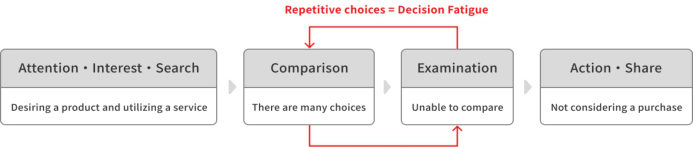
is believed that Decision Fatigue occurs during the comparison and exami- nation phases because of the cognitive overload caused by processing infor- mation related to users’ perceived information to create a customize product according to their preferences (Lee et al., 2017), (Figure 1). Specifically, exces- sive color options for each part lead to decision-making hesitation, as users are unable to process the information. Moreover, users can only create prod- uct based on their intuition because they are unable to compare the selected colors with other images. To make an optimal choice, users are required to repeatedly compare and consider options; this repetitive process signifi- cantly increases the time and energy required to make a decision, resulting in Decision Fatigue (Grant et al., 2018).
Figure 1: Pain points for users of customization services.
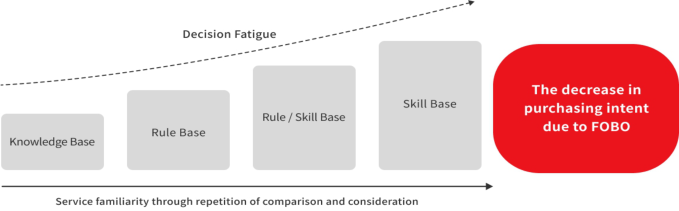
Decrease in Purchasing Motivation Due to Repetitive Decision-Making The Skill-Knowledge-Rule (SKR) model by Rasmussen was utilized to investi- gate the factors that lead to a decrease in Purchasing Intention due to Decision Fatigue regarding Customization Services. The SKR model classifies human behavior into skill-, rule-, and knowledge-based categories (Komatsubara, 1999). As mentioned earlier, Decision Fatigue occurs in Customization Ser- vices because of the repetitive comparisons and examination of each option. This repetitive operation leads to user familiarity with the Customization Ser- vices, increasing the likelihood of rule-based and skill-based behaviors, and leading to incorrect judgments. To avoid making incorrect judgments, users repeat the operation multiple times, leading to a psychological state similar to that of FOBO (Hyunjin et al., 2013), (Figure 2). This state decreases the quality of consumer decision-making and is considered one of the reasons for not making a purchase.
Figure 2: The decrease in purchasing intent due to FOBO.
Unraveling Factors of Decision Fatigue in Customization Services 171
Therefore, a widely adopted method for eliminating user confusion in UI is to reduce the number of options available. However, Customization Services have the advantage of being able to create product according to customer preferences and images from a large number of choices (Sheena, 2001). Reducing the number of choices leads to a reduction in the advan- tages of the services. Therefore, in this research, in the process of creating a product, information about the entire product is presented in such a way that the user can narrow down choices when selecting parts, so that the user can create the finished product more smoothly (Sheena, et al., 2010). We believe that this approach will reduce the factors that make it easier for users to make a choice, thereby reducing the number of decisions they must make and increasing their feelings toward purchasing a product.
RESEARCH METHOD This research aims to elucidate how presenting information during the user’s utilization of Customization Services influences smooth decision-making. Therefore, the research progressed through the following steps (Figure 3).
Figure 3: Research method.
Figure available in the original PDF paper.
1) Hearing about representative Customization Services for household items.
In order to find out in what situations users feel obstacles in making choices in the process of creating customized product from the information pre- sented to them, we selected one representative Customization Services for each product (sneakers, clothes, and sunglasses), in which many parts that can be changed were found in particular, and hearing five subjects.
Customization Services for Clothing and Sunglasses It was found that since there are many parts of clothing and sunglasses that can be changed, such as embroidery and logos, each of these prod- uct is made with the user’s preferred image in mind. Therefore, users are likely to make a decision on the information presented to them without hesitation in their choice.
Sneaker Customization Services Since sneakers have many parts that can be changed and the entire sneaker needs to be imagined around the color combination, we believe that Decision Fatigue occurs with respect to the repeated act of color selection. As a result, we believe that a lack of confidence in the finished product is one factor that reduces the willingness to purchase. Therefore, we focused on sneaker customization services and conducted a prelimi- nary survey to determine what kind of information would enable users to smoothly complete the product without hesitation in their choices.
172 Furuhashi and Yang
2) Interviewing about Customization Services for sneakers As a preliminary research, 20 participants were interviewed to explore the impact of different information presentation methods on decision hesitation. In the interviews, participants were asked to use a sneaker Customization Services and observed their decision-making process leading up to the pur- chase. A thought-speech method was employed during the operation, and a semi-structured interview was conducted after the operation to understand the causes of decision hesitation due to the information presentation method. As a result, we found that the current information presentation only presents information about product in the process of making product, and users can only make choices based on their own senses, which makes them feel uneasy and makes decision-making difficult. Therefore, by providing information that allows users to compare and contrast product, decision-making in the product-making process can be facilitated. We also believe that personal fac- tors such as past sneaker purchase experience and level of interest may also make a difference in the product creation process.
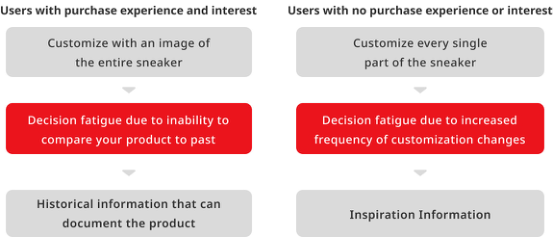
Differences in the way Individuals Create Product Based on the perception that the ability to create product varies depending on the users’ previous experiences and interest in purchasing Nike sneak- ers, this research focused on these Individual Differences. Specifically, users with purchasing experience can imagine the overall completed product in their minds and customize it autonomously. However, when creating prod- uct, they repeatedly compare their “previously created completed product” with the “current state” in their minds (Figure 4). Therefore, they may have difficulty selecting the best product for themselves, leading to obstacles in decision-making. Therefore, providing information about the history of cus- tomize product to users with purchasing experience and interest facilitates smooth decision-making. However, users with less purchasing experience tend to approach their desired image intuitively while performing operations. Therefore, the trial and error process of trying various colors may increase the number of selections and decrease the quality of decision making, mak- ing it difficult to make judgments. Therefore, it is believed that providing inspirational information that allows users to recall the entire product will facilitate smooth decision-making without requiring purchasing experience and interest.
Figure 4: Differences in the process of creating product due to individual differences.
Unraveling Factors of Decision Fatigue in Customization Services 173
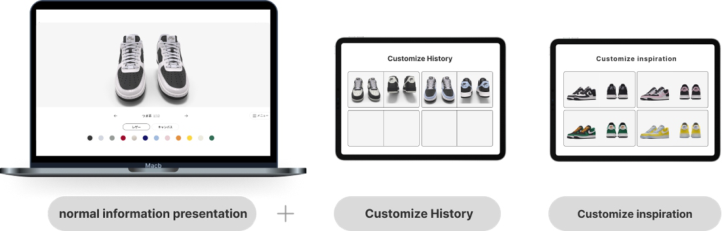
3) Sample and questionnaire reparation To explore whether information presentation in the process of product creation obtained from interviews mitigates selection hesitation, we created three information presentation samples: “normal information presentation,” “information presentation with history,” and “information presentation with inspiration,” and developed a questionnaire on Decision Fatigue and Purchase Intention based on previous research (Figure 5).
Figure 5: Experimental sample preparation.
Decision Fatigue Scale(DFS) The DFS was used in this research with some modifications from pre- vious research. The DFS is a 10-item rating instrument that focuses on decision-making difficulty and was considered the best validated scale to evaluate the current experiment (Emily et al., 2022), (Gabriela et al., 2023). The items are scored on an overall 5-point Likert scale, with higher values indicating more Decision Fatigue.
Purchase Intention (PI) We used a partial selection from several prior validated PI studies (Yuniaristanto et al., 2024), (Peng et al., 2023). The four-item rating instrument, the items of the PI for a product focus on the consumer’s inter- est in the product. The items were rated on a 5-point Likert scale similar to the DFS.
4) Experiments on information presentation methods and Decision Fatigue Questionnaire evaluations and hearings were conducted with 30 partic- ipants in order to determine whether presenting information that allows comparison of product is related to Decision Fatigue. In addition, they were asked to manipulate each sample of product to completion as a task to test whether there were differences in factors that lead to the elimination of Decision Fatigue.
RESEARCH RESULT AND CONSIDERATION From this point on, through the analysis of experimental results and inter- views, we will examine whether the presentation of comparable product information is related to decision-making difficulties and willingness to purchase during the creation process.
174 Furuhashi and Yang
Table 1. Average DFS score and operation time per sample.
Table available in the original PDF paper.
Sample DFS Score Operation Time Normal information presentation 31.30 3min 4sec With customize inspiration 25.07 2min 40sec With customize History 24.07 2min 25sec
1) Impact of information that allows comparison of product on Decision Fatigue and operation time.
First, to verify whether providing comparable information alleviates decision-making hesitation in the process of creating product, the average composite scores of the DFS were compared for three samples. The results suggest that decision-making is easier when information is provided com- pared to ordinary information presentation. The average operation time also indicates that users can create their preferred completed product in a shorter time when information is provided (Table 1). Thus, providing information for comparison allows users to perform operations without experiencing decision-making obstacles.
Table 2. Relationship of decision fatigue factors to the availability of information.
Table available in the original PDF paper.
Item Significant Difference I can’t make a decision because I am to tired and stress. n.s. Making decision is difficult because I can’t concentrate. n.s. It is hard for me to take information and use it to make decision. p<0.05 I don’t have enough confidence in myself to make a good decision. p<0.01 It take to much efforts to make decision. n.s. I have to make a lot of decisions and it gets more and more tedious. p<0.01 I have made decision quickly in order to move on. n.s. I can’t make up my mind about which option is best. p<0.05 I have made decision without carefully thinking about them. n.s. My mood has made it difficult for me to make decision. p<0.05
2) The relationship between the availability of information with which product can be compared and Decision Fatigue factors.
Next, bivariate analysis was performed on the questionnaire items to see what factors on the DFS were affected by the availability of information comparing product (Table 2).
Significant differences were found with a p-value of 0.01 for the items “I don’t have enough confidence in myself to make a good decision.”and “I have to make a lot of decisions and it gets more and more tedious”. Considering the results of the interviews, it was found that providing information such as inspiration or history allows users to narrow down the direction of their ideas and reduces decision-making hesitation. Consequently, users gain confidence and achieve higher-quality decision-making.
Unraveling Factors of Decision Fatigue in Customization Services 175
Significant differences were also found with a p-value of 0.05 for the items “It is hard for me to take information and use it to make decision.” and “I can’t make up my mind about which option is best.” and “My mood has made it difficult for me to make decision.”. Considering the results of the interviews, we found that receiving information for comparison in the process of creating product allowed users to make color selections from an objective perspective, resulting in highly satisfactory completed product.
We believe that the presentation of information is one of the most effective means of presenting these five factors for Customization Services, which have many options, because it can eliminate the causes of confusion in making a choice.
Table 3. Relationship between availability of information and factors of PI.
Table available in the original PDF paper.
Item Significant Difference
n.s.
I intend to buy product in the near future. n.s. Intend to use product regularly. n.s. Will make an effort to use the product. n.s. I intend to purchase this product at an online store when the opportunity arises.
3) Impact on PI through smooth decision making.
Next, based on the suggestion that decision-making hesitation is alleviated by the presence of information when comparing product, a bivariate analysis was conducted on the factors of the PI. The results confirmed that simply providing information did not improve PI(Table 3). Considering the results of the interviews, it was found that providing information about history helps users remember their preferred images, and that providing inspiration allows them to generate new ideas, thereby resolving decision-making hesitation. However, PI is influenced by factors such as financial issues and the level of interest in Nike sneakers; therefore, further examination of this experiment is necessary.
Table 4. Relationship between individual differences and decision fatigue due to the way information is presented.
Table available in the original PDF paper.
Item Significant Difference
p<0.01
I can’t make a decision because I am to tired and stress. p<0.05 Making decision is difficult because I can’t concentrate. p<0.05 It take to much efforts to make decision. p<0.05 I have to make a lot of decisions and it gets more and more tedious.
I have made decision quickly in order to move on. p<0.05
4) Relationship between Individual Differences and Decision Fatigue due to the way information is presented.
176 Furuhashi and Yang
Bivariate analysis was conducted on Individual Differences and question- naire items to clarify how experience and interest in purchasing sneakers affect the ease of decision-making. The results show little relationship between individual differences and ease of decision with respect to inspira- tion (Table 4). Inspirational information is often used to recall ideas early in the product creation process. We also believe that presenting personal- ized information can facilitate smooth decision-making because inspiration information is rarely used when it is not the user’s preference. Next, we found significant differences in the method of presentation in which his- torical information remained, depending on Individual Differences, and confirmed that this was related to the relaxation of decision-making. When considering the results of the interviews, compared to inspiration, the infor- mation in the history is a finished product of the user’s past preferences, which can be compared and modified, making it easier to approach an ideal image. We believe that this reduces the number of choices and quality of the decision-making process, thereby alleviating users’ hesitation to make a choice.
CONCLUSION
In this research, the purchasing model led us to believe that repetition of comparison and consideration phases in creating product with Customiza- tion Services causes Decision Fatigue. In addition, using the SKR model, we considered that users become accustomed to Customization Services through repetitive operations and fall into a psychological state, such as FOBO, which is the cause of their inability to engage in PI. This research suggests that, in the product creation process, the presentation of information that can be compared with the product contributes to smooth decision-making. Methods that alleviate selection confusion by reducing the number of options result in reduced benefits for Customization Services. Therefore, we believe that it is effective to present auxiliary information to narrow down choices, and that it is necessary to provide information that enables users to smoothly select product. The results also suggest that individual user differences have differ- ent effects on decision relaxation. Because the process of creating a product may differ depending on the level of purchase experience and interest, we believe that it is necessary to present information tailored to the different needs of users. Based on these findings, we believe that information that allows users to compare product in a Customization Services can tailor prod- uct with a higher quality of decision-making by eliminating hesitation while choosing. However, regarding the increase in purchase motivation, we believe that user motivations, such as financial issues and interest in Nike sneakers, are closely related; therefore, the experiment needs to be re-examined. In the future, we believe that it is important to improve the method of pre- senting information to further increase the willingness to purchase through Customization Services and to consider effective information presentation in consideration of personalization and usability according to the Individual Differences of users.
Unraveling Factors of Decision Fatigue in Customization Services 177
REFERENCES
Akai, Y. (2021). “Applications Recent Trends and Applications of the business model for the User Experience”, Shonan Institute of Technology Bulletin, Volume 55, Issue 1, pp. 49–56. Akitagawa, S., Watanabe, S. (2019). “Research on interfaces for customizing
products”, Japanese Society For The Science of Design, Volume 66, pp. 418–419. Cynthia, H., Barbara, E, K. (1998). “Variety for sale: Mass customization or mass confusion?”, Journal of Retailing, Volume 74, Issue 4, pp. 491–513. Emily, T., Julia, O., Noa, K. and Ronald, L, H, Jr. (2022). “Decision fatigue among
clinical nurses during the COVID-19 pandemic”, Journal of Clinical Nursing, Volume 31, Issue 7, pp. 869–877. Gabriela, F, M., Joan, U., Veronica, A., Efrain N., Natalia, M., Santiago, A. and William, J, L. (2023), “Compassion and decision fatigue among healthcare work- ers during COVID-19 pandemic in a Colombian sample”, PLOS ONE, Volume 18, Issue 3. Grant, A, P., Richard, J, M., and Ronald, L, H. (2018). “Decision fatigue: A concep-
tual analysis”, Journal of Health Psychology, Volume 25, Issue 1, pp. 123–135. Hyunjin, K., Shyam, S. (2013). “Depleted egos and affirmed selves: The two faces of customization”, Computers in Human Behavior, Volume 29, Issue 6, pp. 2273–2280. Jianxin, J., Martin, G H. (2006), “Development of an electronic configure-to-
order platform for customized product development”, Computer in Industry, Volume 57, Issue 3, pp. 231–244. Kikuchi, S. (2020). “A Study on a Process Design of Customizable Products Dealing with Personal Preferences”, Doctoral dissertation, Graduate School of Technology Management, Ritsumeikan University. Komatsubara, A. (1999). “Preventing Human Error in Experienced Workers from
Cognitive Ergonomics”, Journal of Japan Society for Safety Engineering, Vol- ume 38, Issue 6, pp. 352–358. Lee, J., Chung, J. (2017), “A Study on User Experience Design Process of O2O Shoppin”, Advance Science Letters, Volume 23, Issue 4, pp. 9461–9464. Mumtaz, K., Shah, K. (2023). “Towards the design of personalized adaptive user
interfaces for smart TV viewers”, Journal of King Saud University - Computer and Information Sciences, Volume 35, Issue 9, 101777. Peng, Z., Chun, M., Ziwei, W. and Xiaotong, L. (2023). “Informational cascade, regulatory focus and purchase intention in online flash shopping”, Electronic Commerce Research and Applications, Volume 62, 101343. Raymond, R, B. (2002). “Technology and the customer interface: What consumers
want in the physical and virtual store”, Journal of the Academy of Marketing Science, Volume 30, pp. 411–432. Rohmad, F, A., Herwin, A., Chitra, L, R. (2023). “Understanding Gen Z Investiment Decisions: Capital Market Literacy And Emotional Biases”, Jurnal Manajemen dan Kewirausahaan, Volume 25, Issue 2, pp. 105–119. Sheena, S, I., Mark, L. (2001). “When choice is demotivating : Can one desire too
much of a good thing? “, Journal of Personality and Social Psychology, Volume 79, Issue 6, pp. 995–1006. Sheena, S, I., Sakurai, Y. (2010), The Art of Choosing, Bungeishunju Ltd, Tokyo, pp. 236–261 Shuai, W., Shuang, M. (2023). “Is product customization always beneficial in
the context of C2M platforms? A signaling theory perspective”, Technological Forecasting and Social Change, Volume 197, 122877.
178 Furuhashi and Yang
Sometani, K., Ootsuka, T., Mitsutomo H. (2007). “Impact of E-CommerceDiffusion on Consumer Purchasing Behavior”, Studies in Regional Science, Volume 37, Issue 4, pp. 1157–1172. Yuniaristanto., Wahyudi, S., Muhammad, H. and Hendro, W. (2024), “Exploring the
determinants of intention to purchase electric Motorcycles: The role of national culture in the UTAUT. Transportation Research Part F: Traffic Psychology and Behaviour, Volume 100, pp. 475–492.
LISTED IN THE AHFE DIGITAL BOOKSTORE CATALOGUE
Explore the complete digital volume
Interdisciplinary Practice in Industrial Design
Read this individual research paper free through the original publisher, or explore the full digital proceedings book.
ISBN 978-1-964867-20-5
Explore this ISBN in the AHFE Bookstore ↗Listed in the July 2026 bookstore catalogue; search by ISBN to confirm current availability · Digital book purchase optional