Erhan Efe, Hamide Yavuz, Moses Effinger, Pia Freitag, Nick Tugarin, Christian Van Husen (2024). VR-based, Collaborative and Hybrid Service Prototyping. In: The Human Side of Service Engineering. AHFE Open Access, vol. 143, pp. 243–253. https://doi.org/10.54941/ahfe1005104
Problem definition: Due to increasing globalization, there is a growing demand to be able to collaborate in distributed teams. The use of virtual reality can create new opportunities for both collaboration and creativity. As of today, there is still no established solution for hybrid collaboration (in-person and remote) for creative service prototyping. Methodology: In order to create a solution for this problem, first a suitable service prototyping method is researched. Afterward, a virtual reality environment is created in which the suitable service prototyping method is to be applied. This environment needs to be able to fulfill the requirements of enabling a creative and hybrid collaboration. In addition, an agile development process is utilized to obtain early feedback and to identify potential for improvement. To ensure this, several trials with test participants are carried out at regular intervals. Results: As a result of the research, LEGO® Serious Play® emerged as the most promising service prototyping method. The outcome of the project shows that it is feasible to conduct the service prototyping method LEGO® Serious Play® in a virtual reality environment. The integrated features of the VR application meet the requirements of creative and hybrid collaboration.
At a time when digital transformation is advancing rapidly and immersive technologies are increasingly entering various areas of businesses, the integra- tion of virtual reality into the creative service prototyping method is gaining importance. Service prototyping, as a critical step in the service and ser- vice experience development process, is becoming increasingly important in today’s business world (Boletsis, 2018).
Service prototyping is an iterative and creative development practice that allows service ideas, concepts, and processes to be visualized, tested, and improved before they are fully implemented. This process enables organi- zations to better understand customer needs, identify potential weaknesses early, and develop innovative solutions that ensure a differentiated and high-quality service experience (Blomkvist and Holmlid, 2010).
exploring opportunities that not only enhance the creativity of the prototyp- ing process but also find new ways to collaborate from different locations in a digitally driven and increasingly connected world.
Virtual reality allows users to immerse themselves and interact with computer-generated virtual worlds (Gandhi and Patel, 2018). With the help of virtual reality (VR) headsets and associated hardware, users can have a realistic experience. Integrating VR into service prototyping methods enables innovative design, testing, and optimization of experiences, leading to deeper user interaction and engagement (Abdel-Razek, 2021).
Hybrid collaboration enables teams to work together both on-site and through digital platforms. It combines the efficiency of face-to-face interac- tions with the flexibility and scalability of digital tools. In the area of service prototyping, hybrid collaboration can open up new opportunities to help teams develop and optimize services (Gengnagel et al., 2016).
LITERATURE REVIEW
This chapter shows with relevant literature the demand for this research topic. The following subsections discuss key elements of this research. The subsequent paragraph elaborates on the concept of Service Prototyping.
Lim et al. points out that creating a prototype for a physical product (e.g., a car or LEGO® set) is a common and necessary step in product development (Lim et al., 2008). The prototype allows customers to gain an impression of the product under development. Developing a prototype for a service, on the other hand, is a more challenging task, due to the fact that services are intan- gible prior to the experience of the actual service. Leimeister emphasizes that this is where service prototyping is utilized, which aims to provide experi- ence and tangible ideas of the service to stakeholders (Leimeister, 2012). The role of prototyping in service contexts is crucial, yet it is not commonly used (Blomkvist and Holmlid, 2010).
Abdel Razek et al. show that new trends are shaping the direction of modern services, including digitalization, globalization, connectedness, and customer-tailored solutions. This creates a demand for “complex services” - services that incorporate offerings from multiple parties (Abdel Razek et al., 2020a). The objective is to provide an overview of the final product while utilizing diverse prototyping techniques and methods in the field of Service Engineer- ing. A plethora of tools, techniques, and processes for service prototyping execution are available in a toolbox presented by Abdel Razek et al., ranging from virtual simulation to service blueprinting (Abdel Razek et al., 2020b). Lim et al. state that the use of these techniques results in prototypes that can be used to generate and refine ideas (Lim et al., 2008).
This section of the literature review will focus on the use of VR applications in work meetings and in the area of service prototyping.
The gaming industry of augmented reality is implemented for everyday use situations and is further developed in the context of work and research. In the industry, it is used to represent complex visualizations and engineering fields in a simplified understandable way (Knoll and Stieglitz, 2022).
Digital platforms on which collaboration and learning are possible are becoming more important. Users are able to perceive other participants better,
VR-Based, Collaborative and Hybrid Service Prototyping 245
likewise making experience in real time plays a decisive role. This stimu- lates open communication and working together more effectively (Breyer- Mayländer et al., 2022). In the context of learning, 3D-models have become particularly popular (Monohan et al., 2023). The use of interactive 3D- models also promotes the understanding and motivation of users, thus enabling collaborative learning (Monohan et al., 2023).
As the Corona pandemic has brought a lot of change and situational adap- tation in these areas, the positive effects mentioned above through the use of VR are also finding application in the business context. As per the report of Amir H Sadeghi et. al, VR has been successfully used in the medical sector for meetings and discussions (Sadeghi et al., 2021). In the beginning, it was used for learning procedures. By using VR and head-mounted displays (HMDs), a realistic televirtuality can be created and digital tools can be used. From the preceding proof-of-concept study, initial findings on the use of such a platform are made; the user experiences are largely considered positive, espe- cially the participation in the sessions (Sadeghi et al., 2021). Likewise is the feeling of active participation without further distractions, since everything takes place in a virtual room and no factors from the outside influence the user. Other points listed were the ease of use and user-friendliness of the VR devices (Monohan et al., 2023).
These positive effects are also used in the industry to make complex CAD- models in the engineering field more tangible and thus more understandable in a VR room which you can enter as an avatar. The possibility of remote col- laboration is created, costs are saved and it is a sustainable way of working, especially for people working remotely (Hofeditz et al., 2022).
In addition to the meeting and business applications in VR environments described above, virtual reality is already being used in many different areas to support creativity: art and design, architecture and construction, educa- tion and training, research and development, marketing and advertising, etc. Generally speaking, the virtual world can be used to make models, designs, and experiments immediately tangible and to visualize them in a variety of ways (Hu et al., 2016).
The influence of the use of VR on creativity has already been investigated several times on the basis of various case studies. Yu-shan Chang et al. used a before-and-after experiment with 180 students to examine performance in the areas of creative design and design thinking processes. Virtual reality was found to have a positive influence on the creative design process, a moderate influence on design quality, and no influence on the data collection phase (Chang et al., 2022).
In an experiment with 42 design students, Obeid & Demirkan examined the influence on creativity in immersive and non-immersive virtual design environments. The factors flow state and motivation were considered. The results show that creativity in the design process is more positively influenced in the immersive virtual environment than in the non-immersive environ- ment. In addition, a strong correlation was found between flow state and motivation (Obeid and Demirkan, 2023).
Overall, VR applications offer a promising approach to creativity enhancement and motivation. Nevertheless, the application areas have to be
considered specifically, as in many cases the addition of a creativity method within the VR application may be necessary.
Concrete use cases were also investigated by means of experiments and projects. Graessler et al. focused on evaluating and testing an already devel- oped VR-supported creativity technique “Sensory Stimulus Environment Technique” in a product development project. For this purpose, the test participants went through a predefined process to create a virtual creative environment at the beginning (according to special design guidelines) and then to develop, visualize, and validate new ideas within this environment with the help of creativity methods. The results have shown that the inte- gration of appropriate functions in a VR tool and the application of support measures such as design guidelines are indispensable. Generating ideas in a collaborative virtual environment can help reduce costs and stress for employees and companies (Graessler and Taplick, 2019).
Another use case in the area of product development was investigated by Jannis Vogel et al. on the topic of prototyping in a VR application in design thinking processes. An environment is created in VR in which test persons can collaboratively develop and visualize a prototype within design thinking pro- cesses and present it within the group by means of storytelling. Although the VR application can only be used as a single player so far, it shows promising possibilities in the area of design thinking to support the innovation process and reduce costs (Vogel et al., 2022).
These use cases show that in the field of research and development, there is great potential for VR applications in combination with creativity meth- ods. The advantages are cost reduction, collaboration of globally distributed teams, and extended visualization possibilities in the area of prototyping.
METHODOLOGY
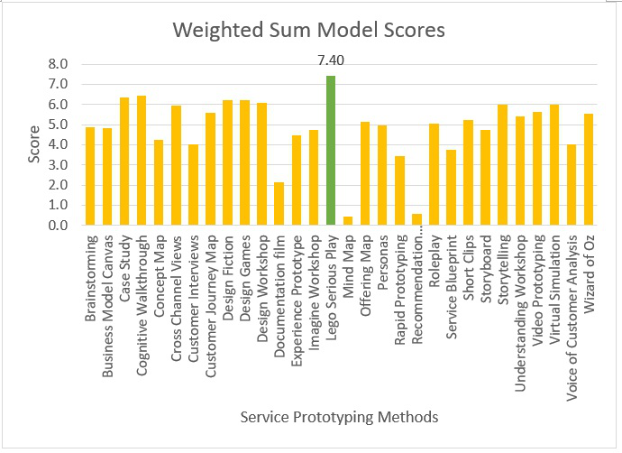
As previously stated, the project’s goal was to conceptualize a hybrid ser- vice prototyping method utilizing VR and hybrid collaboration. To create a feasible solution for the project, a range of service prototyping methods were assessed using a weighted sum model. The method should be able to be used for global collaboration, so virtual interaction must be possible. Ide- ally the participants work on a joint solution. In addition, a hybrid method is required, as both home office and office work are integrated in today’s work- ing world. It should offer sufficient time to work on complex problems and be professionally moderated to ensure fair discussions and promote efficient work. These requirements result in the considered attributes like interactivity, virtuality, complexity, time intensity, the ability to work hybrid and capa- bility to moderate. All attributes are assessed in a pairwise comparison and weighted. All of the considered service prototyping methods are compared by the described attributes in the weighted sum model analysis (see Figure 1). Among the possible methods, LEGO® Serious Play® (LSP) performed the best and displayed the most potential for meeting all the criteria. Therefore, this method was chosen. LSP is outlined in the following paragraph.
Influenced by the ideas of imagination, story making and storytelling (Roos and Victor, 2018), LSP adopts an innovative approach to service pro- totyping. LSP empowers users to express their creativity through the easy and fun use of LEGO® bricks and other materials from the LEGO® set.
VR-Based, Collaborative and Hybrid Service Prototyping 247
The objective is to approach the problem metaphorically by using differ- ently colored and constructed bricks to represent different components, such as a green brick for a tree and a grey brick for a machine. This approach can provide a representative visualization of a service, such as tracing the steps a mechanic (depicted by a LEGO® figure) takes while maintaining a machine (represented by a grey brick). The versatility here allows for a broad range of possibilities, spanning from learning sessions to creative staff meetings (James, 2013). This provides an ideal foundation to develop solu- tions for intricate services, where conventional approaches fall short, thereby promoting the demand for innovation (Zenk et al., 2018).
Digitalizing this method is a further crucial step in this project, utilizing vir- tual reality technology, as future-oriented solutions can prove advantageous. For instance, Bruhn and Hadwich imply that integrating services in the Inter- net of Things (IoT) can provide a range of benefits (Bruhn and Hadwich, 2020), which holds true in today’s fast-paced world. The following paragraph outlines the realization in VR.
Figure 1: Weighted sum model scores.
This project was completed using both hardware and software specifi- cally designed for VR. The HTC VIVE Cosmos® served as the hardware while the VR software platform Unity® was utilized to realize the software of the project. The advantages of using Unity® included the integrated fea- tures within the SteamVR set. To enable a hybrid collaboration, a streaming function for the virtual environment was implemented.
An agile workflow was employed in the project to receive early feed- back and make necessary corrections. The project consisted of four major cycles, each with evaluations conducted at the end of an iteration. This was
realized through rigorous walkthroughs of the method and testing of the pro- totype with test participants, followed by the subsequent implementation of the necessary optimizations. The feedback at first included positive assess- ment on the choice of the method. Following in the second cycle feedback on the usability was given and implemented on the prototype. The third phase included feedback on the interactivity and included optimization of the move- ment and debugging. Feedback from the fourth and final cycle entailed an overall assessment of the project. Here the additions made were largely of cosmetic nature and minor enhancements.
RESULTS
Several features and tools have been implemented in the application to meet the requirements of being creative, collaborative and based on a hybrid model.
To enable collaboration and joint interaction in VR between users from different locations, it is necessary to implement a multiplayer. As part of the project, the MIRROR application from the Unity® Asset Store is used for this purpose.
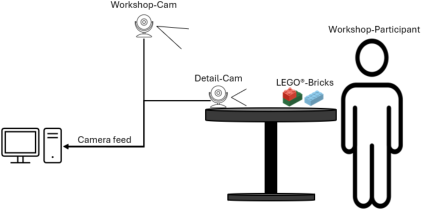
Figure 2: Schematic set-up.
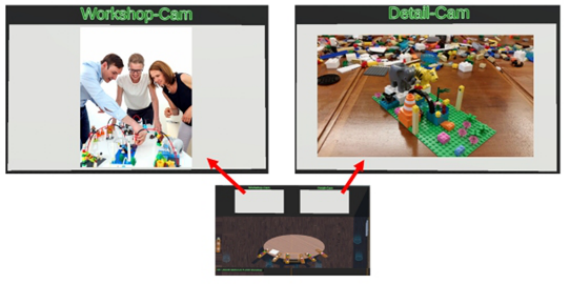
Communication between all users takes place via voice chat and is addi- tionally supported by the integration of two cameras. Webcams are used in this project for this purpose. The first camera is the workshop cam, which provides an overview of the entire group from above. A camera tripod can be used here to get a better view from higher up. This helps VR-users see who is participating and understand what is happening. The second camera is the detail cam. With the help of this, In-Real-Life (IRL) users can present their built LSP creation to VR-users in detail by taking the camera and showing their LSP creation from up close. This allows VR-users to see exactly what the IRL-users have created and respond to it. Voice chat and cameras are therefore used to meet the hybrid and collaborative project requirements.
At the start of the application, the VR-user selects an avatar with which they can identify themselves the most. After selecting an avatar, the user begins a tutorial that familiarizes them with the functions and features of the application. This tutorial is particularly beneficial for users who have no experience with VR and serves as an introduction to the virtual reality environment.
VR-Based, Collaborative and Hybrid Service Prototyping 249
Figure 3: Integration of cameras in the VR-application.
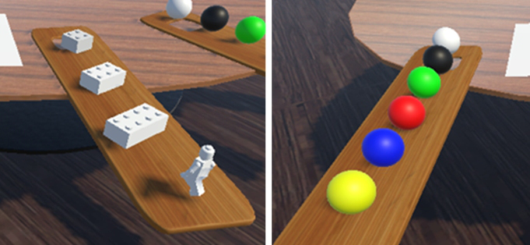
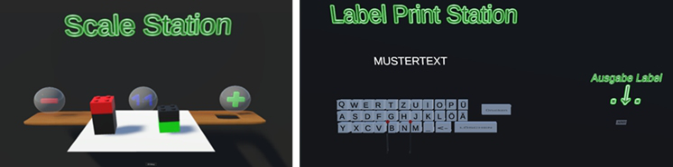
In the virtual reality environment, three different LEGO® brick sizes (4, 6, and 8) and the LEGO® figure are available to the user as standard (see Figure 4). These bricks can be obtained in any number directly at the workstation, and after removing a brick, a new one appears in the same place shortly afterward. The IRL-user has a limited supply of LEGO® objects. The VR-user can create any number of objects, which creates more flexibility. Even though only four different objects are currently available, any number of additional objects can be integrated. In VR, it is not possible to work with the usual hand-held LEGO® brick proportions. The LEGO® bricks must be proportionally much larger in order to build on top of each other. Due to this disproportionality, it is possible to scale the entire LSP structure larger or smaller as required. Six colors are available (blue, green, red, yellow, black, and white) to promote realism and support metaphorical representations. Ini- tially, all LEGO® bricks are white, but they can easily be colored by dragging them through a color palette. The color can be changed as often as required to allow for the versatility and creative design of the buildings. The existing color palette can also be extended if further colors are needed.
Figure 4: LEGO® bricks/figure and color palette in VR.
Unlike the physical world, the LEGO® bricks in VR cannot be clipped together using a clip function. The user has the option of placing the bricks
offset, directly on top of each other and at a 90
angle. The future position is indicated by a semi-transparent copy and disappears as soon as the brick is released. This enables the user to build quickly and precisely and prevents objects from being placed on top of each other at the wrong angle or in the air. Buildings are modeled on a white plate so that several blocks can be moved at the same time (see Figure 5 - left side). When the plate is gripped, all the bricks move with it and the complete structure can be positioned in a different place. This repositioning means that holistic buildings can be created with the entire group and, for example, a company can be symbolized using different locations. User A is building the logistics and User B the production, at the end both models can be combined through repositioning next to each other. In order to maintain an overview of the various buildings Post-it notes are often used in reality to name metaphorical buildings (e.g. red brick = logistics, green brick = production), and any number of labels can be created in the virtual world using a keyboard (see Figure 5 – right side). To create the label, sticks floating in the air can be picked up and held over the various letters. The desired word is created and can be printed by pressing the “Print”button. It can then be grabbed and moved just like any other brick.
Figure 5: Scale station and label print station in VR.
By implementing the “Lego move” service feature, the LEGO® figures in the VR-application can be controlled by the IRL-user from a PC and sequences can be run to represent the flow of a service process.
The virtual implementation of LEGO® Serious Play® opens up even more possibilities. In the virtual world, it is also possible to place objects in the air, thereby opening up new dimensions that can enhance creativity and the possibility of finding new ideas.
CONCLUSION
Looking back on the research question, it can be answered as follows: The realization of the right environment is achieved through the architecture that can be created in Unity® and the interactive operation of certain func- tions. Creativity is supported by the LEGO® Serious Play method, which uses the hand-brain approach. However, in order to measure creativity, a more detailed study needs to be carried out in comparison with conventional work environments. Hybrid collaboration was utilized through the use of appropriate features of the application and physical cameras.
VR-Based, Collaborative and Hybrid Service Prototyping 251
This project shows a possible solution to current issues such as digitaliza- tion and hybrid solution methods. It can also be a possible solution to the challenges of adapting to the digital world (work 4.0), as although this form is digital, it is still linked to physical movements and is also hybrid.
The use of multiplayer enables collaborative teamwork, but this requires a dedicated IT infrastructure and specialist expertise.
Further development of LEGO® Serious Play in VR is conceivable; it could be offered digitally and used with VR-based solutions. This also sup- ports service prototyping and a new meeting culture, which represents a new step towards service engineering. As service prototyping is primarily about making things tangible and understandable, the hand-brain principle can be applied here, i.e. thinking with the hands including movement.
In this application, it is possible to represent services, which is an important factor and part of the service prototyping. A service can be performed virtu- ally by moving individual LEGO® figures and can be recorded. Possible areas of application are architecture, service applications, training, team-building measures, and process management.
IMPLICATIONS FOR FUTURE RESEARCH In this section, the application is critically reflected upon and possible fur- ther development options are shown. The difficulties with the multiplayer theme require more research into user-friendly solutions. Tutorials should be adapted to different levels of experience to make the application more acces- sible. Research efforts could focus on optimizing the learning content and methods to ensure better understanding for users with different abilities. A proposed empirical study in companies offers potential for future research. Research into the impact of the application on different teams could provide useful insights into its practical effectiveness and possible improvements. The high cost of the hardware required poses a challenge. Future research should investigate low-cost alternatives or technological innovations to make the application accessible for wider use. In summary, future research should focus on overcoming the identified challenges, optimizing tutorials, assessing prac- tical impact through empirical studies, and exploring affordable hardware solutions to deploy the application more widely.
REFERENCES
Abdel Razek, A. R., 2021. Impacts of Immersive Technologies on Service Prototyping: Investigating the performance, experience, and acceptance of different service prototype forms. Abdel Razek, A. R., Raban, M., Hengels, A., Van Husen, C., 2020a. Einführung,
in: Van Husen, C., Ovtcharova, J. (Eds.), Multidimensionales Service Prototyping. Springer Berlin Heidelberg, Berlin, Heidelberg, pp. 1–45. https://doi.org/10.1007/ 978-3-662-60732-9_1 Abdel Razek, A. R., Raban, M., Hengels, A., Van Husen, C., Elstermann, M., Häfner, V., Häfner, P., Imran, S., 2020b. Methoden, in: Van Husen, C., Ovtcharova, J. (Eds.), Multidimensionales Service Prototyping. Springer Berlin Heidelberg, Berlin, Heidelberg, pp. 47–129. https://doi.org/10.1007/978-3-662- 60732-9_2
Blomkvist, J., Holmlid, S., 2010. Service Prototyping According to Service Design Practitioners. Boletsis, C., 2018. Virtual Reality for Prototyping Service Journeys. MTI 2, 14. https:
//doi.org/10.3390/mti2020014 Breyer-Mayländer, T., Zerres, C., Müller, A., Rahnenführer, K., 2022. Die Corona- Transformation - Krisenmanagement und Zukunftsperspektiven in Wirtschaft, Kultur und Bildung. Springer Gabler, Offenburg, Hamburg. Bruhn, M., Hadwich, K. (Eds.), 2020. Automatisierung und Personalisierung von
Dienstleistungen: Konzepte – Kundeninteraktionen – Geschäftsmodelle, Forum Dienstleistungsmanagement. Springer Fachmedien Wiesbaden, Wiesbaden. https: //doi.org/10.1007/978-3-658-30166-8 Chang, Y., Kao, J.-Y., Wang, Y.-Y., 2022. Influences of virtual reality on design creativity and design thinking. Thinking Skills and Creativity 46, 101127. https: //doi.org/10.1016/j.tsc.2022.101127 Gandhi, R. D., Patel, D. S., 2018. Virtual Reality – Opportunities and Challenges 05. Gengnagel, C., Nagy, E., Stark, R. (Eds.), 2016. Rethink! Prototyping. Springer
International Publishing, Cham. https://doi.org/10.1007/978-3-319-24439-6 Graessler, I., Taplick, P., 2019. Supporting Creativity with Virtual Reality Technology. Proc. Int. Conf. Eng. Des. 1, 2011–2020. https://doi.org/10.1017/dsi.2019. 207 Hofeditz, L., Löffler, U., Strathmann, C., 2022. Herausforderungen und Handlungsempfehlungen für die VR-basierte Zusammenarbeit mit digitalen Nomad*innen und anderen Remote-Arbeitenden. HMD 59, 207–225. https: //doi.org/10.1365/s40702-021-00825-w James, A. R., 2013. Lego Serious Play: a three-dimensional approach to learning
development. jldhe. https://doi.org/10.47408/jldhe.v0i6.208 Knoll, M., Stieglitz, S., 2022. Augmented Reality und Virtual Reality – Einsatz im Kontext von Arbeit, Forschung und Lehre. HMD 59, 6–22. https://doi.org/10. 1365/s40702-022-00840-5 Leimeister, J. M., 2012. Dienstleistungsengineering und -management. Springer
Berlin Heidelberg, Berlin, Heidelberg. Lim, Y.-K., Stolterman, E., Tenenberg, J., 2008. The anatomy of prototypes: Prototypes as filters, prototypes as manifestations of design ideas. ACM Trans. Comput.-Hum. Interact. 15, 1–27. https://doi.org/10.1145/1375761.1375762 Monohan, T., McArdle, G., Bertolotto, M., 2023. Virtual reality for collaborative
e-learning. Obeid, S., Demirkan, H., 2023. The influence of virtual reality on design process creativity in basic design studios. Interactive Learning Environments 31, 1841–1859. https://doi.org/10.1080/10494820.2020.1858116 Roos, J., Victor, B., 2018. How It All Began: The Origins Of LEGO® Serious Play®.
IJMAR 326–343. https://doi.org/10.18646/2056.54.18-025 Sadeghi, A. H., Wahadat, A. R., Dereci, A., Budde, R. P. J., Tanis, W., Roos-Hesselink, J. W., Takkenberg, H., Taverne, Y. J. H. J., Mahtab, E. A. F., Bogers, A. J. J. C., 2021. Remote multidisciplinary heart team meetings in immersive virtual reality: a first experience during the COVID-19 pandemic. BMJ Innov 7, 311–315. https: //doi.org/10.1136/bmjinnov-2021-000662 Van Husen, C., Ovtcharova, J. (Eds.), 2020. Multidimensionales Service Prototyp-
ing: Service Innovationen kreieren, kommunizieren und bewerten. Springer Berlin Heidelberg, Berlin, Heidelberg. https://doi.org/10.1007/978-3-662-60732-9
VR-Based, Collaborative and Hybrid Service Prototyping 253
Vogel, J., Schuir, J., Thomas, O., Teuteberg, F., 2022. Virtual Reality als Prototyping- Medium in Design-Thinking-Prozessen: Proof of Concept und zukünftige Entwicklungsperspektiven, in: Weber, K., Reinheimer, S. (Eds.), Faktor Mensch, Edition HMD. Springer Fachmedien Wiesbaden, Wiesbaden, pp. 231–251. https: //doi.org/10.1007/978-3-658-34524-2_13 Zenk, L., Hynek, N., Schreder, G., Zenk, A., Pausits, A., Steiner, G., 2018. Design-
ing Innovation Courses In Higher Education Using LEGO® SERIOUS PLAY®. IJMAR 5, 245–263. https://doi.org/10.18646/2056.54.18-019
LISTED IN THE AHFE DIGITAL BOOKSTORE CATALOGUE
Explore the complete digital volume
The Human Side of Service Engineering
Read this individual research paper free through the original publisher, or explore the full digital proceedings book.
ISBN 978-1-964867-19-9
Explore this ISBN in the AHFE Bookstore ↗Listed in the July 2026 bookstore catalogue; search by ISBN to confirm current availability · Digital book purchase optional